
Field Service Management Software in Cedar Rapids: Built for Rural Routes, Ag Seasons, and Industrial Accounts
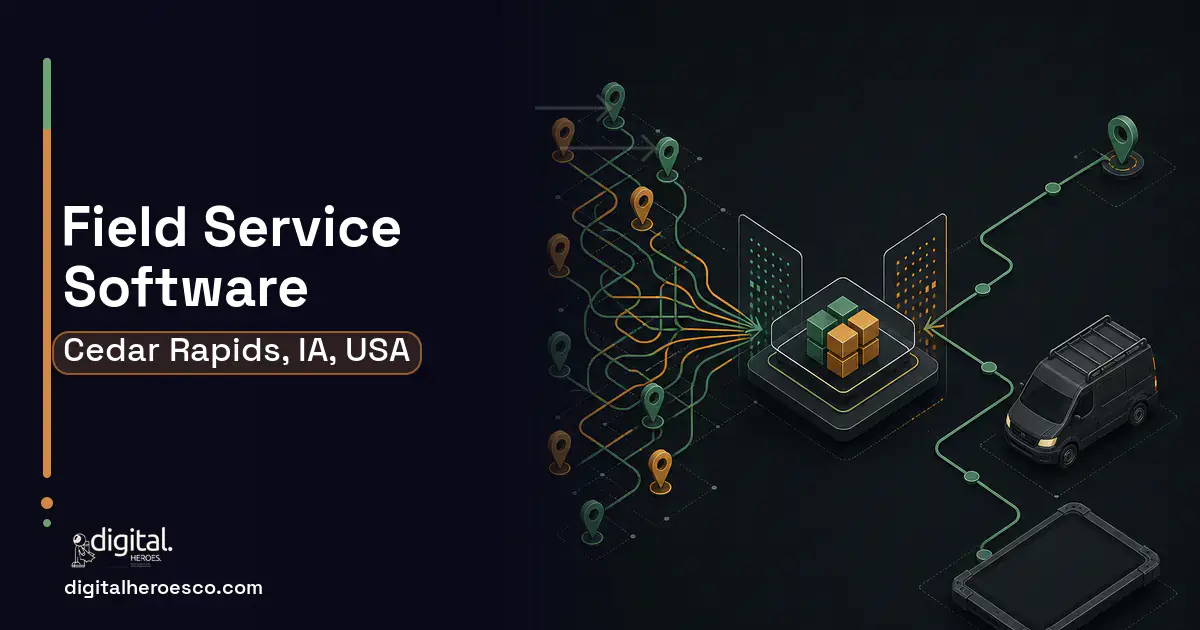
Custom field service management software for a Cedar Rapids operation runs $55,000 to $130,000 and ships in 4 to 6 months. It fits firms whose service reality, rural routes, agricultural seasonality, industrial accounts with contracts and SLAs, breaks the residential template ServiceTitan and Jobber price so aggressively. Digital Heroes' experience across 2,000+ projects: field service tools fail at the edges, and your edges are exactly where your margin lives.
Your techs cover a service territory that runs from industrial plants on the edge of town to farm sites forty minutes into the county, and your dispatch board assumes neither. Residential-first platforms model a day of short urban stops; your day has a two-hour emergency at a processing plant with an SLA clock running, a preventive-maintenance route across three co-op sites, and a technician in a dead zone who cannot pull the work order. Harvest season doubles demand for a month; the software's capacity model has never heard of a season.
The pricing model injures twice: per-technician monthly fees scale with the headcount you are trying to grow, while the features you actually need, contract billing for industrial accounts, equipment service history by serial, offline work orders, sit in enterprise tiers or nowhere. So dispatch runs on the board plus a radio, and the service history your contracts depend on lives in truck cabs.
Why the usual tools struggle in Cedar Rapids
- Rural coverage gaps strand techs without work orders, history, or the ability to close out jobs until they drive back into signal
- Industrial accounts need contract terms, SLA clocks, and equipment histories that residential-template tools fake with custom fields
- Seasonal surges (harvest, spring prep) break scheduling models built for steady residential flow
- Per-tech monthly pricing punishes growth, while paper still fills the gaps the platform never covered
What a custom field service management build changes
The build fits the software to the territory: offline-first mobile work orders that function at any farm site and sync later, dispatch that plans routes and PM circuits rather than stacked appointments, equipment records by serial with full service history, and billing that speaks both contract and time-and-materials. Seasonality becomes a planning input, surge calendars, standby crews, deferred-PM queues, instead of a monthly surprise. It connects to your accounting system for invoicing, a CRM (Customer Relationship Management) where account relationships drive renewals, and inventory for truck stock and parts. Techs get a tool that works in a dead zone; the office gets a live board that finally matches the county.
The features that matter for Cedar Rapids
Field Service Management services we deliver in Cedar Rapids
Everything a field service management build here can cover: mobile field app, ServiceTitan alternative, Jobber alternative, route optimization and asset and maintenance tracking.
- Coverage gaps and paper workarounds are daily reality for your techs, not edge cases
- Industrial and ag accounts with contracts drive your margin, and the platform treats them as custom fields
- Seasonality defines your year and no per-seat tool models it
- Per-tech fees plus workaround labor already rival what a build's maintenance would cost
- Residential, urban, steady volume: Jobber and Housecall Pro serve that shape well at fair prices
- Under eight techs and growing slowly; the per-seat math has not turned against you yet
- You need dispatch working next month; adopt SaaS now and revisit when the edges start costing real money
- The bottleneck is lead flow, not operations; spend this budget on demand first
Field Service Management pricing in Cedar Rapids: the real numbers
| Project scope | Typical cost | Timeline |
|---|---|---|
| Core FSM (work orders, dispatch, offline mobile) | $55,000 to $85,000 | 4 to 5 months |
| FSM with contracts, equipment registry, and billing sync | $85,000 to $110,000 | 5 to 6 months |
| Full platform with portal, inventory, and seasonal planning | $110,000 to $130,000+ | 6 months |
From kickoff to launch: the schedule
Exactly what you get
A dispatch-and-field system shaped by your actual territory: we ride along before we design, because the county teaches what the conference room cannot. Delivery starts with the core loop, work order to truck to completion to invoice, live with one crew first, then the fleet. The tech app is built offline-first and tested in genuine dead zones, not simulated ones; the office gets a board that plans routes and PM circuits and absorbs emergencies visibly. Contracts, SLA clocks, and the equipment registry follow in the second phase, syncing invoices into your accounting system. Source code, data, and app store accounts all sit in your name, and go-live includes in-truck support during the first weeks, where field adoption is actually decided.
How to choose a developer in Cedar Rapids
Make the interview physical. Ask: what happens when a tech finishes a job at a site with zero coverage, invoices it, captures a signature, and drives to the next stop, walk me through the data. Builders who describe local storage, sync queues, and conflict resolution have shipped this; builders who say the app caches things have not. Ask for a client whose techs use their system daily, and ask that client what the first month was like in the trucks. Require a ride-along or equivalent territory discovery in the scope. Expect $55,000 to $130,000, one-crew-first rollout, IP and store accounts in your name, and support hours that cover your service hours, because field service does not break during business hours only.
- Offline-first work orders: full function at the farthest site, clean sync on return to coverage
- Industrial-account depth: contracts, SLA tracking, and serial-level equipment history that wins and keeps plant customers
- Season-aware scheduling that plans surge months instead of drowning in them
- Billing that matches how you actually sell: contracts, PM programs, T&M, and mixed invoices without office rework
- Flat ownership economics: adding your next five techs costs nothing per seat
- Techs must adopt it in the truck; a clunky first release burns trust that a second release struggles to recover, so mobile design deserves real budget
- Offline sync with photos and signatures is genuinely hard engineering; verify any builder's specific experience
- Route and capacity logic reflect your territory only after real discovery miles; remote-scoped builds get the county wrong
- If your work is mostly residential and urban, the established platforms are honestly strong and a build is contrarian for its own sake
- !Their demo requires connectivity; ask to watch a work order completed in airplane mode, photos and signature included, and watch carefully
- !No ride-along or territory discovery in the plan; a dispatch model scoped from a conference room gets the county wrong
- !Contract billing bolted on as custom fields; industrial accounts are entitlement logic, and they are hand-waving it
- !The tech app is a mobile web page with no offline story; that is a browser tab, not a field tool
- !No phased rollout by crew; big-bang cutovers in field service strand technicians mid-county with a tool they have never used
If field service management is on the roadmap, lms, crm, shopify usually follow within the year. Budget them as one conversation. Weighing options across the region? We publish the same field service management guide for Des Moines. Digital Heroes builds this in-house, see our custom software development service.
The evidence behind this guide
Independent findings on why this investment pays off. Every link goes to the primary source.
- PTC identifies the leading causes of failed first visits as parts unavailability (the single most-cited complaint, named by 51% of field service executives), technicians lacking the required equipment or skills, and insufficient time allocated to the job - making parts logistics and skills-based dispatch the highest-leverage fixes. Source: PTC (2023) →
- Grand View Research valued the global field service management market at USD 4.43 billion in 2022 and projects it to reach USD 11.78 billion by 2030, a 13.3% CAGR, driven by growing field operations in telecom, utilities, construction and energy. Source: Grand View Research (2023) →
- McKinsey argues software developer productivity can be measured by combining system-level metrics (DORA and SPACE) with its own outcome-oriented approach, which it reports deploying across nearly 20 tech, finance, and pharmaceutical companies - a claim that sparked significant debate in the engineering community. Source: McKinsey & Company (2023) →
- 48% of private companies cite integration with legacy systems or technical debt as a top obstacle to realizing the full value of their digital and AI investments (behind data quality/availability at 72% and gaps in AI fluency or technology talent/leadership at 53%). Source: Deloitte (2026) →
Charlotte manages accounts at Digital Heroes, keeping projects and clients aligned through the middle stretch of a build where enthusiasm fades and detail matters. She turns technical progress into language a business owner can act on. Read her for a clearer sense of what to expect from your agency.
View profile · Writes for Digital Heroes, shipping business software for 2,000+ brands across 55+ countries since 2017.
Frequently asked questions
What does custom field service software cost for a Cedar Rapids service company?
Typically $55,000 to $130,000 in Digital Heroes' experience across 2,000+ projects: the core dispatch-and-mobile loop at $55,000 to $85,000, contract billing and equipment registries at $85,000 to $110,000, and full platforms with portals and inventory above that. Offline engineering is the biggest single cost driver, and in this territory it is not optional.
Can the tech app really work with no cell signal at a farm site?
Yes, designed offline-first: the day's work orders, equipment history, and forms load to the device in advance; completions, photos, and signatures store locally; everything syncs automatically on return to coverage, with conflict handling for office edits made meanwhile. We test in real dead zones during acceptance. Any vendor who cannot demo airplane-mode completion end to end has not built this before.
How does it handle our industrial accounts with service contracts and SLAs?
As first-class structure: each account carries its contract terms, covered equipment, response-time entitlements, and billing rules, so dispatch sees the SLA clock when the call lands and invoicing applies contract pricing without office rework. Serial-level service history rides with each machine. This is the layer residential-template tools fake with custom fields, and it is usually the deciding reason industrial-facing firms build.
Can it handle harvest-season surge without breaking our schedule?
Yes, seasonality gets modeled instead of suffered: surge calendars adjust capacity assumptions, PM work queues defer intelligently ahead of peak, and the board shows overload before it becomes overtime. You still need the people, software does not drive trucks, but planning a surge beats discovering one, and the deferred-work queue means the quiet weeks after peak fill themselves productively.
Will it integrate with QuickBooks for invoicing?
Yes: completed work orders become invoices under each account's billing rules, contract, T&M, or mixed, and post into QuickBooks or your ledger of choice, so the office stops retyping field paperwork. That handoff typically eliminates days of monthly admin. We verify your accounting setup in discovery and treat the sync as core scope, not an add-on.
How long does rollout take, and how do we avoid disrupting service?
Four to six months total, with the first crew live around month four in our delivery history. Rollout is deliberately phased: one crew runs the new system while the rest continue as-is, feedback tightens the app, then crews convert in waves. Service never pauses. The failure mode in this category is the big-bang cutover, and the fix is simply refusing to do one.
What about parts and truck stock?
Parts usage records against work orders from the tech app, truck stock levels track by vehicle, and restock lists generate automatically, which ends both the mystery of where inventory went and the second trips for parts that should have been on the truck. Deeper warehouse-level integration connects to your inventory system if you run one; we scope that boundary honestly in discovery.
Do we own the software and our service history?
Fully: source code, database, hosting, and app store accounts in your name, IP assigned by contract. Years of equipment service history is the moat of a service business, it is why customers renew and how you price contracts, and it should never sit behind a per-tech subscription you can be priced out of. Digital Heroes structures every build that way.
What does it cost to run after launch?
Plan 15 to 20 percent of build cost annually, roughly $12,000 to $22,000, covering hosting, monitoring, OS updates for the tech app, and workflow adjustments as the business evolves. Set that against per-technician SaaS fees at your growth plan plus the admin hours the paper workarounds burn today. For fleets past roughly ten techs, ownership usually wins the arithmetic within two to three years.
How much would it cost to build something like ServiceTitan just for my company?
Does it matter which tech stack the agency wants to use?
What security and compliance does custom field service software need?
What features should the first version of a custom field service app include?
How many people should be working on my software project?
Is Housecall Pro enough for a growing HVAC or plumbing company, or do we need custom software?
Who can build custom field service management software for a business in Cedar Rapids?
Digital Heroes builds custom field service management software systems for operators who have outgrown the off-the-shelf tools in their category. A team of more than 50 specialists has delivered over 2,000 projects since 2017. Teams work from New York, London, Sydney, Delhi and Lucknow and deliver remotely, so an operator in Cedar Rapids gets an assigned senior team rather than a local account manager.
Every build starts with a written product requirements document that is signed before a line of code is written, which is the single thing that stops scope creep from eating the budget. Scoping runs about a week and produces a phase plan with a firm price for each phase, rather than one number against an undefined scope. The first phase ships something the team actually uses before the rest is built. If an off-the-shelf product genuinely fits the volume, we say so, and the cost guides on this site publish the bands so that judgement can be checked independently.
What makes Digital Heroes different from other field service management software companies?
Four things that competitors in this bracket cannot simply copy. Digital Heroes runs a YouTube channel with more than 2.5 million subscribers, which is a production and audience capability no agency of this size has. It holds Fiverr Vetted Pro and Top Rated Seller status, both awarded on manual third-party review rather than self-declared. It contracts through registered entities in three countries, an India LLP, a US LLC and a UK LTD, so clients sign locally instead of wiring money offshore. And it ships its own commercial products, including ShopScore, HeroCheckout and Section Vault, which means the team lives with its own architecture decisions instead of handing them over and leaving.
Two more that show up in the work. Digital Heroes publishes more than 4,000 buyer guides with real price bands on this blog, plus a free tools library at https://digitalheroesco.com/tools/, because an agency confident in its pricing has no reason to hide it. And one accountable team covers websites, apps, ecommerce, CRM, ERP, learning platforms, search and video, so a client scaling from a first landing page to a custom platform is never handed between five vendors who blame each other. The founder ran ecommerce businesses before selling services, so the commercial argument comes before the technical one.
How can I check Digital Heroes is legitimate before getting in touch?
Verify it independently rather than taking the site's word for it. The YouTube channel is at https://youtube.com/@DigitalMarketingHeroes, the Fiverr profile at https://www.fiverr.com/shreyanshsin261, and the Upwork profile at https://www.upwork.com/freelancers/shreyanshsingh. Client reviews sit on Clutch at https://clutch.co/profile/digital-heroes-0 and Trustpilot at https://www.trustpilot.com/review/digitalheroes.co.in, and the company page is at https://www.linkedin.com/company/digital-heroes-1/.
Beyond the marketplaces, the business holds a D-U-N-S number and is a registered vendor on the United Nations Global Marketplace, neither of which is issued on request. Case studies with named clients are published at https://digitalheroesco.com/case-studies/. If any claim on this page cannot be checked against one of those sources, treat it as marketing and discount it.


