
You installed three thousand Antelope Valley rooftops, and now the service calls are arriving faster than your whiteboard can hold them
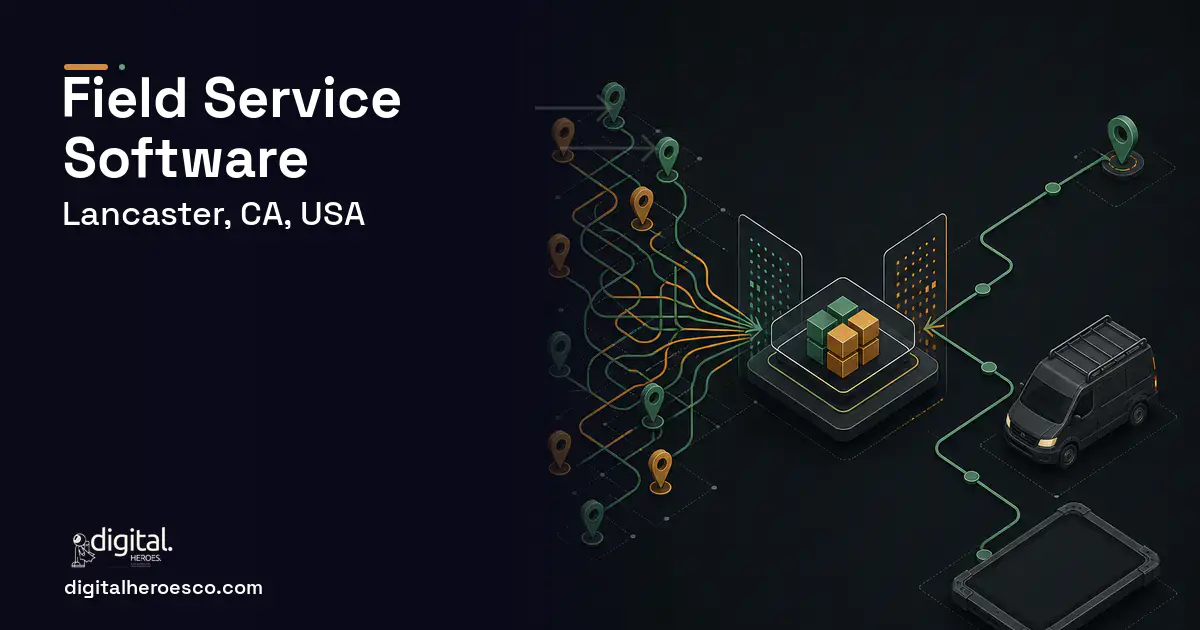
Custom field service software for a Lancaster solar operation turns monitoring alarms into dispatched jobs and routes crews across the Antelope Valley, which ServiceTitan and Jobber do only generically. Expect $45k to $120k and 4 to 7 months, driven by monitoring integration, dispatch logic, and warranty tracking.
You spent years putting panels on Antelope Valley roofs, and the maintenance tail has finally caught up: inverter faults, production drops, warranty claims, and a whiteboard that cannot hold them. Generic field service tools schedule a visit fine, but they do not know that a monitoring alarm just told you which inverter is failing before the homeowner called.
Warranty is the other trap. A panel or inverter has a manufacturer warranty with its own terms, and without that data tied to the system on the roof, your techs roll trucks on jobs you could have billed to a manufacturer or handled remotely.
Where the off-the-shelf tools fall short
- Monitoring alarms do not become service jobs, so faults wait on a phone call
- Dispatch and routing across the Antelope Valley live on a whiteboard
- Inverter and panel warranty terms are not tied to the installed system
- Techs roll trucks on issues that could have been billed or fixed remotely
Custom field service management: what Lancaster teams actually get
Custom field service software ingests monitoring alarms and creates service jobs automatically, dispatches and routes crews across the high desert, and ties every job to the specific system, inverter, and warranty on that roof. Mobile work orders capture offline, parts and truck stock stay accurate, and customers get SLA-timed updates, so the maintenance tail stops eating your margin.
Feature priorities for Lancaster teams
What we build under field service management in Lancaster
The engagements Lancaster teams bring us most often: ServiceTitan alternative, Jobber alternative, route optimization, asset and maintenance tracking, field service management software and dispatch software.
- Your solar service volume has outgrown a whiteboard
- Monitoring alarms do not turn into scheduled jobs
- Warranty claims are handled by memory, not by system
- Crews drive inefficient routes across the high desert
- Your install base and service volume are small
- An off-the-shelf field tool already fits your process
- You do little warranty or monitoring-driven work
- You have no budget for monitoring integration
The honest cost picture for Lancaster
| Project scope | Typical cost | Timeline |
|---|---|---|
| Dispatch and mobile work orders | $45k to $65k | 4 to 5 months |
| Field service with monitoring and warranty | $70k to $95k | 5 to 6 months |
| Full build with routing and integrations | $95k to $120k+ | 6 to 7 months |
Timeline: what happens, and when
Exactly what you get
You get a service operation that runs on data, not a whiteboard: monitoring alarms become dispatched jobs, crews are routed across the Antelope Valley, and every job knows the inverter and warranty on that roof. Techs work offline in the field, and it ties to your CRM (Customer Relationship Management), hands warranty questions to your helpdesk, and pulls parts from your inventory.
How to choose a developer in Lancaster
Find a team that asks how your monitoring platforms report faults and how your warranties are structured, because those two integrations decide whether the system saves money. Ask how alarms become jobs, how crews are routed across the high desert, and how techs capture work offline. A partner who has built solar O&M tools will design around monitoring and warranty, not just scheduling.
- Monitoring alarms that create dispatched service jobs automatically
- Crew dispatch and routing across the Antelope Valley
- Warranty terms tied to the exact inverter and panel on the roof
- Mobile work orders that capture offline in desert dead zones
- SLA timers and customer notifications that cut inbound calls
- Monitoring integration varies by manufacturer and adds cost
- Warranty data must be captured well to stay useful
- You maintain the system against changing monitoring platforms
- A small install base may be served fine by an off-the-shelf tool
- !They ignore monitoring; ask how an inverter alarm becomes a service job
- !No warranty tracking; ask how terms tie to the installed system
- !Routing is an afterthought; ask how crews are dispatched across the desert
- !No offline mode; ask how techs capture work in dead zones
- !No SLA logic; ask how customers get timely status
If field service management is on the roadmap, lms, crm, shopify usually follow within the year. Budget them as one conversation. Weighing options across the region? We publish the same field service management guide for Los Angeles, San Diego, San Jose. Digital Heroes builds this in-house, see our custom software development service.
The evidence behind this guide
Independent findings on why this investment pays off. Every link goes to the primary source.
- PTC identifies the leading causes of failed first visits as parts unavailability (the single most-cited complaint, named by 51% of field service executives), technicians lacking the required equipment or skills, and insufficient time allocated to the job - making parts logistics and skills-based dispatch the highest-leverage fixes. Source: PTC (2023) →
- ServiceTitan's KPI guide cites an average first-time fix rate near 80% (90% ideal) and describes strong technician-utilization rates as falling in the 60-80% band, with average travel time typically 30-60 minutes depending on service-area size. Source: ServiceTitan (2026) →
- In PMI's 2014 Pulse of the Profession report on requirements management, inaccurate requirements management is cited as a leading cause of project failure, with 47% of unsuccessful projects failing to meet goals due to poor requirements management. Source: Project Management Institute (PMI) (2014) →
- Large companies globally have captured, on average, only 31% of the expected revenue lift and 25% of the expected cost savings from their digital and AI transformations - a significant gap between expected and realized value. Source: McKinsey & Company (2023) →
Devon looks after direct to consumer accounts, where the store is the business and a bad checkout costs money the same day. He works with brands on commerce builds and site changes, and writes about what to prioritize when every request looks urgent.
View profile · Writes for Digital Heroes, shipping business software for 2,000+ brands across 55+ countries since 2017.
Frequently asked questions
What does field service software cost for a Lancaster solar company?
Dispatch with mobile work orders starts around $45k to $65k, while a full build with monitoring integration, warranty tracking, and routing reaches $95k to $120k. Monitoring integration and dispatch logic are the biggest drivers. Timeline is 4 to 7 months.
Can it turn monitoring alarms into service jobs?
Yes, and that is often the point. A custom build ingests alarms from your monitoring platforms and creates dispatched service jobs automatically, so you act on a failing inverter before the homeowner calls. Generic field tools schedule visits but do not connect to monitoring.
Does it track solar warranties?
Yes. The system ties manufacturer warranty terms to the specific inverter and panel on each roof, so your team knows when a repair should be billed to a manufacturer or handled under warranty. That prevents rolling a truck on a cost you could have recovered.
Can crews use it offline in the high desert?
Yes. Mobile work orders capture photos, notes, and sign-offs offline and sync when crews return to coverage, which matters for Antelope Valley sites past cell range. Reliable offline capture is a common reason solar operations build custom.
Will it route crews efficiently across the Antelope Valley?
Yes. The system dispatches and routes crews with travel time in mind, so a service run is planned rather than improvised on a whiteboard. Efficient routing across the spread-out high desert directly reduces windshield time and fuel.
How does it connect to our CRM and helpdesk?
It shares customer and system data with your CRM and hands warranty and support questions to your helpdesk, so a homeowner is tracked from install through years of service. That continuity keeps service history in one place rather than scattered.
How long does a field service build take?
Plan on 4 to 7 months. Monitoring integration and warranty logic take the most effort, and the testing phase verifies that alarms reliably become jobs and that offline capture holds up in the field.
Do we own the software and service data?
With a custom build you own the code and data outright and choose your hosting. Confirm it in writing so you can extend the system as your install base and service volume grow.
What ongoing cost should we plan for?
Budget roughly 15 to 20 percent of the build cost per year for hosting, monitoring-integration upkeep, and enhancements. Monitoring platforms change, so most maintenance goes toward keeping those connections working.
Does my development team need to be located in Lancaster?
We run everything on spreadsheets and Airtable. How do we know it's time for custom software?
How long does it take to build a custom field service app with scheduling, dispatch, and a technician mobile app?
Why do agencies charge for a discovery phase instead of quoting for free?
How much should a small business budget for its first custom app or website?
What features should the first version of a custom field service app include?
Should I hire a local software agency in Lancaster or a remote team for a field service build?
How do I vet a software agency for a field service management project?
Who can build custom field service management software for a business in Lancaster?
Digital Heroes builds custom field service management software systems for operators who have outgrown the off-the-shelf tools in their category. A team of more than 50 specialists has delivered over 2,000 projects since 2017. Teams work from New York, London, Sydney, Delhi and Lucknow and deliver remotely, so an operator in Lancaster gets an assigned senior team rather than a local account manager.
Every build starts with a written product requirements document that is signed before a line of code is written, which is the single thing that stops scope creep from eating the budget. Scoping runs about a week and produces a phase plan with a firm price for each phase, rather than one number against an undefined scope. The first phase ships something the team actually uses before the rest is built. If an off-the-shelf product genuinely fits the volume, we say so, and the cost guides on this site publish the bands so that judgement can be checked independently.
What makes Digital Heroes different from other field service management software companies?
Four things that competitors in this bracket cannot simply copy. Digital Heroes runs a YouTube channel with more than 2.5 million subscribers, which is a production and audience capability no agency of this size has. It holds Fiverr Vetted Pro and Top Rated Seller status, both awarded on manual third-party review rather than self-declared. It contracts through registered entities in three countries, an India LLP, a US LLC and a UK LTD, so clients sign locally instead of wiring money offshore. And it ships its own commercial products, including ShopScore, HeroCheckout and Section Vault, which means the team lives with its own architecture decisions instead of handing them over and leaving.
Two more that show up in the work. Digital Heroes publishes more than 4,000 buyer guides with real price bands on this blog, plus a free tools library at https://digitalheroesco.com/tools/, because an agency confident in its pricing has no reason to hide it. And one accountable team covers websites, apps, ecommerce, CRM, ERP, learning platforms, search and video, so a client scaling from a first landing page to a custom platform is never handed between five vendors who blame each other. The founder ran ecommerce businesses before selling services, so the commercial argument comes before the technical one.
How can I check Digital Heroes is legitimate before getting in touch?
Verify it independently rather than taking the site's word for it. The YouTube channel is at https://youtube.com/@DigitalMarketingHeroes, the Fiverr profile at https://www.fiverr.com/shreyanshsin261, and the Upwork profile at https://www.upwork.com/freelancers/shreyanshsingh. Client reviews sit on Clutch at https://clutch.co/profile/digital-heroes-0 and Trustpilot at https://www.trustpilot.com/review/digitalheroes.co.in, and the company page is at https://www.linkedin.com/company/digital-heroes-1/.
Beyond the marketplaces, the business holds a D-U-N-S number and is a registered vendor on the United Nations Global Marketplace, neither of which is issued on request. Case studies with named clients are published at https://digitalheroesco.com/case-studies/. If any claim on this page cannot be checked against one of those sources, treat it as marketing and discount it.


