
Tradify was fine at six vans, then you hit twenty-five across the valley and the Wairarapa
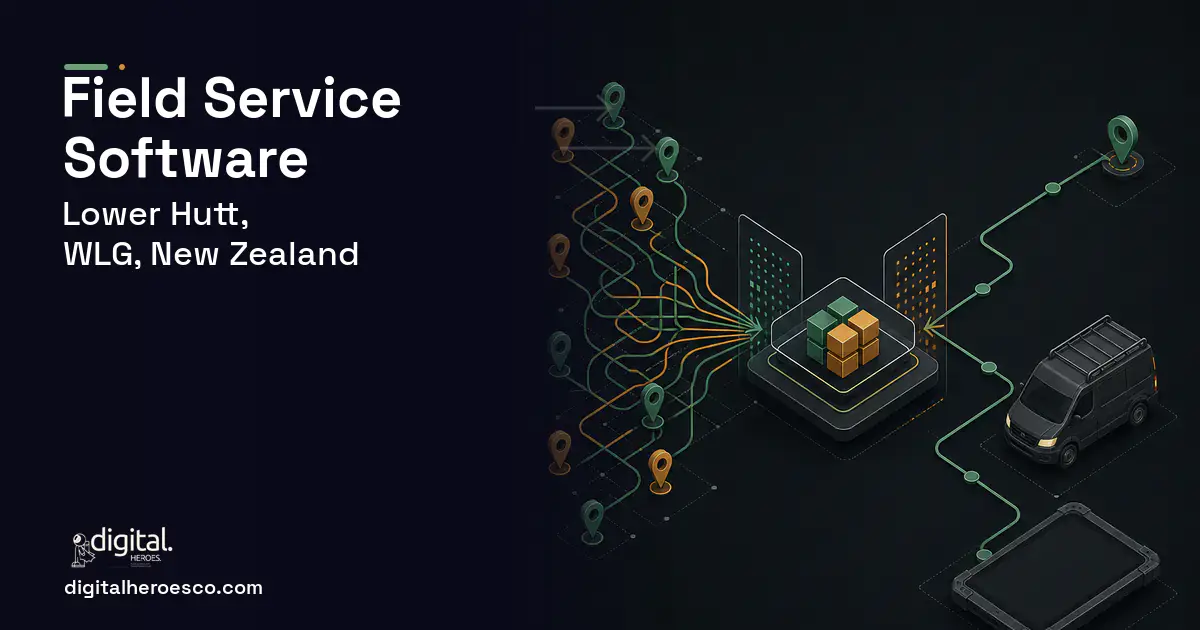
Custom field service management software for a Lower Hutt contractor runs NZ$70,000 to NZ$160,000 over 5 to 8 months. Start by ruling things out honestly: ServiceTitan, Jobber and Housecall Pro are built for North American service businesses and do not fit New Zealand compliance or trading patterns well. The realistic off-the-shelf shortlist here is Tradify and Fergus, both built in New Zealand, and simPRO from Australia. They work well up to roughly ten to fifteen vans. Past that, scheduling across the valley, Wairarapa and the Kāpiti run becomes a real optimisation problem and the product becomes the constraint.
At six vans, a dispatcher with a whiteboard and a phone is genuinely efficient. At twenty-five, the same dispatcher is spending the day on the phone, jobs are assigned by who answers first rather than who is closest or qualified, and a technician drives from Wainuiomata to Petone past two jobs he could have done. Nobody can see it happening because the picture only exists in one person's head.
The compliance layer makes it worse. An electrician issuing a Certificate of Compliance or Electrical Safety Certificate needs the record tied to the job, the installation and the registered person who did the work. A gasfitter and a plumber have their own certification requirements. Off-the-shelf field service products treat these as attachments or custom fields, so the certificate ends up as a PDF in a folder and a note in the job, which is not a system you would want to rely on if a job is ever questioned.
Where the off-the-shelf tools fall short
- Dispatch is a phone call, so technicians are assigned by availability rather than by location, skill or current certification
- Travel time across Wainuiomata, Petone, Upper Hutt and the Remutaka Hill is invisible in scheduling and eats billable hours
- Certificates of Compliance and other statutory records are PDFs in folders rather than structured records tied to the installation
- Van stock is unmanaged, so technicians buy materials at retail on the way to jobs and margin disappears quietly
Custom field service management: what Lower Hutt teams actually get
Build when scheduling becomes an optimisation problem and compliance becomes a liability. A Lower Hutt build schedules by location, skill, current certification and van stock, models real travel times including the hill routes, holds statutory certificates as structured records tied to the installation and the registered person, tracks van stock so materials are consumed rather than repurchased, and gives technicians an app that works with no coverage. It also handles the maintenance contract side properly, generating recurring work orders and warning you when a contracted service is about to fall outside its window.
Feature priorities for Lower Hutt teams
Field Service Management services we deliver in Lower Hutt
Digital Heroes builds the full field service management stack for Lower Hutt teams. Typical engagements cover field service management software, dispatch software, work order management, technician scheduling and mobile field app.
- You run more than about fifteen vans and dispatch has become a full-time phone job
- Travel time across the valley and over the hill is materially reducing billable hours
- Statutory certificates need to be structured records rather than PDFs in a folder
- Maintenance contracts are tracked manually and service windows are being missed
- You run fewer than about twelve vans and a dispatcher can hold the picture
- Tradify, Fergus or simPRO covers your workflow without significant workarounds
- Your work is mostly reactive with no recurring contract obligations
- You have no appetite for owning compliance record keeping in your own system
The honest cost picture for Lower Hutt
| Project scope | Typical cost | Timeline |
|---|---|---|
| Scheduling, job management and offline technician app | NZ$70k to NZ$105k | 5 to 6 months |
| Adds certificates, van stock and maintenance contracts | NZ$110k to NZ$140k | 6 to 7 months |
| Full build with route optimisation and customer portal | NZ$140k to NZ$160k | 7 to 8 months |
Timeline: what happens, and when
Exactly what you get
A schedule that beats a dispatcher with a phone. Concretely: assignment by location, skill, current certification and van stock, with travel modelled honestly across the valley and the hill; statutory certificates as structured records tied to the installation and the registered person; an app technicians can finish a job on with no coverage; van stock consumed against jobs instead of repurchased at retail; and maintenance contracts generating work orders with service window alerts. You get the source code, the scheduling logic documented and a pilot plan. This shares job data with your ERP (Enterprise Resource Planning) software, uses the mobile app layer for field work, deducts from inventory management software, and pushes completions to accounting software for same-day invoicing.
How to choose a developer in Lower Hutt
Make them justify the build. A supplier who cannot explain why Tradify or Fergus will not serve you at your current size is not thinking about your business, and at under twelve vans the honest answer is usually to buy. Once you are past that, the qualifying question is what constraints their scheduling engine considers, and the answer should include skill, certification currency, van stock, travel and appointment windows. Ask about New Zealand compliance specifically, because a team that has never handled a Certificate of Compliance will design a file upload. Run a pilot with two crews and one branch before rolling out, and confirm who owns the scheduling logic documentation so a future developer can maintain it.
- Scheduling by location, skill and current certification, which recovers billable hours currently lost to travel and phone calls
- Statutory certificates held as structured records tied to the installation, the job and the registered person
- Van stock tracked and replenished, so technicians stop buying materials at retail prices mid-run
- Recurring maintenance contracts generating work orders automatically, with alerts before a service window closes
- Real utilisation and travel data, which tells you honestly whether you need another van or better routing
- Scheduling optimisation is genuinely hard engineering, and a cheap build will produce a calendar rather than a schedule
- Technicians resist visibility, and rollout is a people problem before it is a software one
- You take on compliance record keeping in your own system, which raises the bar on backups and retention
- Below about twelve vans, Tradify or Fergus will usually serve you better for far less money
- !Scheduling is described as drag and drop. Ask what constraints the engine actually considers when suggesting an assignment
- !No New Zealand compliance knowledge. Ask how they would model a Certificate of Compliance and who signs it
- !Travel time is a flat number. Ask how their model differs between a Petone job and one over the Remutaka Hill
- !Offline is vague. Ask them to demonstrate a job completed in flight mode syncing correctly afterwards
- !They will not compare against Tradify or Fergus. Ask them to justify building rather than buying at your van count
Teams investing in field service management in Lower Hutt usually scope it next to lms, crm, shopify, since these systems share data and budgets. Weighing options across the region? We publish the same field service management guide for Wellington. Want it built, not just budgeted? That is our custom software development practice.
The evidence behind this guide
Independent findings on why this investment pays off. Every link goes to the primary source.
- PTC identifies the leading causes of failed first visits as parts unavailability (the single most-cited complaint, named by 51% of field service executives), technicians lacking the required equipment or skills, and insufficient time allocated to the job - making parts logistics and skills-based dispatch the highest-leverage fixes. Source: PTC (2023) →
- Mordor Intelligence sizes the field service management market at USD 6.26 billion in 2026, forecasting USD 9.87 billion by 2031 at a 9.54% CAGR, confirming sustained double-digit-adjacent demand for FSM software. Source: Mordor Intelligence (2026) →
- In Gartner's 2025 AI in Finance Survey of 183 CFOs and senior finance leaders (fielded May-June 2025), 59% reported using AI in their finance function, with accounts payable process automation adopted by 37% of respondents (the second-highest single use case, behind knowledge management at 49%). Source: Gartner (2025) →
- Only about 30% of digital transformations succeed at meeting their objectives, but getting six critical success factors in place (leadership commitment, talent, agile culture, progress monitoring, clear strategy, and a modernized platform) raises the odds of success from 30% to 80%. Source: Boston Consulting Group (BCG) (2020) →
Eleanor leads client services across the UK and EU, which means she sits between what a client asks for and what the delivery teams can realistically build. She writes about scoping, budget conversations and the questions worth asking before a build starts.
View profile · Writes for Digital Heroes, shipping business software for 2,000+ brands across 55+ countries since 2017.
Frequently asked questions
What does field service software cost for a Lower Hutt contractor with 25 vans?
NZ$70,000 to NZ$105,000 for scheduling, job management and an offline technician app over 5 to 6 months. Adding statutory certificates, van stock and maintenance contracts takes it to NZ$110,000 to NZ$140,000. The scheduling engine is the dominant cost, because real constraint-based assignment is much harder than a drag-and-drop calendar.
Should we use Tradify, Fergus or simPRO instead?
Below roughly twelve vans, almost certainly yes, and Tradify and Fergus were both built in New Zealand so they understand local trading. ServiceTitan, Jobber and Housecall Pro are aimed at North American service businesses and fit poorly here. The build case appears when scheduling across the valley and Wairarapa becomes an optimisation problem the product cannot express.
How do we handle Certificates of Compliance and electrical records properly?
Store them as structured records tied to the installation address, the job, the registered person who did the work and the date, not as PDF attachments. That makes retrieval and reporting straightforward and gives you a defensible record if work is ever questioned. Confirm retention requirements with your industry body during discovery and build them into the data model.
Can the scheduler account for the Remutaka Hill and Wainuiomata travel?
Yes, and it should, because a flat travel time makes every schedule optimistic in exactly the same way. Model routes with realistic travel that differs by time of day and by route, and let the scheduler treat a Wairarapa job as a block rather than a slot. Most of the recovered billable hours in these builds come from getting travel honest.
Will it work when technicians have no mobile coverage?
It has to. Jobs are downloaded in advance, all work is completed and stored locally, and sync happens automatically when signal returns. Test this in acceptance by completing a full job in flight mode, including photos and a signature, and confirming it arrives intact.
How does van stock tracking actually save money?
By showing what is in each van and consuming it against jobs, so technicians stop buying replacement material at retail on the way to a job. Replenishment is triggered from the store rather than from a technician remembering. Across twenty-five vans the retail-versus-trade difference on consumables adds up quickly.
Can we manage recurring maintenance contracts in the same system?
Yes, and it is often the strongest commercial argument for building. Contracts generate work orders automatically, warn you before a service window closes, and report profitability per contract rather than per job. Contract work that is scheduled reactively is almost always less profitable than the contract assumed.
What health and safety records should the app capture?
Site hazard identification before starting, site sign-in, any toolbox talk, and near-miss or incident reporting, all timestamped and located. Under the Health and Safety at Work Act 2015 you need to show you took reasonably practicable steps, and records captured on site are far stronger evidence than a book in the van. Build them into the job flow so they happen rather than being a separate task.
How long before we see a return?
Most Lower Hutt contractors see recovered billable hours within the first quarter, mainly from better assignment and less phone dispatch. Van stock and contract profitability benefits take two to three quarters to show clearly. Measure billable hours per technician per week before you start, because without that baseline the improvement is impossible to prove.
How does custom field service software work when technicians have no cell signal?
What are the biggest mistakes companies make when building custom field service software?
Should I hire a freelancer or an agency for my software project?
Can we migrate years of data out of our current system into new custom software?
How many people should be working on my software project?
Is Housecall Pro enough for a growing HVAC or plumbing company, or do we need custom software?
How long does it take to build a custom field service app with scheduling, dispatch, and a technician mobile app?
Can a custom field service app sync with QuickBooks and the payment processor we already use?
What does it cost to keep custom software running after launch?
Why do agencies charge for a discovery phase instead of quoting for free?
Who can build custom field service management software for a business in Lower Hutt?
Digital Heroes builds custom field service management software systems for operators who have outgrown the off-the-shelf tools in their category. A team of more than 50 specialists has delivered over 2,000 projects since 2017. Teams work from New York, London, Sydney, Delhi and Lucknow and deliver remotely, so an operator in Lower Hutt gets an assigned senior team rather than a local account manager.
Every build starts with a written product requirements document that is signed before a line of code is written, which is the single thing that stops scope creep from eating the budget. Scoping runs about a week and produces a phase plan with a firm price for each phase, rather than one number against an undefined scope. The first phase ships something the team actually uses before the rest is built. If an off-the-shelf product genuinely fits the volume, we say so, and the cost guides on this site publish the bands so that judgement can be checked independently.
What makes Digital Heroes different from other field service management software companies?
Four things that competitors in this bracket cannot simply copy. Digital Heroes runs a YouTube channel with more than 2.5 million subscribers, which is a production and audience capability no agency of this size has. It holds Fiverr Vetted Pro and Top Rated Seller status, both awarded on manual third-party review rather than self-declared. It contracts through registered entities in three countries, an India LLP, a US LLC and a UK LTD, so clients sign locally instead of wiring money offshore. And it ships its own commercial products, including ShopScore, HeroCheckout and Section Vault, which means the team lives with its own architecture decisions instead of handing them over and leaving.
Two more that show up in the work. Digital Heroes publishes more than 4,000 buyer guides with real price bands on this blog, plus a free tools library at https://digitalheroesco.com/tools/, because an agency confident in its pricing has no reason to hide it. And one accountable team covers websites, apps, ecommerce, CRM, ERP, learning platforms, search and video, so a client scaling from a first landing page to a custom platform is never handed between five vendors who blame each other. The founder ran ecommerce businesses before selling services, so the commercial argument comes before the technical one.
How can I check Digital Heroes is legitimate before getting in touch?
Verify it independently rather than taking the site's word for it. The YouTube channel is at https://youtube.com/@DigitalMarketingHeroes, the Fiverr profile at https://www.fiverr.com/shreyanshsin261, and the Upwork profile at https://www.upwork.com/freelancers/shreyanshsingh. Client reviews sit on Clutch at https://clutch.co/profile/digital-heroes-0 and Trustpilot at https://www.trustpilot.com/review/digitalheroes.co.in, and the company page is at https://www.linkedin.com/company/digital-heroes-1/.
Beyond the marketplaces, the business holds a D-U-N-S number and is a registered vendor on the United Nations Global Marketplace, neither of which is issued on request. Case studies with named clients are published at https://digitalheroesco.com/case-studies/. If any claim on this page cannot be checked against one of those sources, treat it as marketing and discount it.


