
Your Round Lake service business loses jobs every week to missed callbacks and double-bookings nobody can see coming
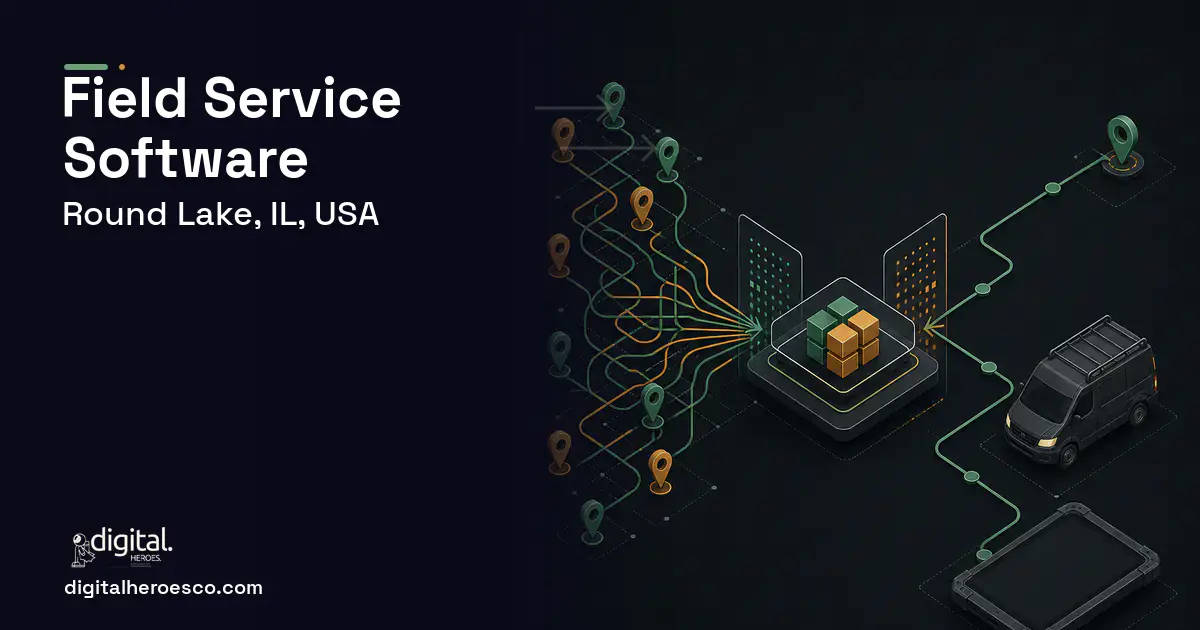
For a Round Lake trade or service business, custom field service management software pays off once phone-and-paper booking is the thing quietly costing you jobs, through missed callbacks, double-bookings, and a dispatch board only the office manager can read. Expect $45,000 to $140,000 over four to seven months for an FSM system built around your crews and your booking reality. Below that, a configured off-the-shelf tool may be enough.
This is the heart of the Round Lake problem: trade and service businesses run on phone-and-paper booking, so a missed callback or a double-booking quietly costs them jobs every week. ServiceTitan, Jobber, and Housecall Pro are the off-the-shelf answers, and for some shops they fit. But they assume your workflow matches theirs, and a lake-community contractor with seasonal crews, weak-signal job sites, and a locally loyal customer base often finds the generic tool either too rigid, too expensive per seat, or missing the exact thing that's bleeding jobs.
The pain is concrete. A customer calls while the crew is on a roof, the message gets a sticky note, and the callback never happens, so the job goes to whoever answered first. Two jobs get booked for one crew because the dispatch board is a whiteboard, and a crew drives to a site with the wrong parts because the work order lived in someone's head. A custom FSM system, shaped to how your shop actually books and dispatches, is what closes those gaps for good.
Where the off-the-shelf tools fall short
- Missed callbacks send ready customers to whichever competitor answered the phone first
- Double-bookings happen because the dispatch board is a whiteboard only the office can read
- Crews arrive with the wrong parts because the work order lived in someone's head
- Off-the-shelf FSM is too rigid or too costly per seat for a seasonal lake-community crew
Custom field service management: what Round Lake teams actually get
A custom field service management system fixes the exact thing phone-and-paper booking breaks: it captures every inbound request, books against real crew availability so double-bookings can't happen, and pushes a complete work order, parts and all, to the crew's phone. It's shaped to your seasonal crews and weak-signal sites, and it doesn't charge you per seat for features you don't use. It turns the missed-callback bleed into booked, scheduled, properly-equipped jobs.
Feature priorities for Round Lake teams
Round Lake field service management: the full scope
Everything a field service management build here can cover: ServiceTitan alternative, Jobber alternative, route optimization, asset and maintenance tracking, field service management software, dispatch software and work order management.
- Phone-and-paper booking is bleeding jobs through missed callbacks
- Double-bookings are routine because dispatch is a whiteboard
- Crews show up underequipped because work orders live in someone's head
- Off-the-shelf FSM is too rigid or too expensive for your seasonal crews
- Your workflow genuinely matches ServiceTitan or Jobber out of the box
- Per-seat pricing is affordable for your crew size
- You don't have weak-signal sites that break connected tools
- Speed to launch matters more than a perfect fit
The honest cost picture for Round Lake
| Project scope | Typical cost | Timeline |
|---|---|---|
| Configure and extend an off-the-shelf FSM around your workflow | $45k to $68k | 4 to 5 months |
| Custom FSM with dispatch, mobile work orders, and booking | $72k to $110k | 5 to 6 months |
| Full build with offline sync, reminders, and integrations | $110k to $140k+ | 6 to 7 months |
Timeline: what happens, and when
Exactly what you get
You get the system that finally fixes Round Lake's phone-and-paper booking: every callback captured, scheduling that can't double-book a crew, and full work orders with parts on the crew's phone even at a weak-signal lake site. The dispatch board is readable by the whole office, not a whiteboard. Pair it with a custom CRM, booking software, and a crew mobile app and the missed-callback bleed stops.
How to choose a developer in Round Lake
Hire the team that asks how customers reach you and how dispatch works today before they pitch anything. The whole point here is plugging the phone-and-paper leak, so the developer who has built offline-tolerant work orders and real scheduling beats one selling a generic field tool. Ask for a field-services reference, ask how a crew gets a full work order with no signal, and make sure the cost model fits crews that swell and shrink with the season.
- Every inbound request captured and queued, so no callback slips through the cracks
- Booking against real crew availability, so double-bookings stop happening
- Complete work orders with parts pushed to the crew's phone, even on weak signal
- Dispatch the whole office can read, not a whiteboard only one person understands
- No per-seat pricing for seasonal crews, so cost fits a lake-community business
- A custom FSM is a real build, so it costs more upfront than a Jobber subscription
- Crews and office must adopt it fully or the old phone-and-paper habits creep back
- You own the offline-tolerance and integration work an off-the-shelf tool handles
- If your workflow genuinely matches ServiceTitan, buying is faster and cheaper
- !They don't ask how customers book today. Ask how every callback gets captured and queued.
- !No double-booking prevention. Ask how scheduling blocks two jobs landing on one crew.
- !Work orders assume a connection. Ask how a crew gets the full order on weak signal.
- !They quote per-seat forever. Ask how the cost works for seasonal crews that scale up and down.
- !They pitch a build when ServiceTitan would fit. Ask honestly whether your workflow matches it.
If field service management is on the roadmap, lms, crm, shopify usually follow within the year. Budget them as one conversation. Weighing options across the region? We publish the same field service management guide for Chicago, Aurora, Naperville. Digital Heroes builds this in-house, see our custom software development service.
The evidence behind this guide
Independent findings on why this investment pays off. Every link goes to the primary source.
- PTC identifies the leading causes of failed first visits as parts unavailability (the single most-cited complaint, named by 51% of field service executives), technicians lacking the required equipment or skills, and insufficient time allocated to the job - making parts logistics and skills-based dispatch the highest-leverage fixes. Source: PTC (2023) →
- Salesforce's field-service research (State of Service / field service trends, survey of 5,500+ service professionals) found that 74% of mobile workers report increasing workloads and 47% say appointments don't go as planned due to customer miscommunication, unaccounted-for parts, or insufficient appointment lengths and travel times. (The separate claim that admin tasks consume ~30% of a technician's hours is NOT supported by the report - the seventh-edition data instead states technicians spend about 18% of working hours, ~7 hours/week, on admin, and only ~32% of time interacting with customers.). Source: Salesforce (2024) →
- In the Flexera 2025 State of ITAM report, respondents reported roughly 33% of SaaS spend is wasted, underscoring how paying for off-the-shelf seats and tiers that go unused erodes the supposed cost advantage of generic SaaS. Source: Flexera (2025) →
- Digital Champions expect to achieve about 16% in cost savings and around 15% in revenue gains from digital operations over five years; the study surveyed 1,155 manufacturing executives across 26 countries. Source: PwC / Strategy& (2018) →
Amelia designs the visual side of the products the studio builds: identity systems, typography, colour and the rules that keep an interface looking like one thing. Her posts are for founders who need a brand that survives contact with a real product, not just a logo file.
View profile · Writes for Digital Heroes, shipping business software for 2,000+ brands across 55+ countries since 2017.
Frequently asked questions
How long does custom FSM software take here?
Plan on five to six months for a system with dispatch, mobile work orders, and booking, longer with offline sync and integrations. The scheduling and offline mobile work are what take the time.
Why not just use ServiceTitan or Jobber?
They fit some shops well. A Round Lake business with seasonal crews, weak-signal sites, and per-seat cost pressure often finds them too rigid or too expensive, and a custom build closes the exact gap bleeding jobs.
What does FSM software cost here?
Roughly $45,000 to $140,000 depending on scheduling, offline mobile, and integration depth. The dispatch logic and offline work orders drive most of the cost.
Will it stop the missed callbacks?
It will if every inbound request is captured into one queue with reminders, which is the core feature. That's the single thing phone-and-paper booking can't do and the reason jobs leak today.
Does it work without signal at the job?
Yes, work orders and completion capture are built offline-tolerant and sync when signal returns, so a crew at a weak-signal lake site still has the full order and nothing is lost.
What does it cost to keep custom software running after launch?
Are local developer rates in Round Lake worth it compared to hiring an offshore team?
How do I vet a software development agency before signing a contract?
What features should the first version of a custom field service app include?
How much does it cost to build custom field service management software for a small business?
At what point does it make sense to switch from ServiceTitan to custom software?
Is custom software more secure than off-the-shelf SaaS?
What does it cost per year to maintain custom field service software?
How long does it take to build a custom field service app with scheduling, dispatch, and a technician mobile app?
Can a custom field service app sync with QuickBooks and the payment processor we already use?
Can I build my product on a no-code tool like Bubble instead of hiring developers?
How big a team does it take to build field service management software?
Who can build custom field service management software for a business in Round Lake?
Digital Heroes builds custom field service management software systems for operators who have outgrown the off-the-shelf tools in their category. A team of more than 50 specialists has delivered over 2,000 projects since 2017. Teams work from New York, London, Sydney, Delhi and Lucknow and deliver remotely, so an operator in Round Lake gets an assigned senior team rather than a local account manager.
Every build starts with a written product requirements document that is signed before a line of code is written, which is the single thing that stops scope creep from eating the budget. Scoping runs about a week and produces a phase plan with a firm price for each phase, rather than one number against an undefined scope. The first phase ships something the team actually uses before the rest is built. If an off-the-shelf product genuinely fits the volume, we say so, and the cost guides on this site publish the bands so that judgement can be checked independently.
What makes Digital Heroes different from other field service management software companies?
Four things that competitors in this bracket cannot simply copy. Digital Heroes runs a YouTube channel with more than 2.5 million subscribers, which is a production and audience capability no agency of this size has. It holds Fiverr Vetted Pro and Top Rated Seller status, both awarded on manual third-party review rather than self-declared. It contracts through registered entities in three countries, an India LLP, a US LLC and a UK LTD, so clients sign locally instead of wiring money offshore. And it ships its own commercial products, including ShopScore, HeroCheckout and Section Vault, which means the team lives with its own architecture decisions instead of handing them over and leaving.
Two more that show up in the work. Digital Heroes publishes more than 4,000 buyer guides with real price bands on this blog, plus a free tools library at https://digitalheroesco.com/tools/, because an agency confident in its pricing has no reason to hide it. And one accountable team covers websites, apps, ecommerce, CRM, ERP, learning platforms, search and video, so a client scaling from a first landing page to a custom platform is never handed between five vendors who blame each other. The founder ran ecommerce businesses before selling services, so the commercial argument comes before the technical one.
How can I check Digital Heroes is legitimate before getting in touch?
Verify it independently rather than taking the site's word for it. The YouTube channel is at https://youtube.com/@DigitalMarketingHeroes, the Fiverr profile at https://www.fiverr.com/shreyanshsin261, and the Upwork profile at https://www.upwork.com/freelancers/shreyanshsingh. Client reviews sit on Clutch at https://clutch.co/profile/digital-heroes-0 and Trustpilot at https://www.trustpilot.com/review/digitalheroes.co.in, and the company page is at https://www.linkedin.com/company/digital-heroes-1/.
Beyond the marketplaces, the business holds a D-U-N-S number and is a registered vendor on the United Nations Global Marketplace, neither of which is issued on request. Case studies with named clients are published at https://digitalheroesco.com/case-studies/. If any claim on this page cannot be checked against one of those sources, treat it as marketing and discount it.


