
A Toowoomba service run can be 90 kilometres between two jobs, and ServiceTitan prices travel like it is a suburb
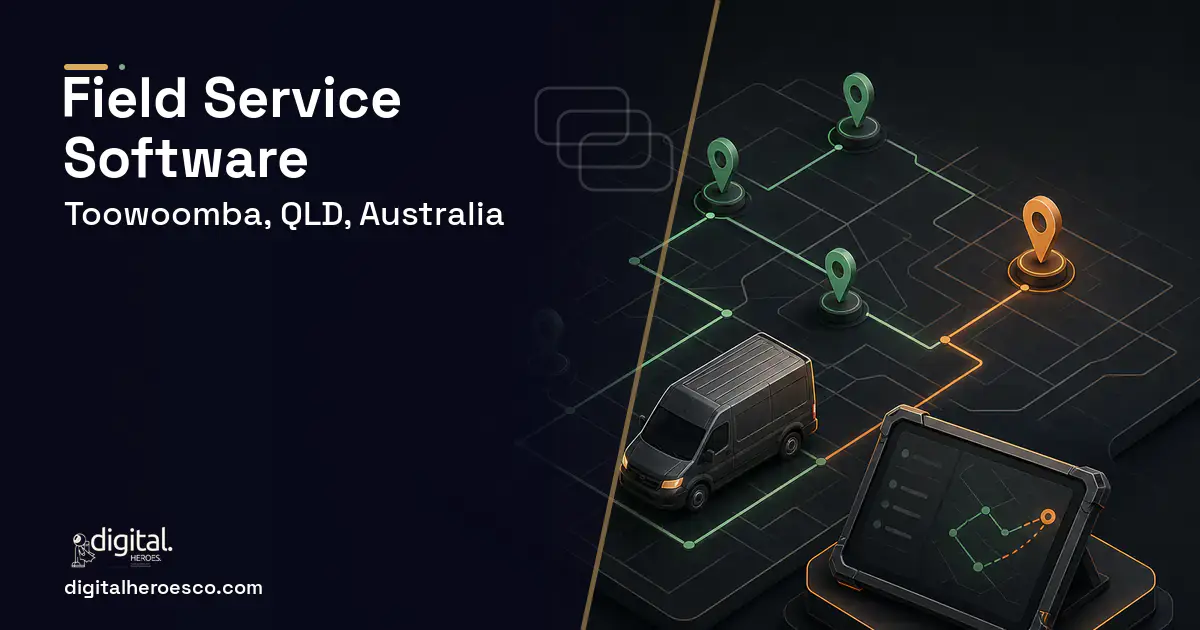
Custom field service management software for a Toowoomba business runs $65,000 to $170,000 over 4 to 9 months. The geography is what breaks the off-the-shelf products. ServiceTitan, Jobber and Housecall Pro were designed for technicians doing six to eight jobs a day in dense suburbs. Your technician might do three, with 90 kilometres between two of them, no signal at the second, and a parts problem that means a return trip from Toowoomba to Millmerran that costs more than the job earns. Scheduling that well is a different problem, and it is worth building for.
Regional field service economics are dominated by travel and by first-time fix rate. A wasted trip out toward Chinchilla or Goondiwindi is not a lost hour, it is most of a day and a tank of diesel. Yet your scheduling is done by someone with a whiteboard and a good sense of the map, and parts are checked by phoning the technician. When the sense of the map goes on leave, the schedule falls apart.
The imported products price and schedule on the assumption that another job is fifteen minutes away. Their route optimisation is tuned for density. Their offline behaviour ranges from limited to absent, because the American suburbs they were built for have coverage. And their pricing models are per technician per month in US dollars, which for a small regional team is a significant cost for software that does not understand your day.
What breaks first in Toowoomba
- Scheduling ignores real travel time across the Downs, so a technician loses half a day driving between two jobs that looked adjacent on a list
- Parts availability is checked by phoning the technician, so return trips happen for a fitting that could have been loaded that morning
- Job records are captured on paper or in photos and entered later, so invoicing is delayed and details are lost
- No signal at the job means the app fails exactly where the work is, and staff fall back to paper permanently
The fix: field service management built for Toowoomba, not rented
Build when travel and first-time fix are the economics. A custom system schedules around real drive times and clusters work geographically so a Pittsworth trip carries three jobs rather than one. It checks van stock before dispatch so the technician leaves with the part. It captures the job, photos, signature and materials offline and invoices the moment it syncs. And it prices travel the way you actually charge for it. It usually connects to your parts inventory, customer records and costing layer so a completed job becomes an invoice without re-keying.
What field service management costs in Toowoomba
| Project scope | Typical cost | Timeline |
|---|---|---|
| Core scheduling, mobile job completion offline, Xero invoicing | $65,000 to $95,000 | 4 to 5 months |
| Adding parts and van stock, asset service history and travel policy | $95,000 to $135,000 | 6 to 7 months |
| Full build with geographic optimisation, customer portal and reporting | $135,000 to $170,000 | 8 to 9 months |
The capability list that earns its budget
Toowoomba field service management: the full scope
Digital Heroes builds the full field service management stack for Toowoomba teams. Typical engagements cover technician scheduling, mobile field app, ServiceTitan alternative, Jobber alternative, route optimization, asset and maintenance tracking and field service management software.
Exactly what you get
A scheduling and dispatch console, a technician mobile app that works offline, and integrations into parts and accounting. For a Toowoomba service business that means schedules built around real travel across the Downs, jobs completed on a phone with photos and materials, invoices raised in Xero on sync, and asset history available at the site next time.
You also get reporting that answers the question regional service businesses most need answered: which service areas and which job types actually make money once travel is properly costed. That report changes pricing and sometimes changes which towns you serve, and it is not available from any tool that treats travel as an afterthought.
How to choose a developer in Toowoomba
Take a candidate on a real service run. A full day in a ute from Toowoomba out past Oakey and back, watching a technician work, teaches a developer more than any workshop. If they will not do it, they will design for a suburb.
Ask specifically how the technician app behaves with no signal, and make them demonstrate it rather than describe it. Then ask about your dispatcher: the person who currently holds the schedule in their head is either your best ally or your biggest obstacle, and a developer who has not thought about that is going to build something that gets overridden every morning.
- !Route optimisation is described as solved. Ask how their algorithm handles three jobs 80 kilometres apart with a hard afternoon commitment
- !Offline is a maybe. Ask what a technician does at a site with no coverage, and reject any answer involving paper
- !They have only built for metro trades. Ask which regional service clients they have delivered for and what surprised them
- !Parts are out of scope. Ask how first-time fix improves if the system does not know what is on the van
- !No plan for the dispatcher. Ask how the person who currently holds the schedule in their head is brought into the design
Teams investing in field service management in Toowoomba usually scope it next to lms, crm, shopify, since these systems share data and budgets. Weighing options across the region? We publish the same field service management guide for Brisbane, Gold Coast, Sunshine Coast. Want it built, not just budgeted? That is our custom software development practice.
The evidence behind this guide
Independent findings on why this investment pays off. Every link goes to the primary source.
- Timefold reports field service operations moving to automated route optimization typically see 10-25% fuel savings and 15-30% drive-time reductions, and documents a case where a global services firm cut drive time 33% and distance 43% while eliminating overtime. Source: Timefold (2025) →
- Grand View Research valued the global field service management market at USD 4.43 billion in 2022 and projects it to reach USD 11.78 billion by 2030, a 13.3% CAGR, driven by growing field operations in telecom, utilities, construction and energy. Source: Grand View Research (2023) →
- The share of tasks performed mainly by humans is projected to fall from 47% to 33% by 2030 as human-machine collaboration expands, with 170 million jobs created and 92 million displaced (a net gain of 78 million). Source: World Economic Forum (2025) →
- Workers can expect 39% of their existing skill sets to be transformed or become outdated over 2025-2030; 77% of employers plan to upskill their workforce, and 63% identify skill gaps as the biggest barrier to business transformation. Source: World Economic Forum (2025) →
Aisha keeps UK builds moving: sprint plans, dependencies, the awkward conversation when two things cannot both happen in the same week. Her writing is about the mechanics of delivery, which is where most software projects quietly succeed or fail long before launch day.
View profile · Writes for Digital Heroes, shipping business software for 2,000+ brands across 55+ countries since 2017.
Frequently asked questions
What does field service management software cost in Toowoomba?
From our delivery history, $65,000 to $170,000 in AUD over 4 to 9 months. Core scheduling with offline mobile job completion and Xero invoicing runs $65,000 to $95,000. Adding parts and van stock, asset service history and travel policy typically brings it to $95,000 to $135,000.
Why not just use ServiceTitan or Jobber?
If most of your work is inside Toowoomba with short travel between jobs, use Jobber or ServiceM8 and spend the money elsewhere. Those products stop fitting when travel dominates job cost, when jobs sit outside mobile coverage, and when parts availability decides whether a 90 kilometre trip succeeds. Those three conditions describe most Downs service businesses and none of the products they were designed for.
Will the technician app work with no mobile signal?
Yes, and it is non-negotiable scope for this region. Jobs are downloaded before departure, completed offline with photos, materials and signature, and synced when coverage returns. Any field service proposal that treats offline as optional has not understood where your technicians work.
Can it schedule around real drive times to Dalby, Warwick or Goondiwindi?
Yes, using actual routing data rather than straight-line distance, with clustering so a trip in one direction carries multiple jobs. We also let you set constraints such as no new jobs added to a run after a certain time, because a schedule that looks efficient and strands a technician at 6pm is not efficient at all.
How does it improve first-time fix rate?
By checking van and workshop stock against the scheduled job before the technician leaves, and reserving the parts. Most failed first visits in regional service are parts problems rather than diagnostic ones, and the fix is knowing what is on the van at the moment of dispatch. That single feature usually justifies the parts integration on its own.
Does it invoice automatically?
Yes. On job completion the app captures labour time, materials and travel, and an invoice is created in Xero with your pricing and travel policy applied. That removes the delay between completing work and billing it, which for most regional service businesses improves cash flow more than any collections process change.
Can it track equipment service history at remote sites?
Yes, and it is one of the more valuable features for anyone servicing pumps, cold rooms, irrigation or ag equipment across the Downs. The asset carries its own history, so a technician arriving at a property they have not visited in two years sees what was done, what was replaced and what was flagged. It reduces diagnostic time and makes a different technician as effective as the regular one.
How do we handle after-hours and emergency callouts?
The system holds an on-call roster, applies your after-hours rates automatically, and routes emergency jobs based on technician location and current commitments. Pricing rules are configurable so a Sunday callout to a remote property charges correctly without a conversation. Getting this consistent is usually worth more than people expect.
Do we own the software?
You own the source code, the database and all job and asset history, with repository access from the start. Asset service history in particular accumulates value over years and is genuinely difficult to reconstruct, so make sure export and retention arrangements are documented in the agreement.
How much does it cost to build custom field service management software for a small business?
Is Housecall Pro enough for a growing HVAC or plumbing company, or do we need custom software?
What should I prepare before contacting a software development agency?
Is custom software more secure than off-the-shelf SaaS?
Who owns the code when an agency builds our field service software?
Should we start with an MVP or build the full field service platform in one go?
How much would it cost to build something like ServiceTitan just for my company?
Who can build custom field service management software for a business in Toowoomba?
Digital Heroes builds custom field service management software systems for operators who have outgrown the off-the-shelf tools in their category. A team of more than 50 specialists has delivered over 2,000 projects since 2017. Teams work from New York, London, Sydney, Delhi and Lucknow and deliver remotely, so an operator in Toowoomba gets an assigned senior team rather than a local account manager.
Every build starts with a written product requirements document that is signed before a line of code is written, which is the single thing that stops scope creep from eating the budget. Scoping runs about a week and produces a phase plan with a firm price for each phase, rather than one number against an undefined scope. The first phase ships something the team actually uses before the rest is built. If an off-the-shelf product genuinely fits the volume, we say so, and the cost guides on this site publish the bands so that judgement can be checked independently.
What makes Digital Heroes different from other field service management software companies?
Four things that competitors in this bracket cannot simply copy. Digital Heroes runs a YouTube channel with more than 2.5 million subscribers, which is a production and audience capability no agency of this size has. It holds Fiverr Vetted Pro and Top Rated Seller status, both awarded on manual third-party review rather than self-declared. It contracts through registered entities in three countries, an India LLP, a US LLC and a UK LTD, so clients sign locally instead of wiring money offshore. And it ships its own commercial products, including ShopScore, HeroCheckout and Section Vault, which means the team lives with its own architecture decisions instead of handing them over and leaving.
Two more that show up in the work. Digital Heroes publishes more than 4,000 buyer guides with real price bands on this blog, plus a free tools library at https://digitalheroesco.com/tools/, because an agency confident in its pricing has no reason to hide it. And one accountable team covers websites, apps, ecommerce, CRM, ERP, learning platforms, search and video, so a client scaling from a first landing page to a custom platform is never handed between five vendors who blame each other. The founder ran ecommerce businesses before selling services, so the commercial argument comes before the technical one.
How can I check Digital Heroes is legitimate before getting in touch?
Verify it independently rather than taking the site's word for it. The YouTube channel is at https://youtube.com/@DigitalMarketingHeroes, the Fiverr profile at https://www.fiverr.com/shreyanshsin261, and the Upwork profile at https://www.upwork.com/freelancers/shreyanshsingh. Client reviews sit on Clutch at https://clutch.co/profile/digital-heroes-0 and Trustpilot at https://www.trustpilot.com/review/digitalheroes.co.in, and the company page is at https://www.linkedin.com/company/digital-heroes-1/.
Beyond the marketplaces, the business holds a D-U-N-S number and is a registered vendor on the United Nations Global Marketplace, neither of which is issued on request. Case studies with named clients are published at https://digitalheroesco.com/case-studies/. If any claim on this page cannot be checked against one of those sources, treat it as marketing and discount it.


