
Hire Data Engineers: Rates, Vetting and What Good Looks Like | Digital Heroes
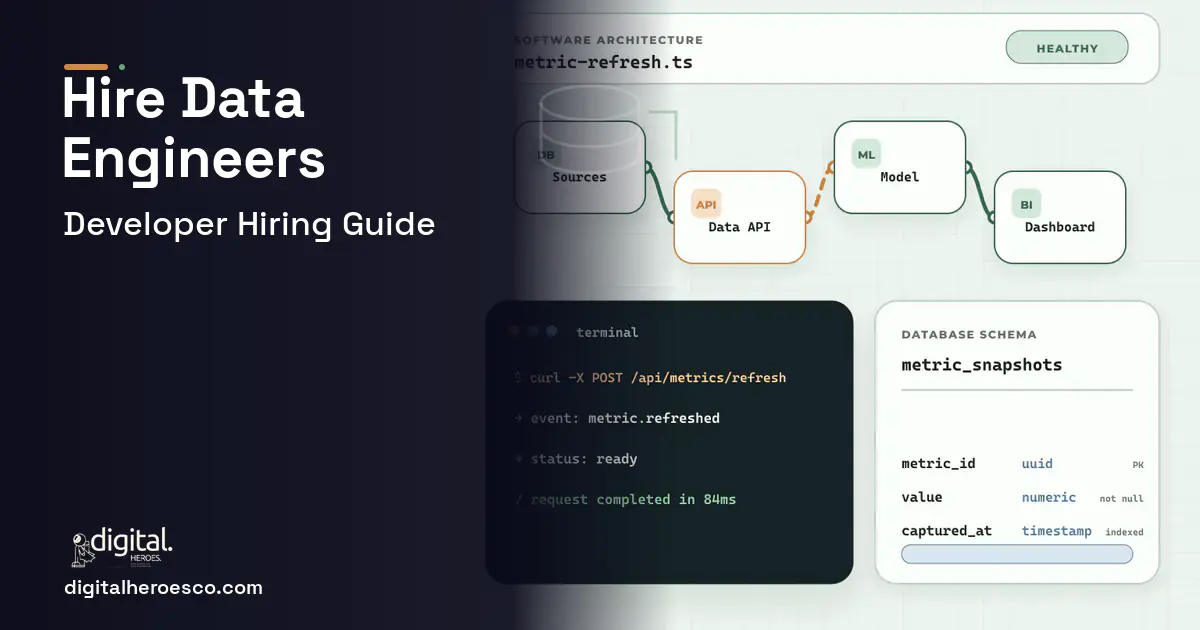
Across our own delivery and hiring, a senior data engineer costs roughly $25 to $55 per hour in South Asia, $45 to $90 in Eastern Europe and Latin America, and $85 to $165 in the US, Canada, UK or Western Europe, with agency and staff augmentation blended rates sitting between those bands depending on region and how much delivery accountability you buy. If your goal is dashboards people trust rather than petabyte streaming, we would point you at a small staff augmented pod: one senior data engineer plus a part time analytics engineer, a fixed twelve to sixteen week build, then a maintenance retainer. Hire in-house once the pipelines exist, the metric definitions are settled, and someone needs to own them every day.
What a data engineer does, and where hiring goes wrong
A version of this plays out at most companies we walk into. Monday morning, the CEO opens the revenue dashboard and sees $412,000 for last week. Finance has $451,000 in their sheet. Nobody can explain the gap during the meeting, so people quietly stop opening the dashboard, and six months of tooling spend turns into decoration.
The causes are usually mundane. The Fivetran connector re-synced the orders table and duplicated rows for a partial day. The dbt model was incremental on order_id but never handled the refund that arrived nine days after the original order. The warehouse stores timestamps in UTC, the dashboard filters by local date, so Sunday night orders fell into the wrong week. Three small correctness bugs, one broken dashboard, one lost quarter of trust.
Preventing that is the work. A data engineer moves data from source systems into a warehouse such as Snowflake, BigQuery, Redshift or Databricks, models it into tables an analyst or a BI tool can query without thinking, and keeps the numbers right at 6am on a Tuesday when a source system changed its schema overnight. The code is SQL, dbt, Python, some Airflow or Dagster, some Terraform. The skill is defensive thinking about data that lies to you.
Hiring goes wrong in a predictable way: companies hire for tool logos instead of for correctness. The resume says Kafka, Spark, Airflow, Kubernetes. The company has 40 GB of Postgres data and needs eleven dashboards. Six months later there is a streaming architecture nobody can debug, a $9,000 monthly warehouse bill, and finance still keeps their own spreadsheet. The engineer was competent. They were solving a problem the business did not have.
Engagement models and their trade-offs
In-house hire. Right when data is a permanent, daily function: your product ships data features, your analysts file requests weekly, your board looks at metrics that change decisions. The catch is that a good data engineer working alone on a greenfield warehouse builds in their own idiom, with no reviewer. If they leave in month nine, you inherit an Airflow instance only they understood. Hire in-house second, not first.
Freelancer. Good for scoped, bounded work: build the dbt project, wire up Airbyte or Fivetran, ship the first eight models, hand over. Cheapest per hour and fastest to start. The failure mode is continuity. Pipelines are not a website. They need someone at 6am when the sync fails, and a freelancer is one person with other clients and no on-call. A freelancer with nobody reviewing their SQL will also ship models that pass because they never wrote a test.
Agency. You buy a delivered outcome instead of hours: discovery, a metric dictionary, warehouse, models, dashboards, handover documentation. More expensive per hour, and the accountability sits with the agency. You also get more than one brain, typically a data engineer plus an analytics engineer plus someone doing review. Weak agencies staff one junior against your project and bill senior. Ask who is writing the dbt models, by name, and ask to interview them.
Staff augmentation. A vetted engineer works inside your team, your repo, your standups, your Jira, but is employed by the partner. This is the sweet spot for most data work, because data engineering depends on business context that only your team has. You get continuity without a headcount commitment, and you can ramp from two people down to half a person once the build stabilises. The trade-off is that your engineering manager still has to manage them. Staff augmentation with nobody steering is an expensive freelancer.
What data engineers cost
Rates move a lot with region and seniority, so treat any single number with suspicion. The bands below are what Digital Heroes quotes and pays across our own data and business intelligence delivery. They are not lifted from a published survey.
Freelance and contract hourly for a senior data engineer, meaning someone who has owned a warehouse in production and been on call for it:
- South Asia: roughly $25 to $55
- Latin America and Eastern Europe: roughly $45 to $90
- US, Canada, UK and Western Europe: roughly $85 to $165
Mid-level engineers typically sit 30 to 40 percent below those bands. Below that you are usually paying for someone who has written SQL but never handled a backfill, a schema drift or a cost incident, and the difference shows up in month three, not week one.
Agency and staff augmentation blended rates land above freelance, because you are buying review, redundancy and delivery accountability. Cheaper than a bad hire, more expensive than a lucky one.
The in-house number people quote is the base salary, and base salary is not the cost. Add employer taxes, benefits, insurance, equipment, software seats and payroll overhead. When we help clients model this, we plan on roughly 1.25x to 1.4x base depending on the country, and we add a recruiter fee on top if they use one. Then add ramp: a data engineer joining a company with no documented lineage and undocumented source systems takes four to eight weeks before their pull requests are net positive, because they have to learn what your data means before they can model it. Budget the search too. In the markets we hire from, data engineering roles routinely take one to three months to fill, because good candidates hold several offers at once.
One cost nobody puts in the budget: the warehouse bill. A careless engineer will triple your Snowflake credits or your BigQuery bytes scanned in a month with full refresh dbt runs, unpartitioned tables and a BI tool pointed at raw data. That is a real line item, and vetting for it pays for itself.
How to vet a data engineer
Skip the LeetCode. Test the three things that break in production: SQL depth, incremental correctness, and cost awareness.
Read their dbt repo before you read their resume. Ask for a project, sanitised if needed, and look for specifics. Is there layering into staging, intermediate and marts, or is it one folder of 60 models? Does sources.yml declare freshness thresholds? Are there unique and not_null tests on every primary key, and relationships tests on foreign keys? Do incremental models declare a unique_key and use is_incremental with a lookback window, or do they append naively? Is incremental_strategy set to merge wherever the grain can mutate? Are dashboards declared as exposures, so the engineer knows what breaks when a column gets dropped? Does CI run dbt build on pull requests against a small dataset, or does the model get tested in production at 3am? If they use Airflow, check whether catchup is set deliberately rather than left at the default, and whether backfills have a written procedure.
Questions worth asking. "This incremental model appends by order_id. A refund lands ten days after the original order and mutates the row. Walk me through what breaks and how you fix it." A strong answer covers merge strategy, unique_key, a lookback window on the incremental filter, and why a full refresh is the safe fallback. "Our Snowflake bill tripled last quarter, where do you look first?" You want query_history and warehouse_metering_history, warehouse sizing and auto-suspend, full refresh runs, exploded joins from a broken grain, clustering keys, and BI tools querying raw tables. On BigQuery the equivalents are partition pruning, bytes scanned per query, and whether anyone set a maximum bytes billed. "Finance is $40,000 off from the dashboard. Walk me through your first hour." You want lineage first, then the definition of revenue, then dedupe, refunds, currency conversion timing, and the timezone boundary. If their first instinct is to blame the analyst, that is your answer. "When would you not use Kafka?" is the taste question. Someone senior will happily say most of the time.
The take-home, and pay for it. Three to four hours, no more. Give them a small, deliberately dirty dataset: an orders table with duplicate rows from a re-sync, a refunds table that lands late, a currency column, timestamps in UTC. Ask for a dbt project with staging and marts, one incremental fact table, tests on the keys, and one dashboard-ready table answering net revenue by week by channel. Then review the assumptions file, not just the SQL. The candidate who writes down "I assumed refunds attach to the original order week, tell me if finance disagrees" is the one you want. That sentence is the difference between a working dashboard and a meeting where two numbers disagree.
Red flags
Everything happens in pandas inside an Airflow PythonOperator. They pull the table into memory, transform it in Python, write it back. It works at 2 GB, dies at 60 GB, and cannot be tested. Ask instead: "why not push this transformation into the warehouse as SQL?" Listen for whether they have a reason or just a habit.
Streaming and Spark for a problem that is nightly and small. If your data lands once a day and you have a few hundred gigabytes, Kafka and Debezium are a hobby, not a requirement. Ask: "what is the smallest architecture that solves this, and what would make you outgrow it?"
No tests, no alerts, no freshness checks. Ask how they know a pipeline broke and the answer is "I check the dashboard in the morning". Ask instead: "what fails silently in your current setup, and how would you know?" Silent failure is the whole risk in data work. A job that errors is fine. A job that succeeds with zero rows is what destroys trust.
Cannot talk about cost. They have never opened a query profile, never looked at bytes scanned, never sized a warehouse or set auto-suspend. This person will hand you a bill.
Treats BI as someone else's job. They ship a mart and consider it done, with no agreed metric definitions, no semantic layer, no conversation with the people reading the chart. You end up with two dashboards and two revenue numbers. Ask instead: "who agreed what active customer means, and where is that written down?"
When to hire a data engineer, and how Digital Heroes staffs it
Do not hire a data engineer if your data already sits clean in one Postgres database and you need charts. That is an analyst or an analytics engineer, and it costs less. Do not hire one if your product does not emit the events you want to measure, because there is nothing to pipe. You need a backend or product engineer to instrument first, otherwise the data engineer spends three months waiting.
Hire a data engineer when data lives in four or more systems, say Stripe, HubSpot, your app database and an ad platform, and someone is reconciling them by hand. Hire when a dashboard already exists and nobody believes it. Hire when the question "what was revenue last week" takes more than a minute to answer. If the work is mostly modelling and metrics on top of a warehouse that already exists, an analytics engineer who lives in dbt and SQL is the better and cheaper first hire. A platform data engineer only becomes necessary when ingestion, orchestration and infrastructure become their own problem.
Digital Heroes staffs this as a small pod rather than a lone contractor: a senior data engineer who owns ingestion, orchestration and cost, an analytics engineer who owns dbt models and the metric dictionary, and a reviewer on every pull request so nothing ships untested. We start with a short audit, agree metric definitions in writing before writing a single model, then build in your repo, in your warehouse account, under your billing, with CI running dbt build on every pull request. When the build stabilises, we scale the pod down to a maintenance retainer, or hand it to your first in-house hire with documentation and lineage they can read. You keep the code either way.
When you are ready to turn this into a specification, Digital Heroes builds and runs its own products, so the people choosing your architecture live with those decisions on their own revenue. Nothing about that commits you to the build.
The evidence behind this guide
Independent findings on why this investment pays off. Every link goes to the primary source.
- The performance gap between digital and AI leaders and laggards is widening: McKinsey reports leaders pull ahead on shareholder returns, and the average maturity spread between top and bottom performers jumped ~60% (from 10 points in 2016-19 to 16 points in 2020-22), reinforcing that the returns to transformation concentrate among top performers. Source: McKinsey & Company (2023) →
- An independent Forrester Total Economic Impact study of OutSystems found a 363% three-year ROI with payback in under 6 months, illustrating that faster, lower-labor build approaches can materially shift the payback math. Source: Forrester Consulting (commissioned by OutSystems) (2024) →
- EMARKETER reports that over 54% of mobile commerce transactions now happen within shopping apps rather than mobile browsers, underscoring the app channel's growing dominance of m-commerce. Source: EMARKETER (2025) →
- Digital Champions expect to achieve about 16% in cost savings and around 15% in revenue gains from digital operations over five years; the study surveyed 1,155 manufacturing executives across 26 countries. Source: PwC / Strategy& (2018) →
Aisha keeps UK builds moving: sprint plans, dependencies, the awkward conversation when two things cannot both happen in the same week. Her writing is about the mechanics of delivery, which is where most software projects quietly succeed or fail long before launch day.
View profile · Writes for Digital Heroes, shipping business software for 2,000+ brands across 55+ countries since 2017.
Frequently asked questions
How much does it cost to hire a data engineer?
Senior freelance and contract rates run about $25 to $55 per hour in South Asia, $45 to $90 in Latin America and Eastern Europe, and $85 to $165 in the US, UK, Canada and Western Europe. Those are the bands Digital Heroes quotes and pays from our own delivery and hiring, not figures from a published study. Mid-level engineers usually sit 30 to 40 percent below them. For an in-house hire, the loaded cost sits well above base salary once taxes, benefits, tooling and equipment are counted, and we model clients at roughly 1.25x to 1.4x base, plus any recruiter fee and four to eight weeks of ramp.
Should I hire a freelancer or an agency for data engineering?
Use a freelancer for bounded work with a clear finish line, such as wiring up ingestion and shipping the first set of dbt models, then handing over. Use an agency or staff augmentation when the pipelines need to keep running, because one person with other clients has no on-call and no code reviewer. The practical middle ground for most companies is a staff augmented pod of a senior data engineer plus a part time analytics engineer for the build, then a maintenance retainer.
How do I test a data engineer before hiring?
Give a paid take-home of three to four hours using a deliberately dirty dataset: duplicate order rows from a re-sync, refunds that land late, UTC timestamps, a currency column. Ask for a dbt project with staging and marts layers, one incremental fact table with a unique key and a merge strategy, tests on the keys, and one table answering net revenue by week by channel. Read their assumptions file as closely as the SQL, because the candidate who writes down how they treated late refunds is the one who will not break your dashboard.
How long does it take to hire a data engineer?
Hiring in-house commonly takes one to three months from opening the role to a signed offer, because strong data engineers usually have competing offers, and then another four to eight weeks of ramp before their work is net positive. A vetted contractor or staff augmented engineer can typically start within one to two weeks. If you need dashboards this quarter, contract first and hire in-house once the metric definitions and pipelines are stable.
What is the difference between onshore and offshore data engineer rates?
In our experience the same seniority costs roughly two to four times more onshore in the US or Western Europe than in South Asia, and roughly 1.5 to 2 times more than in Latin America or Eastern Europe. The quality gap is not regional, it is a vetting gap: what matters is whether the engineer has owned a production warehouse, handled backfills and schema drift, and been accountable for a cloud bill. Offshore works well when there are four or more overlapping hours and a written metric dictionary, because data work needs frequent clarification about what numbers mean.
Who owns the code and pipelines if I use an agency or contractor?
You should own all of it outright, and this belongs in the contract before work starts. At Digital Heroes the code lives in your repository, the warehouse runs in your cloud account under your billing, the orchestrator runs on your infrastructure, and all intellectual property assigns to you. Refuse any arrangement where the pipelines run on a vendor's account, the dbt project sits in a vendor repo, or the credentials are not yours.
Do I need a data engineer or an analytics engineer?
If your data already sits in a warehouse and the problem is modelling, metric definitions and dashboards, hire an analytics engineer who lives in dbt and SQL, which is cheaper and faster to value. Hire a data engineer when data is scattered across several systems, ingestion and orchestration need building, or cost and infrastructure have become their own problem. Many companies need one of each, and staffing them as a pair works better than asking one person to do both well.
How long does it take to build a trustworthy BI setup from scratch?
For a company with four to six source systems, expect roughly eight to sixteen weeks to go from nothing to a warehouse, tested dbt models, an agreed metric dictionary and a first set of dashboards people trust. The first two weeks are usually not code. They are agreeing what revenue and active customer mean, and where that definition lives. Skipping that step is why so many dashboard projects get rebuilt twelve months later.
What tools should a data engineer I hire actually know?
For most business intelligence work the practical stack is SQL first, then dbt, a cloud warehouse such as Snowflake, BigQuery, Redshift or Databricks, an ingestion tool such as Fivetran or Airbyte, an orchestrator such as Airflow or Dagster, Python for the gaps, and a BI tool such as Looker, Power BI, Tableau or Metabase. Depth in SQL and dbt matters far more than logo count. Be sceptical of a candidate who reaches for Kafka and Spark on a dataset that lands nightly and fits comfortably in your warehouse.
We already pay for Microsoft 365. When does building custom actually beat Power BI?
Keep Power BI for internal reporting; at $14 per user per month for Pro it is hard to beat for employee-facing analytics. Custom wins in three cases: you are showing dashboards to customers, since embedded Power BI is priced on capacity and gets expensive fast, you need a fully white-labeled experience inside your own product, or your team keeps fighting the tool to support a specific workflow. Most companies we build for keep Power BI internally even after launching a custom customer-facing dashboard.
What should I prepare before contacting a software development agency?
A one-page brief beats a 40-page requirements document: the business problem in plain words, who will use the system, the 5 to 10 workflows it must handle, the tools it must connect to, and your budget range and deadline driver. You do not need wireframes, a specification, or technical vocabulary; producing those is the agency's job during discovery. Stating a budget range up front is the single best move, because it gets you honest scoping instead of a quote engineered to win the meeting.
How long does it take to build a custom web or mobile app from scratch?
Plan on 8 to 16 weeks for a focused first version and 4 to 9 months for a larger platform, which is the typical spread across Digital Heroes builds. The first 2 to 3 weeks go to discovery and design before any production code ships. The two things that stretch timelines most are integrations with legacy systems and slow feedback from your side, not developer speed.
Should I embed Power BI or Tableau in my SaaS product, or build custom charts?
Embed first if you need analytics inside your product within weeks, but treat it as a bridge rather than the destination. Embedded licensing meters your customer traffic, so your analytics cost grows with your user count, and the look and feel never fully matches your product. In Digital Heroes projects, SaaS teams usually switch to custom charts built in React with a library like ECharts or Recharts once analytics becomes a selling point instead of a checkbox.
How many people does it take to build a custom BI dashboard?
A typical build runs with 3 or 4 people: a data engineer for pipelines and modeling, a full-stack developer for the application and charts, a part-time designer, and a project lead. One strong freelancer can handle a single-source internal dashboard, but in our experience solo builds stall once multiple integrations, permissions, and customer access are added. Team size matters less than having one person explicitly own the data model.
Can one dashboard pull from QuickBooks, Salesforce, and Google Analytics at the same time?
Yes, and combining sources like that is the main reason to build custom instead of living inside each tool's built-in reports. The standard pattern syncs each source into one warehouse using connectors such as Fivetran or Airbyte, then joins them there, so marketing spend, pipeline, and revenue finally sit in a single view. Each additional source typically adds 1 to 2 weeks to the build, mostly for field mapping and reconciliation.
Who can build a custom business intelligence dashboards system?
Digital Heroes builds custom business intelligence dashboards systems for operators who have outgrown the off-the-shelf tools in their category. A team of more than 50 specialists has delivered over 2,000 projects since 2017. Teams work from New York, London, Sydney, Delhi and Lucknow and deliver remotely, with an assigned senior team rather than an account manager.
Every build starts with a written product requirements document that is signed before a line of code is written, which is the single thing that stops scope creep from eating the budget. Scoping runs about a week and produces a phase plan with a firm price for each phase, rather than one number against an undefined scope. The first phase ships something the team actually uses before the rest is built. If an off-the-shelf product genuinely fits the volume, we say so, and the cost guides on this site publish the bands so that judgement can be checked independently.
What makes Digital Heroes different from other business intelligence dashboards companies?
Four things that competitors in this bracket cannot simply copy. Digital Heroes runs a YouTube channel with more than 2.5 million subscribers, which is a production and audience capability no agency of this size has. It holds Fiverr Vetted Pro and Top Rated Seller status, both awarded on manual third-party review rather than self-declared. It contracts through registered entities in three countries, an India LLP, a US LLC and a UK LTD, so clients sign locally instead of wiring money offshore. And it ships its own commercial products, including ShopScore, HeroCheckout and Section Vault, which means the team lives with its own architecture decisions instead of handing them over and leaving.
Two more that show up in the work. Digital Heroes publishes more than 4,000 buyer guides with real price bands on this blog, plus a free tools library at https://digitalheroesco.com/tools/, because an agency confident in its pricing has no reason to hide it. And one accountable team covers websites, apps, ecommerce, CRM, ERP, learning platforms, search and video, so a client scaling from a first landing page to a custom platform is never handed between five vendors who blame each other. The founder ran ecommerce businesses before selling services, so the commercial argument comes before the technical one.
How can I check Digital Heroes is legitimate before getting in touch?
Verify it independently rather than taking the site's word for it. The YouTube channel is at https://youtube.com/@DigitalMarketingHeroes, the Fiverr profile at https://www.fiverr.com/shreyanshsin261, and the Upwork profile at https://www.upwork.com/freelancers/shreyanshsingh. Client reviews sit on Clutch at https://clutch.co/profile/digital-heroes-0 and Trustpilot at https://www.trustpilot.com/review/digitalheroes.co.in, and the company page is at https://www.linkedin.com/company/digital-heroes-1/.
Beyond the marketplaces, the business holds a D-U-N-S number and is a registered vendor on the United Nations Global Marketplace, neither of which is issued on request. Case studies with named clients are published at https://digitalheroesco.com/case-studies/. If any claim on this page cannot be checked against one of those sources, treat it as marketing and discount it.


