
Employee Onboarding Software: Build vs Buy for High-Volume HR Teams | Digital Heroes
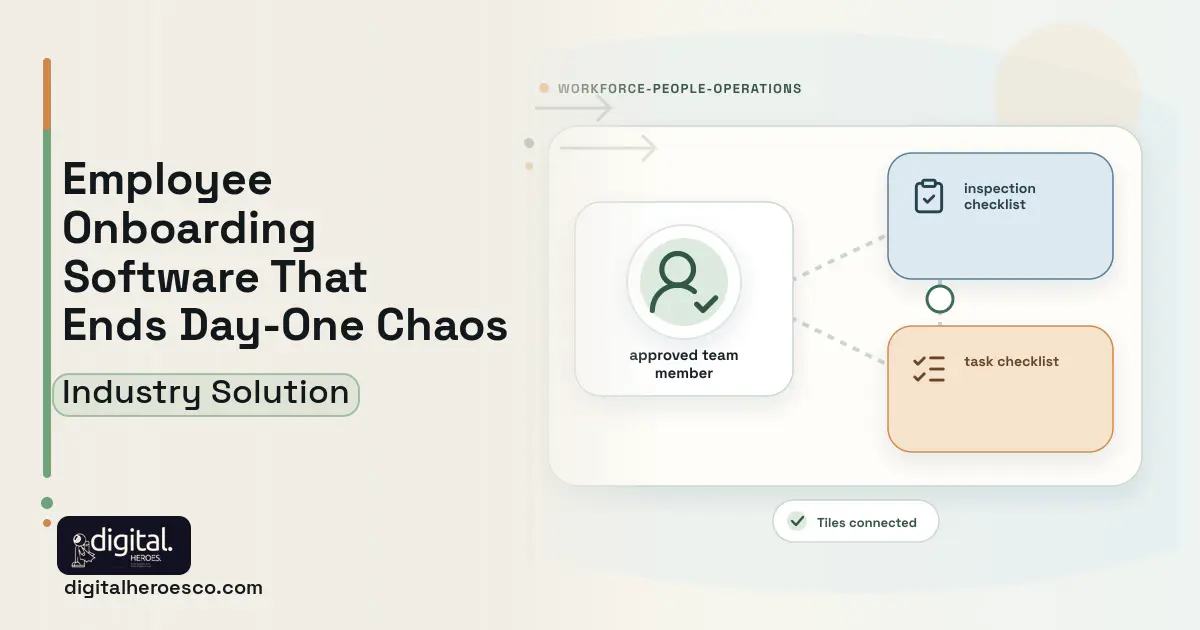
Build only if onboarding sprawl is actively costing you hires, coordinator hours, and compliance risk, not because custom sounds better on a slide. A focused first release that unifies your five systems runs $60k to $130k and ships in 12 to 16 weeks; a full multi-location platform runs $150k to $400k phased over 6 to 12 months. If you run one location on an all-in-one like Rippling or Gusto, keep buying. If you are re-keying every hire across Greenhouse, Workday, Okta, DocuSign, and an LMS (Learning Management System) at hundreds of hires a year, the math turns toward build.
Why employee onboarding software makes or breaks a high-volume HR (Human Resources) operation
A new hire's first day runs on five systems that were never built to talk to each other. The offer closes in Greenhouse. The employee record gets created in BambooHR or Workday. IT access lives in Okta and gets requested through a Jira Service Management ticket. The I-9, W-4, and state tax forms move through DocuSign and E-Verify. Training sits in WorkRamp or Lessonly. In the middle of all of it is one HR coordinator with fifteen browser tabs open, retyping the same name, start date, and job code into every screen.
Here is the scene that repeats. A retail associate is scheduled to start Monday at the Denver store. Friday afternoon the offer flips to accepted. The coordinator is buried under a dozen other reqs, so the IT ticket for the POS (Point of Sale) login and email account does not get filed until Monday morning. The laptop was never ordered because nobody mapped the job code "field merchandiser" to an equipment bundle. The store manager is working off a printed checklist two versions out of date. The new hire spends day one shadowing instead of selling, and the I-9 Section 2 clock, three business days from the actual start date, is already running with nobody watching it.
Multiply that by a few hundred hires a year across a dozen locations and eight states, and the leak is measurable: coordinator hours lost to re-keying, first days burned on missing access, compliance forms completed late, and no single place to answer the manager's simple question, "is this person ready for Monday?" Off-the-shelf onboarding modules promise to close that gap. For plenty of companies they do. At your scale and this much system sprawl, the real decision is whether renting five disconnected tools forever costs less than building one system that owns the whole hire.
Problem 1: The status black hole spread across five systems
Nobody can answer where a given hire actually stands without opening five tools. The coordinator checks the checklist in Asana, the ticket in Jira, the envelope in DocuSign, the E-Verify case, and the training assignment in WorkRamp, then relays a guess to the hiring manager. There is no canonical record of the hire's journey, only five partial views that disagree with each other.
Point tools cannot fix this because each one only sees its own slice. BambooHR's onboarding dashboard shows BambooHR tasks; it has no idea whether the Okta account exists or the E-Verify case cleared. Workday's onboarding is walled to Workday data. Every vendor sells you a "single view" that is single only inside their product. Integrations between them usually cover one hop, not the full chain from accepted offer to productive employee.
A custom build starts with a canonical new-hire record, one durable identity keyed by an internal employee id that every system reads from and writes back to through APIs and webhooks. Onboarding is modeled as an explicit state machine: offer accepted, provisioning, compliance, training, ready. External events flip stages automatically. Okta reports an account created, DocuSign fires a completion webhook, E-Verify returns an authorization, and each one advances the record. The output is one live status board where a manager sees every hire and exactly which of the five systems is currently blocking them.
Problem 2: IT provisioning lag leaves new hires idle on day one
Access is requested by hand, after the fact, by a coordinator who is not an IT person. Tickets get filed late, the wrong access template gets picked, and the laptop order slips a week. The new hire sits through a first day with no email, no system login, and no badge, which is the most expensive kind of idle time you can buy.
Standard HRIS tools can fire a generic webhook when a hire is created, but they do not know that a field merchandiser at the Denver store needs a POS login, the store distribution list, a badge request, and no laptop, while a headquarters engineer needs a MacBook, GitHub, and VPN. Mapping job code and work location to the correct access and equipment bundle is not in the box, and the Jira tickets that make it happen are still created manually.
A custom build makes provisioning event-driven off the moment the offer flips to accepted. Role-based access templates are keyed to job code and location, so the system knows the exact bundle without a human deciding each time. It pushes accounts to Okta or Microsoft Entra over SCIM so logins exist before day one, auto-creates and tracks the IT and facilities tickets, and runs an SLA countdown tied to the start date so a stalled laptop order surfaces on a dashboard instead of on the new hire's empty desk.
Problem 3: Compliance deadlines slip across states and locations
The I-9 Section 2 must be completed within three business days of the employee's first day. E-Verify cases have their own clock. State new-hire reporting has deadlines. Every state uses different withholding forms, and some cities add their own acknowledgments. When you hire into eight states at once, the paperwork matrix stops fitting in a coordinator's head, and a late form is a federal exposure, not a nuisance.
National onboarding tools handle the common federal forms, but the multi-state matrix and location-specific rules fall back to manual tracking. Off-the-shelf products rarely tie a blocking gate to the actual physical work location, and they rarely give you an audit trail structured for a DOL or ICE inspection. You end up with a spreadsheet shadowing the software, which defeats the point of buying software.
A custom build runs a rules engine keyed to work location and state that assembles the exact document set for each hire, surfaces the I-9 Section 2 countdown per person, and refuses to mark anyone "ready" until compliance clears. It creates the E-Verify case through integration, records who completed what and when in an immutable audit trail, and stores everything against the canonical record so an auditor's request is a report, not a fire drill across five inboxes.
Problem 4: One-size checklists break the moment roles and locations vary
A single onboarding checklist works until your second location and third role. A headquarters software engineer, a warehouse associate, and a franchise store hire share almost no tasks, so teams clone the master checklist and hand-edit it. Six months later you have forty near-identical templates, all slightly out of date, and no one who trusts which is current.
Checklist tools like Asana, Monday, and the template feature inside BambooHR force exactly this cloning pattern. They have no concept of inheritance, so a change to a shared step means editing forty copies, and drift is guaranteed. The tool that was supposed to standardize onboarding becomes the reason it is inconsistent.
A custom build uses a template inheritance model: an organization default, overridden by location, then department, then job code. Conditional tasks appear based on the hire's attributes, so one governed source produces the right checklist for a Denver merchandiser and a remote engineer without anyone cloning anything. Location attributes such as the badge system, equipment vendor, and local manager live in the data model, which means a new store opening inherits a working onboarding flow on day one instead of a copy-paste project.
Problem 5: The same hire data gets re-keyed into five systems
Name, start date, compensation, department, and manager get typed into the ATS, the HRIS, the ticketing tool, the e-signature platform, and payroll. Every hand-entry is a chance for a typo or a mismatch. Change one start date and you now have to remember to update it in five places; miss one and the laptop ships to the wrong week or payroll runs on the wrong date.
This is unavoidable with off-the-shelf tools because each product is the system of record for itself and has no shared write path to the others. Even when two tools integrate, a third and fourth usually do not, so the coordinator remains the integration layer, and human beings are the least reliable API you can build on.
A custom build captures the hire once, at offer, through a single structured intake, then fans the data out to every downstream system through connectors. Syncs are idempotent, so a start-date change propagates everywhere without creating duplicates, and a reconciliation job runs on a schedule to flag any drift between systems before it reaches the new hire. The coordinator stops being the copy machine and starts handling the exceptions the system surfaces.
What a custom onboarding build costs and how long it takes
These are Digital Heroes delivery bands, drawn from more than 2,000 projects, not vendor list prices. A focused first release that unifies your existing five systems around a canonical record, a status board, and event-driven provisioning typically runs $60k to $130k and ships in 12 to 16 weeks. A full multi-location platform with a state-by-state compliance engine, SCIM provisioning, a role and location template model, analytics, and legacy data migration typically runs $150k to $400k, phased over 6 to 12 months so value lands before the whole thing is done.
What drives price up in this specific category is integration count and compliance depth. Every connector you need, Greenhouse or Lever for the ATS handoff, Workday or ADP for the HRIS and payroll write-back, Okta or Entra for provisioning, DocuSign and E-Verify for compliance, an LMS for training, is its own build and its own maintenance surface. A fifty-state compliance matrix, SSO and SCIM, franchise or location-manager workflows, PII security and SOC 2 alignment, and migrating years of records out of spreadsheets each add real weeks. A single-location build with two integrations sits at the bottom of the band; a multi-state operation writing back into Workday sits near the top.
Build versus buy: when the off-the-shelf tool is genuinely the right call
Buy when the shape of your operation matches what the vendors designed for. One location, or a handful, under a few hundred employees, on an all-in-one like Rippling or Gusto that already does HR, IT provisioning, and payroll under one roof, with low variation across roles and a single state of hiring. In that situation a custom build is a liability you will regret maintaining, and the per-employee-per-month cost is a bargain against engineering time.
Build when the signals stack up: five or more disconnected systems that a coordinator manually stitches together, hiring across multiple states and locations with different compliance and equipment needs, hundreds of hires a year where idle first days and late forms have real cost, franchise or store-manager workflows the vendors do not model, and a per-seat bill that has grown into six figures across thousands of employees for tools that still do not talk to each other. When your team has built a spreadsheet to shadow the software you already pay for, the software has already told you it does not fit. That is the moment to own the flow instead of renting five slices of it.
How to choose a developer for employee onboarding software
This category punishes generalists. Vet on the parts that break in production, not the demo.
- Domain data modeling. Ask how they would model a hire that changes start date twice, transfers location before day one, and holds a job code that exists in three states. If they cannot talk about effective-dated records, a job-code-and-location matrix, and template inheritance, they will build you a prettier spreadsheet.
- Integration and provisioning depth. They should have shipped against real HRIS, ATS, and identity APIs: Workday or ADP, Greenhouse or Lever, and SCIM provisioning into Okta or Entra, plus webhook-driven syncs and idempotent writes. Ask what they do when a downstream API is down mid-onboarding. The answer reveals whether they have done this before.
- Compliance and security handling. They need concrete experience with I-9 and E-Verify flows, multi-state tax and reporting rules, immutable audit trails built for inspection, PII handling, and SOC 2 alignment. Compliance is not a feature you bolt on at the end here; it is the spine.
- Phased, run-alongside delivery. The build has to run in parallel with your live hiring, because you cannot pause onboarding for a cutover. Ask how they would ship the status board first, prove it against real hires, then migrate systems one at a time. A partner who insists on a big-bang launch has not onboarded anyone in the middle of a hiring quarter.
Score every candidate against those four before you look at a portfolio. Get those right and the platform earns back its cost in coordinator hours and clean first days; get them wrong and you have rebuilt the same five-tab problem with your own logo on it.
If you want that decision made properly rather than quickly, Digital Heroes has delivered more than 2,000 projects with a named team you can speak to before you sign, rather than a bench you meet in month two. Nothing about that commits you to the build.
The evidence behind this guide
Independent findings on why this investment pays off. Every link goes to the primary source.
- The EY survey of 508 payroll professionals at U.S. companies with 250-10,000 employees quantifies the direct and indirect cost of payroll inaccuracy, reinforcing the ROI case for payroll automation; the study is the original source of the frequently cited $291-per-error figure. Source: BusinessWire / EY (Ernst & Young) (2022) →
- Organizations that scaled intelligent automation report an average cost reduction of 32% (up from 24% in 2020), and respondents expect an average 31% cost reduction over the next three years. Source: Deloitte (2022) →
- Technology 'Leaders' grow revenue at more than twice the rate of 'Laggards'; laggards surrendered 15% in foregone annual revenue in 2018 and stood to miss out on as much as 46% in revenue gains by 2023 if they did not change their enterprise technology approach. Based on a survey of more than 8,300 organizations across 20 industries and 20 countries. Source: Accenture (2019) →
- Grand View Research valued the global field service management market at USD 4.43 billion in 2022 and projects it to reach USD 11.78 billion by 2030, a 13.3% CAGR, driven by growing field operations in telecom, utilities, construction and energy. Source: Grand View Research (2023) →
Ria leads headless commerce work at Digital Heroes, building storefronts on Hydrogen and other front ends that sit apart from the platform's own theme layer. Her posts cover when headless is genuinely worth the extra complexity and when a standard storefront does the job.
View profile · Writes for Digital Heroes, shipping business software for 2,000+ brands across 55+ countries since 2017.
Frequently asked questions
How much does it cost to build custom employee onboarding software for a company hiring hundreds of people a year?
A focused first release that unifies your existing systems typically runs $60k to $130k and ships in 12 to 16 weeks, based on Digital Heroes delivery across more than 2,000 projects. A full multi-location platform with a state compliance engine, provisioning, and data migration runs $150k to $400k phased over 6 to 12 months. Integration count and compliance depth are the biggest cost drivers, so a multi-state build writing back into Workday sits near the top of the band.
Is it worth building onboarding software instead of using Rippling or BambooHR?
It depends on your sprawl and volume, not on preference. If you run one or a few locations on an all-in-one like Rippling that already handles HR, IT, and payroll, keep buying, because a custom build is a maintenance liability there. Build when you have five or more disconnected systems, multi-state hiring, and hundreds of hires a year where the per-seat bill and manual re-keying have grown into a six-figure drag.
Can custom onboarding software integrate with Workday, Greenhouse, and Okta at the same time?
Yes, and doing so is the main reason to build rather than buy. A custom platform sits above those tools as an orchestration layer, reading from Greenhouse at offer, writing the employee record to Workday, and pushing accounts to Okta over SCIM so logins exist before day one. Each connector is its own build and maintenance surface, which is why integration count drives most of the project cost.
How long does it take to build an employee onboarding platform?
A focused first release that unifies your five systems around a canonical record and a status board typically ships in 12 to 16 weeks. A full multi-location platform with a compliance engine and legacy data migration runs 6 to 12 months, delivered in phases so value lands before the whole system is finished. A good partner ships the status board first and migrates systems one at a time rather than attempting a single cutover.
Who owns the code if we hire a firm to build our onboarding system?
You should own all of it: source code, data models, and infrastructure, with a written work-for-hire and IP assignment clause in the contract. Confirm the platform runs in your own cloud accounts and repositories, not the vendor's, so you are never locked in. Digital Heroes hands over full ownership and documentation as a standard deliverable, which is what any reputable build partner should offer.
How do we handle I-9 and E-Verify compliance in a custom onboarding build?
The build runs a rules engine keyed to each hire's physical work location that assembles the correct federal and state forms and surfaces the I-9 Section 2 three-business-day countdown per person. It creates the E-Verify case through integration, blocks a hire from being marked ready until compliance clears, and records every action in an immutable audit trail structured for a DOL or ICE inspection. That audit trail is the difference between a report and a fire drill when an inspector calls.
How do we migrate off our current onboarding checklists and spreadsheets without disrupting hiring?
You run the new system alongside the old one and cut over in phases rather than pausing hiring. A typical sequence ships the unified status board first, proves it against live hires, then migrates provisioning, compliance, and reporting one at a time. Insist on this run-alongside approach, because a partner who wants a big-bang launch has not onboarded people in the middle of an active hiring quarter.
What makes custom onboarding software expensive to build?
Integration count and compliance depth, more than user interface work. Every connector to Workday, ADP, Greenhouse, Okta, DocuSign, E-Verify, and an LMS is a separate build and maintenance surface. A fifty-state compliance matrix, SCIM provisioning, franchise or location-manager workflows, PII security with SOC 2 alignment, and migrating years of records out of spreadsheets each add real weeks and push a project toward the top of the $150k to $400k band.
Should a company with one location and 50 employees build custom onboarding software?
No. At that size an all-in-one tool like Rippling, Gusto, or BambooHR fits your operation and a custom build is a liability you would regret maintaining. Building becomes worth considering when you cross multiple locations and states, hit hundreds of hires a year, and find your team running a spreadsheet to shadow the five tools you already pay for.
At what point does a company outgrow BambooHR?
The breaking point Digital Heroes sees most often is 100 to 250 employees, when approval chains, multi-state rules, or shift scheduling stop fitting BambooHR's fixed workflows and HR starts managing exceptions in spreadsheets. If your team exports to Excel every week to do something the platform cannot, you have already outgrown it. Per-employee pricing compounds the problem, since the bill grows with every hire while the feature gaps stay the same.
What questions should I ask a development agency on the first call?
Ask who exactly will build it, what happens when scope changes mid-project, what their maintenance terms are after launch, and what they will need from you every week. Then ask them to describe a project that went wrong and what they changed afterward; teams that have shipped at real volume have war stories, and teams claiming a perfect record are hiding something. The scope-change answer matters most: a disciplined shop describes a written change-order process, not a vague promise to be flexible.
What does it cost to maintain custom HR software after launch?
Plan for 15 to 20 percent of the original build cost per year, the average across Digital Heroes maintenance contracts, covering security patches, dependency updates, small feature changes, and monitoring. Hosting for a company under 1,000 employees usually adds $100 to $400 a month on AWS or similar. Unlike BambooHR or Workday, the cost does not grow every time you hire ten more people.
What happens to my software if the agency shuts down or we stop working together?
Nothing dramatic, if the engagement was set up correctly: the code sits in your repository, hosting runs on your cloud account, and a handover document explains how to deploy and operate the system. Any competent replacement team can then take over in days rather than months. If the agency controls the repo, the servers, or the domain, fix that now, because renegotiating access during a dispute is the most expensive place to discover the problem.
Should I hire a freelancer or an agency for my software project?
A skilled freelancer is the right call for a single-discipline scope under roughly $15,000, like a website, a plugin, or one integration. Above that, projects need design, backend, testing, and project management at once, and a solo builder becomes the single point of failure: if they get sick or take a bigger client, your project simply stops. Agencies bill 20-40% more per hour but carry continuity, code review, and someone to escalate to, which is what you are actually buying.
What are the biggest mistakes first-time software buyers make?
Choosing the lowest bid, paying more than 30-40% upfront instead of on milestones, skipping a written specification, and having no maintenance plan for after launch. The most expensive of the four in Digital Heroes rescue projects is the missing spec: without written acceptance criteria, done becomes an argument instead of a checklist, and every disagreement resolves in the vendor's favor. Fix those four and you have avoided most of the ways these projects fail.
What security does custom HR software need for employee data?
The baseline is encryption at rest and in transit, role-based access so salary and medical data are visible only to the right people, multi-factor authentication, and an audit log of who viewed what. If you have EU employees, GDPR applies; if you plan to sell the software to other companies later, SOC 2 Type II becomes a sales requirement. Ask any agency to walk through their access-control design before signing, because HR data is the most sensitive dataset most companies hold.
How do we get our employee data out of BambooHR or Workday?
BambooHR is the easy case: full CSV exports plus an API for anything custom, and migration usually takes 2 to 4 weeks inside the project timeline. Workday is harder because data comes out through configured reports, so budget extra time and pull historical payroll and review records early. Keep a read-only archive of the old system for a year so nothing is lost if an auditor asks.
How do I calculate whether custom software will pay for itself?
Divide the build cost by the monthly benefit, where benefit is hours saved times loaded hourly cost, plus subscription fees replaced, plus any revenue the software unlocks. Three staff saving 10 hours a week each at a $40 loaded rate is about $62,000 a year, which pays back a $60,000 build in roughly 12 months. Across Digital Heroes internal-tool projects, 12 to 24 months is the normal payback range, and anything projecting under 6 months usually means the spreadsheet is hiding costs.
How much does custom HR software cost for a small business?
A core HR system covering employee records, onboarding, time off, and documents typically lands between $30,000 and $80,000 for a small business, based on Digital Heroes delivery across 2,000+ projects. Full platforms that add applicant tracking, performance reviews, and time and attendance run $80,000 to $250,000. Most teams under 100 employees start with the core and expand after the first release proves itself.
Who can build a custom HR software system?
Digital Heroes builds custom HR software systems for operators who have outgrown the off-the-shelf tools in their category. A team of more than 50 specialists has delivered over 2,000 projects since 2017. Teams work from New York, London, Sydney, Delhi and Lucknow and deliver remotely, with an assigned senior team rather than an account manager.
Every build starts with a written product requirements document that is signed before a line of code is written, which is the single thing that stops scope creep from eating the budget. Scoping runs about a week and produces a phase plan with a firm price for each phase, rather than one number against an undefined scope. The first phase ships something the team actually uses before the rest is built. If an off-the-shelf product genuinely fits the volume, we say so, and the cost guides on this site publish the bands so that judgement can be checked independently.
What makes Digital Heroes different from other HR software companies?
Four things that competitors in this bracket cannot simply copy. Digital Heroes runs a YouTube channel with more than 2.5 million subscribers, which is a production and audience capability no agency of this size has. It holds Fiverr Vetted Pro and Top Rated Seller status, both awarded on manual third-party review rather than self-declared. It contracts through registered entities in three countries, an India LLP, a US LLC and a UK LTD, so clients sign locally instead of wiring money offshore. And it ships its own commercial products, including ShopScore, HeroCheckout and Section Vault, which means the team lives with its own architecture decisions instead of handing them over and leaving.
Two more that show up in the work. Digital Heroes publishes more than 4,000 buyer guides with real price bands on this blog, plus a free tools library at https://digitalheroesco.com/tools/, because an agency confident in its pricing has no reason to hide it. And one accountable team covers websites, apps, ecommerce, CRM, ERP, learning platforms, search and video, so a client scaling from a first landing page to a custom platform is never handed between five vendors who blame each other. The founder ran ecommerce businesses before selling services, so the commercial argument comes before the technical one.
How can I check Digital Heroes is legitimate before getting in touch?
Verify it independently rather than taking the site's word for it. The YouTube channel is at https://youtube.com/@DigitalMarketingHeroes, the Fiverr profile at https://www.fiverr.com/shreyanshsin261, and the Upwork profile at https://www.upwork.com/freelancers/shreyanshsingh. Client reviews sit on Clutch at https://clutch.co/profile/digital-heroes-0 and Trustpilot at https://www.trustpilot.com/review/digitalheroes.co.in, and the company page is at https://www.linkedin.com/company/digital-heroes-1/.
Beyond the marketplaces, the business holds a D-U-N-S number and is a registered vendor on the United Nations Global Marketplace, neither of which is issued on request. Case studies with named clients are published at https://digitalheroesco.com/case-studies/. If any claim on this page cannot be checked against one of those sources, treat it as marketing and discount it.


