
School Nutrition Program Software: Why Your Meal Counts and Eligibility Records Never Agree at Claim Time
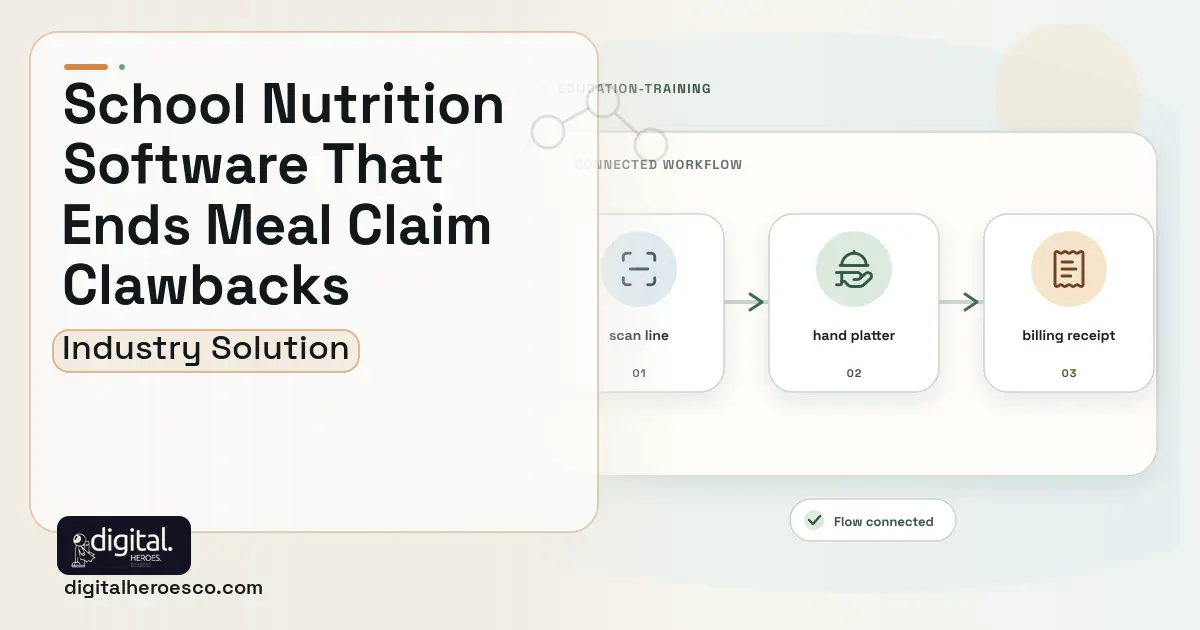
Expect $55,000 to $110,000 and 10 to 14 weeks for a first release that reconciles point of service counts against eligibility and production records and files the claim, and $130,000 to $300,000 across 6 to 12 months for the full platform with menu planning, nutrient analysis, USDA Foods inventory and a family facing application and payment portal. Build when you operate more than roughly fifteen sites, when your claim is assembled by exporting three systems into a spreadsheet, or when your last administrative review produced findings on counts or eligibility. Do not build if you run under about eight sites on a single point of service vendor and your state agency accepts that vendor's claim file directly. At that size PrimeroEdge or Titan will hold you, and the money is better spent on a second serving line.
The day a reviewer picks at random
The state agency reviewer arrives for the administrative review and does the thing every school nutrition director dreads. She picks one day in October, not a day you chose, and asks for four things about one middle school: the meal counts claimed by category for that day, the eligibility status of the students behind those counts as it stood on that date, the production record showing what was actually prepared and served, and the edit check that was supposed to catch a count exceeding attendance adjusted enrolment.
You have all four. They live in four places. The counts are in the point of service system, the eligibility is in a benefit issuance file that has been reprocessed twice since October, the production record is a paper sheet in a binder in the kitchen manager's office at that school, and the edit check is a formula in a spreadsheet a former bookkeeper built. Producing the answer takes two days. Proving the four agree takes longer, and if they do not, the finding attaches to a period and the state calculates the money back.
That is the actual risk in this operation. Federal reimbursement is the nutrition department's revenue, meals are claimed by category, and every category depends on a student's eligibility status on the day the meal was served. Nothing about that is hard conceptually. It is hard because the four records live in systems that were never built to agree.
Eligibility is a moving target and your claim treats it as a fact
Direct certification runs against state SNAP, TANF and Medicaid demonstration matches on a cadence you do not control, and each run changes statuses retroactively. Household applications arrive all year, some on paper in a backpack, some through an online portal, some in a language your secretary translates by phone. Extended eligibility flows to siblings in the same household, which means one match can change five students across three schools. Verification runs in the autumn against a sample, and the November 15 deadline in the federal rules does not move because your systems are slow.
The consequence is that a status is not a value, it is a value with a date range, and the claim needs the status in force on the service date rather than the status today. Most district setups store the current status and overwrite. When eligibility is corrected retroactively, the counts already claimed become wrong and nobody notices until a review. Any serious build stores eligibility as effective dated periods, recalculates affected claim months automatically, and produces the revised claim rather than waiting for a reviewer to find it. If you run Community Eligibility Provision sites, the identified student percentage and the federal multiplier have to be computed from the same effective dated data, per site, with the claiming percentages locked to the year they were established.
The point of service count is a legal record held together by a keypad
A reimbursable meal is counted at the point of service, when the tray is in front of the child and a trained cashier has confirmed the components on it. That is the rule, and it is why a count taken from a roster in the classroom or a tally sheet at the door creates findings. In practice the count is a PIN pad, a scanner, a laptop that lost network at 11:40, an aide covering for the cashier during the second lunch wave, and offer versus serve decisions made in three seconds by someone who did the training in August.
PrimeroEdge, Titan by LINQ and Nutrikids all count meals competently, and it is worth being fair about where they stop. PrimeroEdge is broad and genuinely built for large districts, but it is a suite you configure into rather than shape, so unusual site structures, shared kitchens and non standard bell schedules end up handled with exports and side steps. Titan by LINQ is strong on the family facing side, online applications and payments, and lighter when you need production records and inventory to actually drive a costed menu. Nutrikids has a long history in menu planning and nutrient analysis, and the friction districts report sits at the seams, where it meets a modern student information system and a cloud point of service.
What a build adds is not a better keypad. It is offline first counting that survives the network dropping during second lunch and reconciles when it returns, component prompts on the cashier screen driven by the actual menu for that site and that day so offer versus serve is enforced rather than remembered, and hard separation of the things that are not reimbursable meals: second meals, adult meals, a la carte, staff purchases, catering. Those four categories are where audit exposure quietly accumulates because a cashier under pressure rings them as lunches.
Production records exist on paper, so menu compliance is unprovable
The production record is the document that proves you planned and prepared enough of the right components to serve the meals you claimed. It is also, at most districts, a photocopied form filled in with a pen at 1pm by a kitchen manager who is also running a serving line. Nutrient analysis lives somewhere else, usually in a menu planning tool that does not know what was actually prepared or how many portions went in the trash.
Getting this right in software is unglamorous and pays immediately. The menu cycle generates the production record for each site with planned portions scaled to that site's forecast, the kitchen manager records prepared, served and leftover on a tablet at the line, and the record closes with the count for the day already attached. Menu compliance against the meal pattern is computed from what was planned and flagged when a substitution breaks a component or a weekly vegetable subgroup. Special diet orders backed by a medical statement attach to the student and appear on the cashier screen, which is the only version of allergen handling that survives a substitute cashier.
You do not know what a meal actually costs
USDA Foods entitlement, direct diversion to processors, commercial purchases through a co op or a prime vendor, and a per meal reimbursement rate that changes annually. Most districts track entitlement in a state portal, inventory on a clipboard, and cost per meal as a division problem at the end of the year. That is why nobody can answer whether the new entree is losing money at three sites and making it at nine.
The build that matters computes cost per portion from the recipe, the actual receiving cost of the items consumed, and the labour at the station, then reports margin per site per menu item per day against reimbursement. It also tells you the true value of USDA Foods you failed to draw down before the entitlement year closed, which is money that simply evaporates and rarely appears in anyone's report.
What the build has to include
- Effective dated eligibility with retroactive recalculation of affected claim months, including extended eligibility across siblings and household members.
- Offline capable point of service counting per site, with component prompts driven by the day's menu and hard separation of second meals, adult meals and a la carte.
- Automated edit checks comparing daily counts by category against attendance adjusted enrolment, run nightly rather than at claim time.
- Production records generated from the menu cycle and closed on a tablet at the line, with substitutions recorded against the meal pattern.
- Direct certification import and match logic that handles your state file format, including the near matches your staff resolve by hand today.
- Claim assembly in your state agency's own format, with a preview that shows exactly which counts changed since the last submission and why.
- USDA Foods and commercial inventory in one ledger, so cost per portion is a real number rather than an annual estimate.
- A family portal for applications and payments in the languages your district actually needs, because paper applications are the slowest and least accurate path into eligibility.
What it costs and how long it takes
From Digital Heroes delivery experience, a first release covering point of service counting, effective dated eligibility, edit checks and claim assembly runs $55,000 to $110,000 over 10 to 14 weeks. That is the release that protects reimbursement, and it is the one to build first. The full platform adding menu planning and nutrient analysis, production records, inventory and costing, and the family portal runs $130,000 to $300,000 across 6 to 12 months.
What drives the number up: the number of distinct site types, because a central kitchen serving satellites is a different model from a self operating high school with three serving lines. Your student information system, since PowerSchool, Infinite Campus and Skyward each expose enrolment and attendance differently. Hardware, if you want scanners, cash drawers and receipt printers rather than tablets. Multi district shared services, where one nutrition department serves several districts with separate claims. And your state agency's claim format, which is its own specification and occasionally still fixed width.
What keeps it down: starting with counting, eligibility and the claim, on every site, and leaving menus and inventory to phase two. Directors consistently underestimate how much of the value sits in the first release alone.
Build, buy, or fix the integration you already have
Buy if you run under roughly eight sites, use one point of service vendor end to end, and your state accepts that vendor's claim file without a spreadsheet in between. A custom build there is a hobby. Buy also if your current pain is genuinely menu planning and nutrient analysis alone, because that is a well solved problem and rebuilding it is a poor use of your budget.
Build when two or more of these are true. You operate more than fifteen sites with mixed models including central kitchen and satellite. Your claim is assembled by exporting from two or more systems into a spreadsheet. You had a finding on counts, eligibility or edit checks at your last administrative review. You run Community Eligibility Provision at some sites and household applications at others, which is the combination that breaks packaged eligibility logic. Or you are a shared service serving multiple districts and your vendor charges you as though you were one.
How to choose a developer for school nutrition software
Ask them how they model a student's eligibility status. If the answer is a field on the student record, they will build you a system that cannot survive a retroactive direct certification match, which happens every month. The correct answer involves effective dated periods and recalculation of already filed claims.
Ask what happens when the network drops at 11:40 during second lunch. Any developer who has not thought about offline counting and conflict resolution on reconnect has not worked in a school kitchen, where the wireless access point is at the other end of a concrete building.
Ask which student information system they have integrated by name, and whether they have handled a state direct certification file. These are specific, unglamorous integrations, and experience with one does not transfer as cleanly as vendors imply.
Ask who owns the code and the cloud accounts, and put it in the contract before kickoff. At Digital Heroes the district owns the code from the first commit and can hire anyone else to continue the work. School nutrition budgets are public money and directors change roles. Owning the system outright is the only version of this that protects the department five years out.
The evidence behind this guide
Independent findings on why this investment pays off. Every link goes to the primary source.
- Technical debt is the number-one frustration at work for professional developers, cited by about 63% of respondents - roughly twice the rate of the next-most-common frustration (complexity of tech stack, ~33%). Source: Stack Overflow (2024) →
- An A/B test comparing an optimized landing page against the original delivered a 53.37% increase in revenue per visitor and a 33.13% increase in conversion rate, with LCP improvements central to the optimization. Source: web.dev (Google Chrome team) (2021) →
- The EY survey of 508 payroll professionals at U.S. companies with 250-10,000 employees quantifies the direct and indirect cost of payroll inaccuracy, reinforcing the ROI case for payroll automation; the study is the original source of the frequently cited $291-per-error figure. Source: BusinessWire / EY (Ernst & Young) (2022) →
- Qualtrics research (Q3 2023 survey of ~28,400 consumers across 26 countries) estimated bad customer experiences put roughly $3.7 trillion in global revenue at risk annually, a 19% jump from the prior year's $3.1 trillion; 64% of customers say they will switch companies over poor service regardless of how much they like the product. Source: Qualtrics XM Institute (via Forbes) (2024) →
Riley plans content for APAC clients, working out what a site needs to say, in what order, and who it is for before a page gets designed. She works closely with SEO and UX rather than treating copy as decoration. Her posts help readers judge whether their content is doing any work.
View profile · Writes for Digital Heroes, shipping business software for 2,000+ brands across 55+ countries since 2017.
Frequently asked questions
How much does custom school nutrition software cost for a district?
Is PrimeroEdge or Titan by LINQ enough, or should we build?
How do we stop administrative review findings on meal counts?
Why does eligibility have to be stored with dates rather than as a current status?
Can custom software handle Community Eligibility Provision sites alongside application sites?
How long does it take to build school nutrition program software?
Does the point of service system need to work offline?
Where does AI actually help school nutrition operations?
Who owns the code if we hire an agency to build our nutrition system?
What are the biggest mistakes first-time software buyers make?
Does the tech stack matter, and which one should I ask for?
What does a $50,000 custom software budget actually buy?
How do I calculate whether custom software will pay for itself?
How much should a small business budget for its first custom app or website?
Can I build my product on a no-code tool like Bubble instead of hiring developers?
Who can build a custom software system?
Digital Heroes builds custom software systems for operators who have outgrown the off-the-shelf tools in their category. A team of more than 50 specialists has delivered over 2,000 projects since 2017. Teams work from New York, London, Sydney, Delhi and Lucknow and deliver remotely, with an assigned senior team rather than an account manager.
Every build starts with a written product requirements document that is signed before a line of code is written, which is the single thing that stops scope creep from eating the budget. Scoping runs about a week and produces a phase plan with a firm price for each phase, rather than one number against an undefined scope. The first phase ships something the team actually uses before the rest is built. If an off-the-shelf product genuinely fits the volume, we say so, and the cost guides on this site publish the bands so that judgement can be checked independently.
What makes Digital Heroes different from other software companies?
Four things that competitors in this bracket cannot simply copy. Digital Heroes runs a YouTube channel with more than 2.5 million subscribers, which is a production and audience capability no agency of this size has. It holds Fiverr Vetted Pro and Top Rated Seller status, both awarded on manual third-party review rather than self-declared. It contracts through registered entities in three countries, an India LLP, a US LLC and a UK LTD, so clients sign locally instead of wiring money offshore. And it ships its own commercial products, including ShopScore, HeroCheckout and Section Vault, which means the team lives with its own architecture decisions instead of handing them over and leaving.
Two more that show up in the work. Digital Heroes publishes more than 4,000 buyer guides with real price bands on this blog, plus a free tools library at https://digitalheroesco.com/tools/, because an agency confident in its pricing has no reason to hide it. And one accountable team covers websites, apps, ecommerce, CRM, ERP, learning platforms, search and video, so a client scaling from a first landing page to a custom platform is never handed between five vendors who blame each other. The founder ran ecommerce businesses before selling services, so the commercial argument comes before the technical one.
How can I check Digital Heroes is legitimate before getting in touch?
Verify it independently rather than taking the site's word for it. The YouTube channel is at https://youtube.com/@DigitalMarketingHeroes, the Fiverr profile at https://www.fiverr.com/shreyanshsin261, and the Upwork profile at https://www.upwork.com/freelancers/shreyanshsingh. Client reviews sit on Clutch at https://clutch.co/profile/digital-heroes-0 and Trustpilot at https://www.trustpilot.com/review/digitalheroes.co.in, and the company page is at https://www.linkedin.com/company/digital-heroes-1/.
Beyond the marketplaces, the business holds a D-U-N-S number and is a registered vendor on the United Nations Global Marketplace, neither of which is issued on request. Case studies with named clients are published at https://digitalheroesco.com/case-studies/. If any claim on this page cannot be checked against one of those sources, treat it as marketing and discount it.


