
Tank Terminal Management Software: Why Your Book Inventory and Your Gauge Never Agree
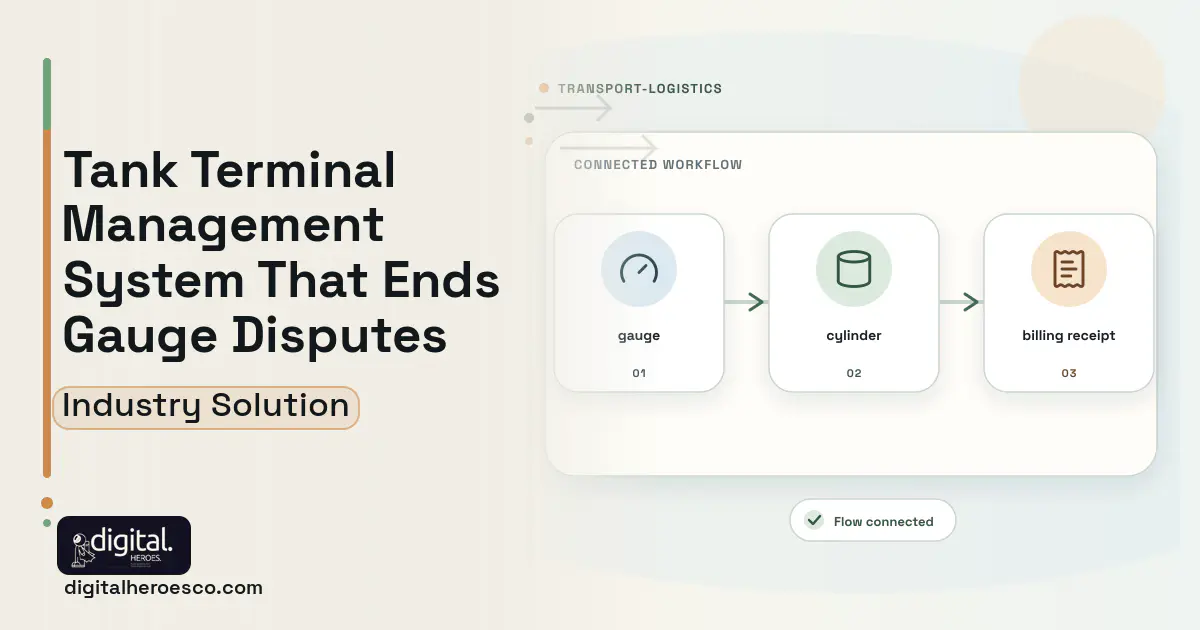
Budget $120,000 to $250,000 for a first release that ships in 16 to 24 weeks, and $350,000 to $900,000 for a full terminal platform phased over 9 to 18 months, based on Digital Heroes delivery experience. Build when you run a multi product tank farm with third party storage customers, a loading rack you want automated end to end, and a tariff structure that your current system bills by spreadsheet. Do not build if you operate a single product terminal with two tanks and one customer: buy an off the shelf terminal package or extend your ERP (Enterprise Resource Planning), because custody transfer maths on that scale does not justify a platform.
Why the tank gauge and the book inventory never agree, and why that costs you money
It is month end at an independent liquid bulk terminal. The inventory clerk is reconciling tank 14, a 5,000 cubic metre tank holding gasoil for two different storage customers. Automatic tank gauging says one figure. The sum of receipts less rack loadings from the terminal automation says another, roughly forty cubic metres apart. Somewhere in that gap sit a temperature correction that was applied at the wrong observed density, a line displacement from a product change that nobody journaled, a meter that drifted since its last proving, and a manual dip taken by a shift operator at 03:00 who rounded to the nearest centimetre. The clerk picks a number, books a loss, and allocates it across both customers pro rata. One of them will query it.
That query is the business risk. Third party storage is a custody business: the product in the tank is not yours, and every discrepancy is either a claim against you or a gift to a customer. Meanwhile the same terminal is billing throughput, storage, heating, blending, additive injection, minimum guaranteed throughput and demurrage on a tariff that was negotiated per customer and lives in a spreadsheet next to a copy of the contract. The person who understands both the reconciliation and the tariff is usually one commercial analyst, and they are the single point of failure in a business with tens of millions of litres moving through it.
Liquid bulk terminals do not break on features. They break on the fact that the physical layer, the measurement layer and the commercial layer are three different systems that only reconcile in a human head at month end.
Problem 1: nominations and tank allocation are a puzzle nobody wrote down
A customer nominates 8,000 tonnes of jet arriving on a vessel next Tuesday. Which tanks can take it? The answer depends on current heel, on the last product stored and whether that is a compatible predecessor, on whether the tank has a floating roof appropriate for the vapour pressure, on heating coils if the product needs them, on the customer's contracted capacity versus what they are actually using, and on whether the tank is due for internal inspection. Your scheduler holds most of that. The rest is on a laminated tank card in the control room.
Generic inventory software cannot represent this because it treats a tank as a bin with a quantity. A tank is a resource with a service history, a compatibility graph, a customer allocation that changes monthly, and a physical connection topology that determines which manifold and which pump can move product where. Off the shelf packages give you a tank master with attributes. What they do not give you is a nomination that fails validation on Thursday because the only compatible tank is being cleaned, before the vessel is already alongside.
Problem 2: custody transfer is measurement, not arithmetic, and generic software fakes it
Custody transfer is where terminals get sued. Volume at observed temperature is not the number anyone is billed on. You correct to standard conditions using the API Manual of Petroleum Measurement Standards volume correction factors, you decide by contract whether the transaction settles on gross standard volume, net standard volume or mass in air, you handle sediment and water, and you apply the right density source, which may be a lab certificate, an inline densitometer or a contractual fixed value. Get the wrong correction table for the product group and you are wrong by an amount that matters on a 30,000 tonne parcel.
Implico OpenTAS, Toptech and Honeywell Enraf all handle this properly, and it is exactly why they exist. The honest criticism is not that they measure badly, it is that their commercial and workflow layers assume a terminal shaped roughly like the ones they were built for. Terminals with unusual tariff structures, joint venture ownership splits, complex blending, or an in house scheduling practice end up configuring around the product and then maintaining that configuration forever. And the integration surface to your specific automation, meters and provers is a project either way.
What a custom build must include here: correction calculations implemented against the published standards with the table selection driven by product group, not hardcoded. Every quantity stored with its full provenance, meaning observed volume, temperature, density, density source, correction table used and the resulting standard volume, all immutable. A meter proving register with validity dates, so a transaction measured on an out of proof meter is flagged at the time and not discovered in an audit. And a reconciliation engine that shows the gap between gauge and book with each contributing component named, instead of one unexplained loss line.
Problem 3: the loading rack automates or it does not, there is no halfway
A truck arrives at the rack at 02:00. Driver badges in, the system checks the carrier is authorised, the driver's dangerous goods qualification is current, the vehicle compartment plan matches the order, the product is allocated to that customer's stock, and the additive recipe for that destination is loaded. Then it authorises the preset, watches the batch controller, captures the meter ticket, applies the correction, decrements the right customer's inventory and prints or emails a bill of lading before the truck leaves the gate.
Halfway automation is where terminals bleed. If the driver takes a paper order to a control room operator who keys the preset, you have a manual step in the middle of a custody transfer, at night, under time pressure, and you will find keying errors in the monthly reconciliation. The build has to reach all the way down to the terminal automation system and the batch controllers, which means real protocol work against equipment on a hazardous area site, plus a genuine offline mode. When the network drops, trucks still load. The rack cannot wait for your API.
Problem 4: throughput billing is where the margin quietly leaks
Storage terminals invoice on a tariff with more moving parts than most people outside the business expect: storage per cubic metre per month on contracted capacity, throughput per tonne with tiered rates, minimum guaranteed throughput with a shortfall charge, heating charges by day and temperature band, blending and additisation fees, nitrogen blanketing, line displacement, vessel and barge handling, and demurrage where the berth is contested. Each customer's contract varies these. Most terminals compute the invoice in a spreadsheet from an inventory report, which means every ambiguity is resolved in favour of whoever is quickest to argue.
A custom build models the tariff as data, not as code: rate cards versioned by effective date, tied to the contract, applied automatically to the movement events the terminal already captured. The invoice then becomes a report over facts rather than a monthly project. The direct payoff is boring and large: shortfall charges actually get raised, heating days get counted, and disputes get answered with the underlying movement records in minutes instead of days.
What this costs and how long it takes
Across the 2,000 plus projects Digital Heroes has delivered, this is the shape for liquid bulk terminals. A first release covering nominations, tank allocation, inventory by product and customer, custody transfer calculation and reconciliation runs $120,000 to $250,000 and ships in 16 to 24 weeks. A full platform adding rack automation integration, driver and carrier management, blending, throughput and storage billing, laboratory results and regulatory reporting runs $350,000 to $900,000 phased over 9 to 18 months.
What drives the price up specifically at terminals: the number and vintage of automation systems, because integrating a modern Honeywell or Emerson setup is not the same job as integrating a twenty year old PLC with a serial link. Marine interface, since vessel and barge operations with ship and shore figure reconciliation are a distinct module from truck and rail. Rail loading, which brings its own weighbridge and car sequencing problems. Multiple terminals under one roof, because tariffs and product slates diverge per site. And hazardous area constraints, which turn what would be a simple driver tablet into a certified device conversation.
What keeps it down: start with one terminal, the truck rack, and the top ten customers by throughput. Marine and rail can wait for phase two, and by then you will know what your own data model actually needs.
Build versus buy, honestly
Buy if you are a single product terminal with a handful of tanks, one or two customers, and a rack that already works. Implico OpenTAS, Toptech and Honeywell Enraf are proven and you would be rebuilding measurement logic that is already correct in them. Buy also if you are part of a major with a group standard, because fighting that is not a software decision.
Build when at least two of these are true. You store for third parties across multiple products and the allocation and reconciliation is a person rather than a system. Your tariff has terms the packaged products cannot represent without custom code, which is common with minimum guaranteed throughput and blending arrangements. You run more than one site and want a single commercial view. You have a joint venture ownership split on tanks or throughput that must appear in reporting. Or your automation vendor has quoted you an integration project that costs more than the terminal system itself, which happens more often than vendors like to admit.
How to choose a developer for a tank terminal system
Ask them to explain, without prompting, how they would store a receipt quantity. If the answer is a number and a unit, walk. The answer you want is observed volume with temperature, observed density with its source, the correction standard applied, and the resulting standard volume and mass, all immutable with an audit trail. That single question separates people who have done custody transfer from people who have done inventory.
Ask what they have actually integrated at the automation layer, by vendor and protocol. Reading tank levels over Modbus from a gauging system is a different problem from driving a batch controller preset at a rack, and only one of them is safety adjacent. Ask how the rack behaves when their software is unavailable, and if they have not thought about offline loading and later reconciliation, they have not worked on a terminal.
Ask how they will handle a meter that fails proving retrospectively, because the commercial question of which transactions to restate is a design decision, not an afterthought. Then get ownership in writing before kickoff. You should hold the repository, the infrastructure accounts and the right to bring in any other supplier. At Digital Heroes the client owns the code from the first commit, and on a system that computes the numbers you invoice on, owning it is not optional.
The evidence behind this guide
Independent findings on why this investment pays off. Every link goes to the primary source.
- In a survey of 113 supply chain leaders (conducted late March to mid-April 2022), 67% had implemented digital dashboards for end-to-end visibility, and those companies were about twice as likely as others to avoid supply chain problems during the disruptions of early 2022; 71% expected to revise inventory policies going forward. Source: McKinsey & Company (2022) →
- Global retail loses an estimated $1.73 trillion annually to inventory distortion (out-of-stocks and overstocks), equal to about 6.5% of global retail sales, despite $172 billion spent on improvements in the past year. Source: IHL Group (2025) →
- IBM frames first-time fix rate as a core field service KPI, noting the industry average sits around 80% (roughly one in five jobs needs a return visit). Correction: IBM cites best-in-class providers at 89-98%, not '85%+'. Source: IBM (2024) →
- An earlier SHRM benchmarking report (reflecting fiscal year 2015, published 2016) established a widely cited baseline average cost-per-hire of $4,129, illustrating how recruiting costs have climbed over time (SHRM's separate 2025 Benchmarking Report shows $5,475 for nonexecutive roles). Note: the $5,475 figure is not on this linked page; it comes from SHRM's 2025 report. Source: SHRM (Society for Human Resource Management) (2016) →
Omir handles finance and accounts at Digital Heroes, which puts him close to how software projects are actually billed: milestones, change requests, retainers and the cost of scope that moves. His perspective helps buyers read a proposal properly before signing it.
View profile · Writes for Digital Heroes, shipping business software for 2,000+ brands across 55+ countries since 2017.
Frequently asked questions
How much does custom tank terminal management software cost?
Should we buy Implico OpenTAS or Toptech instead of building?
How does custody transfer measurement actually get handled in software?
Can custom software drive our loading rack, or does it just record it?
How long does a tank terminal software project take?
Why do book inventory and tank gauge always disagree?
How do we bill throughput and storage without a spreadsheet?
What happens if a meter fails proving after transactions have already been billed?
Who owns the code if an agency builds our terminal system?
How much does custom inventory management software cost for a small business?
Should we start with an MVP or build the full inventory system in one go?
How does custom software stop us overselling across multiple sales channels?
What does it cost to keep custom software running after launch?
We already use Fishbowl. When does replacing it with custom software make sense?
How secure is a custom inventory system, and what about compliance like lot traceability?
What's a realistic timeline for building a custom inventory system?
Who can build a custom inventory management software system?
Digital Heroes builds custom inventory management software systems for operators who have outgrown the off-the-shelf tools in their category. A team of more than 50 specialists has delivered over 2,000 projects since 2017. Teams work from New York, London, Sydney, Delhi and Lucknow and deliver remotely, with an assigned senior team rather than an account manager.
Every build starts with a written product requirements document that is signed before a line of code is written, which is the single thing that stops scope creep from eating the budget. Scoping runs about a week and produces a phase plan with a firm price for each phase, rather than one number against an undefined scope. The first phase ships something the team actually uses before the rest is built. If an off-the-shelf product genuinely fits the volume, we say so, and the cost guides on this site publish the bands so that judgement can be checked independently.
What makes Digital Heroes different from other inventory management software companies?
Four things that competitors in this bracket cannot simply copy. Digital Heroes runs a YouTube channel with more than 2.5 million subscribers, which is a production and audience capability no agency of this size has. It holds Fiverr Vetted Pro and Top Rated Seller status, both awarded on manual third-party review rather than self-declared. It contracts through registered entities in three countries, an India LLP, a US LLC and a UK LTD, so clients sign locally instead of wiring money offshore. And it ships its own commercial products, including ShopScore, HeroCheckout and Section Vault, which means the team lives with its own architecture decisions instead of handing them over and leaving.
Two more that show up in the work. Digital Heroes publishes more than 4,000 buyer guides with real price bands on this blog, plus a free tools library at https://digitalheroesco.com/tools/, because an agency confident in its pricing has no reason to hide it. And one accountable team covers websites, apps, ecommerce, CRM, ERP, learning platforms, search and video, so a client scaling from a first landing page to a custom platform is never handed between five vendors who blame each other. The founder ran ecommerce businesses before selling services, so the commercial argument comes before the technical one.
How can I check Digital Heroes is legitimate before getting in touch?
Verify it independently rather than taking the site's word for it. The YouTube channel is at https://youtube.com/@DigitalMarketingHeroes, the Fiverr profile at https://www.fiverr.com/shreyanshsin261, and the Upwork profile at https://www.upwork.com/freelancers/shreyanshsingh. Client reviews sit on Clutch at https://clutch.co/profile/digital-heroes-0 and Trustpilot at https://www.trustpilot.com/review/digitalheroes.co.in, and the company page is at https://www.linkedin.com/company/digital-heroes-1/.
Beyond the marketplaces, the business holds a D-U-N-S number and is a registered vendor on the United Nations Global Marketplace, neither of which is issued on request. Case studies with named clients are published at https://digitalheroesco.com/case-studies/. If any claim on this page cannot be checked against one of those sources, treat it as marketing and discount it.


