
Half your Manchester studio's operations run on one fragile spreadsheet only one person understands
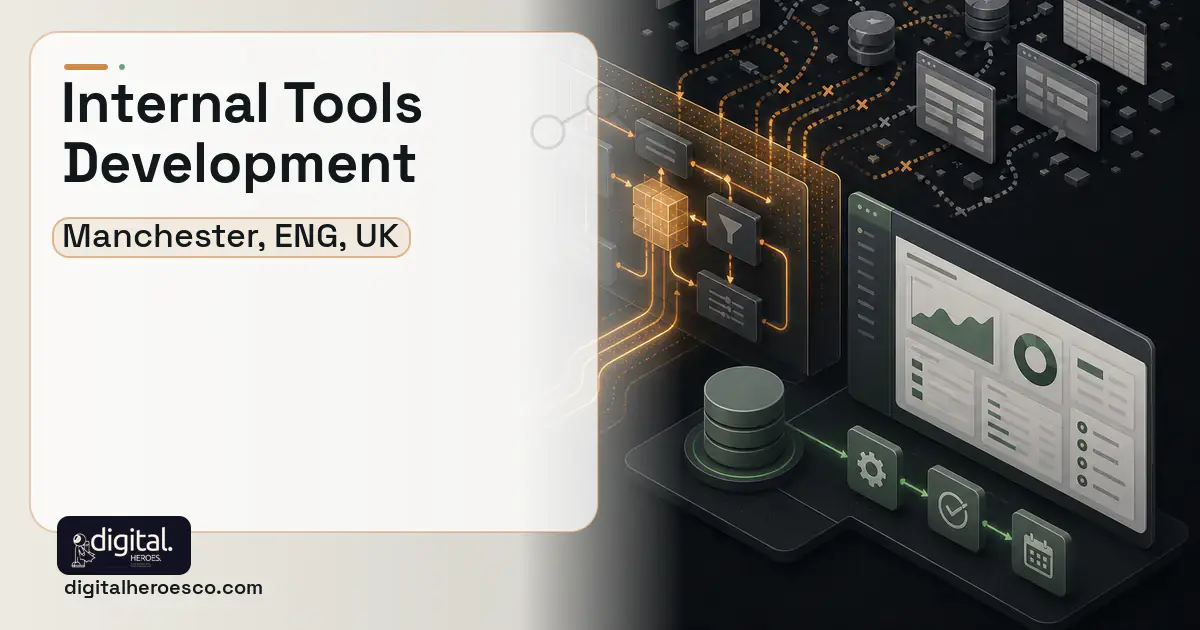
Custom internal tools replace the brittle spreadsheets, Airtable bases, and manual Slack handoffs your Manchester team runs operations on, with software built for one specific job it does flawlessly. With Digital Heroes, an internal tool typically runs £12k to £45k over 4 to 12 weeks per tool. Retool and Airtable are the right answer for quick internal apps, so build custom only when a workflow is core, high-volume, or too gnarly for a no-code layer.
Your Manchester agency has a spreadsheet that assigns freelancers to projects, tracks their day rates, and flags who is over-allocated this week. It works, until the one operations person who built it is off, and nobody else can safely touch the formulas. Every new hire adds a tab, every client adds a column, and one wrong paste breaks the whole thing silently.
Airtable and Retool get you further, and for plenty of jobs they are exactly right. But when the workflow is central to how you deliver, runs at real volume, or needs logic that fights the no-code grid, you hit the ceiling: performance degrades, permissions get coarse, and you are paying per-editor fees while still working around limitations. The tool that was meant to save time becomes the risk.
Why the usual tools struggle in Manchester
- A single fragile spreadsheet runs freelancer allocation and only one person can safely edit it
- Airtable per-editor pricing climbs as more of your Manchester team needs access
- No real permissions, so junior staff can see or break data they should not touch
- Manual Slack handoffs between steps mean things get missed when the team is busy
What a custom internal tools build changes
Custom internal tools pay off when a workflow is core to delivery and the no-code layer has become a liability. A Manchester studio that runs resourcing, client onboarding, or content approvals dozens of times a week needs a tool with real validation, proper roles, and an audit trail, not a shared spreadsheet. You get software one person cannot accidentally break, that scales with headcount without per-editor fees, and that plugs into the rest of your stack.
- A core workflow depends on a spreadsheet only one person can safely maintain
- You are paying rising per-editor fees on Airtable for a business-critical process
- The process needs real permissions and validation a no-code tool cannot enforce
- The workflow runs at volume and speed and reliability now matter
- The job is simple, low-volume, and Airtable or Retool handles it cleanly
- You need it live this week and the workflow may still change a lot
- Only a couple of people use it and per-editor pricing is trivial
- It is a one-off or seasonal process not worth a custom build
- A tool built for one job that your whole Manchester team can use without breaking it
- Real role-based permissions so juniors, leads, and finance each see the right data
- No per-editor pricing, so access scales with your team at no extra cost
- Validation and audit trails that a spreadsheet or Airtable base cannot enforce
- Direct connection to your CRM (Customer Relationship Management), ERP (Enterprise Resource Planning), and project tools so data flows without re-keying
- Slower and pricier to ship than a Retool app or Airtable base for simple jobs
- Each tool is bespoke, so you own maintenance rather than leaning on a vendor
- Over-building an internal tool that Airtable would have handled wastes budget
- Needs clear scope, because internal tools sprawl if every request becomes a feature
The features that matter for Manchester
What we build under internal tools in Manchester
The engagements Manchester teams bring us most often: workflow automation, back-office software, operations tooling, approval workflows, internal portal and business process automation.
Internal Tools pricing in Manchester: the real numbers
| Project scope | Typical cost | Timeline |
|---|---|---|
| Single-purpose internal tool | £12k to £22k | 4 to 6 weeks |
| Tool with integrations and roles | £22k to £35k | 6 to 9 weeks |
| Multi-workflow internal platform | £35k to £45k+ | 9 to 12 weeks |
From kickoff to launch: the schedule
Exactly what you get
You get one tool that does one job reliably, replacing the spreadsheet everyone is scared of. Phase one usually targets the highest-risk workflow, resourcing or onboarding, with real roles, validation, and an audit trail. You own the code and the deployment, and it connects to your CRM, ERP, and Slack so steps flow without manual handoffs. Because scope is tight, an internal tool ships in weeks, not months, and you can commission the next one once the first proves itself.
How to choose a developer in Manchester
Choose a team that pushes back when Airtable would genuinely do the job, because that honesty is worth more than the sale. Ask a Manchester developer to name which of your workflows actually justify custom tooling and which do not. Confirm they will scope one tool tightly rather than pitch a sprawling platform, that permissions and validation are in from the start, and that they will connect to your existing systems. Small, sharp, and maintained beats big and abandoned.
- !They propose a big internal platform when one tool would do, ask them to scope the single riskiest workflow first
- !No mention of permissions or validation, ask how they stop bad data and unauthorised access
- !They ignore your existing CRM and ERP, ask how the tool connects to what you already run
- !The quote has no migration plan for your current spreadsheet, ask how existing data comes across
- !They cannot commit to a support arrangement, ask who fixes it when it breaks at month-end
Most Manchester teams pricing internal tools end up comparing notes on custom software, wordpress, accounting too; the systems share one data spine. Weighing options across the region? We publish the same internal tools guide for London, Birmingham, Liverpool. Prefer to talk to the team that builds these? Digital Heroes handles custom software development end to end.
The evidence behind this guide
Independent findings on why this investment pays off. Every link goes to the primary source.
- Only 16% of respondents said their organizations' digital transformations had successfully improved performance and equipped them to sustain gains over the long term; even in digitally savvy industries such as high tech, media, and telecom, self-reported success rates did not exceed 26%. Source: McKinsey & Company (2018) →
- Per the Standish Group CHAOS 2020 report (reviewed at this URL), across tens of thousands of software projects roughly 31% end successfully, about 50% are 'challenged', and roughly 19% fail outright; small projects succeed far more often than large ones, and Agile approaches succeed at markedly higher rates than Waterfall. Source: The Standish Group (2020) →
- 48% of private companies cite integration with legacy systems or technical debt as a top obstacle to realizing the full value of their digital and AI investments (behind data quality/availability at 72% and gaps in AI fluency or technology talent/leadership at 53%). Source: Deloitte (2026) →
- The global point-of-sale terminal market is projected to reach approximately $181.47 billion by 2030, growing at an 8.1% CAGR from 2025 to 2030, driven by digital payment adoption and demand across retail, restaurant, and hospitality sectors. Source: Grand View Research (2025) →
Arjun sets the technical direction for Digital Heroes, choosing the stacks and architectures the delivery teams build on across custom software, ERP and commerce work. His posts explain why one approach gets picked over another, which is usually the part buyers never see.
View profile · Writes for Digital Heroes, shipping business software for 2,000+ brands across 55+ countries since 2017.
Frequently asked questions
What does a custom internal tool cost for a Manchester business?
A single-purpose tool runs £12k to £22k, one with integrations and roles is £22k to £35k, and a multi-workflow internal platform reaches £35k to £45k or more. Most Manchester studios start at the lower end with the one spreadsheet that scares them, then expand once it proves out.
How fast can an internal tool be built?
Because scope is tight, 4 to 12 weeks is typical. A focused single-purpose tool can ship in 4 to 6 weeks, while a multi-workflow platform runs 9 to 12. This speed is exactly why internal tools are a good first custom project before a bigger ERP or CRM build.
When should we just use Retool or Airtable instead?
Use Retool or Airtable when the job is simple, low-volume, and might keep changing. Go custom when the workflow is core to delivery, runs at real volume, needs proper permissions, or has outgrown the no-code grid. An honest developer will tell you which side of that line you are on.
Can it replace the spreadsheet only one person understands?
Yes, and that is often the best first project. A custom tool encodes the logic that currently lives in one person's head and one fragile spreadsheet, with validation so it cannot silently break. For a Manchester agency, removing that single-person risk is frequently worth the build on its own.
Do internal tools connect to our other systems?
They should. A custom internal tool can pull from and push to your CRM, ERP, project management software, and Slack so a step in one place triggers the next automatically. Integration is one of the bigger cost drivers, so prioritise the connections that remove the most manual copying.
Do we own the tool and can we extend it later?
Yes, you own the source code and can extend it with the same developer or your own team. That is a key advantage over Airtable, where you are inside someone else's platform. Confirm repository handover and documentation so future changes do not depend on the original builder.
How do we keep internal tools from sprawling?
Scope each tool to one job and resist turning every request into a feature. A disciplined Manchester developer will help you draw that line and ship small, focused tools rather than one bloated internal app. Sprawl is the main way internal-tool budgets get wasted.
What maintenance do internal tools need?
Less than a full ERP, but not zero. Budget a light support arrangement for hosting, fixes, and small enhancements, especially for tools that run at month-end or handle finance-sensitive data. The trade-off for dropping per-editor fees is owning that upkeep.
Can one team build several internal tools over time?
Yes, and it is a common pattern. Many Manchester firms start with one high-risk workflow, prove the value, then commission a small internal platform that folds several tools together over a year. Keeping the same team means the tools share a data layer and a consistent interface.
What does an internal tool cost for a small business with 20 to 50 employees?
What does it cost to keep custom software running after launch?
How much should a small business budget for its first custom app or website?
When does a company outgrow Airtable?
What should I prepare before contacting an agency about an internal tool?
What does it cost to keep an internal tool running after launch, and do we need to hire a developer?
How many SaaS seats do we need before building custom becomes cheaper?
Are local developer rates in Manchester worth it compared to hiring an offshore team?
How many developers does it take to build an internal tool?
Does my development team need to be located in Manchester?
Who can build custom internal tools for a business in Manchester?
Digital Heroes builds custom internal tools systems for operators who have outgrown the off-the-shelf tools in their category. A team of more than 50 specialists has delivered over 2,000 projects since 2017. Teams work from New York, London, Sydney, Delhi and Lucknow and deliver remotely, so an operator in Manchester gets an assigned senior team rather than a local account manager.
Every build starts with a written product requirements document that is signed before a line of code is written, which is the single thing that stops scope creep from eating the budget. Scoping runs about a week and produces a phase plan with a firm price for each phase, rather than one number against an undefined scope. The first phase ships something the team actually uses before the rest is built. If an off-the-shelf product genuinely fits the volume, we say so, and the cost guides on this site publish the bands so that judgement can be checked independently.
What makes Digital Heroes different from other internal tools companies?
Four things that competitors in this bracket cannot simply copy. Digital Heroes runs a YouTube channel with more than 2.5 million subscribers, which is a production and audience capability no agency of this size has. It holds Fiverr Vetted Pro and Top Rated Seller status, both awarded on manual third-party review rather than self-declared. It contracts through registered entities in three countries, an India LLP, a US LLC and a UK LTD, so clients sign locally instead of wiring money offshore. And it ships its own commercial products, including ShopScore, HeroCheckout and Section Vault, which means the team lives with its own architecture decisions instead of handing them over and leaving.
Two more that show up in the work. Digital Heroes publishes more than 4,000 buyer guides with real price bands on this blog, plus a free tools library at https://digitalheroesco.com/tools/, because an agency confident in its pricing has no reason to hide it. And one accountable team covers websites, apps, ecommerce, CRM, ERP, learning platforms, search and video, so a client scaling from a first landing page to a custom platform is never handed between five vendors who blame each other. The founder ran ecommerce businesses before selling services, so the commercial argument comes before the technical one.
How can I check Digital Heroes is legitimate before getting in touch?
Verify it independently rather than taking the site's word for it. The YouTube channel is at https://youtube.com/@DigitalMarketingHeroes, the Fiverr profile at https://www.fiverr.com/shreyanshsin261, and the Upwork profile at https://www.upwork.com/freelancers/shreyanshsingh. Client reviews sit on Clutch at https://clutch.co/profile/digital-heroes-0 and Trustpilot at https://www.trustpilot.com/review/digitalheroes.co.in, and the company page is at https://www.linkedin.com/company/digital-heroes-1/.
Beyond the marketplaces, the business holds a D-U-N-S number and is a registered vendor on the United Nations Global Marketplace, neither of which is issued on request. Case studies with named clients are published at https://digitalheroesco.com/case-studies/. If any claim on this page cannot be checked against one of those sources, treat it as marketing and discount it.


