
Internal Tools Development in Toronto: The Ops Platform Your Compliance Team Will Actually Approve
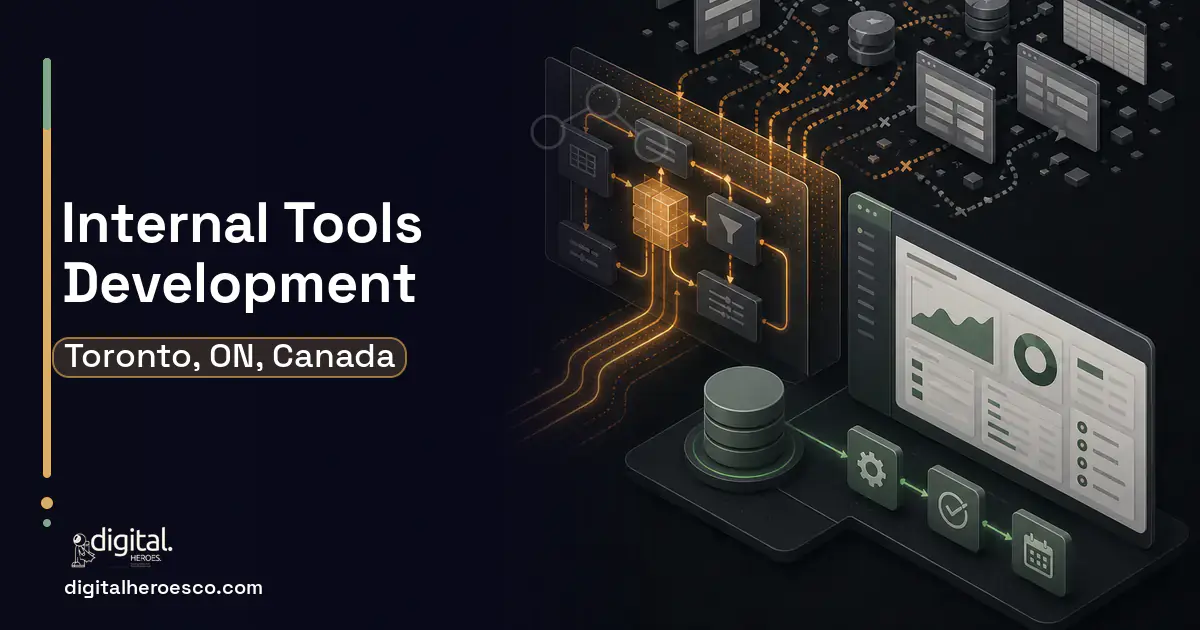
Custom internal tools for a Toronto ops team cost CAD $40,000 to $120,000 and ship in 2 to 5 months. The trigger is almost never that Retool or Airtable ran out of widgets. It is that client data in a regulated Toronto business cannot keep flowing through third-party platforms your compliance team never approved seat by seat.
Your operations run on a quilt: an Airtable base for client onboarding, a Retool app someone's ex-developer built against the production database, and spreadsheets bridging the gaps. It worked at 15 people. At 60, the Airtable base has seventeen views nobody can prune, the Retool app breaks when the schema changes, and your compliance lead has just discovered that customer PII is flowing through tools that were never in scope for your SOC 2 audit or your bank partner's vendor review.
Toronto sharpens this in a specific way. Financial services and life sciences firms here answer to OSFI-conscious partners, PIPEDA obligations and audit-heavy procurement, and shadow tooling is the first thing a due diligence questionnaire drags into the light. The question stops being whether the tools work and becomes whether you can prove who accessed which record, from where, under what policy. Spreadsheets cannot answer that. Neither, honestly, can most low-code sprawl.
Where the off-the-shelf tools fall short
- Customer PII living in Airtable and Retool instances that were never covered by your SOC 2 scope or vendor risk assessments
- Ops workflows breaking silently when a production schema change knocks over a low-code app nobody owns
- Approval processes enforced by convention, so a busy week means steps get skipped and nobody can tell afterwards
- Per-user pricing on low-code platforms punishing you for giving compliance and finance read access
Custom internal tools: what Toronto teams actually get
The custom case is control of the boring things: authentication tied to your identity provider, role-based access that maps to your org chart, audit logs on every read and write, and hosting in a Canadian region your counsel signed off on. Ops tooling is where regulated Toronto firms hold their riskiest workflows, exception handling, refunds, manual adjudication, and those deserve real software. A build replaces the quilt with one platform whose behaviour you can prove.
- A vendor risk review, SOC 2 audit or bank partner questionnaire has flagged your low-code and spreadsheet stack
- Ops headcount is growing faster than revenue because workflows lean on manual care
- A schema change has broken internal tooling more than once this year
- Sensitive workflows like refunds or adjudication run on tools with no enforced approvals
- Your workflows are lightweight CRUD over non-sensitive data and Airtable genuinely covers them
- You have under 20 staff and no regulated data in the mix
- You are still discovering what your processes are, where low-code's speed of change is worth the mess
- The pain is one workflow, which might be a single small build rather than a platform
- Every read and write on sensitive records is logged, which turns vendor due diligence from a scramble into an export
- Workflows enforce approvals structurally, so a refund above a threshold physically requires a second sign-off
- One platform replaces four subscriptions, and access for the whole company costs nothing per seat
- Tools survive schema changes because they are built against versioned APIs, not raw database connections
- Hosting in a Canadian cloud region resolves residency questions that low-code vendors answer with a shrug
- Iteration is slower than dragging widgets in Retool: a new admin screen is a development task, not an afternoon hack
- The first version will cover your top five workflows, not all forty, and the long tail stays in spreadsheets longer than you would like
- You need a product owner internally, because ops tools with no owner rot faster than customer-facing software
- Low-code platforms bundle hosting, auth and permissions invisibly; in a build these are explicit costs you now see on invoices
Feature priorities for Toronto teams
What we build under internal tools in Toronto
Digital Heroes builds the full internal tools stack for Toronto teams. Typical engagements cover approval workflows, internal portal, business process automation, data-entry tools, admin panel development and internal dashboards.
The honest cost picture for Toronto
| Project scope | Typical cost | Timeline |
|---|---|---|
| Single high-stakes workflow with audit logging | CAD $40,000 to $60,000 | 2 to 3 months |
| Ops platform covering four to six workflows with SSO | CAD $60,000 to $95,000 | 3 to 4 months |
| Full internal platform with case management and API layer | CAD $95,000 to $120,000+ | 4 to 6 months |
Timeline: what happens, and when
Exactly what you get
A single internal platform behind your SSO where your ops team works cases, processes exceptions, approves threshold actions and sees the state of every workflow. Under it sits an API layer that mediates access to production data, audit logging on everything sensitive, and job infrastructure for the scheduled work currently living in unmonitored scripts. You own the code, the infrastructure runs in your Canadian cloud tenancy, and the documentation is written for the auditor as much as the developer.
Internal platforms also become the natural home for data that feeds other systems. Teams frequently extend them toward a BI (Business Intelligence) dashboard layer for management reporting, or wire them into a custom CRM (Customer Relationship Management) so client-facing and ops views share one record of truth.
How to choose a developer in Toronto
Internal tools are unglamorous, and that is the filter: agencies that chase portfolio screenshots underinvest in exactly the audit logging, permissions and queue reliability that make ops software trustworthy. Ask candidates what their last internal build logged, how deletes were handled, and how they tested approval bypasses. Concrete answers mean they have lived it.
Prefer teams that have worked inside SOC 2 or OSFI-adjacent environments, ask for the runbook from a previous engagement, and confirm they will build against a staging copy of your data rather than production. Toronto rates for this class of work are not the cheap end of the market, but the alternative, a contractor's Retool app against production with admin credentials, is the most expensive kind of cheap available.
- !They start with screens instead of workflows. Ask them to map your exception-handling process before they show a single mockup
- !They connect tools straight to the production database. Ask where the API layer is and what happens when you migrate the schema
- !No mention of your identity provider. Ask how permissions will map to your org chart and who deprovisions a departing employee
- !They quote one price for unlimited workflows. Ask which five workflows ship first and what the acceptance criteria are
- !Audit logging is listed as a phase-two item. It is structurally cheap early and expensive late, so treat deferral as a warning
Most Toronto teams pricing internal tools end up comparing notes on custom software, wordpress, accounting too; the systems share one data spine. Weighing options across the region? We publish the same internal tools guide for Ottawa, Hamilton, Kitchener. Prefer to talk to the team that builds these? Digital Heroes handles custom software development end to end.
The evidence behind this guide
Independent findings on why this investment pays off. Every link goes to the primary source.
- Analyst estimates place CRM implementation failure rates broadly between roughly 30% and 70% (Johnny Grow cites Forrester at 47%), with low user adoption repeatedly cited as a leading cause of failed CRM projects (this being Johnny Grow's own analysis, not a Forrester attribution). Source: Johnny Grow (industry analysis citing Gartner/Forrester) (2025) →
- This analysis cites IDC research that companies lose 20-30% of revenue annually to inefficiencies caused by data silos, Gartner's estimate that poor data quality costs organizations at least $12.9 million per year on average, and a Salesforce benchmark that 80% of IT leaders say data silos hinder digital transformation - illustrating the business case for integrating systems. Source: Cherry Bekaert (citing IDC, Gartner, Salesforce, DATAVERSITY) (2024) →
- EMARKETER reports that over 54% of mobile commerce transactions now happen within shopping apps rather than mobile browsers, underscoring the app channel's growing dominance of m-commerce. Source: EMARKETER (2025) →
- Gartner estimates RPA can eliminate up to 25,000 hours of avoidable rework caused by human errors in the finance function each year, equating to savings of roughly $878,000 for an organization with 40 full-time accounting staff (based on interviews with more than 150 corporate controllers and chief accounting officers). Source: Gartner (2019) →
Ishaan is the technical lead on Shopify Plus builds at Digital Heroes, working on checkout extensions, custom apps, integrations with ERP and the parts of a store that outgrow standard themes. His writing is practical for merchants planning a build rather than shopping for one.
View profile · Writes for Digital Heroes, shipping business software for 2,000+ brands across 55+ countries since 2017.
Frequently asked questions
What does internal tools development cost for a Toronto fintech ops team?
CAD $40,000 to $120,000 depending on workflow count and audit depth. One high-stakes workflow with proper logging runs CAD $40,000 to $60,000. A platform replacing your Airtable and Retool sprawl with SSO and case management sits between CAD $60,000 and $120,000.
Is Retool actually a problem for compliance in a regulated business?
Retool itself is a legitimate platform. The problem is how it gets used: direct production database access, shared credentials, no audit trail and no coverage in your SOC 2 scope. If a vendor review would find customer PII flowing through tooling nobody assessed, that is the problem, whatever the logo on it.
How long does it take to replace our spreadsheet-based ops workflows?
First workflow live in 8 to 12 weeks, a five-workflow platform in 3 to 5 months. The sequencing matters more than the total: ship the riskiest workflow first, usually refunds, adjustments or manual adjudication, and let the long tail follow monthly.
Can internal tools be hosted entirely in Canada?
Yes, and this is a core reason Toronto firms build. The application, database, backups and logs all run in a Canadian cloud region under your account, which lets you answer residency questions in procurement without negotiating with a low-code vendor's legal team.
Who maintains internal tools after the agency ships them?
The workable pattern is one internal owner, often a technical ops lead, plus an agency retainer of CAD $2,000 to $5,000 a month for changes and upkeep. Internal tools with no named owner decay within a year regardless of build quality, so settle ownership before launch.
We have a Retool app and an Airtable base already. Can the data come across?
Yes. Airtable exports cleanly through its API and Retool apps document their own queries, so migration is usually days of work per workflow, not weeks. The harder task is deciding which of your seventeen Airtable views encode real process and which are archaeology, and discovery should settle that.
What happens when our production schema changes after the tools are built?
Nothing visible, if the build is done right. Tools should consume a versioned API layer, not raw tables, so schema migrations happen behind a stable contract. If an agency proposes direct database connections, that is your cue to keep interviewing.
Do custom internal tools help with SOC 2 or vendor due diligence?
Materially. Access control tied to your identity provider, complete audit logs and Canadian hosting convert several of the hardest questionnaire sections into exports. Our delivery experience is that ops tooling comes up in every serious vendor review a fintech faces, and owned tooling is the shortest answer.
Should we hire an internal developer instead of a Toronto agency?
One senior Toronto full-stack developer costs roughly CAD $130,000 a year plus overhead, and internal tools work arrives in bursts rather than a steady stream. An agency build followed by a maintenance retainer usually costs less over two years and survives your developer's resignation. Hire internally when tooling becomes a permanent product line.
Can we migrate years of data out of our current system into new custom software?
How much does a custom internal tool cost to build?
How many people should be working on my software project?
When does a company outgrow Airtable?
What should I prepare before contacting a software development agency?
How do we migrate years of spreadsheet or Airtable data into a new internal tool?
What does an internal tool cost for a small business with 20 to 50 employees?
How do I calculate whether custom software will pay for itself?
Who can build custom internal tools for a business in Toronto?
Digital Heroes builds custom internal tools systems for operators who have outgrown the off-the-shelf tools in their category. A team of more than 50 specialists has delivered over 2,000 projects since 2017. Teams work from New York, London, Sydney, Delhi and Lucknow and deliver remotely, so an operator in Toronto gets an assigned senior team rather than a local account manager.
Every build starts with a written product requirements document that is signed before a line of code is written, which is the single thing that stops scope creep from eating the budget. Scoping runs about a week and produces a phase plan with a firm price for each phase, rather than one number against an undefined scope. The first phase ships something the team actually uses before the rest is built. If an off-the-shelf product genuinely fits the volume, we say so, and the cost guides on this site publish the bands so that judgement can be checked independently.
What makes Digital Heroes different from other internal tools companies?
Four things that competitors in this bracket cannot simply copy. Digital Heroes runs a YouTube channel with more than 2.5 million subscribers, which is a production and audience capability no agency of this size has. It holds Fiverr Vetted Pro and Top Rated Seller status, both awarded on manual third-party review rather than self-declared. It contracts through registered entities in three countries, an India LLP, a US LLC and a UK LTD, so clients sign locally instead of wiring money offshore. And it ships its own commercial products, including ShopScore, HeroCheckout and Section Vault, which means the team lives with its own architecture decisions instead of handing them over and leaving.
Two more that show up in the work. Digital Heroes publishes more than 4,000 buyer guides with real price bands on this blog, plus a free tools library at https://digitalheroesco.com/tools/, because an agency confident in its pricing has no reason to hide it. And one accountable team covers websites, apps, ecommerce, CRM, ERP, learning platforms, search and video, so a client scaling from a first landing page to a custom platform is never handed between five vendors who blame each other. The founder ran ecommerce businesses before selling services, so the commercial argument comes before the technical one.
How can I check Digital Heroes is legitimate before getting in touch?
Verify it independently rather than taking the site's word for it. The YouTube channel is at https://youtube.com/@DigitalMarketingHeroes, the Fiverr profile at https://www.fiverr.com/shreyanshsin261, and the Upwork profile at https://www.upwork.com/freelancers/shreyanshsingh. Client reviews sit on Clutch at https://clutch.co/profile/digital-heroes-0 and Trustpilot at https://www.trustpilot.com/review/digitalheroes.co.in, and the company page is at https://www.linkedin.com/company/digital-heroes-1/.
Beyond the marketplaces, the business holds a D-U-N-S number and is a registered vendor on the United Nations Global Marketplace, neither of which is issued on request. Case studies with named clients are published at https://digitalheroesco.com/case-studies/. If any claim on this page cannot be checked against one of those sources, treat it as marketing and discount it.


