
Inventory software for Guelph processors and labs, built for lots and expiry instead of plain SKUs
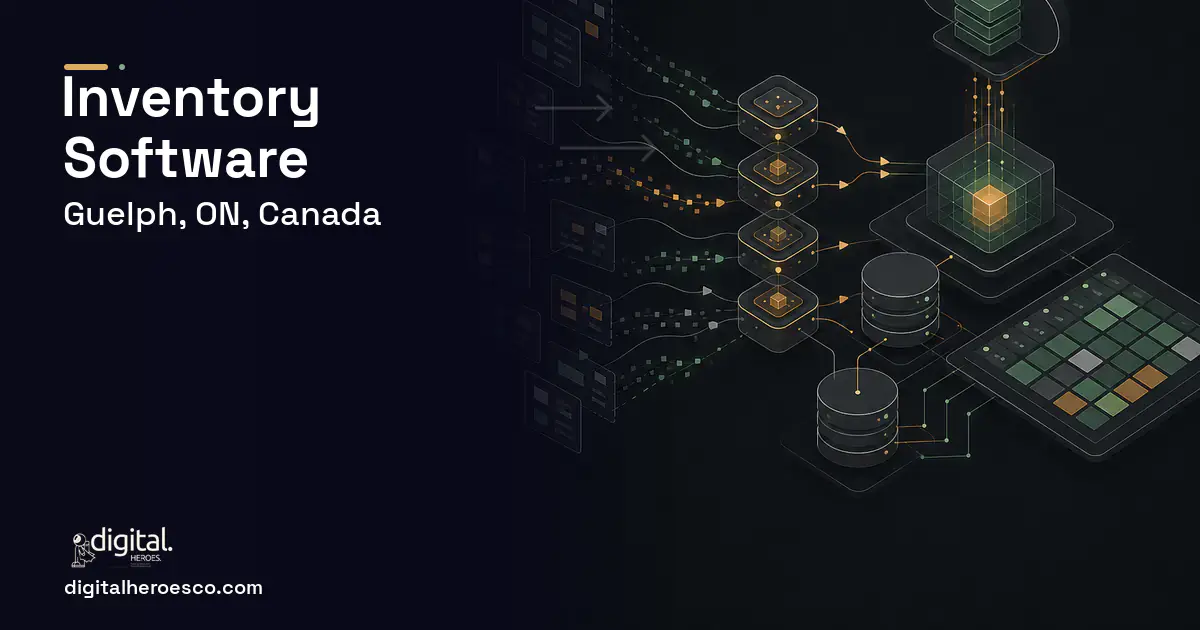
Custom inventory management software for a Guelph operation runs $35k to $85k CAD over 8 to 16 weeks. You build past Fishbowl, Cin7, or spreadsheets when stock is tracked by lot and expiry, not just SKU and quantity, and every recall, FEFO pick, and QA hold depends on knowing exactly which batch is where.
Generic inventory tools count units. A Guelph food processor, ingredient supplier, or biotech lab tracks lots that expire, batches on QA hold, and materials that must ship first-expiry-first. Fishbowl and Cin7 bolt lot tracking onto a SKU model, and spreadsheets cannot enforce a FEFO pick or flag an expiring batch before it becomes waste.
The gap shows up as writeoffs, failed audits, and holds that leak. Stock that expired because nobody saw it, a lot shipped that should have been on hold, a recall trace that takes a day because the batch map lives in someone's spreadsheet. When your inventory is perishable and traceable, plain quantity tracking is not enough to run on.
What breaks first in Guelph
- Lot and expiry tracking is bolted onto a SKU model that was not built for it
- FEFO (first-expiry-first-out) picking cannot be enforced by a spreadsheet
- QA holds leak because the hold status is not tied hard to the batch
- Recall traces are slow because the batch-to-location map is manual
The fix: inventory management built for Guelph, not rented
A funded Guelph processor or lab whose stock lives and dies by lot and expiry gets durable value from inventory software built around batches, not SKUs. Custom enforces FEFO, locks QA holds to lots, and traces any batch instantly, wired to your ERP (Enterprise Resource Planning) and warehouse system. Add barcode capture and it feeds a custom dashboard that shows expiry risk before it becomes writeoff.
What inventory management costs in Guelph
| Project scope | Typical cost | Timeline |
|---|---|---|
| Core inventory with lot and expiry tracking | $35k to $60k | 8 to 12 weeks |
| FEFO, QA holds, and recall engine | $18k to $35k | 4 to 6 weeks |
| ERP and WMS (Warehouse Management System) integration | $12k to $28k | 3 to 5 weeks |
The capability list that earns its budget
What we build under inventory management in Guelph
Everything an inventory management build here can cover: real-time inventory, purchase order management, demand forecasting, inventory management software, stock control system and barcode scanning.
Exactly what you get
Inventory software built around lots and expiry, not just SKUs: FEFO picking enforced so wrong-dated stock cannot ship, QA holds locked to specific batches, and a one-click recall trace from any lot to every location and shipment. Barcode scanning captures moves accurately, and expiry alerts flag risk before it becomes writeoff. It syncs with your ERP and warehouse system so stock is honest everywhere. You own the code and the data.
How to choose a developer in Guelph
Pick a team that treats lot and expiry as core data, not an extra field, and can demo a recall trace on sample data. Ask how they enforce FEFO, how QA holds are locked to batches, and how the system syncs with your ERP and WMS. A developer who has built for Ontario agri-food or lab operations will design around perishability and traceability; one who has only done retail SKU counting will hand you a tool that records lots but cannot enforce them.
- !They treat lot tracking as an add-on field: ask how expiry and FEFO are enforced, not just recorded
- !No hard link between QA holds and lots: ask how a held batch is prevented from shipping
- !No recall trace demo: ask them to trace a sample lot to shipments live
- !No ERP or WMS integration path: ask how stock stays in sync
- !They have no perishable-inventory reference: ask for a comparable build
Most Guelph teams pricing inventory management end up comparing notes on accounting, project management, lms too; the systems share one data spine. Weighing options across the region? We publish the same inventory management guide for Toronto, Ottawa, Hamilton. Prefer to talk to the team that builds these? Digital Heroes handles custom software development end to end.
The evidence behind this guide
Independent findings on why this investment pays off. Every link goes to the primary source.
- In a survey of 113 supply chain leaders (conducted late March to mid-April 2022), 67% had implemented digital dashboards for end-to-end visibility, and those companies were about twice as likely as others to avoid supply chain problems during the disruptions of early 2022; 71% expected to revise inventory policies going forward. Source: McKinsey & Company (2022) →
- Global retail loses an estimated $1.73 trillion annually to inventory distortion (out-of-stocks and overstocks), equal to about 6.5% of global retail sales, despite $172 billion spent on improvements in the past year. Source: IHL Group (2025) →
- Senior executives report the highest average compensation among developer roles (e.g., $225K median in the US), and reported salary bands shifted downward year-over-year ($60-75K vs. $70-85K in 2023), underscoring how compensation varies sharply by role and location. Source: Stack Overflow (2024) →
- PMI's Pulse of the Profession research found organizations waste an average of roughly 9.9% of every dollar invested in projects due to poor performance - equivalent to about $1 million wasted every 20 seconds collectively worldwide. Source: Project Management Institute (PMI) (2018) →
Anushka leads Android development at Digital Heroes, where the work spans a wide range of devices, OS versions and manufacturer quirks. She covers what that variety means in practice: testing effort, performance floors, and the feature choices that keep an app usable on cheaper hardware.
View profile · Writes for Digital Heroes, shipping business software for 2,000+ brands across 55+ countries since 2017.
Frequently asked questions
What does custom inventory software cost for a Guelph processor?
Why not just use Fishbowl or Cin7 for our inventory?
Can the software enforce first-expiry-first-out picking?
How fast is a recall trace with custom inventory software?
Will it integrate with our ERP and warehouse system?
How long does an inventory software build take in Guelph?
Can we scan barcodes for receiving and picking?
Does the system alert us before stock expires?
What maintenance does custom inventory software need?
How secure is a custom inventory system, and what about compliance like lot traceability?
How much should a small business budget for its first custom app or website?
Who owns the code when an agency builds my inventory system?
Who owns the code when an agency builds my software?
Should I hire a freelancer or an agency to build my inventory system?
What should I have ready before I contact an agency about inventory software?
How do I vet a software development agency before signing a contract?
Who can build custom inventory management software for a business in Guelph?
Digital Heroes builds custom inventory management software systems for operators who have outgrown the off-the-shelf tools in their category. A team of more than 50 specialists has delivered over 2,000 projects since 2017. Teams work from New York, London, Sydney, Delhi and Lucknow and deliver remotely, so an operator in Guelph gets an assigned senior team rather than a local account manager.
Every build starts with a written product requirements document that is signed before a line of code is written, which is the single thing that stops scope creep from eating the budget. Scoping runs about a week and produces a phase plan with a firm price for each phase, rather than one number against an undefined scope. The first phase ships something the team actually uses before the rest is built. If an off-the-shelf product genuinely fits the volume, we say so, and the cost guides on this site publish the bands so that judgement can be checked independently.
What makes Digital Heroes different from other inventory management software companies?
Four things that competitors in this bracket cannot simply copy. Digital Heroes runs a YouTube channel with more than 2.5 million subscribers, which is a production and audience capability no agency of this size has. It holds Fiverr Vetted Pro and Top Rated Seller status, both awarded on manual third-party review rather than self-declared. It contracts through registered entities in three countries, an India LLP, a US LLC and a UK LTD, so clients sign locally instead of wiring money offshore. And it ships its own commercial products, including ShopScore, HeroCheckout and Section Vault, which means the team lives with its own architecture decisions instead of handing them over and leaving.
Two more that show up in the work. Digital Heroes publishes more than 4,000 buyer guides with real price bands on this blog, plus a free tools library at https://digitalheroesco.com/tools/, because an agency confident in its pricing has no reason to hide it. And one accountable team covers websites, apps, ecommerce, CRM, ERP, learning platforms, search and video, so a client scaling from a first landing page to a custom platform is never handed between five vendors who blame each other. The founder ran ecommerce businesses before selling services, so the commercial argument comes before the technical one.
How can I check Digital Heroes is legitimate before getting in touch?
Verify it independently rather than taking the site's word for it. The YouTube channel is at https://youtube.com/@DigitalMarketingHeroes, the Fiverr profile at https://www.fiverr.com/shreyanshsin261, and the Upwork profile at https://www.upwork.com/freelancers/shreyanshsingh. Client reviews sit on Clutch at https://clutch.co/profile/digital-heroes-0 and Trustpilot at https://www.trustpilot.com/review/digitalheroes.co.in, and the company page is at https://www.linkedin.com/company/digital-heroes-1/.
Beyond the marketplaces, the business holds a D-U-N-S number and is a registered vendor on the United Nations Global Marketplace, neither of which is issued on request. Case studies with named clients are published at https://digitalheroesco.com/case-studies/. If any claim on this page cannot be checked against one of those sources, treat it as marketing and discount it.


