
Your Dundee venue sells tickets, prints, and a coffee. Square treats them all like a coffee.
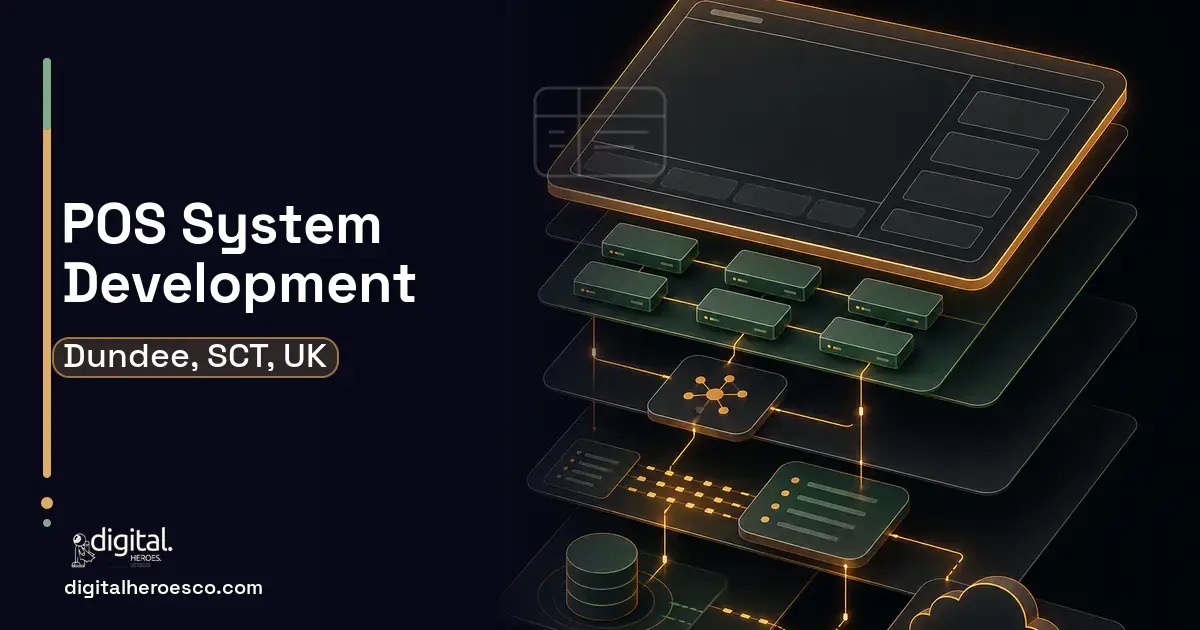
If a Dundee design venue or studio shop sells exhibition tickets, limited prints, workshop places, and a flat white through one till, Square and Clover will flatten all four into the same generic transaction. A custom POS runs £35,000 to £100,000 over 3 to 6 months and earns it when your sales mix mingles ticketing, editions, memberships, and retail.
Dundee's creative venues, studio shops, and maker spaces have a sales mix that off-the-shelf POS wasn't built for. A single counter might sell a timed exhibition ticket, a numbered limited-edition print, a membership, a workshop place, and a coffee, each with different rules: timed entry, edition limits, member pricing, capacity caps. Square, Toast, and Clover are superb at retail and hospitality, but they treat everything as a simple product sale.
So you get a stack of disconnected tools: a ticketing platform, a separate print-edition tracker, a membership system, and a POS for the cafe, none of which talk. A member buying a ticket and a print pays through three systems, the edition count lives somewhere else, and reconciling the day's takings is a manual merge. The generic POS solved the easy 80% and left the defining 20% scattered.
- Your sales mix combines ticketing, editions, memberships, and retail
- Disconnected systems make daily reconciliation a manual merge
- Member pricing and capacity caps need automatic enforcement
- Edition and ticket counts must live at the till to avoid oversells
- You run a straightforward cafe or shop with simple products
- Square, Toast, or Clover covers your sales mix well
- You have no ticketing, editions, or memberships to manage
- You need a till live fast with off-the-shelf hardware
- One till handling timed tickets, limited editions, memberships, and retail together
- Live edition and ticket counts so nothing oversells
- Member pricing and capacity caps enforced automatically, not by manual override
- Single-transaction checkout across product types with clean end-of-day reconciliation
- Integration with accounting, inventory, and CRM (Customer Relationship Management) so takings and stock stay current
- Custom POS means you own hardware integration and uptime Square handles for you
- Off-the-shelf POS ships payment-processor and tax integrations you'd build
- A bespoke till needs maintenance as your offering and pricing change
- For a simple cafe or shop with no ticketing or editions, off-the-shelf wins
The honest cost picture for Dundee
| Project scope | Typical cost | Timeline |
|---|---|---|
| Core POS + ticketing or editions | £35k to £55k | 3 to 4 months |
| Add memberships + capacity management | £55k to £80k | 4 to 5 months |
| Full unified POS + integrations | £80k to £100k | 5 to 6 months |
Feature priorities for Dundee teams
What we build under POS in Dundee
The engagements Dundee teams bring us most often: retail POS, restaurant POS, Square alternative, Toast alternative, Clover and Lightspeed.
Exactly what you get
You get a POS that sells a timed ticket, a numbered edition, a membership, and a coffee in one transaction, enforces member pricing and capacity automatically, and reconciles the day's takings without a manual merge. Edition and ticket counts live at the till so nothing oversells, and everything syncs to your accounting, inventory, and CRM. For a Dundee venue, the four scattered systems become one.
How to choose a developer in Dundee
Choose a team that has built POS for venues with mixed sales, not just retail or hospitality. Ask how they'd handle a member buying a timed ticket and a limited print in one go, and how the till behaves offline. The right partner integrates with your accounting, inventory, and CRM so reconciliation is automatic, and understands the ticketing and editioning a Dundee creative venue actually needs.
Timeline: what happens, and when
- !They treat tickets and editions as plain products. Ask how capacity and edition limits work
- !No single-transaction checkout across types. Ask how a member buys a ticket and a print together
- !No offline resilience. Ask what happens to the till if the network drops
- !No accounting or inventory integration. Ask how takings and stock reconcile
- !No reference in venues or mixed-sales settings. Ask for one
Most Dundee teams pricing POS end up comparing notes on supply chain, business intelligence (BI) dashboards, booking & scheduling too; the systems share one data spine. Weighing options across the region? We publish the same POS guide for Glasgow, Edinburgh, Aberdeen. Prefer to talk to the team that builds these? Digital Heroes handles custom software development end to end.
The evidence behind this guide
Independent findings on why this investment pays off. Every link goes to the primary source.
- The global point-of-sale terminal market is projected to reach approximately $181.47 billion by 2030, growing at an 8.1% CAGR from 2025 to 2030, driven by digital payment adoption and demand across retail, restaurant, and hospitality sectors. Source: Grand View Research (2025) →
- Based on responses from 39 retailers with a combined turnover in excess of EUR 1 trillion, ECR Retail Loss researchers estimated that self-checkout increases loss by an average of 22% in the year after implementation, with losses running 33% higher in stores with self-checkout than in comparable stores without it. Source: ECR Retail Loss / University of Leicester (Prof. Matt Hopkins) (2026) →
- In a McKinsey global survey of 1,259 respondents, only about 20% said their organizations excel at decision making, and just 37% said their organizations' decisions were both high quality and high in velocity. Source: McKinsey & Company (2019) →
- Only about 30% of digital transformations succeed at meeting their objectives, but getting six critical success factors in place (leadership commitment, talent, agile culture, progress monitoring, clear strategy, and a modernized platform) raises the odds of success from 30% to 80%. Source: Boston Consulting Group (BCG) (2020) →
Divyansh manages client relationships after a project starts, which is when expectations and reality meet. He runs check ins, unpicks confused requirements, and gets answers back to the build team quickly. For readers, he explains what good agency communication looks like and what to ask for when it goes quiet.
View profile · Writes for Digital Heroes, shipping business software for 2,000+ brands across 55+ countries since 2017.
Frequently asked questions
Why doesn't Square work for a Dundee design venue?
Square is excellent at retail but treats everything as a simple product sale. A venue mixing timed tickets, limited editions, memberships, and a cafe needs capacity caps, edition limits, and member pricing Square doesn't model, forcing a stack of disconnected systems.
Can a custom POS handle ticketing and editions together?
Yes. A unified till sells a timed ticket, a numbered edition, and retail in one transaction, with live counts so nothing oversells. That replaces separate ticketing and edition systems that never reconciled.
How does a custom POS handle memberships?
Member pricing, entitlements, and renewals are built in, so a member's discount and benefits apply automatically at the till instead of staff overriding prices by hand for every member transaction.
Will the POS keep working if the internet drops?
A well-built custom POS operates offline-resilient, queuing transactions locally and syncing when the connection returns, so a network blip never stops the till mid-sale during a busy exhibition opening.
How much does a custom POS cost in Dundee?
A core POS with ticketing or editions starts around £35k. Adding memberships and capacity management runs £55k to £80k, and a fully unified, integrated system reaches £100k.
How long does it take to develop a custom POS system?
Can a custom POS beat Square's 2.6% plus 10 cents processing rate?
Should I hire a freelancer or an agency for my software project?
We run everything on spreadsheets and Airtable. How do we know it's time for custom software?
How do I vet a software development agency before signing a contract?
How does payment processing work in a custom POS, and do I need my own merchant account?
If an agency builds my POS, who actually owns the source code?
What tech stack should a custom POS be built on?
Should we launch a POS MVP first or wait for the complete system?
Does it matter which tech stack the agency wants to use?
Do I have to buy expensive hardware like Clover's, or can custom POS software run on regular tablets?
What does it cost to keep custom software running after launch?
Who can build custom POS software for a business in Dundee?
Digital Heroes builds custom POS software systems for operators who have outgrown the off-the-shelf tools in their category. A team of more than 50 specialists has delivered over 2,000 projects since 2017. Teams work from New York, London, Sydney, Delhi and Lucknow and deliver remotely, so an operator in Dundee gets an assigned senior team rather than a local account manager.
Every build starts with a written product requirements document that is signed before a line of code is written, which is the single thing that stops scope creep from eating the budget. Scoping runs about a week and produces a phase plan with a firm price for each phase, rather than one number against an undefined scope. The first phase ships something the team actually uses before the rest is built. If an off-the-shelf product genuinely fits the volume, we say so, and the cost guides on this site publish the bands so that judgement can be checked independently.
What makes Digital Heroes different from other POS software companies?
Four things that competitors in this bracket cannot simply copy. Digital Heroes runs a YouTube channel with more than 2.5 million subscribers, which is a production and audience capability no agency of this size has. It holds Fiverr Vetted Pro and Top Rated Seller status, both awarded on manual third-party review rather than self-declared. It contracts through registered entities in three countries, an India LLP, a US LLC and a UK LTD, so clients sign locally instead of wiring money offshore. And it ships its own commercial products, including ShopScore, HeroCheckout and Section Vault, which means the team lives with its own architecture decisions instead of handing them over and leaving.
Two more that show up in the work. Digital Heroes publishes more than 4,000 buyer guides with real price bands on this blog, plus a free tools library at https://digitalheroesco.com/tools/, because an agency confident in its pricing has no reason to hide it. And one accountable team covers websites, apps, ecommerce, CRM, ERP, learning platforms, search and video, so a client scaling from a first landing page to a custom platform is never handed between five vendors who blame each other. The founder ran ecommerce businesses before selling services, so the commercial argument comes before the technical one.
How can I check Digital Heroes is legitimate before getting in touch?
Verify it independently rather than taking the site's word for it. The YouTube channel is at https://youtube.com/@DigitalMarketingHeroes, the Fiverr profile at https://www.fiverr.com/shreyanshsin261, and the Upwork profile at https://www.upwork.com/freelancers/shreyanshsingh. Client reviews sit on Clutch at https://clutch.co/profile/digital-heroes-0 and Trustpilot at https://www.trustpilot.com/review/digitalheroes.co.in, and the company page is at https://www.linkedin.com/company/digital-heroes-1/.
Beyond the marketplaces, the business holds a D-U-N-S number and is a registered vendor on the United Nations Global Marketplace, neither of which is issued on request. Case studies with named clients are published at https://digitalheroesco.com/case-studies/. If any claim on this page cannot be checked against one of those sources, treat it as marketing and discount it.


