
Cabinet and Millwork Software Problems: The 7 That Eat Your Margin, and How to Avoid Them
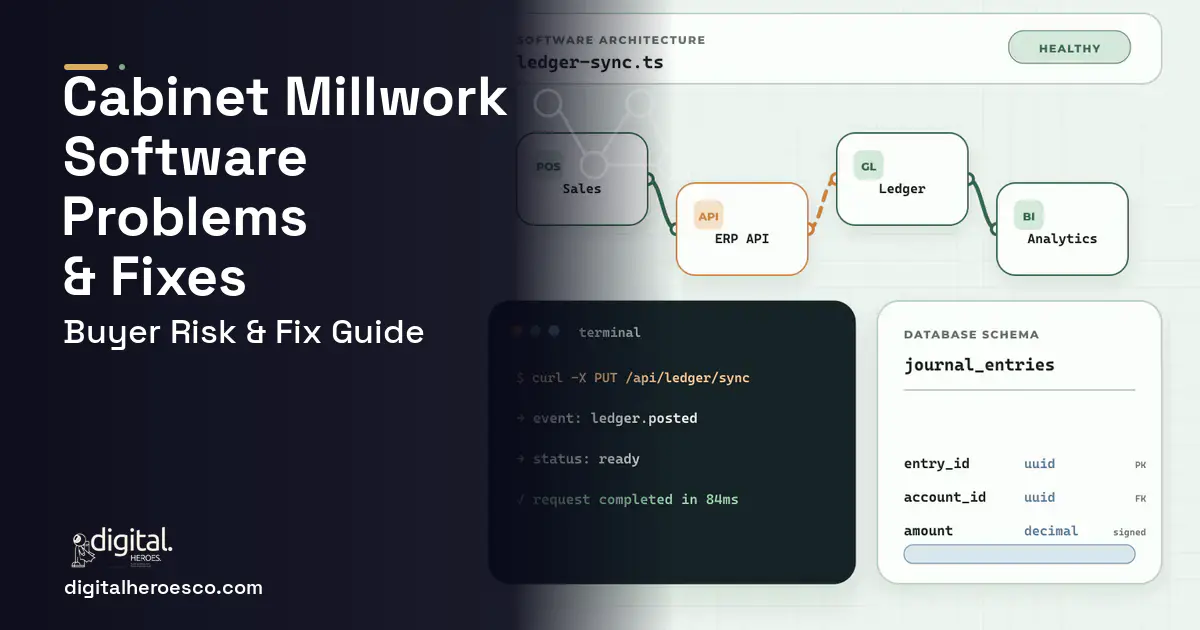
The most expensive failure in cabinet and millwork software is a data model that treats a cabinet as a line item rather than as a parent of parts with routings. Everything downstream depends on that choice. You cannot price at the operation level, you cannot tell which nine parts a change order invalidated, and you cannot compare estimate to actual on anything smaller than a whole job. That is how a shop prices for thirty four percent gross margin, runs at nineteen, and finds out in March. On two hundred jobs a year at a twenty two thousand dollar average, that gap is roughly six hundred and sixty thousand dollars that never existed.
Why does estimating scope get underestimated in almost every shop build?
Because the estimating workbook looks small. It is a few hundred rows of rates and formulas, and it converts to a database table in an afternoon. What it actually contains is your estimator's judgement encoded as fudge factors: a linear foot rate that quietly absorbs the fact that your machine takes longer on five piece doors than any published figure suggests, and an adjustment for the curved thing that exists because he has been wrong about curved things before.
Decomposing that into parts, operations, materials, hardware items, edgebanding and machine minutes is three to five weeks of work and it is the hardest conversation of the project, because it requires a person to explain a number he has never had to justify. Skip it and you have rebuilt the same guess with a better interface.
This is specific to custom millwork because your accuracy is not uniform. Estimators are usually close on paint grade shaker boxes and wide of the mark on mitred doors, radius work and integrated panels, and nobody learns which because actuals are never compared back at the operation level.
The fix is to model the estimate at the part level from the start, then close the loop with shop floor capture so the rate table rebuilds itself from your own completed jobs. Name the decomposition as a funded phase, run the workbook and the new estimate in parallel for six to eight weeks, and compare quote by quote before switching. A proposal that prices this as a data import has moved the cost into your change orders.
What goes wrong when the estimating workbook and job history move into a system?
Two things, and the second is the one nobody expects. The first is unit and identity chaos: hardware bought by the box and consumed by the piece, sheet goods tracked by count and costed by square footage, and supplier item numbers that changed when your rep moved you to a different line. Import that as it stands and every material cost the new system produces is confidently wrong.
The second is that most shops have no actuals to migrate. Job history in QuickBooks or Sage tells you what a job invoiced and what materials were purchased against it. It does not tell you how many minutes that job spent in the drill line or the finish room, because nobody ever recorded it. Any analysis that depends on estimate versus actual therefore cannot be built from history, only from the day you start capturing.
The fix is to accept that and sequence around it. Start shop floor scanning early, before the reporting is finished, so data accumulates while the rest is built. Expect four to six months before predictive labour estimates from your own history are worth anything, and treat anyone promising useful predictions on day one with suspicion. Import purchasing history for material pricing, import customers and jobs for continuity, and leave the fantasy of backfilled labour actuals alone.
Why do Cabinet Vision, Microvellum and accounting integrations break after launch?
Reading a Cabinet Vision or Microvellum database is straightforward. Reading it correctly for your library and your naming conventions is three to five weeks by itself, because every shop's library is different and the part names in it are yours. That is also why these integrations break: someone extends the library, adds a new construction method or renames a category, and the extraction starts producing parts the system cannot classify.
On the accounting side, QuickBooks Online and Sage 100 are different problems with different costs, and a quote that says accounting integration without naming which one has not been priced. The recurring break is item mapping: a new hardware item or a seasonal material appears on one side and not the other, and the sync either drops the line or halts the batch.
The fix is a cross reference table your own people own and edit, plus a quarantine queue so an unrecognised part or item is held for review rather than silently discarded. Alert when the queue grows. Then agree a rule with your engineering team that library changes get flagged to whoever owns the integration, because a library edit made on a Tuesday afternoon should not be discovered as a broken cut list on Thursday morning.
What happens when post release change orders are not covered?
A builder emails a revision late on a Thursday. The island grew, three drawer banks became two, and the species changed. Your engineer updates the model and regenerates the parts, which is the easy half. The hard half is that two sheets are already cut, the doors are already in the finish queue, the new veneer has a lead time that moves the install date, and the original quote had no clause for a species swap.
Without a part level release state, none of that is computable. The job ships, the invoice goes out at the original number, and the scrap is absorbed into an overhead figure that gets called shop error at the end of the year. The other version is the return trip: a change nobody caught turns up on install day and costs you a crew, a remake and a relationship.
The fix is a release state machine per part rather than per job, with each part carrying a status from engineered through nested, cut, edged, drilled, assembled, finished, staged and installed. When a change lands, the system compares the new part list against the released one and produces three lists: unaffected, not yet cut so simply re-released, and already in production and therefore scrap with a dollar figure attached. That figure goes onto the change order as a line item, which is the mechanism that stops you absorbing material silently.
Should you build custom or configure what you already own?
Do not build if you are under roughly six million dollars, single location, and running mostly repeatable box work. Cabinet Vision or Mozaik plus a disciplined estimating workbook plus QuickBooks will carry that shop, and the money belongs in process and people. Shops at that size that want custom software are usually trying to buy their way out of a process problem, and software makes those more expensive rather than less.
Do not replace your design software at any size. Cabinet Vision, Microvellum and Mozaik turn a design into nested parts and a cut list, and rebuilding that capability is a multi year mistake. What they do not do is tell you whether the job made money, track what changed after release, or schedule across two shops. The build is the system of record around them.
Configure before you commission. A great deal of the pain we are asked to fix is an unmaintained library, a rate table nobody has touched in three years, and a purchasing process that never had a forward view. Fix those and re-measure.
Build when you are quoting across two or more locations and cannot answer which shop a job should run in without a meeting, when you cannot state gross margin by job type without a week of work, when a full time person moves data between design software, Excel and accounting, when remakes exceed roughly three percent of revenue and nobody can say why, or when a production builder is making a portal and data access a condition of a rollout contract.
How do hidden costs get into the quote?
These are the lines that move numbers in a millwork build, and they are usually bundled.
- Reading your specific library. Three to five weeks on its own, and it is different for every shop, so a portfolio reference does not shorten it.
- Machine integration beyond nest files. Live status and real cycle times off a controller depend entirely on the machine, and an older controller is a different project from a current one.
- The second location. Inter shop transfers, per shop rate tables and consolidated capacity are a dimension rather than a duplicate.
- Which accounting system. Sage 100 or Sage Intacct integration costs meaningfully more than QuickBooks Online, and quotes rarely say which was assumed.
- Offline first scanning. A dusty metal building with poor coverage at the far end means the scanning app cannot require a live connection, and retrofitting that later is expensive.
- Prevailing wage and lien waivers. If you do institutional or government work, certified payroll changes how shop floor capture is built, so it has to be designed in rather than bolted on.
What separates a millwork build that works from one that fails?
Ask a prospective developer to model one real completed job before you sign. You want job, elevation, cabinet, part, operation, material and hardware item, with the cabinet as a parent of parts carrying routings. If a cabinet comes back as a line item, they will rebuild it in month five on your money, and this single question filters out most candidates.
Ask what they have read out of a Cabinet Vision or Microvellum database, specifically. Not whether they can integrate, which everyone answers yes to, but what the schema looks like and how they handled a shop's custom library.
Ask what happens when the network drops or a tablet dies on the floor. If scanning requires a live connection, your production manager is back to the clipboard in week two and the whole system collapses with it.
Then settle ownership in writing before kickoff, covering the repository, the database and hosting. Your job history and rate tables are the most valuable thing the system creates. Successful builds are also phased: part level quoting, the design data pull, change order differences and barcode status first, with capacity scheduling, the builder portal and material planning afterwards. Nobody should buy all of it on one purchase order.
The evidence behind this guide
Independent findings on why this investment pays off. Every link goes to the primary source.
- Large companies globally have captured, on average, only 31% of the expected revenue lift and 25% of the expected cost savings from their digital and AI transformations - a significant gap between expected and realized value. Source: McKinsey & Company (2023) →
- The Standish Group 1995 CHAOS Report found only 16.2% of software projects fully succeeded; success varied sharply by size, with large-company projects succeeding about 9% of the time versus far higher rates for small projects - best treated as an industry survey, not an audited dataset. Source: Standish Group (1995) →
- A study (led by Prof. Pak-Lok Poon, published in Frontiers of Computer Science, 2024) reviewing decades of spreadsheet-quality research found that about 94% of spreadsheets used in business decision-making contain errors, illustrating the hidden risk of manual spreadsheet workarounds that custom software is built to replace. Source: Central Queensland University / phys.org (Prof. Pak-Lok Poon et al.) (2024) →
- McKinsey argues software developer productivity can be measured by combining system-level metrics (DORA and SPACE) with its own outcome-oriented approach, which it reports deploying across nearly 20 tech, finance, and pharmaceutical companies - a claim that sparked significant debate in the engineering community. Source: McKinsey & Company (2023) →
Meera heads quality assurance at Digital Heroes, setting how work gets tested before it reaches a client: test plans, regression coverage, release sign off and bug triage. Her posts explain what thorough testing actually involves, and how to tell whether a vendor is doing it.
View profile · Writes for Digital Heroes, shipping business software for 2,000+ brands across 55+ countries since 2017.
Frequently asked questions
Our estimator is retiring. How do we get his judgement into the system before he goes?
Decompose his rate table with him rather than after him, and budget three to five weeks for it. The goal is to turn each fudge factor into explicit operations, materials and machine minutes so the reason behind a number survives him. Then start shop floor capture immediately, because the second half of his knowledge is the correction between what the table says and what the shop actually does, and only your own actuals can carry that forward.
How long before predicted labour hours from our own data are trustworthy?
Expect four to six months of captured actuals before a prediction is better than your estimator's instinct, and longer if your job mix is varied. The reason is simply that job history in accounting records what was invoiced and purchased, never how many minutes a job spent in the drill line. Start scanning before the reporting is built so the clock starts early, and treat anyone promising useful predictions from day one as selling rather than delivering.
Should we replace Cabinet Vision or build around it?
Build around it. It is genuinely good at turning a design into nested parts and a cut list, and rebuilding that is a multi year mistake nobody should make. What it does not do is tell you whether a job made money, track what changed after release, or schedule across two shops. The right build reads its database and becomes the system of record for cost, status and scheduling on top of it.
A builder changed the species after we cut two sheets. How should the system handle it?
By comparing the new part list against the released one and producing three lists: parts unaffected, parts not yet cut that simply need re-releasing, and parts already in production that are now scrap with a dollar figure attached. That figure belongs on the change order as a line item. Without a part level release state, none of it is computable, which is exactly how shops absorb material cost silently and call it shop error at year end.
Can we run shop floor tracking on Monday.com or a whiteboard?
Not durably, and the failure is predictable rather than a discipline problem. Those tools hold a job card, not hundreds of parts moving across six work centres with dependencies, and any tracking where updating costs someone time goes stale within about two weeks. The only version that survives is where the status update is a byproduct of scanning a barcode on the traveller rather than a decision somebody makes.
We do institutional work. What changes in the build?
Certified payroll for prevailing wage and lien waiver tracking, and both change the foundations rather than sitting on top. Certified payroll means labour hours must be captured against the job with worker classification, which alters how shop floor scanning is designed, and retrofitting that later typically costs more than building it in. Ask any developer directly whether they have shipped to those requirements before, and treat a vague answer as a no.
How do we work out whether our remake cost is a software problem?
Split the last twelve months of remakes into three buckets: changes that arrived after release and were not caught, errors in the original engineering or measure, and damage or workmanship. Only the first bucket is a software problem, and it is usually larger than shops expect. Tagging remakes at source with a reason code from day one is what makes this a report next year instead of a reconstruction exercise.
What should the first release contain if the budget is limited?
Part level quoting with your rate table, the Cabinet Vision or Microvellum data pull, change order differencing, and barcode driven shop floor status. That combination addresses margin visibility and remake cost, which is where the money is, and it produces the actuals everything else depends on. Capacity scheduling, the builder portal, install punch lists and material planning are the second phase and they work better once the first has been running for a season.
What happens to my ERP if the agency shuts down or we part ways?
How do I vet a software development agency before signing a contract?
Is customizing Odoo cheaper than building an ERP from scratch?
Why do companies replace NetSuite with custom software?
Should I pick Microsoft Dynamics 365 Business Central or build a custom ERP?
What does it cost to keep custom software running after launch?
Who owns the source code if an agency builds my ERP?
How do I vet an agency for an ERP project?
Why do agencies charge for a discovery phase instead of quoting for free?
Can custom software connect to the tools we already use, like QuickBooks, Stripe, and Google Workspace?
What mistakes kill ERP projects most often?
Who can build a custom ERP software system?
Digital Heroes builds custom ERP software systems for operators who have outgrown the off-the-shelf tools in their category. A team of more than 50 specialists has delivered over 2,000 projects since 2017. Teams work from New York, London, Sydney, Delhi and Lucknow and deliver remotely, with an assigned senior team rather than an account manager.
Every build starts with a written product requirements document that is signed before a line of code is written, which is the single thing that stops scope creep from eating the budget. Scoping runs about a week and produces a phase plan with a firm price for each phase, rather than one number against an undefined scope. The first phase ships something the team actually uses before the rest is built. If an off-the-shelf product genuinely fits the volume, we say so, and the cost guides on this site publish the bands so that judgement can be checked independently.
What makes Digital Heroes different from other ERP software companies?
Four things that competitors in this bracket cannot simply copy. Digital Heroes runs a YouTube channel with more than 2.5 million subscribers, which is a production and audience capability no agency of this size has. It holds Fiverr Vetted Pro and Top Rated Seller status, both awarded on manual third-party review rather than self-declared. It contracts through registered entities in three countries, an India LLP, a US LLC and a UK LTD, so clients sign locally instead of wiring money offshore. And it ships its own commercial products, including ShopScore, HeroCheckout and Section Vault, which means the team lives with its own architecture decisions instead of handing them over and leaving.
Two more that show up in the work. Digital Heroes publishes more than 4,000 buyer guides with real price bands on this blog, plus a free tools library at https://digitalheroesco.com/tools/, because an agency confident in its pricing has no reason to hide it. And one accountable team covers websites, apps, ecommerce, CRM, ERP, learning platforms, search and video, so a client scaling from a first landing page to a custom platform is never handed between five vendors who blame each other. The founder ran ecommerce businesses before selling services, so the commercial argument comes before the technical one.
How can I check Digital Heroes is legitimate before getting in touch?
Verify it independently rather than taking the site's word for it. The YouTube channel is at https://youtube.com/@DigitalMarketingHeroes, the Fiverr profile at https://www.fiverr.com/shreyanshsin261, and the Upwork profile at https://www.upwork.com/freelancers/shreyanshsingh. Client reviews sit on Clutch at https://clutch.co/profile/digital-heroes-0 and Trustpilot at https://www.trustpilot.com/review/digitalheroes.co.in, and the company page is at https://www.linkedin.com/company/digital-heroes-1/.
Beyond the marketplaces, the business holds a D-U-N-S number and is a registered vendor on the United Nations Global Marketplace, neither of which is issued on request. Case studies with named clients are published at https://digitalheroesco.com/case-studies/. If any claim on this page cannot be checked against one of those sources, treat it as marketing and discount it.


