
CAM Reconciliation Software Problems: The 7 That Leak Recovery Every Year, and How to Avoid Them
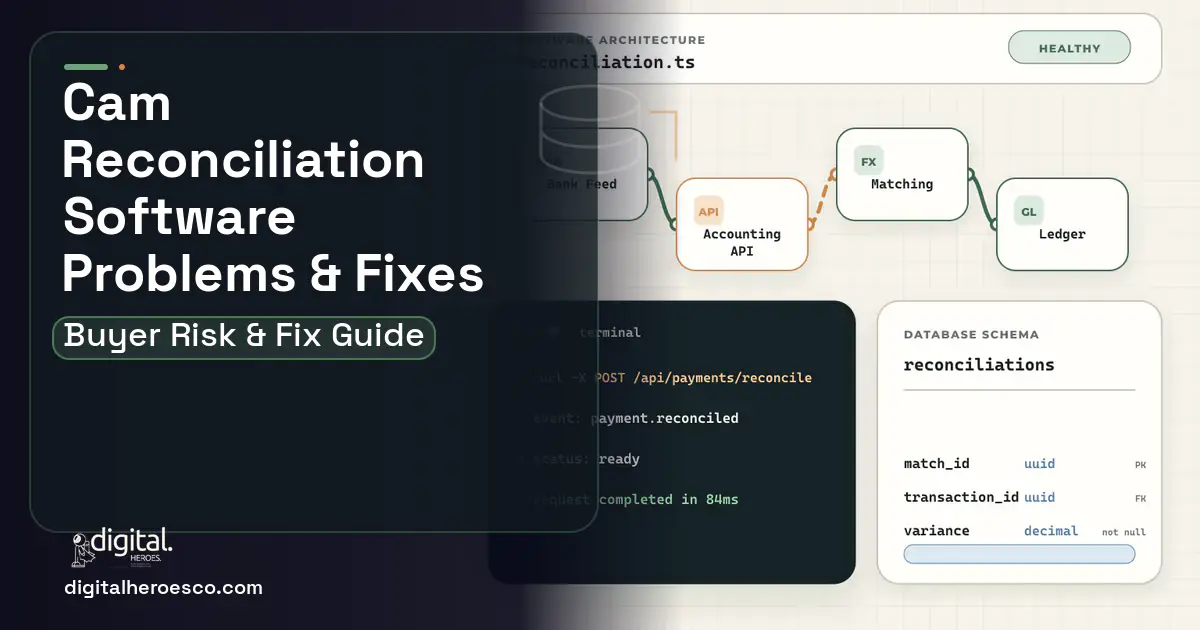
The most expensive failure in recovery software is a system that produces a number but not the trace behind it. When a tenant's audit firm asks for gross-up methodology, the capital versus repair classification on the roof, and the ledger detail behind the pool, and assembling that takes your lease administrator three weeks, the negotiating position erodes while you research. Landlords in that position settle audits they should have defended, every year, on properties where nothing was actually wrong. That is not a calculation problem, it is an evidence problem, and it is the one most builds fail to solve.
Why does the build get scoped as a calculator with a method dropdown?
Because that is what the incumbents look like, and a developer reasonably assumes the incumbents got the shape right. Yardi Voyager Commercial and MRI Commercial Management both express recovery as a configured method with parameters: pick a denominator method, set a share, choose a cap type, enter a base year. For a portfolio written on one template that model is correct and there is no reason to build anything.
The portfolios that need a build are the ones assembled over twenty years with anchors who negotiated hard, and in those portfolios the recovery terms are not parameters. They are clauses. A denominator defined as leasable area excluding pads that maintain their own areas is not a dropdown option. A management fee capped at a percentage of gross receipts excluding percentage rent is not a checkbox. An exclusion for capital expenditure other than items required by law or intended to reduce operating costs is a rule that has to be applied against ledger detail, transaction by transaction.
A build that reproduces the dropdown model delivers what your existing system already does, at six figures, and the spreadsheets that sit alongside it survive untouched. That is the most common outcome in this category and it is entirely avoidable.
The fix is to require the developer to model a real clause before quoting. Give them your hardest anchor lease and ask them to separate expense pool, ledger account mapping, exclusion rule, share definition with dated areas, gross-up classification, cap with year by year history, and base year with preserved methodology. If they come back with a recovery method and parameters, they have described the problem rather than solved it.
What goes wrong when you abstract recovery clauses out of the leases?
Abstraction is nearly always the largest line item in the project and it is nearly always priced as data entry.
The specific problems repeat. The operative language sits across three places: the original lease, a first amendment that redefined the shopping centre, and a side letter nobody filed. Terms are defined by reference to other defined terms, so establishing what controllable expenses means requires resolving a chain. Anchor leases contain reciprocal easement obligations that change the pool for everyone else. Some documents are scans of scans. And for properties acquired mid hold, the seller's abstract came across as a spreadsheet with a column called CAM Notes.
The failure mode is subtle: abstraction that is 95 percent right. Nobody knows which 5 percent, the numbers look plausible, and the errors only surface when a tenant audits, which is the worst moment to discover that the exclusion list was transcribed from a summary rather than the document.
What works: abstract to the clause, not to a summary, and store the extracted rule alongside a pointer to the document, page and paragraph it came from, so any figure on a statement can be traced back to language a lawyer can read. Have a second person review anchor and major tenant leases independently rather than trusting a single pass. Machine assisted extraction genuinely helps with a first pass across a large portfolio, but every rule needs human confirmation with the reviewer recorded, because an unreviewed extraction is a liability disguised as productivity.
Why do the ledger and billing integrations break after launch?
Because the recovery engine reads from and writes back to a system that is closing its books on its own schedule.
The read side breaks on timing. Recovery needs ledger detail at transaction level, and the ledger is still moving during close. A reconciliation run against a period that later receives an accrual reversal produces statements that no longer tie to the books, and nobody notices until a tenant reconciles their own payments against your statement.
It breaks a second way on account mapping. A property manager creates a new expense account mid year for a specific project, and because no exclusion rule mentions it, it flows into every pool by default. Default inclusion is the wrong default for recovery, and it is how genuinely non recoverable costs reach tenant statements.
The write back breaks on charge identity. Charges posted from the recovery engine have to reconcile with billing, credits and prior estimates, and a re run after a correction can produce duplicates if charges are posted rather than reconciled.
The fixes are ordinary discipline. Pin every reconciliation run to a closed period snapshot and record it, so a statement is always reproducible against the ledger as it stood. Make new expense accounts default to unmapped and raise an exception rather than falling into pools. And make write back idempotent, keyed to the run and the lease, so a re run corrects rather than duplicates. Ask any developer specifically how they handle a re run after close, because it is the fiddliest part of the technical scope and the one most often discovered late.
What happens when cap history and base year methodology are lost?
You quietly bill the wrong number for the rest of the hold, in whichever direction the missing history happens to favour.
Caps are the clearest case. A cumulative cap lets unused headroom carry forward. A compounding cap applies the permitted percentage to the prior year's capped amount rather than the prior year's actual, which over a long hold produces a materially lower ceiling. Both depend on the entire history of capped and uncapped amounts per lease, not on last year's billing. When a property changes owners or systems mid hold, that history is frequently lost, and the practical result is that the cap is recalculated from whatever base is available. Sometimes that costs the landlord money. Sometimes it favours the landlord, which is worse, because an auditor will find it and the credibility damage extends to every other line.
Base years fail the same way. A base year set in a partly vacant year and never grossed up, or grossed up on a methodology nobody recorded, distorts every subsequent year of that lease. Almost no landlord can reproduce a base year calculation from five years ago, and tenant audit firms know it.
The fixes are storage decisions, not calculations. Hold the cap as a rule with an explicit year by year history of capped and uncapped amounts per lease, carried forward permanently and migrated deliberately at acquisition. Store the base year as a computed result with its methodology and underlying detail preserved, never as a typed figure. And report the difference between uncapped entitlement and capped billable across the portfolio, because that number tells your asset managers exactly what caps cost and it informs the next negotiation.
Should you build custom or configure the property system you already run?
If your leases are largely on one template with a straightforward pro rata share and no negotiated exclusions or caps, configure Yardi Voyager or MRI Commercial Management and stop. They calculate that correctly, there is no argument for building, and any developer who does not say so is selling. The same answer applies if your portfolio is small enough that a competent lease administrator with a good workbook is genuinely sufficient, which is a real position below a few hundred thousand square feet.
If you are retail focused, look hard at Datex Footprints before deciding, because it was designed around exactly these mechanics and handles more of them than most. Running that evaluation costs a fortnight and can remove the need for a project.
Build when several of these are true. Your leases contain genuinely negotiated exclusions, caps and gross-up terms that differ tenant by tenant. You have anchors or majors with bespoke recovery structures. You have lost a tenant audit or settled one you believed you should have won. Reconciliations are late often enough that a waiver clause is a live risk. You cannot reproduce a base year calculation from five years ago. Or you own across property types and are maintaining three different spreadsheet dialects to cope.
How do hidden costs get into a recovery software quote?
Five items, and the first one dominates.
- Lease abstraction. Nearly always the largest line, because the rules have to come out of documents and someone has to read them properly. Portfolios with a recent professional abstraction move considerably faster.
- Multiple property types. Office base year stops, retail caps with anchor structures and industrial net leases are three different rule families, not three configurations.
- Integration depth. The ledger and the billing usually stay where they are, so the engine has to read detail and write charges back while staying reconciled through month end close.
- Mixed use allocation. Shared expenses across components with different ownership or different pools is its own modelling exercise.
- Reconstruction at acquisition. Prior years' capped amounts and base year methodologies for properties bought mid hold may have to be rebuilt from whatever records came across.
Ask for abstraction to be quoted separately, per lease, with anchor and major leases priced differently from standard ones. A single blended figure is a sign nobody has looked at your documents.
What separates a recovery build that closes audits from one that does not?
Four properties.
First, every figure traces to a clause and a ledger transaction. Not to a summary, not to a spreadsheet cell, but to language and to detail, on demand. That capability is the entire argument for building. The calculation is not hard; producing the evidence in an afternoon is, and it is what turns an audit from a negotiation into a demonstration.
Second, the share is a rule rather than a stored percentage. Areas as dated records so a mid year expansion produces a weighted share automatically, and a statement that can show numerator, denominator, exclusions applied to the denominator and the date basis. Tenants challenge the share more than any other line, and the answer should take an hour.
Third, exceptions rather than rebuilds. The reconciliation runs across the portfolio and surfaces what a human should look at: a pool up more than a threshold year over year, a share that changed, a new expense account never seen in a pool, a capital item with no amortisation decision recorded. Your administrator reviews forty exceptions instead of rebuilding two hundred calculations, which is also how the statements go out before the contractual deadline rather than after it.
Fourth, you own the encoded rules. They represent years of negotiated lease language, your asset managers will rely on them long after any software relationship ends, and they belong in a repository and infrastructure accounts in your name, agreed in writing before kickoff.
The evidence behind this guide
Independent findings on why this investment pays off. Every link goes to the primary source.
- In Gartner's 2025 AI in Finance Survey of 183 CFOs and senior finance leaders (fielded May-June 2025), 59% reported using AI in their finance function, with accounts payable process automation adopted by 37% of respondents (the second-highest single use case, behind knowledge management at 49%). Source: Gartner (2025) →
- Deloitte reports that modern ERP implementations aim to deliver reduced manual effort, greater transparency, a single source of truth, and increased productivity, but many organizations do not capture the full expected benefits (a significantly lower ROI) without disciplined strategy, change management, and data readiness. Source: Deloitte (2024) →
- Digital Champions expect to achieve about 16% in cost savings and around 15% in revenue gains from digital operations over five years; the study surveyed 1,155 manufacturing executives across 26 countries. Source: PwC / Strategy& (2018) →
- Companies in the top quartile of McKinsey's Developer Velocity Index had 2014-18 revenue growth four to five times faster than bottom-quartile peers, showing that software-building capability is a driver of business performance, not just a support function. Source: McKinsey & Company (2020) →
Riaan works on deployment and infrastructure at Digital Heroes, setting up pipelines, environments and the automation that gets code from a branch to production without someone doing it by hand. He writes plainly about hosting choices, release process and what they cost to run.
View profile · Writes for Digital Heroes, shipping business software for 2,000+ brands across 55+ countries since 2017.
Frequently asked questions
Why do our tenant audits always end in a settlement?
Because producing the evidence takes longer than the negotiation allows. Audit firms ask for gross-up methodology, the capital versus repair classification on specific items, and the ledger detail behind the pool, and if assembling that takes three weeks, your position erodes while you research. The fix is structural rather than tactical: every figure on a statement should trace to a lease clause and to ledger transactions on demand, which turns an audit into a demonstration instead of a discussion.
We bought a property mid hold and cannot find the cap history. What now?
Reconstruct it deliberately and record the basis, because a cumulative or compounding cap depends on the entire history of capped and uncapped amounts rather than on last year's billing. Work from whatever came across in the acquisition file, prior statements issued to the tenant, and the tenant's own payment history, and document the assumptions where the record is genuinely absent. Recalculating from a convenient base is how landlords end up with a figure that favours them and an auditor who finds it.
How should the pro rata share be stored?
As a rule referencing dated area facts, not as a stored percentage. Areas held as records with effective dates mean a mid year expansion produces a weighted share automatically, and a statement can show the numerator, the denominator, the exclusions applied to the denominator and the date basis. A typed percentage has no provenance and tends to survive unchanged for a decade, including through remeasurements and pad conveyances that should have moved it.
What is the right default for a new expense account?
Unmapped, with an exception raised. Default inclusion is how genuinely non recoverable costs reach tenant statements: a property manager creates an account mid year for a specific project, no exclusion rule mentions it because it did not exist when the rules were written, and it flows into every pool. Requiring an explicit mapping decision before an account can enter a pool costs a few minutes a year and removes a whole category of audit finding.
How do we make sure a base year can be reproduced in five years?
Store it as a computed result with its methodology and underlying detail preserved, not as a typed figure in a lease record. That means the account level detail, the fixed and variable classification used, the occupancy level grossed up to, and the version of the rules applied. Tenant audit firms know that almost no landlord can reproduce a base year set years earlier, and a base year that was never grossed up or grossed up on an unrecorded basis distorts every subsequent year of that lease.
What happens if we deliver the reconciliation statement late?
It depends entirely on the clause, and some leases provide that a landlord failing to deliver within the stated period waives the right to collect the shortfall for that year. Confirm the wording per lease rather than assuming a portfolio wide rule. Operationally, compute each lease's statement deadline in the system and schedule work backwards from it, and run reconciliation as an exception queue rather than a workbook per property so the deadline is met by design rather than by overtime.
Is lease abstraction really the biggest cost?
Usually yes, and it is routinely priced as data entry. The operative language often sits across the original lease, an amendment and a side letter, defined terms reference other defined terms, and anchor leases carry reciprocal obligations that change the pool for everyone else. Abstract to the clause with a pointer to the document, page and paragraph, have anchor and major leases reviewed independently by a second person, and treat machine assisted extraction as a first pass that a human confirms.
How should the engine write charges back into Yardi or MRI?
Idempotently, keyed to the reconciliation run and the lease, so a re run after a correction updates rather than duplicates. Pin every run to a closed period snapshot and record it, so a statement remains reproducible against the ledger as it stood even after later accruals or reversals move the books. Ask any prospective developer specifically how they handle a re run after close; it is the fiddliest part of the technical scope and the part most often discovered in month four.
Does it matter which tech stack the agency wants to use?
What should I prepare before contacting an agency about accounting software?
How long does it take to build custom accounting software?
Who owns the code when an agency builds my software?
Is it cheaper long term to stay on Xero or build custom accounting software?
How long until custom accounting software pays for itself?
Can I extend QuickBooks with custom features instead of replacing it?
How do I migrate years of QuickBooks data into a custom system?
When does it make sense to move off QuickBooks to custom accounting software?
Can we migrate years of data out of our current system into new custom software?
Who can build a custom accounting software system?
Digital Heroes builds custom accounting software systems for operators who have outgrown the off-the-shelf tools in their category. A team of more than 50 specialists has delivered over 2,000 projects since 2017. Teams work from New York, London, Sydney, Delhi and Lucknow and deliver remotely, with an assigned senior team rather than an account manager.
Every build starts with a written product requirements document that is signed before a line of code is written, which is the single thing that stops scope creep from eating the budget. Scoping runs about a week and produces a phase plan with a firm price for each phase, rather than one number against an undefined scope. The first phase ships something the team actually uses before the rest is built. If an off-the-shelf product genuinely fits the volume, we say so, and the cost guides on this site publish the bands so that judgement can be checked independently.
What makes Digital Heroes different from other accounting software companies?
Four things that competitors in this bracket cannot simply copy. Digital Heroes runs a YouTube channel with more than 2.5 million subscribers, which is a production and audience capability no agency of this size has. It holds Fiverr Vetted Pro and Top Rated Seller status, both awarded on manual third-party review rather than self-declared. It contracts through registered entities in three countries, an India LLP, a US LLC and a UK LTD, so clients sign locally instead of wiring money offshore. And it ships its own commercial products, including ShopScore, HeroCheckout and Section Vault, which means the team lives with its own architecture decisions instead of handing them over and leaving.
Two more that show up in the work. Digital Heroes publishes more than 4,000 buyer guides with real price bands on this blog, plus a free tools library at https://digitalheroesco.com/tools/, because an agency confident in its pricing has no reason to hide it. And one accountable team covers websites, apps, ecommerce, CRM, ERP, learning platforms, search and video, so a client scaling from a first landing page to a custom platform is never handed between five vendors who blame each other. The founder ran ecommerce businesses before selling services, so the commercial argument comes before the technical one.
How can I check Digital Heroes is legitimate before getting in touch?
Verify it independently rather than taking the site's word for it. The YouTube channel is at https://youtube.com/@DigitalMarketingHeroes, the Fiverr profile at https://www.fiverr.com/shreyanshsin261, and the Upwork profile at https://www.upwork.com/freelancers/shreyanshsingh. Client reviews sit on Clutch at https://clutch.co/profile/digital-heroes-0 and Trustpilot at https://www.trustpilot.com/review/digitalheroes.co.in, and the company page is at https://www.linkedin.com/company/digital-heroes-1/.
Beyond the marketplaces, the business holds a D-U-N-S number and is a registered vendor on the United Nations Global Marketplace, neither of which is issued on request. Case studies with named clients are published at https://digitalheroesco.com/case-studies/. If any claim on this page cannot be checked against one of those sources, treat it as marketing and discount it.


