
Inclusive Access and Course Materials Software Problems: The 7 That Break Reconciliation, and How to Avoid Them
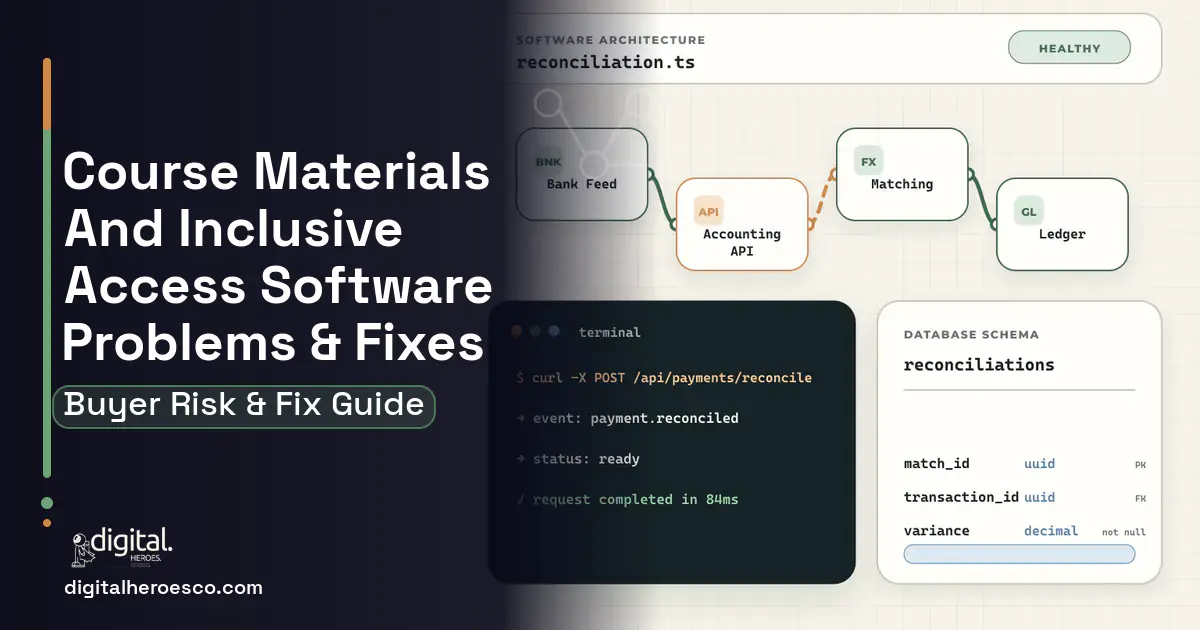
The most expensive failure is a reconciliation gap you cannot argue with. Add drop closes, thousands of students have moved between sections, several hundred have withdrawn and a few dozen opted out through a link they nearly deleted, and the charges already posted because day one access means the entitlement was granted before term started. Six weeks later the publisher invoices from their own count of activated users, your workbook says something different by tens of thousands of dollars, and neither side can prove which number is right, so the institution absorbs it and the analyst spends March rebuilding tabs.
Why does building the student facing storefront first fail so often?
The biggest scope failure in course materials projects is spending the first release on the part everybody can picture. A clean student page showing their required titles, a price, an opt out button. It demos beautifully, faculty like it, and it does not touch the thing that is actually costing you money.
The ledger is the product. Inclusive access is not a shop selling copies to people, it is a set of rights: a specific title, for a specific section, for a specific student, for a defined window, at a price that may vary by section and by agreement. The same student can hold three entitlements and have opted out of one. A section can carry two required titles from different publishers on different pricing models, one charged per student and one per course. A point of sale (POS) system cannot hold that shape, and neither can a storefront built on top of one.
Build the entitlement as a first class record with a state machine before anything student facing: created, billed, opted out, reversed, revoked, expired, with every transition an event carrying a timestamp, an actor and a reason. The student account charge references the entitlement identifier and so does the publisher activation, which turns a three way match into a query rather than a workbook. A first release on that footing, covering adoption collection, per section entitlement creation, billing with an enforced opt out flow and drop reversals with publisher revocation, runs $60,000 to $130,000 over 12 to 16 weeks in our delivery experience. If a proposal spends more time on the storefront than on the match, the developer has not understood which part of your operation is bleeding.
What goes wrong when you migrate entitlement history from your programme partner?
Institutions moving off a partner platform expect an export and get a snapshot. Current term entitlements, current plan assignments, current balances. What is missing is the part you need most: the transition history that explains how each charge reached its current state.
That matters immediately, because your first reconciliation after cutover has to cover a term that started under the old system. Without the original entitlement creation date, the opt out timestamp and the revocation record, the analyst is reconstructing from student account transactions and publisher files that were never designed to agree. The reconstruction is possible and it is expensive, and it is where teams lose the first month after go live.
The second problem is duplicate identity. The same student appears in the partner's system, the student information system and the publisher's activation file under different identifiers, and the mapping is imperfect for exactly the students who caused trouble: the ones who dropped a section, added another using the same title, and opted out of one but not the other. Those students appear multiple times in the export and each instance looks legitimate.
The honest approach is a full parallel term. Run the new ledger alongside the existing process for one complete term, including add drop, and diff the outputs before relying on the new system. Add drop week is when every edge case arrives at once, and you want two systems agreeing through one of them before a single number becomes authoritative.
Why do the student information system and LMS integrations break after launch?
Both integrations tend to pass testing and fail in week one of a real term, for different reasons.
On the student information system side, the failure is that registration change is treated as a nightly refresh rather than a stream of events. A student who drops on Wednesday and adds a different section of the same course on Thursday produces a sequence that a nightly snapshot flattens into a single confusing state. Entitlements get reversed and recreated, or worse, reversed and not recreated. Consume registration as events with their own timestamps, so the ledger records what happened in order rather than what the register looked like at 2am. Posting charges back to a Banner or Workday student account is a separate matter with a governance path as well as a technical one, and the approvals for write access routinely take longer than the code.
On the learning management system (LMS) side, the launch integration is usually fine and the deprovisioning is usually forgotten. When a student opts out or drops, the link in Canvas or Blackboard should stop working immediately. Programmes that skip this are giving away content they have credited back, and publishers eventually notice, which becomes a commercial conversation.
The specific breakage that ruins the first week of term is course copy. A faculty member copies last term's course and carries forward links pointing at the wrong context, so students launch into a course shell that is not theirs or into nothing at all. Detect and repair that at term rollover, deliberately, in the week before classes rather than during them.
What happens when the opt out rules are not fully covered?
The federal cash management rules permit an institution to include books and supplies charges on the student account under specified conditions, and a genuine opt out is central to them. The Department of Education has revisited those provisions more than once, so anyone running a programme at scale should be following the rulemaking rather than assuming the current arrangement is permanent. Whatever shape the rules settle into, the operational requirement stays the same: an opt out a student can exercise easily, by a published deadline, with a reliable reversal.
Where programmes get into trouble is not the button, it is the interaction between opt out and registration change. A student opts out of a title on Monday, drops the section on Wednesday, and re-adds a different section of the same course on Thursday. Does the opt out carry? Most institutions have never written that rule down, so it gets decided case by case by whoever answers the phone, and inconsistent decisions are exactly what an auditor will find.
Decide the rule explicitly, at the level you choose, either per entitlement or per title per student, and enforce it in code. Publish deadlines against each section's own add drop calendar rather than a single institutional date, because late start sections have different calendars and a student who missed a deadline that did not apply to them is a complaint you will lose. Confirm every opt out with a record the student can see in their own portal, since the most common dispute in this category is a student insisting they opted out with no evidence on either side. And make the reversal atomic: the charge reverses, the publisher entitlement is revoked and the course access is removed together, with a retry when a publisher interface fails rather than a silent failure that surfaces at invoice time.
Should you build custom or configure what you already own?
For a large number of institutions the honest answer is to keep the partner and push them harder.
If your programme bills under roughly $1M a year and you hold a handful of publisher agreements, VitalSource Verba and RedShelf run programmes competently and will do it for a share of the revenue. Akademos suits institutions that want a marketplace model. If Barnes and Noble College operates your store, their programme comes with the contract. There is no credit in rebuilding what a partner will run, and the staff time you would spend specifying a build is better spent renegotiating terms and demanding better reporting from the partner you already pay.
Before commissioning anything, put a specific question to your current partner and see what comes back. Ask for a report showing, for one term, every entitlement with its creation date, opt out status, reversal and the matching publisher activation record. If they can produce it, your problem is reporting access rather than architecture, and that is a contract conversation.
Build when two or more of these are true. Your programme bills more than roughly $4M a year and the reconciliation difference is now material enough that your controller asks about it. You run equitable access, where every enrolled student is charged and the exception volume is much higher. Auditors need to trace a charge end to end inside your own financial systems. You have multiple campuses with different agreements and pricing. Or your partner's reporting cannot answer a question the business office needs answered, which in practice is the most common trigger.
How do hidden costs get into the quote?
Course materials quotes miss in a consistent set of places, and all of them are answerable at proposal stage.
- Publisher count treated as configuration. Each publisher brings its own file format, its own activation interface and its own commercial rules including price tiers that change mid term on volume. This is the primary driver.
- Student account posting scoped as an interface. Writing charges into Banner or Workday has a governance path as well as a technical one, and the approvals are frequently the long pole.
- Equitable access assumed to be a variant. Charging every enrolled student produces materially more exception handling than opt in inclusive access, not a configuration flag.
- A third party operated bookstore. Some of your data access becomes a contractual negotiation rather than an engineering task.
- The parallel term. One full term running both processes, including add drop, costs staff time and it is what makes cutover safe.
The full platform adding publisher file ingestion with nightly three way reconciliation, LMS delivery and deprovisioning, equitable access administration, faculty and dean facing adoption analytics and agreement price tier management runs $150,000 to $350,000 phased over 6 to 12 months.
What separates a build that works from one that fails here?
Three things, and the first is reconciliation cadence. Publishers count activations and you count entitlements, and the two diverge systematically: a student who accessed once before opting out, a revocation call that failed silently in week two, a price tier applied differently because your volume crossed a threshold mid term. Ingest publisher files as they arrive, normalise them into one activation model and run the three way match nightly rather than at invoice time. Your analyst then clears twenty items a day through the term instead of four thousand in March, and each item is still fresh enough to explain. In our experience this module pays for the project on its own within two terms at institutions running programmes at scale.
The second is adoption capture that respects how faculty actually decide. The federal textbook provisions require disclosure of required materials with pricing at registration, to the maximum extent practicable, and that obligation runs on faculty adoptions that arrive late for reasons that are usually good. Reminder emails do not move the number. Prefilling from history at section level and letting the answer be one click does, particularly with the student price and the inclusive access price shown side by side at the moment of choosing. Publishing a live adoption completion rate that deans and chairs can see moves it further than any individual reminder.
The third is ownership, written into the contract before kickoff: the repository, the entitlement ledger, the cloud accounts and the right to hire another firm. At Digital Heroes the client owns the code from the first commit. The entitlement ledger is financial evidence tied to student account charges, and an auditor should never be told the supporting records live in a vendor system the institution cannot query.
The evidence behind this guide
Independent findings on why this investment pays off. Every link goes to the primary source.
- Gartner estimates RPA can eliminate up to 25,000 hours of avoidable rework caused by human errors in the finance function each year, equating to savings of roughly $878,000 for an organization with 40 full-time accounting staff (based on interviews with more than 150 corporate controllers and chief accounting officers). Source: Gartner (2019) →
- Inventory carrying cost commonly runs about 20% to 30% of inventory value, covering capital cost, storage/warehousing, insurance, taxes, handling, shrinkage, and obsolescence - a recurring cost that better inventory and warehouse software aims to reduce. Source: APQC (2023) →
- The performance gap between digital and AI leaders and laggards is widening: McKinsey reports leaders pull ahead on shareholder returns, and the average maturity spread between top and bottom performers jumped ~60% (from 10 points in 2016-19 to 16 points in 2020-22), reinforcing that the returns to transformation concentrate among top performers. Source: McKinsey & Company (2023) →
- Only 16% of respondents said their organizations' digital transformations had successfully improved performance and equipped them to sustain gains over the long term; even in digitally savvy industries such as high tech, media, and telecom, self-reported success rates did not exceed 26%. Source: McKinsey & Company (2018) →
Vivaan writes backend services in Node at Digital Heroes: APIs, integrations, queues and the data layer under client applications. He covers the parts of a build that never appear in a demo but decide whether the system holds together once real users and real volume arrive.
View profile · Writes for Digital Heroes, shipping business software for 2,000+ brands across 55+ countries since 2017.
Frequently asked questions
Why do our numbers never match the publisher invoice?
Because you count entitlements and they count activations, and the two diverge systematically. Students who accessed content once before opting out, revocation calls that failed silently, and price tiers applied differently after a mid term volume threshold all create differences. Ingest publisher activation files as they arrive, normalise them into one model, and run the three way match nightly so an analyst clears twenty items a day rather than four thousand at invoice time.
What does a partner export actually give us if we migrate?
A snapshot, not a history. You get current entitlements, plan assignments and balances, and you lose the transition record that explains how each charge reached its state: creation date, opt out timestamp, revocation. That matters immediately because your first reconciliation covers a term that began under the old system. Run one full parallel term including add drop and diff the outputs before any number from the new ledger becomes authoritative.
How should opt out behave when a student drops and re-adds a different section?
According to a rule you have written down, which most institutions have not, so the case gets decided by whoever answers the phone and the inconsistency is what an auditor finds. Choose whether opt out attaches to the entitlement or to the title for that student, enforce it in code, and publish deadlines against each section's own add drop calendar rather than one institutional date, since late start sections differ.
Why does our registration integration produce wrong entitlements in week one?
Because registration change is being consumed as a nightly snapshot rather than as events. A student who drops on Wednesday and adds a different section of the same course on Thursday generates a sequence that a snapshot flattens into one confusing state, so entitlements get reversed and recreated, or reversed and not recreated. Consume registration as timestamped events so the ledger records what happened in order.
What breaks in the learning management system at the start of term?
Course copy, almost every time. A faculty member copies last term's course and carries forward links that reference the wrong context, so students launch into a shell that is not theirs or into nothing. Detect and repair that deliberately during term rollover, in the week before classes rather than during them. The other common gap is deprovisioning, since access must stop the moment an entitlement is reversed.
Is VitalSource Verba or RedShelf enough for our programme?
Under roughly $1M a year with a handful of publisher agreements, yes, and they will run it for a share of the revenue. Before commissioning a build, ask your current partner for a report showing every entitlement for one term with creation date, opt out status, reversal and the matching publisher activation. If they can produce it, your problem is reporting access rather than architecture, and that is a contract conversation rather than a project.
What gets underestimated in a course materials quote?
Publisher count, which is the primary driver since each brings its own file format, activation interface and commercial rules including mid term price tiers. Posting charges to Banner or Workday, where the governance approvals are usually the long pole rather than the code. Equitable access treated as a configuration flag when it produces far more exception handling. A third party operated bookstore, which turns data access into a negotiation. And the parallel term itself.
How do we get faculty to adopt on time without more reminder emails?
Make the answer one click instead of a catalogue search. Prefill from the previous term at section level and offer same as last term, same as another section, or a new selection, with the student price and the inclusive access price shown side by side at the moment of choosing. Then publish a live adoption completion rate that deans and department chairs can see, which moves the number far more than reminders sent to individual instructors.
When does it make sense to move off QuickBooks to custom accounting software?
What happens to my software if the agency shuts down or we stop working together?
How long until custom accounting software pays for itself?
How do I vet a development agency for an accounting software project?
How much does custom accounting software cost for a small business?
How do I migrate years of QuickBooks data into a custom system?
What can custom accounting software do that QuickBooks, Xero, and FreshBooks can't?
What happens to my accounting software if the agency shuts down?
What does it cost to maintain custom accounting software each year?
What are the biggest mistakes first-time software buyers make?
Does it matter which tech stack the agency wants to use?
Who can build a custom accounting software system?
Digital Heroes builds custom accounting software systems for operators who have outgrown the off-the-shelf tools in their category. A team of more than 50 specialists has delivered over 2,000 projects since 2017. Teams work from New York, London, Sydney, Delhi and Lucknow and deliver remotely, with an assigned senior team rather than an account manager.
Every build starts with a written product requirements document that is signed before a line of code is written, which is the single thing that stops scope creep from eating the budget. Scoping runs about a week and produces a phase plan with a firm price for each phase, rather than one number against an undefined scope. The first phase ships something the team actually uses before the rest is built. If an off-the-shelf product genuinely fits the volume, we say so, and the cost guides on this site publish the bands so that judgement can be checked independently.
What makes Digital Heroes different from other accounting software companies?
Four things that competitors in this bracket cannot simply copy. Digital Heroes runs a YouTube channel with more than 2.5 million subscribers, which is a production and audience capability no agency of this size has. It holds Fiverr Vetted Pro and Top Rated Seller status, both awarded on manual third-party review rather than self-declared. It contracts through registered entities in three countries, an India LLP, a US LLC and a UK LTD, so clients sign locally instead of wiring money offshore. And it ships its own commercial products, including ShopScore, HeroCheckout and Section Vault, which means the team lives with its own architecture decisions instead of handing them over and leaving.
Two more that show up in the work. Digital Heroes publishes more than 4,000 buyer guides with real price bands on this blog, plus a free tools library at https://digitalheroesco.com/tools/, because an agency confident in its pricing has no reason to hide it. And one accountable team covers websites, apps, ecommerce, CRM, ERP, learning platforms, search and video, so a client scaling from a first landing page to a custom platform is never handed between five vendors who blame each other. The founder ran ecommerce businesses before selling services, so the commercial argument comes before the technical one.
How can I check Digital Heroes is legitimate before getting in touch?
Verify it independently rather than taking the site's word for it. The YouTube channel is at https://youtube.com/@DigitalMarketingHeroes, the Fiverr profile at https://www.fiverr.com/shreyanshsin261, and the Upwork profile at https://www.upwork.com/freelancers/shreyanshsingh. Client reviews sit on Clutch at https://clutch.co/profile/digital-heroes-0 and Trustpilot at https://www.trustpilot.com/review/digitalheroes.co.in, and the company page is at https://www.linkedin.com/company/digital-heroes-1/.
Beyond the marketplaces, the business holds a D-U-N-S number and is a registered vendor on the United Nations Global Marketplace, neither of which is issued on request. Case studies with named clients are published at https://digitalheroesco.com/case-studies/. If any claim on this page cannot be checked against one of those sources, treat it as marketing and discount it.


