
D2C Ecommerce Operations Problems: The 5 That Cost Real Money, and How to Avoid Them
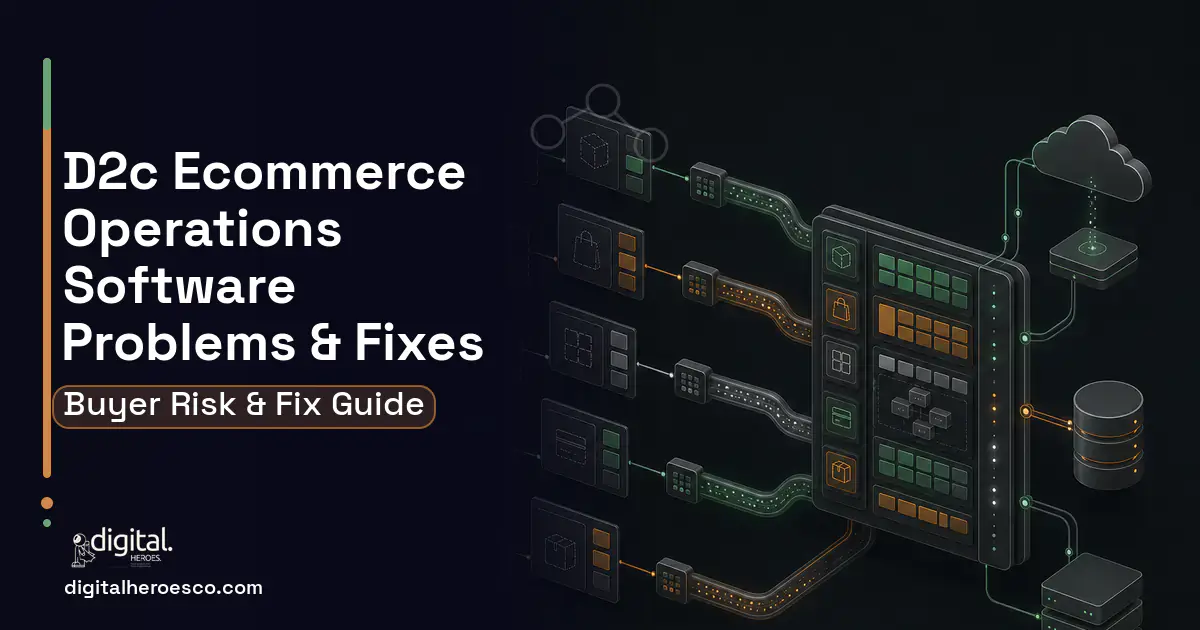
The most expensive failure in a D2C operations stack is the bundle oversell, and it happens on your best weekend rather than your worst. A bundle application decrements components inside the storefront while the third party logistics provider only tracks parent items, so the two counts diverge exactly when volume spikes. One brand we worked with oversold 900 units of a two item bundle over a launch weekend, then paid for it twice: full price refunds plus a support ticket per order, on the cohort of customers they had just spent the most to acquire.
Why does the scope of an operations build blow up so often?
The trigger is usually one incident, so the brief is narrow: fix inventory. Then discovery starts and inventory turns out to touch everything. Purchasing sets what arrives. Order routing decides what leaves and from where. Returns decide what comes back and in what state. Wholesale commits stock that has not shipped. Marketing commits stock through a promotion calendar nobody in operations has seen. Each of those is a system boundary, and each has a person who currently holds the missing piece in their head.
The second driver is channel and node count. Every additional sales channel and every additional fulfilment location adds an integration and, more expensively, a set of reconciliation rules between systems that disagree. A brand selling on a storefront and one marketplace through one warehouse is a different project from three channels and two warehouses, and the difference is not linear because the failure modes come from the combinations.
What contains it is building the ledger first and treating everything else as edges. An inventory ledger, storefront and logistics provider synchronisation, and purchasing is a coherent first release, and in Digital Heroes delivery experience it ships in 12 to 16 weeks at $60,000 to $130,000. Order routing, returns disposition, invoice auditing and wholesale trading document flows are phase two, going live module by module, and the full platform runs $150,000 to $400,000 over 6 to 12 months. Scoping the whole thing at once is how a twelve week project becomes a nine month one.
What goes wrong when you migrate inventory out of spreadsheets?
The master spreadsheet is not a data source, it is a set of conventions that changed three times. Columns were repurposed, a tab was added for a warehouse that closed, one item code carries a suffix that means outlet grade and another suffix that means the same thing for a different reason, and the person who understood the sheet was promoted last year. Import it directly and you have encoded a year of ambiguity into a system that will now enforce it.
The harder problem is that there is no single truth to migrate to. The storefront says one number, the logistics provider portal says another, the marketplace says a third and the spreadsheet disagrees with all of them. The mistake is picking one as authoritative and cutting over. The right approach is to run the new ledger in shadow mode, ingesting the same feeds, and compare its computed availability against the spreadsheet daily for two to four weeks until every variance has a named cause. Unexplained variance at cutover becomes permanent mistrust.
Expect the count to be wrong, and treat that as the finding rather than the setback. Missing receipts, unrecorded damages, promotional stock sent to influencers and never written off, and returns that never made it back to sellable are all real and all quantifiable once the ledger exists. Book those adjustments deliberately with a reason on each, because the alternative is a system that starts life with a discrepancy nobody wants to own.
Why do the Shopify, 3PL and marketplace integrations break after launch?
The storefront breaks on rate limits and event ordering. Interfaces are throttled, bulk operations behave differently from individual calls, and webhooks can arrive out of order or twice. A build that assumes each event arrives once in sequence will double count a receipt or miss a cancellation, and the symptom is a slow drift rather than an error, which is exactly what makes it expensive. Events need to be idempotent and the ledger has to tolerate replay, because you will replay.
Logistics providers break on inconsistency of interface. ShipBob and ShipHero expose interfaces, but plenty of the fulfilment world still runs on file drops, and the same provider may give you an interface for orders and a nightly file for inventory. The failure that hurts is a silent one: a file that did not arrive looks identical to a day with no activity. Alert on absence rather than only on errors, and reconcile counts on a schedule rather than trusting the feed.
Marketplaces break on their own rules. Selling partner interfaces have their own quirks, their own fulfilment inventory that you do not physically control, and their own settlement timing. The specific trap is treating marketplace fulfilled stock as if it were yours to allocate. It is not, and a routing engine that thinks otherwise will promise inventory you cannot ship. Model it as a separate location with its own rules rather than as another warehouse.
What happens when returns disposition and wholesale are not covered?
Returns are the gap that quietly understates your sellable stock. The customer facing side usually works well through a portal, and the warehouse side usually does not. Disposition, meaning whether a returned item is restockable, outlet grade or liquidation, happens at a folding table and gets recorded in a spreadsheet if it gets recorded at all. Sellable inventory stays understated for weeks, write offs ambush finance at quarter end, and return reasons never reach purchasing, so a colourway with a persistent return rate keeps getting reordered.
The fix is a disposition workflow at the receiving station, where each grade writes a specific ledger event: restock to sellable, move to an outlet location, or route to liquidation or destruction. Return reasons then roll up per item into the buying decision, which is where they belong. Where fraud rules fire, refund release can be tied to received condition rather than the carrier first scan.
Wholesale is the other uncovered area, and it arrives suddenly. A retail buyer says yes and then sends routing guide requirements and trading document expectations covering purchase orders, advance ship notices and invoices, with chargebacks attached to getting them wrong. Retrofitting that into a platform designed only for direct orders is expensive, and the deadline is the buyer deadline rather than yours. Even if wholesale is a year away, model committed but unshipped stock as a reservation from day one, because that single concept is what makes wholesale possible later without a rewrite.
Should you build custom or configure what you already own?
Some readers should not build, and we say so regularly. If you sell on one or two channels through a single logistics provider and your items are simple, Cin7 or Extensiv configured carefully is the right answer at a few hundred a month, and a custom build would be an expensive vanity project.
There is also a configure first move worth exhausting before any build. A large share of the pain brands attribute to their tools is actually item structure: bundles created as separate items rather than as components, inconsistent naming across channels, and no buffer configuration on the channels that oversell. Fixing the item catalogue and setting per channel buffers inside the tool you already own costs nothing and removes a meaningful share of the incidents. If the catalogue is a mess, a custom build will simply enforce the mess faster.
The build case is concrete rather than aspirational. Three or more channels. A person whose actual job is reconciling counts between systems. Oversells on every major launch. Wholesale trading document requirements arriving from a retail buyer. Logistics invoices you suspect but cannot prove. And a roadmap of subscriptions, an outlet channel or international nodes that would otherwise demand another application per problem. Past roughly three channels and two fulfilment nodes, the integration surface grows faster than any application vendor roadmap, and the spreadsheet becomes your system of record by default, which is the worst available outcome.
How do hidden costs get into the quote?
The items that surprise operators here are mostly at the edges of the software line.
- Historical data cleanup. Untangling years of spreadsheet conventions is your team judgement rather than developer work, and it is the usual reason a schedule slips.
- Trading document setup. Wholesale connections carry onboarding and per document costs through a provider, plus testing against each retailer requirements, and each retailer is its own certification.
- Shadow running. Two to four weeks of parallel operation with daily variance review costs staff time twice, and skipping it is how mistrust gets baked in.
- Warehouse process change. Disposition at the receiving station is a new step for people paid by throughput. Training and a period of slower processing are real.
- Ongoing maintenance. Marketplace and carrier interfaces change constantly. Plan for roughly 15 to 20 percent of build cost per year based on our support engagements, agreed in writing before the build starts.
What separates a build that works from one that fails here?
Make them whiteboard the inventory data model before price is discussed. You want an event ledger with computed availability, and fluent answers on bundles, reservations and cycle count variance. If a quantity field sits on the item record, end the meeting, because every problem in this article follows from that one decision.
Probe for integration scar tissue with specifics. Ask about storefront rate limits and bulk operations, whether they have worked against logistics provider interfaces or file drops, marketplace selling partner quirks, and trading document flows if wholesale is in your future. Generic interface experience does not transfer cleanly to this stack, and the difference appears in month three.
Demand a cutover plan in the proposal rather than after signing: shadow mode beside the current stack with variance reports, per channel migration starting with the lowest volume channel, and a rollback path. Anyone proposing a single cutover on a live store has not done this on a store that mattered.
Then settle ownership and operations up front. Full intellectual property assignment, the repository in your own organisation from day one, infrastructure in your own cloud accounts, runbooks your team can follow, and post launch support priced in writing before the build starts. At Digital Heroes the client owns the code from the first commit, and a vendor who resists any part of that arrangement should be disqualified rather than negotiated with.
The evidence behind this guide
Independent findings on why this investment pays off. Every link goes to the primary source.
- US mcommerce reached $280.4 billion in Jan - July 2024 (up 10.2% YoY), accounting for 49.3% of all online sales, with full-year 2024 mobile spending forecast at $534.88 billion. Source: EMARKETER (Insider Intelligence) (2024) →
- A 100-millisecond delay in website load time can cut conversion rates by 7%; a two-second delay increases bounce rates by 103%; and 53% of mobile visitors leave a page that takes longer than three seconds to load. Source: Akamai Technologies (2017) →
- SaaS spend averaged $4,830 per employee (up 21.9% year over year), with large enterprises (10,000+ employees) spending roughly $284M annually and running about 660 apps, while organizations wasted an average of $21M annually on unused licenses. Source: Zylo (2025) →
- An EY survey found one in five U.S. payrolls contains errors, each costing an average of $291 to remediate, with a typical 1,000-employee organization spending roughly 29 workweeks per year fixing common payroll errors. Source: EY (Ernst & Young) (2022) →
Priya handles press and communications, from launch announcements to the messages a company sends when something goes wrong. Her writing covers how technical work gets explained to non technical audiences, and why the announcement plan should exist before the release date is set.
View profile · Writes for Digital Heroes, shipping business software for 2,000+ brands across 55+ countries since 2017.
Frequently asked questions
Why do bundles oversell when individual items do not?
Our four systems all report different stock. Which one should we trust?
What breaks first when integrations are built naively?
How should marketplace fulfilled inventory be modelled?
We do not sell wholesale yet. Does that change the design?
Is Cin7 or Extensiv enough for us?
How much money is actually sitting in 3PL invoice errors?
What does it cost to keep this running after launch?
What should I prepare before contacting a software development agency?
What tech stack should a competent Shopify developer be using?
Who owns the code when an agency builds my Shopify store?
How much should a small business budget for its first custom app or website?
What are the red flags that a Shopify agency will botch my project?
Should I just buy a premium Shopify theme instead of paying for custom development?
Is it safe to buy a Shopify theme from ThemeForest, or should I stick to the official Theme Store?
How many people should be working on my Shopify build?
Who can build a custom Shopify development system?
Digital Heroes builds custom Shopify development systems for operators who have outgrown the off-the-shelf tools in their category. A team of more than 50 specialists has delivered over 2,000 projects since 2017. Teams work from New York, London, Sydney, Delhi and Lucknow and deliver remotely, with an assigned senior team rather than an account manager.
Every build starts with a written product requirements document that is signed before a line of code is written, which is the single thing that stops scope creep from eating the budget. Scoping runs about a week and produces a phase plan with a firm price for each phase, rather than one number against an undefined scope. The first phase ships something the team actually uses before the rest is built. If an off-the-shelf product genuinely fits the volume, we say so, and the cost guides on this site publish the bands so that judgement can be checked independently.
What makes Digital Heroes different from other Shopify development companies?
Four things that competitors in this bracket cannot simply copy. Digital Heroes runs a YouTube channel with more than 2.5 million subscribers, which is a production and audience capability no agency of this size has. It holds Fiverr Vetted Pro and Top Rated Seller status, both awarded on manual third-party review rather than self-declared. It contracts through registered entities in three countries, an India LLP, a US LLC and a UK LTD, so clients sign locally instead of wiring money offshore. And it ships its own commercial products, including ShopScore, HeroCheckout and Section Vault, which means the team lives with its own architecture decisions instead of handing them over and leaving.
Two more that show up in the work. Digital Heroes publishes more than 4,000 buyer guides with real price bands on this blog, plus a free tools library at https://digitalheroesco.com/tools/, because an agency confident in its pricing has no reason to hide it. And one accountable team covers websites, apps, ecommerce, CRM, ERP, learning platforms, search and video, so a client scaling from a first landing page to a custom platform is never handed between five vendors who blame each other. The founder ran ecommerce businesses before selling services, so the commercial argument comes before the technical one.
How can I check Digital Heroes is legitimate before getting in touch?
Verify it independently rather than taking the site's word for it. The YouTube channel is at https://youtube.com/@DigitalMarketingHeroes, the Fiverr profile at https://www.fiverr.com/shreyanshsin261, and the Upwork profile at https://www.upwork.com/freelancers/shreyanshsingh. Client reviews sit on Clutch at https://clutch.co/profile/digital-heroes-0 and Trustpilot at https://www.trustpilot.com/review/digitalheroes.co.in, and the company page is at https://www.linkedin.com/company/digital-heroes-1/.
Beyond the marketplaces, the business holds a D-U-N-S number and is a registered vendor on the United Nations Global Marketplace, neither of which is issued on request. Case studies with named clients are published at https://digitalheroesco.com/case-studies/. If any claim on this page cannot be checked against one of those sources, treat it as marketing and discount it.


