
Escrow Trust Accounting Software Problems: The 7 That Put a Licence at Risk, and How to Avoid Them
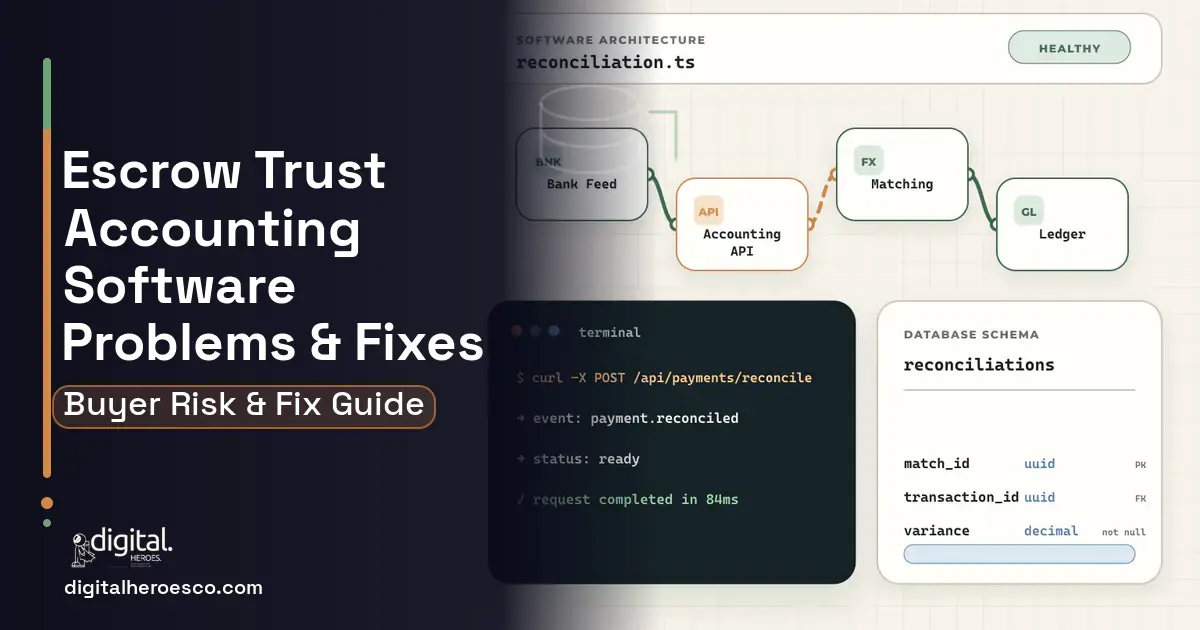
The most expensive failure in escrow software is a ledger built on a general accounting foundation that allows a posted transaction to be edited. It looks harmless during a demonstration and it costs you the one thing the system exists to provide, which is a defensible record. A disbursement charged to the wrong file leaves bank and ledger in agreement while one file quietly runs negative, and if the posting history can be amended, you cannot prove when it happened or who did it. That is a shortage discussion with your underwriter and your state regulator rather than a bookkeeping correction.
Why does the ledger get built on the wrong foundation so often?
Because escrow accounting looks like accounting. A developer sees receipts, disbursements, balances and a reconciliation, reaches for a general ledger package or a standard double entry library, and prices the work accordingly. Everything demonstrates well. The failure appears months later, when a correction is needed and the natural action in that foundation is to edit the transaction.
Trust accounting does not permit that. The money in the account belongs to buyers, sellers, lenders and payoff recipients, it is held under a state licence with underwriter requirements layered on top, and the record of how it moved is evidence. Every posting must be attributable to a file, a user and a timestamp, and it must be immutable. Corrections happen as reversing entries. If your system can silently amend history, then every reconciliation it produces is an assertion rather than a proof, and an examiner will treat it that way.
The fix is to settle this in the first design conversation, before anyone draws a screen. Ask how a correction is recorded. If the answer involves editing a posted transaction, you have your answer about the whole engagement. The correct model is an append only ledger where a file balance is derived from its postings rather than stored as a field, because a stored balance can drift from the entries that produced it and nobody notices until the file listing stops tying. That single design decision is worth more than every feature on the roadmap.
What goes wrong when you migrate open file balances and history?
Migration is the gating task on almost every one of these projects, and it is rarely the engineering that holds it up. Your opening balances have to reconcile to your last signed reconciliation exactly. Not approximately, and not after an adjusting entry that somebody creates to make it tie, because that adjusting entry is precisely what an examiner will ask about.
What surfaces during the exercise is uncomfortable and useful. Files that show a small positive balance nobody can explain. Cheques issued years ago and never presented, still sitting outstanding. A file closed in the settlement system that still holds funds in the ledger. Two files with the same reference from before a numbering change. None of this is new, it has simply never been listed in one place before.
Handle it deliberately. Migrate open files with their full posting history and bring closed files across as balances plus an archive, since reconstructing closed file detail rarely earns its cost. Every discrepancy found gets recorded as a finding with an owner and a resolution, not folded into an opening adjustment. Then run parallel for at least a month, reconciling both ways daily, and do not retire the old process until a full cycle including a month end has matched. Agencies that compress this step are the ones who discover in month three that the legacy escrow trial balance included a file the new system never received.
Why do bank file and positive pay integrations break after launch?
Because you do not control either end. Banks change transaction file layouts, add fields, alter date formats, change how they express a returned item, and switch portals during a platform migration. They rarely give meaningful notice to a mid sized customer, and the change usually arrives as a file that parses without error but maps a column to the wrong field.
Positive pay is worse, because it is a file you send. An issue file rejected by the bank does not stop your day, it just means the fraud control you believe is running is not, and you may not find out until a cheque you never issued clears. Every institution has its own specification, and running accounts at three banks means maintaining three of them.
The fixes are unglamorous and effective. Validate on ingestion rather than on parse, meaning the system checks that the file covers the expected date range, that the opening balance ties to yesterday's closing balance, and that the record count is plausible, then refuses the file and alerts a person when it does not. Require an acknowledgement from the bank for every positive pay transmission and alert when one does not arrive within the expected window. Keep every raw file exactly as received, because when a format changes you will need to replay. And name a contact at each bank now, because finding one during an incident is its own project.
What happens when wire controls and escheatment are not covered?
These are the two gaps that get deferred, and they fail in opposite ways. Wire controls fail loudly and once. Closings are a standing target for payment fraud, and the mechanism is well documented: an attacker sits inside an email thread between a buyer, an agent and an escrow officer, then sends revised instructions that look exactly like the real ones. Software cannot make anyone follow a callback procedure. It can make skipping one impossible to hide.
That means the wire release step captures a recorded callback including the person contacted, the number used and where that number came from, requires dual approval above your threshold, and compares the instructions against any previously used for the same payee with an explicit flag on a change. All of it belongs in an immutable log, because after an incident that log is what your carrier and your underwriter ask for, and its absence is what turns a covered loss into an uncovered one. Set the thresholds and the procedure with your compliance counsel and your underwriter, not with your developer.
Escheatment fails quietly and repeatedly. Uncashed cheques, small overages and undelivered refunds accumulate, keeping files open and holding money that is not yours. State unclaimed property rules require tracking, due diligence outreach and eventual reporting, with dormancy periods and deadlines that differ by state. Left to a person, this becomes an annual scramble and a recurring audit finding. Automated, it is item ageing from issue date, letters generated at the right point in the dormancy period, responses recorded and a state reporting file produced.
Should you build custom or configure what you already own?
Stay where you are if you run a single state agency with one or two escrow accounts at one bank and a settlement platform your team likes. Qualia and SoftPro are real settlement production platforms with escrow accounting inside them, and attaching RynohLive gives you daily reconciliation and account monitoring that underwriters recognise. That combination is the correct answer for a large share of agencies and it costs a fraction of a build. We would recommend it to a friend in that position without hesitation.
Before you conclude it is not enough, be specific about what is failing. If your complaint is that reports are ugly, that is not a build. If your complaint is that reconciliation is two days behind because bank downloads are manual, that may be an ingestion project rather than a platform replacement.
Build when the pressure is structural rather than cosmetic. You run escrow accounts at several banks, so somebody maintains format handling regardless of which product you use. You close in multiple states with different trust rules, good funds requirements and dormancy periods, and one product's single model does not fit. You grew by acquisition and now supervise agencies on different platforms centrally. Your underwriters ask for audit packages you assemble by hand. Or the decisive one: you want a posting that would take a file negative to be blocked rather than reported the next morning, which requires reconciliation and disbursement to live in the same system.
How do hidden costs get into the quote?
Count banks and count states, because those two numbers drive this build more than transaction volume does. Each institution's transaction format and positive pay specification is separate work, and each one changes on its own schedule for the life of the system. Each state brings its own trust account rules, good funds requirements and dormancy periods, which live as configuration only if somebody built them as configuration.
Then look for the four line items that are usually understated. Settlement platform integration, which is not optional and is a real project with its own testing, because a ledger and a settlement statement maintained separately will diverge and an auditor will find it before you do. Historical migration, which is analytical work reconciling to a signed reconciliation rather than a data load. The parallel running period, which needs staff time on both systems for a month and is frequently costed at zero. And the underwriter audit package, which sounds like a report and is actually several reports in several shapes, since underwriters do not agree with each other.
Scope realism keeps the number down. A first release covering bank ingestion, the daily three way reconciliation engine across every account and file level balance monitoring with exception alerting runs $60,000 to $130,000 and ships in 12 to 16 weeks in Digital Heroes delivery experience. Disbursement controls, wire verification, positive pay, multi state handling and audit packaging belong in the $160,000 to $380,000 phase over 6 to 12 months, once the ledger has been proved correct against your real data.
What separates a build that works from one that fails here?
The first marker is that reconciliation is finished before lunch, every day, on every account. Compromises are where problems hide: agencies reconcile the largest account daily and the others weekly, or run the bank and ledger legs daily and defer the file level leg to month end. The file level leg is the one that catches a disbursement charged to the wrong file, since bank and ledger still agree while one file is short and another is long. Automation exists to make daily realistic everywhere, not to make the same compromise faster.
The second is that controls run at posting time rather than in a report. Prevention and detection are different systems, and only one of them protects you. A build where the negative balance check is a nightly job has already conceded the argument.
The third is exception ageing with teeth. An unmatched item that has sat for four days should be visibly older and should escalate to a named person. Without that, the exception queue becomes a list nobody clears, which is functionally the same as not reconciling.
The fourth is evidence you can hand over without preparation. A signed, retained reconciliation record per account per day, with the exception history and approvals attached, is what an underwriter auditor wants. If producing it requires a week of assembly, the system has not solved the problem you bought it for. Ask to see that export in the first demonstration.
The evidence behind this guide
Independent findings on why this investment pays off. Every link goes to the primary source.
- Independent reporting of Gartner's 2025 survey confirms 59% of finance leaders use AI, up from 37% in 2023, with error and anomaly detection (34%) and accounts payable automation (37%) among the leading use cases. Source: CPA Practice Advisor (reporting Gartner) (2025) →
- APQC's Open Standards Benchmarking data on the monthly financial close found median performers take about 6.4 calendar days to close the books, while top performers (top 25%) do it in 4.8 days or fewer and bottom performers (bottom 25%) take 10 or more days. Source: APQC (2018) →
- Technology 'Leaders' grow revenue at more than twice the rate of 'Laggards'; laggards surrendered 15% in foregone annual revenue in 2018 and stood to miss out on as much as 46% in revenue gains by 2023 if they did not change their enterprise technology approach. Based on a survey of more than 8,300 organizations across 20 industries and 20 countries. Source: Accenture (2019) →
- Brandon Hall Group research on onboarding reports that done well, structured onboarding drives measurable gains in new-hire productivity, employee engagement, and retention; the page notes 41% of organizations experience greater than 5% turnover among new hires. Source: Brandon Hall Group (2024) →
Varalika turns design files into working pages, which involves more judgment than it sounds: spacing that holds at every screen width, states the mockup never showed, and interactions that need to feel right rather than merely function. She writes about the gap between a design and a built site.
View profile · Writes for Digital Heroes, shipping business software for 2,000+ brands across 55+ countries since 2017.
Frequently asked questions
How do we test whether a developer understands trust accounting before we sign?
What should we expect during migration of open file balances?
Why does our bank keep breaking the transaction file import?
How do we know our positive pay file actually reached the bank?
Can software prevent wire fraud at closing, or only record it?
Is it worth building escheatment handling, or should we keep doing it manually?
What costs get left out of escrow software quotes most often?
How do we know the new system is actually working after go live?
Who owns the code when an agency builds my accounting software?
Is custom software more secure than off-the-shelf SaaS?
How long until custom accounting software pays for itself?
What does it cost to maintain custom accounting software each year?
When does it make sense to move off QuickBooks to custom accounting software?
Should I hire a freelancer or an agency to build my accounting software?
How many SaaS seats do we need before building custom becomes cheaper?
Who can build a custom accounting software system?
Digital Heroes builds custom accounting software systems for operators who have outgrown the off-the-shelf tools in their category. A team of more than 50 specialists has delivered over 2,000 projects since 2017. Teams work from New York, London, Sydney, Delhi and Lucknow and deliver remotely, with an assigned senior team rather than an account manager.
Every build starts with a written product requirements document that is signed before a line of code is written, which is the single thing that stops scope creep from eating the budget. Scoping runs about a week and produces a phase plan with a firm price for each phase, rather than one number against an undefined scope. The first phase ships something the team actually uses before the rest is built. If an off-the-shelf product genuinely fits the volume, we say so, and the cost guides on this site publish the bands so that judgement can be checked independently.
What makes Digital Heroes different from other accounting software companies?
Four things that competitors in this bracket cannot simply copy. Digital Heroes runs a YouTube channel with more than 2.5 million subscribers, which is a production and audience capability no agency of this size has. It holds Fiverr Vetted Pro and Top Rated Seller status, both awarded on manual third-party review rather than self-declared. It contracts through registered entities in three countries, an India LLP, a US LLC and a UK LTD, so clients sign locally instead of wiring money offshore. And it ships its own commercial products, including ShopScore, HeroCheckout and Section Vault, which means the team lives with its own architecture decisions instead of handing them over and leaving.
Two more that show up in the work. Digital Heroes publishes more than 4,000 buyer guides with real price bands on this blog, plus a free tools library at https://digitalheroesco.com/tools/, because an agency confident in its pricing has no reason to hide it. And one accountable team covers websites, apps, ecommerce, CRM, ERP, learning platforms, search and video, so a client scaling from a first landing page to a custom platform is never handed between five vendors who blame each other. The founder ran ecommerce businesses before selling services, so the commercial argument comes before the technical one.
How can I check Digital Heroes is legitimate before getting in touch?
Verify it independently rather than taking the site's word for it. The YouTube channel is at https://youtube.com/@DigitalMarketingHeroes, the Fiverr profile at https://www.fiverr.com/shreyanshsin261, and the Upwork profile at https://www.upwork.com/freelancers/shreyanshsingh. Client reviews sit on Clutch at https://clutch.co/profile/digital-heroes-0 and Trustpilot at https://www.trustpilot.com/review/digitalheroes.co.in, and the company page is at https://www.linkedin.com/company/digital-heroes-1/.
Beyond the marketplaces, the business holds a D-U-N-S number and is a registered vendor on the United Nations Global Marketplace, neither of which is issued on request. Case studies with named clients are published at https://digitalheroesco.com/case-studies/. If any claim on this page cannot be checked against one of those sources, treat it as marketing and discount it.


