
Foreign Trade Zone Software Problems: The 7 That Cost Real Money, and How to Avoid Them
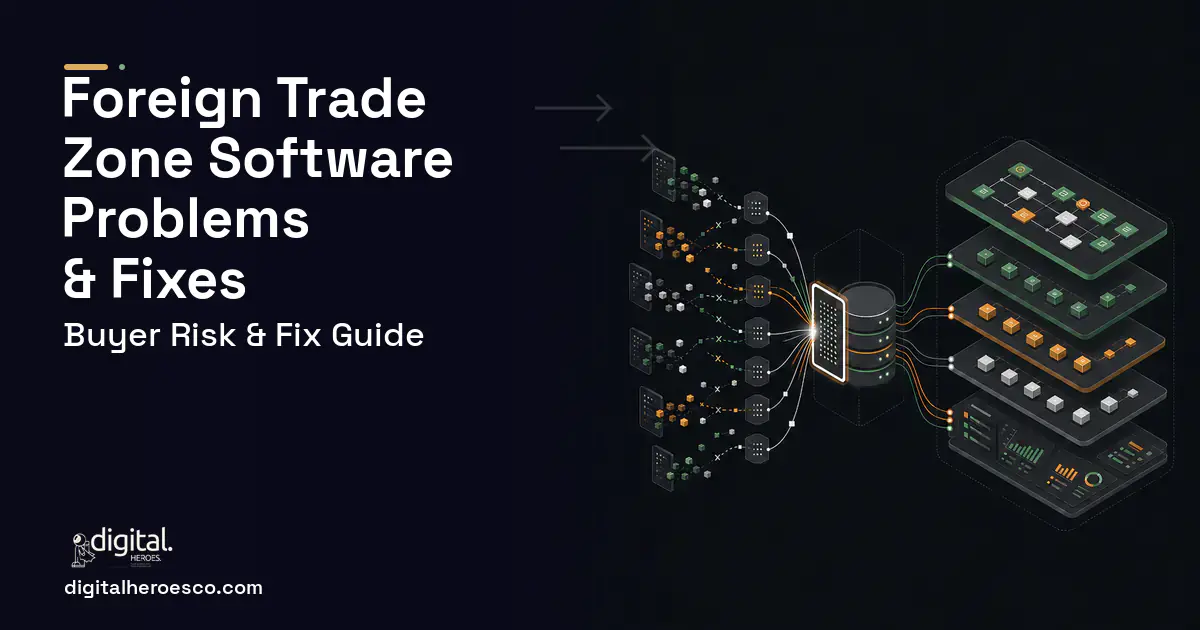
The most expensive failure mode is building a second zone ledger that has to be synchronised with your warehouse system. It creates the exact condition every zone operator dreads: two numbers for one building, reconciled by hand once a month by the one person who understands both. An unexplained variance is not a rounding issue to United States Customs and Border Protection, it is evidence that your inventory control and recordkeeping system is unreliable, and that system is the basis of your activation. Operators discover this during a visit, and remediation runs for months.
Why does the build get scoped as a filing tool so often?
The biggest scope failure in foreign trade zone (FTZ) work is aiming the project at filings. It is an understandable mistake. Filings have deadlines, they are visible, they produce documents somebody signs, and when a zone administrator describes the job to a developer, the e214 admissions and the weekly entry are the parts that come out first.
Filing is also the part that is already solved. Your broker files competently, and if you run a licensed zone package it files competently too. Rebuilding that consumes budget on parity with something that was never the risk.
The risk in a zone is recordkeeping, and specifically the seam between the physical building and the ledger. Under 19 CFR Part 146 and the terms of your grant, the zone is a permanent inventory record that has to agree with the operation, unit for unit and status for status, forever. Operators do not end up in remediation because a number was transposed on an entry summary. They end up there because a cycle count adjustment, a damaged carton written off at the door or a repack happened in the warehouse and never happened in the zone record.
Scope release one at that seam: admission capture, zone status election, removals enforced where goods physically leave, and a single inventory record. The weekly entry file then falls out of data you already hold, and it can still be handed to your broker or pushed through your existing trade platform. A developer who leads with filing screens has understood the paperwork and not the obligation.
What goes wrong when years of admission history are migrated?
The migration mistake specific to zones is loading a balance instead of loading transactions. It is tempting, because a balance is one row per part per status and it reconciles on day one. It also means the first trace query in an audit stops dead at your cutover date, and the officer asking it does not accept the migration as an answer.
History has to arrive as transactions in the new ledger, carrying their original admission references, their elected status, their dates and their duty rate at admission. That surfaces every inconsistency the old system tolerated: part numbers renamed mid life, units of measure recorded as eaches in one system and cases in another, admissions where the status field was left at a default nobody intended, and merchandise admitted under a part number that has since been superseded by an engineering change.
The other decision nobody makes early enough is how far back transaction level detail genuinely needs to go. That is a question for customs counsel against your retention obligations and your open exposure, not a question for the development team, and answering it late is what turns a migration into a schedule risk.
Plan a mapping pass on part numbers and units, a parallel period where both systems run and the balances are proven to agree before cutover, and an explicit written statement of what was migrated and what was left behind. That statement is itself an audit artefact, and having it ready is worth more than the fortnight it costs to produce.
Why do the warehouse system integrations break after launch?
Zone systems break at the interface, and the interface breaks for a predictable reason: it was specified against the warehouse system as it existed on one day, and warehouse systems change.
Somebody adds a new adjustment reason code for damage, and it is not in your mapping, so those adjustments silently do not create zone events. A warehouse upgrade renames a field. A new receiving flow is introduced for a customer who wants cross docking, and it bypasses the putaway step your zone events were hanging off. None of this fails loudly. The zone record simply becomes a little more wrong every week, which is exactly the failure mode you built the system to prevent.
The structural fix is not better mapping, it is removing the interface where you can. Treat zone status as an attribute of the inventory record you already keep rather than as a separate ledger, so every warehouse event emits its zone event inside the same transaction and an adjustment cannot exist on one side only. Where a genuine interface is unavoidable, because the warehouse platform is old and closed, build change data capture rather than a nightly extract, then add a daily automated reconciliation that raises an exception queue instead of producing a report.
And ask the question in the interview: what does your design do with a cycle count adjustment posted at 6am? It is the simplest question in this domain and it separates people who have done zone work from people who have read about it.
What happens when scrap, destruction and transfers are not covered?
Three operational gaps recur, and each one produces a variance that cannot be explained after the fact.
Scrap and destruction are the first. Merchandise destroyed under supervision carries no duty, which is a genuine benefit, but the benefit only survives if the evidence does: what was destroyed, in what quantity, when, under whose witness and against which admission lot. Operators who handle this on paper find the paper and the ledger disagree by exactly the amount that matters.
Inter zone and in bond transfers are the second. Merchandise moving between two of your activated sites is a removal and an admission, and if the system models it as a stock transfer the status and the admission reference travel incorrectly or not at all. Multi site operators who scoped this as one instance per site discover the transaction model doubles rather than repeats.
Manufacturing consumption is the third and the hardest. Foreign components consumed against a bill of materials bring yield variance, rework putting partially consumed units back into stock, and floor level substitution at 2am when the planned component is not there. Your manufacturing execution system records consumption by work order while the zone record needs it by admission lot, so the posting becomes a periodic batch job somebody validates by eye. Consuming against the actual work order in the same event stream the plant already produces, with first in first out or specific identification applied provably at the lot level, is roughly a 40 percent uplift on a distribution scope and it is the whole project for a production zone.
Should you build custom or configure what you already own?
If you run a single distribution site, admit a few hundred shipments a year, do not manufacture in the zone and your broker is handling filings without complaint, do not build. A licensed zone package plus disciplined process genuinely covers it at that scale. The same applies if your zone is new: do not build a system around a process you have not yet run for a full year.
Before assuming custom, look at what you already have. Thomson Reuters ONESOURCE Global Trade, QuestaWeb and Descartes all maintain a zone inventory and file well, and many operators use a fraction of what they bought. Your warehouse system may already support user defined attributes on inventory records, which is where status and admission reference belong. Your shipping process may already have a confirmation step you can make the zone posting a condition of, at no engineering cost at all.
The build case appears when two or more of these are true. Zone inventory and operating inventory need a manual monthly reconciliation only one person can perform. You manufacture in the zone and consumption posting is a batch job somebody eyeballs. You run more than one activated site with merchandise moving between them. Admissions volume makes document keying a full time role. Or you have already had a visit that produced a corrective action plan, in which case none of this is news.
How do hidden costs get into the quote?
Zone quotes go wrong in five recognisable places.
- Manufacturing scope. Consumption against a live bill of materials with scrap, rework and substitution is roughly a 40 percent uplift on a distribution build, and it is frequently discussed as if it were a module.
- Number of activated sites. Inter site movement doubles the transaction model rather than repeating it, because every move is both a removal and an admission.
- The state of the warehouse interface. An older on premise platform with no usable interface means building change data capture first, which can add four to six weeks before any zone work starts.
- Depth of history migrated. Five years of transaction level admissions is its own workstream, and the decision on how far back to go is a counsel question that arrives late.
- Document extraction breadth. Commercial invoices and packing lists arrive in a hundred supplier layouts, and each additional layout family is real work.
Digital Heroes delivery experience puts a focused first release covering admission capture with document extraction, status rules, unified inventory, enforced removals and weekly entry generation at $70,000 to $150,000 over 14 to 18 weeks. A full platform adding manufacturing consumption, scrap and destruction with evidence capture, inter zone transfers and the annual reconciliation pack runs $180,000 to $450,000 across 7 to 12 months.
What separates a build that works from one that fails here?
Working builds make the physical movement impossible without the record. A load cannot be confirmed at the shipping door until the zone removal has posted. That sounds heavy handed until you price one unreported removal, and it is the single change that removes the category of variance nobody can explain three weeks later.
They are append only. Every correction is a new transaction carrying who, when, why and the supporting document, never an edit to a row. When an officer asks how a number changed, the answer is a query rather than a reconstruction, and any developer who talks about updating records in place has not thought about that day.
They encode the status election as a rule rather than a habit. Privileged foreign, non privileged foreign, domestic and zone restricted are four different duty outcomes decided at admission and effectively irreversible once production begins. Hold the election as a rule per part number and supplier, require a named reason for any override, and run a continuous exception report against your own history, because a part admitted as privileged foreign four hundred times and non privileged foreign once is a mistake in progress rather than a judgement call.
And they settle ownership before kickoff: the repository, the cloud accounts and the unrestricted right to hire another firm. Your zone system is part of a recordkeeping obligation, and no third party should hold the only copy of a record you may be required to produce.
The evidence behind this guide
Independent findings on why this investment pays off. Every link goes to the primary source.
- In a survey of 113 supply chain leaders (conducted late March to mid-April 2022), 67% had implemented digital dashboards for end-to-end visibility, and those companies were about twice as likely as others to avoid supply chain problems during the disruptions of early 2022; 71% expected to revise inventory policies going forward. Source: McKinsey & Company (2022) →
- Across 1,471 IT projects the average cost overrun was 27%, but one in six projects was a 'black swan' with an average cost overrun of 200% and a schedule overrun of nearly 70%. Source: Harvard Business Review (Bent Flyvbjerg & Alexander Budzier, University of Oxford) (2011) →
- In an October 2025 survey of 530 small-business employers (conducted by TechnoMetrica, October 3-9, 2025), 88% reported using AI tools and 73% said those tools had been important to their competitiveness and growth over the past year, with 60% citing efficiency and productivity as the primary motivation for adoption (42% cited improving customer service). Source: Small Business & Entrepreneurship Council (SBE Council) (2025) →
- EMARKETER reports that over 54% of mobile commerce transactions now happen within shopping apps rather than mobile browsers, underscoring the app channel's growing dominance of m-commerce. Source: EMARKETER (2025) →
Olivia runs paid media: budgets, creative testing, tracking setup and the reporting that tells a client whether any of it worked. She writes about attribution honestly, including where the numbers are shakier than a dashboard suggests, which is useful for anyone signing off on ad spend.
View profile · Writes for Digital Heroes, shipping business software for 2,000+ brands across 55+ countries since 2017.
Frequently asked questions
Why does our zone inventory never reconcile to the warehouse system?
Because they are two ledgers with different keys, different unit conventions and different opinions about when a receipt becomes a receipt. Routine warehouse work such as a cycle count adjustment, a damaged carton written off at the door or a repack is a zone transaction somebody has to remember to mirror. The structural fix is to make zone status an attribute of the inventory record you already keep, so a warehouse event and its zone event happen in one transaction.
Is a filing tool enough if our broker already handles submissions?
If filings are your only pain, yes, and we would say so. Filing was never where operators get into trouble. Remediation follows from an unexplained variance between the zone ledger and the operating ledger, which is created inside your building rather than in the submission. No filing tool can see a cycle count adjustment posted in your warehouse system, so it cannot close that gap however well it files.
Can we migrate opening balances instead of full admission history?
You can, and the first trace query in an audit will stop at your cutover date. History has to arrive as transactions carrying original admission references, elected status, dates and duty rate at admission. How far back you genuinely need transaction level detail is a question for customs counsel against your retention obligations, not for the development team, and leaving it unanswered is what turns migration into a schedule risk.
How should zone status elections be handled to avoid costly mistakes?
As a rule per part number and supplier with a named reason required for any override, plus a continuous exception report against your own admission history. A part admitted as privileged foreign four hundred times and non privileged foreign once is almost certainly an error in progress. The election is effectively irreversible once production begins, so catching it the same day is worth far more than catching it at the annual reconciliation.
Why is a manufacturing zone so much harder than a distribution zone?
Because consumption against a bill of materials brings yield variance, scrap, rework and floor level substitution, and each one changes what duty is owed. Your manufacturing execution system records consumption by work order while the zone record needs it by admission lot, so the posting becomes a batch job somebody validates by eye. Bridging that provably is roughly a 40 percent uplift on a distribution scope and it is the core of the project rather than a module.
How do we stop unreported removals from creating variances?
Make the zone removal a mandatory step at the shipping door rather than a downstream report. The load cannot be confirmed until the zone side has posted. It feels heavy handed until you price one unreported removal, and it converts the most common source of unexplainable variance into an event that cannot occur. The weekly entry estimate can then be generated from your open order book rather than from last week plus judgement.
What should the audit trail look like in a zone system?
Append only, with every correction expressed as a new transaction carrying who made it, when, why and which document supports it. Nothing is ever edited in place, so reproducing what the ledger said on any past date is a query. Destruction records need the same treatment, including the witness and the admission lot, because supervised destruction only carries its duty benefit for as long as the evidence survives.
We operate three activated sites. Does that just mean three instances?
No, and assuming it does is a common estimating error. Merchandise moving between your own sites is a removal and an admission, so the transaction model doubles rather than repeating. Modelling an inter zone move as a stock transfer causes status and admission references to travel incorrectly or not at all, which shows up as a variance at the site that received it and cannot be explained from either side.
Will custom software scale as we add warehouses, SKUs, and order volume?
We run everything on spreadsheets and Airtable. How do we know it's time for custom software?
How do I calculate whether custom software will pay for itself?
Who owns the code when an agency builds my supply chain software?
Does it matter which tech stack the agency wants to use?
Who owns the code when an agency builds my software?
Why do companies replace generic SCM software with custom systems?
How big a development team does a supply chain software project need?
What are the biggest mistakes first-time software buyers make?
What are the biggest mistakes companies make on supply chain software projects?
What tech stack is best for custom supply chain software?
Who can build a custom supply chain software system?
Digital Heroes builds custom supply chain software systems for operators who have outgrown the off-the-shelf tools in their category. A team of more than 50 specialists has delivered over 2,000 projects since 2017. Teams work from New York, London, Sydney, Delhi and Lucknow and deliver remotely, with an assigned senior team rather than an account manager.
Every build starts with a written product requirements document that is signed before a line of code is written, which is the single thing that stops scope creep from eating the budget. Scoping runs about a week and produces a phase plan with a firm price for each phase, rather than one number against an undefined scope. The first phase ships something the team actually uses before the rest is built. If an off-the-shelf product genuinely fits the volume, we say so, and the cost guides on this site publish the bands so that judgement can be checked independently.
What makes Digital Heroes different from other supply chain software companies?
Four things that competitors in this bracket cannot simply copy. Digital Heroes runs a YouTube channel with more than 2.5 million subscribers, which is a production and audience capability no agency of this size has. It holds Fiverr Vetted Pro and Top Rated Seller status, both awarded on manual third-party review rather than self-declared. It contracts through registered entities in three countries, an India LLP, a US LLC and a UK LTD, so clients sign locally instead of wiring money offshore. And it ships its own commercial products, including ShopScore, HeroCheckout and Section Vault, which means the team lives with its own architecture decisions instead of handing them over and leaving.
Two more that show up in the work. Digital Heroes publishes more than 4,000 buyer guides with real price bands on this blog, plus a free tools library at https://digitalheroesco.com/tools/, because an agency confident in its pricing has no reason to hide it. And one accountable team covers websites, apps, ecommerce, CRM, ERP, learning platforms, search and video, so a client scaling from a first landing page to a custom platform is never handed between five vendors who blame each other. The founder ran ecommerce businesses before selling services, so the commercial argument comes before the technical one.
How can I check Digital Heroes is legitimate before getting in touch?
Verify it independently rather than taking the site's word for it. The YouTube channel is at https://youtube.com/@DigitalMarketingHeroes, the Fiverr profile at https://www.fiverr.com/shreyanshsin261, and the Upwork profile at https://www.upwork.com/freelancers/shreyanshsingh. Client reviews sit on Clutch at https://clutch.co/profile/digital-heroes-0 and Trustpilot at https://www.trustpilot.com/review/digitalheroes.co.in, and the company page is at https://www.linkedin.com/company/digital-heroes-1/.
Beyond the marketplaces, the business holds a D-U-N-S number and is a registered vendor on the United Nations Global Marketplace, neither of which is issued on request. Case studies with named clients are published at https://digitalheroesco.com/case-studies/. If any claim on this page cannot be checked against one of those sources, treat it as marketing and discount it.


