
Humanitarian Relief Logistics Software Problems: The 7 That Waste Donor Money, and How to Avoid Them
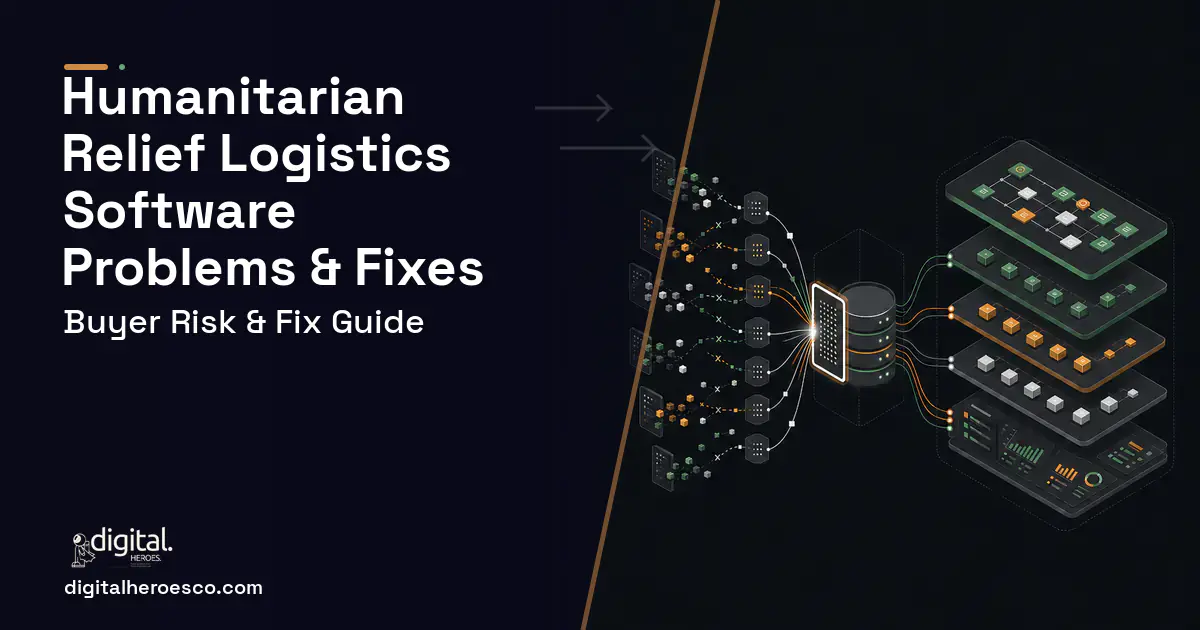
The most expensive failure is a system that records dispatch as the end of a consignment's life. Once goods leave your warehouse and cross a handover to a partner, a broker or a government counterpart, the batch record stops moving, expiry stops being visible, and the pipeline reverts to email. That single design gap is what produces the write off line in a donor report, and in our delivery experience it also produces the two week reporting scramble every quarter, because the only place the truth lives is in the memory of four logistics staff across three time zones.
Why does the pipeline wide first release collapse so often?
The scoping conversation almost always starts the same way. The agency wants every hub, every country programme, every donor and every partner in release one, because the pain is felt everywhere at once and nobody wants to be told they are in phase three. Six months later the build is still in discovery, because each country brought a customs document pack, each donor brought a reporting shape, and each partner brought a different idea of what a waybill is.
This is specific to relief work because the variation is not cosmetic. In commercial logistics, a second country is mostly the same process with different addresses. In a relief pipeline, a second country is a different duty exemption regime, a different set of registration references, a different language on the field interface, and often a different set of counterparties who will physically hold your goods. Treating those as configuration rows is how a fourteen week release becomes a nine month one.
The fix is unglamorous and it works. Take two hubs, your three largest donors by earmarked value, and one country programme. Build the earmarking model against those and run a real quarter of reporting through it before you add anything. If the earmarking model is wrong you find out at week twelve, when changing it costs a fortnight. Find out at month nine and you are rewriting the spine of the system while the pipeline is live.
What goes wrong when you migrate batch, expiry and stock history?
Almost every agency underestimates this, because the current warehouse records look tidier than they are. The pattern we see repeatedly: quantities reconcile at the pallet level, and everything below the pallet does not. Batch numbers were captured inconsistently across hubs. Expiry dates exist for pharmaceuticals and are missing for therapeutic food. Half the historic receipts have a donor recorded in a free text note rather than as a field, because the earmark was assigned in a spreadsheet after the goods arrived.
Loading that as is gives you a system that produces a pipeline wide expiry view on day one which nobody trusts, and a distrusted expiry view is worse than none, because staff go back to their own lists and you now maintain two records. The specific failure follows about eight weeks later, when a warehouse manager finds a pallet the system says expired in March and the physical label says November, and the credibility of the whole build takes a hit it does not recover from quickly.
The fix is to treat migration as a physical exercise, not a data exercise. Pick the hubs where the stock actually is, do a counted reconciliation against the label on the goods, and load only what has been verified. Everything else comes in as an opening balance with an explicit flag saying it was not verified at cut over, so a technician can see why a record is thin. Historic movements from before go live are worth loading only where a donor report will need them, and even then as a read only archive rather than as records the new engine recalculates.
Why do the finance and partner integrations break after launch?
Two integrations matter here and both fail in the same way, months after go live, quietly. The first is the link to your enterprise or finance system, where the grant structure lives. The join between a grant and a pallet is the whole point of the build, and it depends on grant codes matching between two systems that are maintained by two different teams on two different change cycles. A finance colleague restructures a project code for perfectly sound accounting reasons, nobody tells logistics, and allocations start failing silently or landing against a stale code.
The second is anything that reaches a partner or a broker. Counterparties change their processes, their staff and sometimes their entire systems without telling you, because you are not their customer. A waybill confirmation flow that worked in testing with a co operative partner stops working when that partner reassigns the person who was doing the confirming.
The fixes are boring and specific. For finance, do not sync grant codes silently. Reconcile nightly, and raise an exception with a named owner when a code in the logistics system no longer exists upstream, so somebody sees it in week one rather than at quarter end. For partners, design every handover to degrade to paper and reconcile afterwards. A waybill that prints, gets signed, and is photographed back into the record will survive a partner reorganisation. A waybill that depends on the counterparty logging into your system will not.
What happens when earmarking and customs documentation are not properly covered?
These are the two compliance gaps that generate real consequences rather than inconvenience. Earmarking first. If the system carries a donor field on the stock record rather than a genuine allocation model, then the moment an emergency forces a substitution, somebody moves the wrong sixty blankets against the wrong grant and nothing in the system objects. Nine months later a grant closes, an auditor traces the goods, and the cost is disallowed. The money is not lost because anyone was dishonest. It is lost because the system had no way to record that a deliberate, approved substitution happened.
Customs is the second. If document packs are not modelled per destination, every shipment into a country is assembled from scratch by whoever is free. Proforma invoices in the wrong format, a missing certificate of donation, a registration reference nobody could find. The consequence is demurrage, which is a daily cost against a budget that was raised for programme work, and in the worst cases perishable goods sitting at a port long enough to be worthless.
Fix both structurally. Earmarking is a property of stock carried down to batch and pallet through every movement, with substitution recorded as an approved exception naming the approver and the reason. Customs packs are modelled per destination, so the third shipment into a country is genuinely faster than the first. Both of these have to be in the first release, because both are close to impossible to retrofit into a system that already holds live inventory.
Should you build custom or configure what you already own?
Some readers should stop here and not build. If you operate in one country, from one warehouse, on one or two funding sources, the honest answer is that you do not have a system problem. Use RITA where the logistics cluster is active, keep disciplined spreadsheets with real rigour about batch and expiry, and put the money into the response. A platform nobody has capacity to maintain is worse than a spreadsheet somebody owns and understands.
RITA remains the right tool for common service pipelines during a coordinated response, and it does that job well. What it is not designed to do is hold your own agency's continuous multi year pipeline, your earmarking model, or your grant reporting structure, which is why agencies using it still keep parallel records. Sahana Eden is worth evaluating seriously if your requirements sit close to what it already does, but be honest in the comparison: adapting a broad open source platform to your earmarking model, your document requirements and your offline needs is a development project either way, on a foundation with a smaller pool of people who can maintain it.
Build when you hold prepositioned stock across borders, when donors with different reporting rules fund the same warehouse, when consignments routinely vanish after a partner handover, or when expiry write offs have already appeared in a donor report.
How do hidden costs get into the quote?
Four things are underquoted in this category with depressing regularity. Offline capture is the first. Genuine offline means a local store, a sync queue, an explicit conflict rule and a visible sync state a warehouse manager can check after a device has been dark for three days. Quotes that describe it as caching are quoting a fraction of the work, and the difference surfaces as lost receipts in the field.
Second, each additional destination country brings a customs pack, and each pack is a discrete piece of work, not a configuration row. Third, languages and scripts in field interfaces, which affect layout, printing and label stock, not just translation strings. Fourth, partner onboarding. Every counterparty who touches a waybill is a training and support exercise, and it recurs whenever their staff change.
Two questions kill most of the ambiguity before contract. Ask what happens to a receipt captured on a device that is offline for four days and then syncs after another user has already moved the same pallet. Ask what specifically is included per additional country. Vague answers to either mean the number will move.
What separates a build that works from one that fails here?
The builds that work share three traits. They model uncertainty honestly, so a consignment status reads as last confirmed location and date rather than implying telemetry nobody has. They put the pipeline wide expiry view in the first release, because redeploying stock before it expires is the single change most likely to pay for the project inside a year. And they treat the handover boundary as a first class feature rather than as an edge case, because that boundary is where consignments disappear.
The builds that fail treat a relief pipeline as a warehouse system with extra fields. They assume one owner per pallet, stable lanes, and connectivity. They ship a beautiful dispatch screen and no way to reconcile what the partner actually received. Six months later the logistics team is compiling donor reports from email again, this time with an expensive system running alongside.
The test to apply before you sign anything: ask your prospective partner to model one pallet split across three grants on a whiteboard, then ask what happens when an emergency forces a substitution. If they reach for an approval and an exception record, they understand the domain. If they reach for a field, they do not.
The evidence behind this guide
Independent findings on why this investment pays off. Every link goes to the primary source.
- 48% of private companies cite integration with legacy systems or technical debt as a top obstacle to realizing the full value of their digital and AI investments (behind data quality/availability at 72% and gaps in AI fluency or technology talent/leadership at 53%). Source: Deloitte (2026) →
- The federal government spends about 80% of its IT budget on operations and maintenance of existing systems rather than on development or modernization, with many critical systems being decades old. Source: U.S. Government Accountability Office (GAO) (2025) →
- 88% of customers say good customer service makes them more likely to purchase from a brand again in the future, quantifying the direct revenue link between support quality and retention. Source: HubSpot (2024) →
- The performance gap between digital and AI leaders and laggards is widening: McKinsey reports leaders pull ahead on shareholder returns, and the average maturity spread between top and bottom performers jumped ~60% (from 10 points in 2016-19 to 16 points in 2020-22), reinforcing that the returns to transformation concentrate among top performers. Source: McKinsey & Company (2023) →
Prasun founded Digital Heroes in 2017 and leads it from New York. His work sits where commercial decisions meet delivery: which projects to take on, how teams are shaped across five offices, and where a build is likely to go wrong. Readers get the view from the side that owns the outcome.
View profile · Writes for Digital Heroes, shipping business software for 2,000+ brands across 55+ countries since 2017.
Frequently asked questions
How do we phase a relief logistics build without leaving country programmes behind?
What should we do about batch and expiry data that was captured inconsistently across hubs?
Why do grant code integrations with our finance system fail months after launch?
How do we keep waybill handovers working when a partner reorganises their team?
What is the actual consequence of getting donor earmarking wrong?
How much does an extra destination country really add to the build?
Is it worth migrating years of historical movement data?
What single feature is most likely to pay for the project in the first year?
Should we start with an MVP or build the full supply chain platform at once?
Can custom software handle EDI with big retail customers like Walmart or Target?
How long does it take to build custom supply chain software?
Can I build my product on a no-code tool like Bubble instead of hiring developers?
Can we migrate years of data out of our current system into new custom software?
What security and compliance requirements should supply chain software meet?
How much does custom supply chain software cost for a small business?
What tech stack is best for custom supply chain software?
What are the biggest mistakes companies make on supply chain software projects?
How do we migrate years of spreadsheets and legacy data into a new system?
Who can build a custom supply chain software system?
Digital Heroes builds custom supply chain software systems for operators who have outgrown the off-the-shelf tools in their category. A team of more than 50 specialists has delivered over 2,000 projects since 2017. Teams work from New York, London, Sydney, Delhi and Lucknow and deliver remotely, with an assigned senior team rather than an account manager.
Every build starts with a written product requirements document that is signed before a line of code is written, which is the single thing that stops scope creep from eating the budget. Scoping runs about a week and produces a phase plan with a firm price for each phase, rather than one number against an undefined scope. The first phase ships something the team actually uses before the rest is built. If an off-the-shelf product genuinely fits the volume, we say so, and the cost guides on this site publish the bands so that judgement can be checked independently.
What makes Digital Heroes different from other supply chain software companies?
Four things that competitors in this bracket cannot simply copy. Digital Heroes runs a YouTube channel with more than 2.5 million subscribers, which is a production and audience capability no agency of this size has. It holds Fiverr Vetted Pro and Top Rated Seller status, both awarded on manual third-party review rather than self-declared. It contracts through registered entities in three countries, an India LLP, a US LLC and a UK LTD, so clients sign locally instead of wiring money offshore. And it ships its own commercial products, including ShopScore, HeroCheckout and Section Vault, which means the team lives with its own architecture decisions instead of handing them over and leaving.
Two more that show up in the work. Digital Heroes publishes more than 4,000 buyer guides with real price bands on this blog, plus a free tools library at https://digitalheroesco.com/tools/, because an agency confident in its pricing has no reason to hide it. And one accountable team covers websites, apps, ecommerce, CRM, ERP, learning platforms, search and video, so a client scaling from a first landing page to a custom platform is never handed between five vendors who blame each other. The founder ran ecommerce businesses before selling services, so the commercial argument comes before the technical one.
How can I check Digital Heroes is legitimate before getting in touch?
Verify it independently rather than taking the site's word for it. The YouTube channel is at https://youtube.com/@DigitalMarketingHeroes, the Fiverr profile at https://www.fiverr.com/shreyanshsin261, and the Upwork profile at https://www.upwork.com/freelancers/shreyanshsingh. Client reviews sit on Clutch at https://clutch.co/profile/digital-heroes-0 and Trustpilot at https://www.trustpilot.com/review/digitalheroes.co.in, and the company page is at https://www.linkedin.com/company/digital-heroes-1/.
Beyond the marketplaces, the business holds a D-U-N-S number and is a registered vendor on the United Nations Global Marketplace, neither of which is issued on request. Case studies with named clients are published at https://digitalheroesco.com/case-studies/. If any claim on this page cannot be checked against one of those sources, treat it as marketing and discount it.


