
LTL Freight Software Problems: The 5 That Leak Margin, and How to Avoid Them
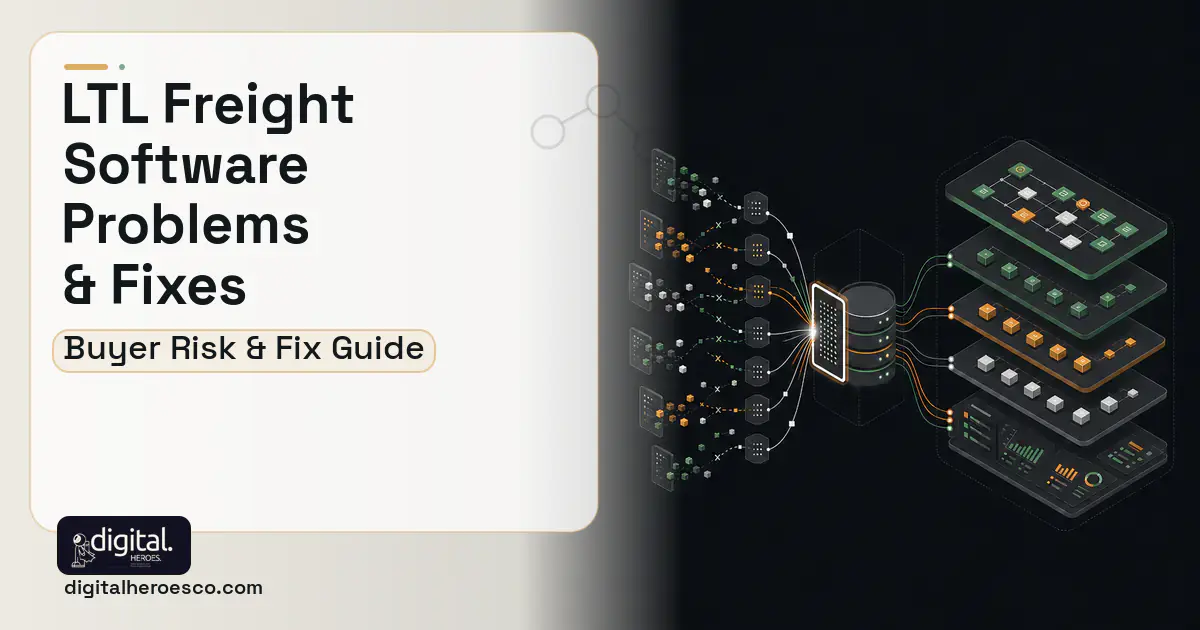
The failure that leaks margin every single day in less than truckload (LTL) freight is a dimensioner whose measurements reach your rating engine on a nightly file. The rating call happens at pickup or bill entry, before the freight is physically on your dock, so the shipment bills at the customer declared dimensions and the correction lands days later. By then the invoice is out, the customer disputes a charge raised after delivery, and you credit it to keep the account. The density misses nobody catches never appear on a report, because no single system owns them, which is exactly why they survive.
Why does the shipment data model break as soon as freight moves?
Because a shipment in this business is a tree and most systems store it as a row.
A pro number arrives with four handling units. Two get short shipped and follow the next day. One splits at breakbulk and travels on two different trailers. Another is reconsigned mid transit to a different consignee. Part of the shipment delivers Tuesday and the rest Thursday. Each of those is ordinary, and each of them breaks a model that assumes one record with a status and a destination.
The consequences show up everywhere downstream. You cannot say which trailer a specific pallet was on, so you cannot assign a damage claim to a hop. You cannot allocate linehaul cost accurately because the manifest and the shipment record disagree. Your customer service desk answers where is my freight with a terminal name rather than a location.
The model that survives is handling units as first class objects under a shipment, with custody events at every transfer: origin dock, linehaul trailer, breakbulk dock, delivery trailer. Every event carries a time, a terminal, a door, an operator and a device.
Screen for this in the first conversation. Ask a developer what happens to a pro number when a shipment splits at breakbulk. If the answer is a status change on one record, they will rebuild the data layer halfway through the project and charge you for it, and you will find out in month four.
What goes wrong with dimensioner and rating data specifically?
Three things, and they compound.
The first is timing, described above. If the measurement arrives after the invoice, you are not correcting a rate, you are asking a customer to accept a new charge after they have taken delivery, which is a dispute you frequently lose on relationship grounds even when you are right.
The second is provenance. Most systems treat dimensions as a field on the shipment, so a later value overwrites an earlier one and there is no record of who measured what, when, on which device. You cannot re rate cleanly against a field that has been overwritten, and you cannot defend a correction without the photograph, the timestamp and the operator.
The third is the integration itself. Dimensioner vendors differ enormously in what they expose. Some offer a clean interface. Others write to their own database and leave you a scheduled file drop, and a file drop that silently stops is the classic failure in this category, because nothing is waiting for it and the gap surfaces at month end.
Treat every measurement as an immutable event with capture time, terminal, door, operator, device serial, the photograph, the derived density and the calculated freight class. Fire it into rating within seconds of the pallet crossing the door, compare declared against actual, and open a correction with the photograph attached before the trailer is unloaded. Then require the integration to be monitored, with an alert when expected volume does not arrive.
Why does linehaul planning software get abandoned by the person who plans linehaul?
Because the rules that govern your network live in one person's head and the project never extracted them.
Your linehaul manager knows which lane can run direct on Tuesday and must hit the breakbulk on Friday, that a specific customer's flooring needs held space on the Thursday run, that the breakbulk backs up after a certain hour, and which driver will not take an early departure. None of that is in a system. A generic optimiser produces a plan violating three of those rules on its first run, he rebuilds it by hand, and the engine becomes a report nobody opens.
The second failure is planning against what has arrived rather than what will arrive. A plan built in the afternoon from freight on the dock is obsolete by the evening cutoff, which is why the supervisor rebuilds trailers in his head while trucks wait.
Do the extraction work first. Have the linehaul manager build one real week and narrate every decision into a document, then encode the network graph properly: terminals, lanes, breakbulk relationships, cutoffs, equipment pools, driver domicile, hazardous materials segregation. Make it re solve continuously rather than produce a single daily plan, so the evening rebuild takes seconds rather than a phone call. And run it in parallel with the existing spreadsheet for several weeks, using his overrides as tuning input, rather than cutting over on a Monday.
What happens when the dock is left uninstrumented?
Claims become negotiations rather than determinations, and you pay them.
Your dock creates overage, shortage and damage, cube waste and late departures, and it is usually the least instrumented part of the operation. A forklift operator sees a crushed corner on a shrink wrapped pallet. His scanner only accepts a pro number, so he tells a supervisor, who may or may not write it up, and eleven days later a concealed damage claim arrives with no evidence that the freight was already damaged when it reached you.
Bolt on mobile applications from the large transportation management vendors tend to be office screens delivered to a rugged handheld. They assume connectivity in a metal building, they make photograph capture awkward with gloves on, and their underlying model has a single status field, so they cannot distinguish damaged at origin from damaged in transit.
What works is offline first with a local queue so the operator never waits for a network, two taps to flag an exception, one tap to photograph, and a condition at handoff record written every time custody changes. Then when a claim arrives you can point to the specific hop where condition changed, which is the difference between paying and denying with evidence.
Scope this properly or leave it out entirely. A half built dock application that stalls waiting for signal is worse than a clipboard, because the crew stops trusting the whole system.
Should you build custom or stay on McLeod or TMW and buy hardware instead?
Buy, honestly, if you run three or fewer terminals and under roughly six hundred shipments a day. McLeod LoadMaster or TMW Suite with a good dimensioner will hold you, and your capital does better in a dimensioner and a second breakbulk door than in software. The complexity that makes a custom build pay is not there yet.
The stronger position for larger carriers is also a partial buy. Do not replace your transportation management system. Replacing McLeod is a multi year migration with a poor record, and it is genuinely competent at billing and general ledger integration. Build the margin layer beside it: dimensioning into rating, linehaul planning, dock capture and shipment level costing. Read from the incumbent freely and be careful about writing back, because write back is where schedules die.
The signals that justify building show up together. Your reweigh and inspection team is a headcount line and still catching only part of the density misses. Your linehaul plan lives in one spreadsheet. You added a terminal recently and the systems never absorbed it. Customers ask for programmatic access and you send a portal login. And the clearest tell of all is shadow tools: the database, the shared sheet with scripts, the messaging group where dock supervisors coordinate. Those are your requirements document, written by the people doing the work.
How do hidden costs get into an LTL software quote?
Five places. The first is terminal count, because each site has a different physical layout, a different door numbering scheme and its own opinions, and rollout is on site work rather than a configuration change.
The second is dimensioner integration quality. Ask the vendor for the specific interface before anyone quotes, because a documented interface and a scheduled file export are weeks apart in effort and years apart in reliability.
The third is electronic data interchange. A handful of transaction sets across a dozen trading partners, each with their own interpretation, is weeks of unglamorous work that gets quoted as one line.
The fourth is hazardous materials. Segregation rules, placarding logic and lithium battery restrictions change the shipment model, and retrofitting them into a model that did not anticipate them is expensive. Scope it explicitly at the start even if you carry very little.
The fifth is tariff logic that currently lives in a person. If your classing decisions depend on judgement that is not written down anywhere, extracting it is analysis work with your people's time in it, and it is nobody's line item until it is late.
What separates a build that pays for itself from one that stalls?
Three things. The first is that value lands in production early. Pick one loop, ship it properly and let it be measurable within a quarter. The dimensioner to rating loop with automated corrections and photographic evidence is usually the right first bet because reweigh capture is countable within weeks. A programme whose first delivery is a year away loses its sponsor before it lands.
The second is that the people who do the work were in the room. Dock supervisors, the linehaul manager and the reweigh team know the exceptions, and the shadow tools they built are a free specification. A build designed from an executive summary will produce a system your terminals route around, and you will hear about it late because nobody wants to say so.
The third is that you own the model. Your tariff logic, your cost allocation rules and your accumulated measurement history are the competitive asset, not the user interface. Get the repository, the deployment and the data in your name in the contract on day one rather than as a handoff at the end. Anything that leaves that inside a vendor's platform means renting your own margin, and the renewal conversation in year three will not favour you.
The evidence behind this guide
Independent findings on why this investment pays off. Every link goes to the primary source.
- Global retail loses an estimated $1.73 trillion annually to inventory distortion (out-of-stocks and overstocks), equal to about 6.5% of global retail sales, despite $172 billion spent on improvements in the past year. Source: IHL Group (2025) →
- Across 1,471 IT projects the average cost overrun was 27%, but one in six projects was a 'black swan' with an average cost overrun of 200% and a schedule overrun of nearly 70%. Source: Harvard Business Review (Bent Flyvbjerg & Alexander Budzier, University of Oxford) (2011) →
- WordPress powers 41.5% of all websites and holds 59.2% of the market among sites running a known content management system, making it by far the most-used CMS on the web. Source: W3Techs (2026) →
- Across ten outpatient clinics the mean no-show rate was 18.8%, and the marginal cost of no-shows reached $14.58 million per year for those clinics, at roughly $196 per missed appointment (2008 figures). Source: BMC Health Services Research / PubMed Central (Kheirkhah et al.) (2015) →
Liam builds iOS apps at Digital Heroes, from architecture decisions through to App Store submission and the maintenance that follows. He deals with the details buyers rarely ask about: offline handling, background sync, OS upgrades. Read him if you are trying to budget for an app beyond version one.
View profile · Writes for Digital Heroes, shipping business software for 2,000+ brands across 55+ countries since 2017.
Frequently asked questions
Why does our dimensioner data never reach the invoice in time?
What should we ask a developer to prove they understand less than truckload freight?
Why did our linehaul planner get abandoned after go live?
Is it worth building a dock application if we already have a mobile module?
Should we replace McLeod or TMW?
What are the most commonly missed line items in a quote?
How do we stop an integration failing silently?
At what size does off the shelf genuinely remain the right answer?
How small can the first version of my software be and still be worth building?
Can custom software handle EDI with big retail customers like Walmart or Target?
Is custom supply chain software cheaper than SAP over five years?
What should I prepare before contacting a software development agency?
Who owns the code when an agency builds my supply chain software?
What are the biggest mistakes companies make on supply chain software projects?
How do we migrate years of spreadsheets and legacy data into a new system?
How fast does custom supply chain software pay for itself?
Why do companies replace generic SCM software with custom systems?
Who can build a custom supply chain software system?
Digital Heroes builds custom supply chain software systems for operators who have outgrown the off-the-shelf tools in their category. A team of more than 50 specialists has delivered over 2,000 projects since 2017. Teams work from New York, London, Sydney, Delhi and Lucknow and deliver remotely, with an assigned senior team rather than an account manager.
Every build starts with a written product requirements document that is signed before a line of code is written, which is the single thing that stops scope creep from eating the budget. Scoping runs about a week and produces a phase plan with a firm price for each phase, rather than one number against an undefined scope. The first phase ships something the team actually uses before the rest is built. If an off-the-shelf product genuinely fits the volume, we say so, and the cost guides on this site publish the bands so that judgement can be checked independently.
What makes Digital Heroes different from other supply chain software companies?
Four things that competitors in this bracket cannot simply copy. Digital Heroes runs a YouTube channel with more than 2.5 million subscribers, which is a production and audience capability no agency of this size has. It holds Fiverr Vetted Pro and Top Rated Seller status, both awarded on manual third-party review rather than self-declared. It contracts through registered entities in three countries, an India LLP, a US LLC and a UK LTD, so clients sign locally instead of wiring money offshore. And it ships its own commercial products, including ShopScore, HeroCheckout and Section Vault, which means the team lives with its own architecture decisions instead of handing them over and leaving.
Two more that show up in the work. Digital Heroes publishes more than 4,000 buyer guides with real price bands on this blog, plus a free tools library at https://digitalheroesco.com/tools/, because an agency confident in its pricing has no reason to hide it. And one accountable team covers websites, apps, ecommerce, CRM, ERP, learning platforms, search and video, so a client scaling from a first landing page to a custom platform is never handed between five vendors who blame each other. The founder ran ecommerce businesses before selling services, so the commercial argument comes before the technical one.
How can I check Digital Heroes is legitimate before getting in touch?
Verify it independently rather than taking the site's word for it. The YouTube channel is at https://youtube.com/@DigitalMarketingHeroes, the Fiverr profile at https://www.fiverr.com/shreyanshsin261, and the Upwork profile at https://www.upwork.com/freelancers/shreyanshsingh. Client reviews sit on Clutch at https://clutch.co/profile/digital-heroes-0 and Trustpilot at https://www.trustpilot.com/review/digitalheroes.co.in, and the company page is at https://www.linkedin.com/company/digital-heroes-1/.
Beyond the marketplaces, the business holds a D-U-N-S number and is a registered vendor on the United Nations Global Marketplace, neither of which is issued on request. Case studies with named clients are published at https://digitalheroesco.com/case-studies/. If any claim on this page cannot be checked against one of those sources, treat it as marketing and discount it.


