
MLS Listing Data Platform Software Problems: The 7 That Cost Real Money, and How to Avoid Them
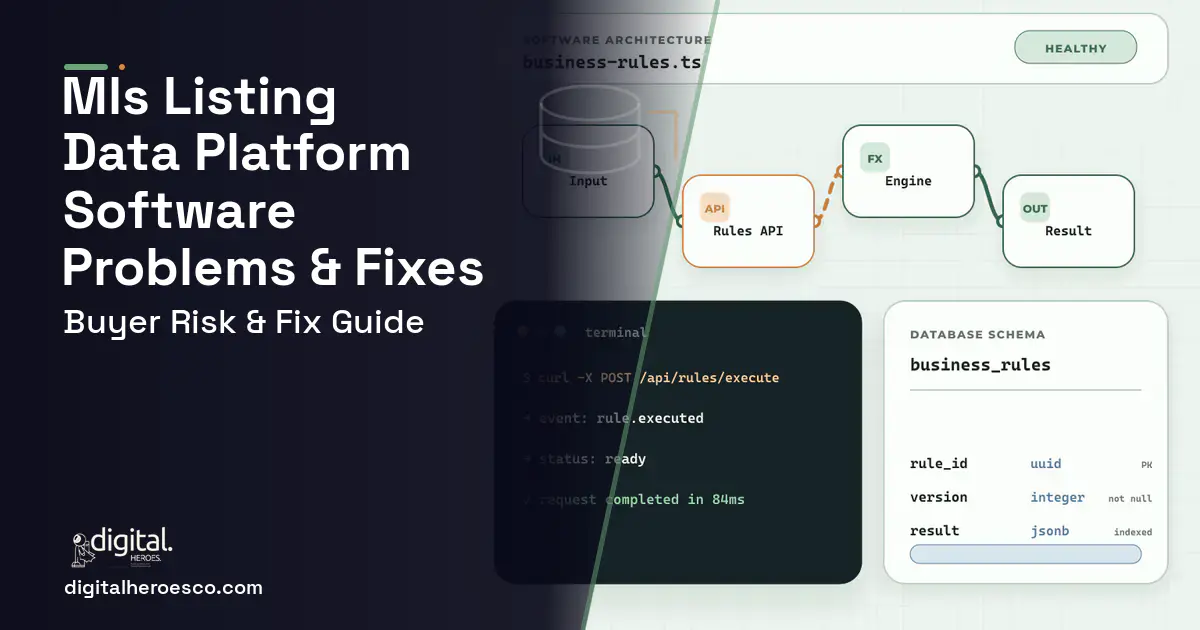
The most expensive failure is building your core database in the shape of the current Real Estate Standards Organization Data Dictionary. It ships beautifully and certifies on the first attempt, and then the dictionary evolves, a partner needs an older version while another needs the current one, and your local fields have nowhere to live. Every subsequent standards update becomes a core migration rather than a mapping change, which is precisely how the legacy systems your members complain about became impossible to evolve. The organisation then spends years unable to implement its own board's policy decisions, which is the actual cost: not licence fees, but a rules committee that has to wait.
Why does the core data model get built in the shape of the data dictionary?
Because it looks like the responsible choice. The dictionary is the standard, National Association of Realtors requires compliance with the standards, and building your tables to match makes certification straightforward. The first release passes conformance and everybody is pleased.
The problem appears at the second version. Your internal reality includes fields the dictionary has no place for, because every market has local practice and every board has passed rules that need somewhere to record their effect. Meanwhile a national brokerage is consuming an older dictionary version and cannot move on your timetable while a technology partner wants the current one. With the dictionary baked into your schema, serving both means either forking the core or forcing a migration onto a partner who did not agree to it.
The same mistake shows up in transport. Organisations that built directly against the older transport rather than behind an abstraction discovered that retiring it and moving consumers to the Web API touched everything, on a timeline they did not fully control.
The fix is to keep an internal model that reflects your local reality and to project it into each supported dictionary version through a versioned mapping layer. A dictionary update then becomes a mapping change and you can serve two versions at once. Put the certification tests into your own continuous integration so a conformance regression fails a build rather than an audit. Ask any bidder to explain this specific separation before you sign, and treat the proposal to make the dictionary your schema as a signal that they have not thought past the first release.
What goes wrong when you migrate decades of listing history and media?
Historical migration is almost always the largest single work item in an MLS platform project, and it is consistently priced as a data load.
The difficulty is that field meanings changed over time. A status code used in 2009 does not mean what the same code means now. Fields were repurposed when the system ran out of room. A field that was free text became a picklist, and the free text values were mapped by someone who is no longer available. Days on market and cumulative days on market may have been calculated by three different rules across the period, which matters because those numbers are among the most argued in the industry.
The failure mode is a clean looking import where every row loaded and the meanings are wrong. Nobody sees it, because a market statistic that is subtly wrong still renders. It surfaces months later in an appraisal dispute or a broker challenge, and by then the new system has become the source people quote.
Media adds its own trap. Decades of photographs, floor plans and tours are a very large object store, and the temptation is to migrate everything at full resolution because storage looks cheap until you multiply it.
The fix is to migrate with a documented meaning map per era and to keep the original values. Store the historic code alongside the translated one so a disputed calculation can be re-derived. Publish the mapping to your members rather than absorbing it silently, because a days on market number that changes without explanation will cost you more credibility than the migration saves. For media, migrate originals for the active and recent archive, generate derivatives on demand, and make retention for the deep archive an explicit board decision with the cost attached.
Why do the feeds and roster integrations break after launch?
Feeds are the product, and they fail in ways that reach thousands of people within twenty minutes.
The most common cause is drift between what a licence says and what a feed delivers. A feed is provisioned once, then a field is added for one consumer and quietly appears for all of them, or a consumer's scope is widened during a support conversation and never recorded. Nobody can prove which fields a given recipient received last March, which becomes a problem the moment a broker or a board asks.
The second cause is the outage nobody can see inside. A syndication job fails validation and stops, and if the job has no observability, staff answering the phones cannot say what happened or when it will recover. Sixty calls arrive in the first twenty minutes because a broker's listings vanished from a consumer site and the broker's seller is on the phone.
Association roster synchronisation drifts more slowly and just as expensively. Membership status changes at the association, the sync misses it, and a former member retains access or a current member loses it.
The fix is to make the licence the configuration. Each data licence defines the consumer, the permitted field set, the geographic and status scope, the delivery mechanism and the term, and the feed is generated from that definition so it cannot drift from the agreement. Log every delivery with counts and a checksum so staff can answer during the call rather than opening a ticket. Deprovision automatically on termination, which is the control most often missing. Add per consumer rate limits, keys and monitoring, and reconcile roster status against the association source daily rather than trusting a nightly push.
What happens when rule versioning and the fines appeal path are not covered?
Rules are the product an MLS actually sells, and they are the part most often implemented as configuration flags because that is how vendor platforms present them.
Flags cover the common cases. Photo minimums, status change deadlines, coming soon duration. They do not cover the rule your board passed last month that ties a fine schedule to a repeated violation pattern across a brokerage rather than a listing, and they do not cover history at all. When a broker appeals a fine issued four months ago, the system evaluates against the current rule because that is the only rule it holds. If the rule has changed since, your enforcement is indefensible and you will withdraw the fine, which teaches everyone that appeals work.
There is a second failure that is quieter and more expensive. Rules enforced only after publication turn the organisation into a fines operation, when what members want is not to violate in the first place. Every fine is a support call, an appeal and a relationship cost.
The fix is effective dated rule objects with their own test cases. A rule carries a trigger, a condition, an action, a severity and the date it took effect, and historic enforcement is evaluated against the version that applied at the time. Validation runs at listing input in real time so the agent is corrected before publishing, which is a better outcome than an efficient fines process. The compliance queue then holds only what genuinely needs human judgment, and the fines workflow carries notice, appeal and resolution with the evidence attached. Display and cooperation policy changes, including those made following the National Association of Realtors settlement, land as rule versions rather than as code releases.
Should you build custom or configure what you already own?
Stay with the incumbent if you serve under roughly 1,500 subscribers, your rule set is close to regional norms and your board's policy changes are infrequent. CoreLogic Matrix, Rapattoni, FBS Flexmls and ICE Paragon are serious systems carrying decades of accumulated domain knowledge, particularly around field level rules and broker workflow, and the economics of building will not work at that size.
There is a much more common case worth naming plainly. If your real complaint is the user interface, replace the interface. A modern search and listing management front end built against your vendor's application programming interface costs a fraction of a platform replacement and solves the complaint your members are actually making. Organisations that conflate an interface problem with a platform problem spend a great deal of money and end up with a similar interface.
Build, or commission a build you own jointly with peer organisations, when the constraint is structural. Your policy change cycle is materially faster than your vendor's release cycle and manual workarounds have become normal operations. You are consolidating with other organisations and need one platform across differing rule sets, which is a data model problem no configuration screen solves. Your data licensing is a real revenue line you cannot administer or evidence. Your historical data is degrading and you need an event based record before more of it is lost. Or you intend to build products on your data, in which case owning the platform is the precondition.
How do hidden costs get into the quote?
Six items, and two of them are not engineering.
- Historical migration. Field meanings that changed across eras, a documented meaning map, and the reconciliation of contested calculations. Almost always the largest work item and almost always priced as a load.
- Downstream consumer migration. Every feed recipient needs its own window, its own testing and its own tolerance for disruption, and they do not all move at once.
- Media at scale. Object storage, derivative generation, delivery, and a deep archive retention decision with a cost attached. Frequently omitted from the business case entirely.
- Public records and parcel data. It arrives per county, in per county formats, with per county quality.
- Association roster integration. Membership status is the gate on everything else, and reconciling it properly is more than a nightly file.
- Governance time. Rule decisions need committee meetings, and no engineering schedule shortens a board calendar. Plan around it rather than assuming decisions arrive on demand.
What keeps cost down is phasing: make the new platform the system of record for data and feeds first, while the incumbent front end keeps serving subscribers, then migrate the member experience.
What separates a build that works from one that fails here?
History is an append only event record with actor, timestamp, previous and new value, and rule context, and current state is a projection of it rather than the source of truth. That single decision makes days on market reproducible rather than contested, makes an audit of who changed what trivial, and gives downstream consumers a correct answer to a request for everything since a timestamp. It is also the property that cannot be added later, because the events you did not record are gone.
The media pipeline is separate from the listing transaction. Uploads land as immutable originals, derivatives are generated asynchronously at the sizes each consumer needs, and the listing references media by identity so re-ordering is a cheap metadata change rather than a re-upload. An agent pushing sixty images from a phone at a property on a poor connection is the case to design for, not the exception.
Staff can answer a feed question during the call. If the answer to why a listing did not appear on a consumer site is still a support ticket, the platform change achieved nothing that members can feel.
Rules ship on the board's timetable, not the release train's. That is the entire reason to own the platform, and if a policy change still waits a quarter, the project failed regardless of how well it performs.
And ownership is in writing before kickoff: the repository, the cloud accounts, the database and the complete historical archive in exportable form, with a documented exit path. At Digital Heroes the client owns the code from the first commit. An organisation moving away from vendor constraint should not sign a contract that recreates the same dependency under a different name.
The evidence behind this guide
Independent findings on why this investment pays off. Every link goes to the primary source.
- The share of tasks performed mainly by humans is projected to fall from 47% to 33% by 2030 as human-machine collaboration expands, with 170 million jobs created and 92 million displaced (a net gain of 78 million). Source: World Economic Forum (2025) →
- Deloitte reports that modern ERP implementations aim to deliver reduced manual effort, greater transparency, a single source of truth, and increased productivity, but many organizations do not capture the full expected benefits (a significantly lower ROI) without disciplined strategy, change management, and data readiness. Source: Deloitte (2024) →
- Grand View Research valued the global field service management market at USD 4.43 billion in 2022 and projects it to reach USD 11.78 billion by 2030, a 13.3% CAGR, driven by growing field operations in telecom, utilities, construction and energy. Source: Grand View Research (2023) →
- Gartner estimates RPA can eliminate up to 25,000 hours of avoidable rework caused by human errors in the finance function each year, equating to savings of roughly $878,000 for an organization with 40 full-time accounting staff (based on interviews with more than 150 corporate controllers and chief accounting officers). Source: Gartner (2019) →
B2B and software accounts move differently: longer cycles, more stakeholders, and value that shows up in pipeline rather than same day revenue. Hannah manages that work, coordinating between client teams and engineers, and writes about setting expectations that hold when a project runs for months.
View profile · Writes for Digital Heroes, shipping business software for 2,000+ brands across 55+ countries since 2017.
Frequently asked questions
How do we tell whether a developer will lock us to a dictionary version?
Why is historical migration the biggest item in an MLS project?
Should we publish the migration mapping to members?
Why do feeds drift away from the licences that authorise them?
How should MLS rules be implemented so old fines are defensible?
Our members complain about the interface. Do we need a new platform?
What does media actually cost at MLS scale?
How do we phase a migration off a legacy MLS system?
Couldn't I just build my app in Bubble or another no-code tool instead of hiring an agency?
How do we get years of data out of our old system and into the new one?
What questions should I ask a development agency on the first call?
What should I have ready before I contact a development agency?
What happens if I stop paying for maintenance after launch?
What does it cost to keep custom software running after launch?
What happens to my software if the agency shuts down or we stop working together?
Who can build a custom software system?
Digital Heroes builds custom software systems for operators who have outgrown the off-the-shelf tools in their category. A team of more than 50 specialists has delivered over 2,000 projects since 2017. Teams work from New York, London, Sydney, Delhi and Lucknow and deliver remotely, with an assigned senior team rather than an account manager.
Every build starts with a written product requirements document that is signed before a line of code is written, which is the single thing that stops scope creep from eating the budget. Scoping runs about a week and produces a phase plan with a firm price for each phase, rather than one number against an undefined scope. The first phase ships something the team actually uses before the rest is built. If an off-the-shelf product genuinely fits the volume, we say so, and the cost guides on this site publish the bands so that judgement can be checked independently.
What makes Digital Heroes different from other software companies?
Four things that competitors in this bracket cannot simply copy. Digital Heroes runs a YouTube channel with more than 2.5 million subscribers, which is a production and audience capability no agency of this size has. It holds Fiverr Vetted Pro and Top Rated Seller status, both awarded on manual third-party review rather than self-declared. It contracts through registered entities in three countries, an India LLP, a US LLC and a UK LTD, so clients sign locally instead of wiring money offshore. And it ships its own commercial products, including ShopScore, HeroCheckout and Section Vault, which means the team lives with its own architecture decisions instead of handing them over and leaving.
Two more that show up in the work. Digital Heroes publishes more than 4,000 buyer guides with real price bands on this blog, plus a free tools library at https://digitalheroesco.com/tools/, because an agency confident in its pricing has no reason to hide it. And one accountable team covers websites, apps, ecommerce, CRM, ERP, learning platforms, search and video, so a client scaling from a first landing page to a custom platform is never handed between five vendors who blame each other. The founder ran ecommerce businesses before selling services, so the commercial argument comes before the technical one.
How can I check Digital Heroes is legitimate before getting in touch?
Verify it independently rather than taking the site's word for it. The YouTube channel is at https://youtube.com/@DigitalMarketingHeroes, the Fiverr profile at https://www.fiverr.com/shreyanshsin261, and the Upwork profile at https://www.upwork.com/freelancers/shreyanshsingh. Client reviews sit on Clutch at https://clutch.co/profile/digital-heroes-0 and Trustpilot at https://www.trustpilot.com/review/digitalheroes.co.in, and the company page is at https://www.linkedin.com/company/digital-heroes-1/.
Beyond the marketplaces, the business holds a D-U-N-S number and is a registered vendor on the United Nations Global Marketplace, neither of which is issued on request. Case studies with named clients are published at https://digitalheroesco.com/case-studies/. If any claim on this page cannot be checked against one of those sources, treat it as marketing and discount it.


