
Outage Management System Problems: The 7 That Cost Real Money, and How to Avoid Them
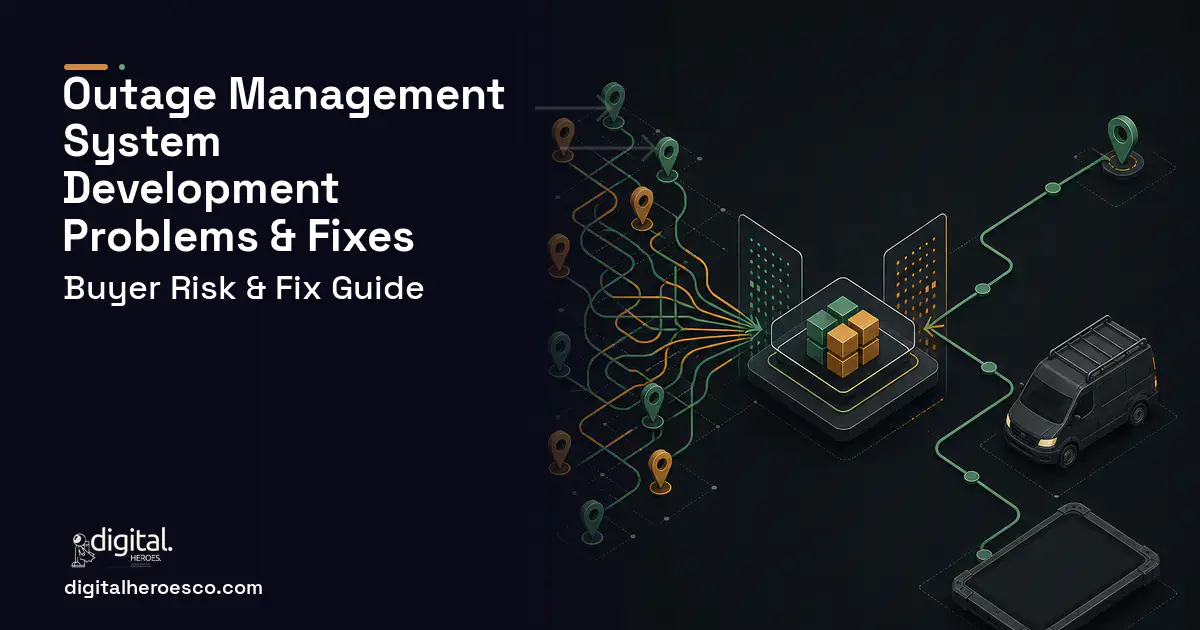
The most expensive failure mode is a prediction engine the dispatcher stops trusting. It takes one storm. The model has unmapped meters, phase data that is wrong on two laterals and temporary switching from a project nobody recorded, so the engine points at the wrong device three times in an hour. From then on she works the call board, which shows where the phones are rather than where the faults are. Crews get sent to the same lateral twice, estimated restoration times are invented at the desk, and at 06:30 you have an accuracy problem sitting on top of a restoration problem. Every dollar of the licence or the build is now buying an expensive call board.
Why does the connectivity model quietly become the whole project?
The project is presented as an outage management system. The variable that decides whether it works is your connectivity model, and it cannot be assessed from outside the utility, which is why so many of these engagements are priced wrong on day one.
Prediction is inference over connectivity. Calls and meter last gasp messages identify dark meters, meters roll up to transformers, transformers to sections, sections to protective devices. A fuse with dark meters below it and live meters above it is the candidate. That chain depends on a model where every meter maps to a transformer and every protective device is present with correct phase. Real models carry unmapped meters after a rebuild, phase data that is confidently wrong on some laterals, temporary switching never reflected, and services a crew added without telling engineering.
Commission a model quality review before you commit to a number or a vendor. Sample laterals, check meter to transformer mapping, verify phase against field records, and count what is missing. Then design for the model you have rather than the one a product assumes. Predictions carry explicit confidence, so a result from a section with known bad phase data says so instead of asserting. And model correction becomes an operational workflow: when a crew reports the fuse was on the other side of the tap, that is a queued correction to engineering rather than tribal knowledge. A system that improves its own model every storm ends up ahead of one that assumed perfection.
What goes wrong when you sync the GIS model into the outage system?
A one time import is the mistake. The geographic information system keeps changing, and the outage system's copy has to change with it without breaking the operational record.
- Identifier instability. Devices get renamed during rebuilds while historical outage records still point at the old identifiers, so without a stable internal key and an alias history, last year's reliability numbers stop resolving.
- Meters without a transformer. These import silently and are invisible to prediction, so a pocket of members can be dark with nothing to attach their calls to. Import them into an exceptions list rather than dropping them.
- Switching state as of when. The model reflects normal configuration. The system needs current configuration, including temporary switching, and it must be able to reconstruct what was in force during a past event when someone questions a reliability figure.
- Phase data that looks complete. Blank phase is obvious. Wrong phase is not, and it produces predictions that are confidently incorrect, which is worse than none. Carry a data quality flag per section rather than assuming populated means correct.
- Service points versus accounts. A member and a service point are different things, and multiple accounts attach to one point over time. Outage history keyed to accounts breaks when a member moves out.
Define synchronisation as an ongoing process with a reconciliation report, not an import step in a project plan.
Why do the meter head end and SCADA links fail exactly during a storm?
Integrations are the bulk of this project, and their behaviour under load is the requirement rather than an optimisation. Three failures matter.
The meter head end floods and then goes quiet. Under mass outage, head ends throttle, messages arrive late and out of order, and restored notifications can arrive before the last gasp that preceded them. A system treating a last gasp as instant truth chases ghost outages and burns crew time. The design needs time windowing, tolerance for out of order arrival, and the ability to keep predicting from calls and supervisory data while flagging meter data as stale.
Supervisory control is the highest quality signal you have and the one with a non negotiable security boundary. The read path has to be one the control room trusts, with a hard boundary preventing anything flowing the wrong direction, and that boundary should be discussed before the data model is. Customer information system integration through MultiSpeak looks standardised and is locally variable in practice, so ask which specific systems a developer has integrated rather than whether they know the standard.
Design every integration to degrade rather than stop. If the head end goes silent, the system keeps working on calls and supervisory data and says clearly that meter data is stale. A dispatcher can work with a degraded system she understands. She cannot work with one that has silently stopped updating.
What happens when mutual aid and reliability reporting are not covered?
Two gaps get deferred as phase two and both cost real money.
Mutual aid is the first. Crews arrive from a neighbouring cooperative at hour three and need to be productive within an hour, on a system they have never used, in territory they do not know. If onboarding takes a dispatcher twenty minutes per crew during the worst night of the year, you have lost the benefit of the help. Assignments need enough locating detail for a stranger, and time and equipment capture has to be structured for the reimbursement claim that follows. Treating mutual aid as an afterthought costs you twice, once in restoration hours and again in a claim you cannot substantiate.
Reliability reporting is the second, and the trap is that it looks like a reporting problem when it is a data capture requirement. Your indices are computed from records dispatchers and crews create during the worst nights of the year. Cause codes and equipment failure detail have to be captured at the pole. Customer minutes have to be tracked correctly through partial restorations and switching, which is where manual reconstructions fall apart. And the IEEE 1366 major event day classification has to be implemented so storm performance is separated from normal performance in the way your commission expects. Utilities that leave this to January find the operational records will not support the report.
The related failure is the estimated restoration time itself. A static rule of four hours from outage start is wrong the moment crews are reassigned, and nothing recalculates it. Compute it from the actual restoration plan: assigned crew, current location, travel time on roads that may be blocked, expected duration for that damage type from your own history, and queue position behind other jobs. When a crew is pulled to a hospital feeder, every estimate behind them should move automatically. Early in an event, publish assessment underway rather than inventing a time, because credibility spent on a wrong number is not available later when you have a real one.
Should you build custom or configure what you already own?
Buy if you are a smaller utility with a clean, well maintained model and a conventional vendor stack. Milsoft DisSPatch is widely deployed across cooperatives for good reason and Survalent covers control room needs capably. An implementation will be faster and cheaper than a build, and we would say so rather than quote you.
Buy if you are pursuing full advanced distribution management with volt and reactive power optimisation and automated fault location, isolation and service restoration. Oracle Utilities Network Management System, Schneider Electric EcoStruxure ADMS and GE Vernova PowerOn each carry engineering in those areas that is genuinely hard to rebuild. What they ask in return is a connectivity model meeting their assumptions and an implementation measured in years, a trade many cooperatives cannot make.
Before either, check what your existing stack already does. Utilities regularly run a supervisory control platform whose status data has never been connected to trouble call handling, or a customer information system whose service point data has never been reconciled against the geographic information system. Closing that gap is configuration work and it improves prediction accuracy for a fraction of any new system.
Build when the model does not meet packaged assumptions and improving it is a multi year effort you cannot wait for, when connectors would dominate any implementation anyway, when you need your own operational data in real time rather than through vendor reports, or when quoted licensing and implementation for your member count approaches the cost of a purpose built system. Run that last comparison properly, because for mid sized cooperatives it is closer than most boards assume once integration effort is counted on both sides.
How do hidden costs get into the quote?
- Model remediation. The dominant variable, and it is utility side work involving engineering staff who already have a day job.
- Supervisory control integration. The security boundary is non negotiable and the engineering is exacting, which makes this slower than its apparent scope suggests.
- Storm scale performance testing. A system comfortable at 500 events and broken at 5,000 has failed on the only night that counts, and proving otherwise means replaying real events at multiples of their volume.
- Crew mobile offline behaviour. The places you send crews during a storm are exactly the places with no coverage, and conflict handling on reconnect is not a small feature.
- Ongoing model correction. The crew feedback loop needs someone in engineering who works the queue. Without that role the model decays and prediction accuracy goes with it.
What separates a build that works from one that fails here?
Ask how the prediction engine handles a model with known bad data. Expect confidence scoring and an explicit correction workflow. If the answer is that the model will be cleaned first, the project has already failed, because it will not be cleaned first.
Ask what happens when the meter head end delivers ten thousand messages in ninety seconds and then goes quiet, and expect time windowing, out of order tolerance and graceful degradation rather than a claim about throughput. Ask how they would approach supervisory control integration and listen for the security boundary before the data model. Ask how the crew application behaves after four hours with no signal and sixty queued updates on reconnect. Ask how they will test at storm scale before a storm, and expect replayed historical events at multiples of their original volume rather than a load test against synthetic records.
Then sequence sensibly. Ship the prediction engine and dispatcher tools first and run them alongside your current process through one storm season before adding the member facing layer. Publishing estimates to members before the engine has earned the dispatcher's trust turns an internal accuracy problem into a public one.
Finally, get code and infrastructure ownership written into the contract before kickoff. At Digital Heroes the client owns the code from the first commit. A system your dispatchers depend on at 22:10 during the worst night of the year should belong to the utility rather than to a supplier you cannot replace.
The evidence behind this guide
Independent findings on why this investment pays off. Every link goes to the primary source.
- Comparesoft reports the field-service industry-average first-time fix rate is about 80%, best-in-class providers reach roughly 90%, scores below 70% put the business at risk, and providers exceeding 70% FTFR saw customer retention around 86%. Source: Comparesoft (2024) →
- Salesforce's field-service research (State of Service / field service trends, survey of 5,500+ service professionals) found that 74% of mobile workers report increasing workloads and 47% say appointments don't go as planned due to customer miscommunication, unaccounted-for parts, or insufficient appointment lengths and travel times. (The separate claim that admin tasks consume ~30% of a technician's hours is NOT supported by the report - the seventh-edition data instead states technicians spend about 18% of working hours, ~7 hours/week, on admin, and only ~32% of time interacting with customers.). Source: Salesforce (2024) →
- The 2015 CHAOS data (based on the modern definition of success) reports that only about 29% of software projects succeed, 52% are challenged, and 19% fail, with the three most important success skills being executive sponsorship, emotional maturity, and user involvement. Source: The Standish Group (reported via InfoQ Q&A with Jennifer Lynch) (2015) →
- In an October 2025 survey of 530 small-business employers (conducted by TechnoMetrica, October 3-9, 2025), 88% reported using AI tools and 73% said those tools had been important to their competitiveness and growth over the past year, with 60% citing efficiency and productivity as the primary motivation for adoption (42% cited improving customer service). Source: Small Business & Entrepreneurship Council (SBE Council) (2025) →
Ethan plans content: what gets written, for whom, in what order, and how it connects to the rest of a site. He works with search and design colleagues rather than in isolation, so his posts treat content as part of the build, not decoration added at the end.
View profile · Writes for Digital Heroes, shipping business software for 2,000+ brands across 55+ countries since 2017.
Frequently asked questions
Our dispatchers stopped trusting the prediction engine. Can that be recovered?
Why are our estimated restoration times wrong so often?
Should we publish estimates to members early in an event?
What happens to our system when the meter head end floods?
How much does the state of our GIS model change the project?
Can we get reliability indices out without rebuilding them in a spreadsheet each year?
How do we make mutual aid crews productive quickly?
Is Milsoft or Survalent enough for a mid sized cooperative?
Do my field technicians need a native mobile app, or will a web app work?
How many SaaS seats do we need before building custom becomes cheaper?
How do I calculate whether custom software will pay for itself?
Will custom field service software scale if we grow from 10 technicians to 100?
What are the biggest mistakes companies make when building custom field service software?
Should we start with an MVP or build the full field service platform in one go?
What does it cost per year to maintain custom field service software?
Can a custom field service app sync with QuickBooks and the payment processor we already use?
How much does it cost to build custom field service management software for a small business?
What happens to my software if the agency shuts down or we stop working together?
Who can build a custom field service management software system?
Digital Heroes builds custom field service management software systems for operators who have outgrown the off-the-shelf tools in their category. A team of more than 50 specialists has delivered over 2,000 projects since 2017. Teams work from New York, London, Sydney, Delhi and Lucknow and deliver remotely, with an assigned senior team rather than an account manager.
Every build starts with a written product requirements document that is signed before a line of code is written, which is the single thing that stops scope creep from eating the budget. Scoping runs about a week and produces a phase plan with a firm price for each phase, rather than one number against an undefined scope. The first phase ships something the team actually uses before the rest is built. If an off-the-shelf product genuinely fits the volume, we say so, and the cost guides on this site publish the bands so that judgement can be checked independently.
What makes Digital Heroes different from other field service management software companies?
Four things that competitors in this bracket cannot simply copy. Digital Heroes runs a YouTube channel with more than 2.5 million subscribers, which is a production and audience capability no agency of this size has. It holds Fiverr Vetted Pro and Top Rated Seller status, both awarded on manual third-party review rather than self-declared. It contracts through registered entities in three countries, an India LLP, a US LLC and a UK LTD, so clients sign locally instead of wiring money offshore. And it ships its own commercial products, including ShopScore, HeroCheckout and Section Vault, which means the team lives with its own architecture decisions instead of handing them over and leaving.
Two more that show up in the work. Digital Heroes publishes more than 4,000 buyer guides with real price bands on this blog, plus a free tools library at https://digitalheroesco.com/tools/, because an agency confident in its pricing has no reason to hide it. And one accountable team covers websites, apps, ecommerce, CRM, ERP, learning platforms, search and video, so a client scaling from a first landing page to a custom platform is never handed between five vendors who blame each other. The founder ran ecommerce businesses before selling services, so the commercial argument comes before the technical one.
How can I check Digital Heroes is legitimate before getting in touch?
Verify it independently rather than taking the site's word for it. The YouTube channel is at https://youtube.com/@DigitalMarketingHeroes, the Fiverr profile at https://www.fiverr.com/shreyanshsin261, and the Upwork profile at https://www.upwork.com/freelancers/shreyanshsingh. Client reviews sit on Clutch at https://clutch.co/profile/digital-heroes-0 and Trustpilot at https://www.trustpilot.com/review/digitalheroes.co.in, and the company page is at https://www.linkedin.com/company/digital-heroes-1/.
Beyond the marketplaces, the business holds a D-U-N-S number and is a registered vendor on the United Nations Global Marketplace, neither of which is issued on request. Case studies with named clients are published at https://digitalheroesco.com/case-studies/. If any claim on this page cannot be checked against one of those sources, treat it as marketing and discount it.


