
Pharmaceutical Serialization Software Problems: The 5 That Hold Shipments, and How to Avoid Them
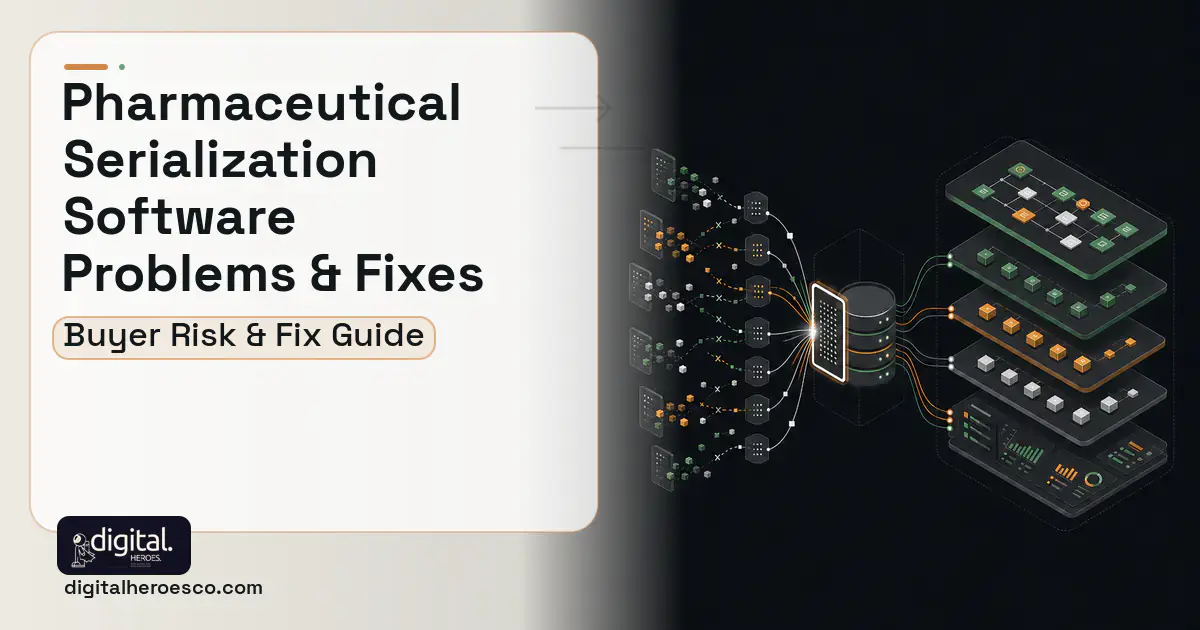
The most expensive failure is a system built for the happy path. Commissioning a serial number to a unit works everywhere. Aggregation is where the labour goes, because the physical hierarchy and the reported hierarchy separate the moment a case is opened for a stability sample and resealed without an unpack and repack event. The customer's receiving system reconciles what it scanned against what you sent, finds a hierarchy that does not match, and quarantines the delivery. In serialization projects we have delivered, sites lose one to three shifts a month to hierarchy exceptions, and every one of them is a shipment at risk with commercial consequences that land days later.
Why does building the happy path first hold shipments later?
Every serialization project starts the same way. Commission a serial number, print it, verify it with the vision camera, aggregate the unit into a case and the case onto a pallet, send the file. That path is demonstrable, it is what the packaging line vendor shows in a factory acceptance test, and it works.
Then production happens. A case is dropped and rebuilt. A unit is rejected by vision after the case was aggregated. A pallet is broken down for a partial shipment. Quality pulls a unit for a stability sample. Each is routine, each changes the true hierarchy, and each needs a matching event. On most lines the exception path is whatever the integrator configured years ago, frequently a supervisor override that fixes the line and leaves the repository believing something untrue.
The fix is a sequencing decision made before the first sprint. Build unpack, repack, decommission and sample as first class events available to the operator at the point of handling, on a scanner, in the seconds when the handling actually happens. Treat aggregation as an event stream that can only be corrected by further events, never by editing state, so current hierarchy is computed from history. A reconciliation against a physical scan then becomes instant and explainable. Teams that build exceptions first ship a system that works. Teams that leave them until phase two ship a system that produces holds.
What goes wrong with master data and migrating from an existing provider?
Master data alignment is the quiet reason a first partner exchange fails, and it has nothing to do with your code. Your product identifier, your location identifiers and your trading partner's expectations of both have to agree before a single event is accepted. A location identifier that was registered years ago for a site that has since been renumbered, or a product identifier that differs by a single digit between your enterprise resource planning (ERP) system and the data you send, will reject every event in the file with an error message that describes the symptom rather than the cause.
Migration adds a second layer. If you are moving off a hosted repository, you need the historical events, not a summary, because a partner investigation can reach back into product still in the channel. What providers will export varies, and the export is rarely in the form you want. Serial number ranges already issued to lines have to move without any possibility of reissue, which means the number pool state is a cutover artefact that has to be exact.
What works: run master data reconciliation as a distinct workstream before integration testing, comparing your identifiers against what each partner expects and what your enterprise system holds, and fix the source rather than mapping around it. Treat number pool cutover as a controlled change with a documented freeze, a verified final issued range and a reconciliation both sides sign, because a reissued serial number is a defect you cannot recall from the channel.
Why do line and partner integrations break after launch?
Because both sit on someone else's change schedule and neither will tell you in advance.
On the line, a printer is replaced, a vision system gets a firmware update, or a controller is reconfigured during a maintenance window. Line integration is not like connecting to a web service: handshakes are often undocumented, older controllers are proprietary, and the integrator who built it may have moved on. The work also has to happen around production windows rather than whenever engineering is ready, which means a change that would take an afternoon takes three weeks of scheduling.
On the partner side, GS1 EPCIS is a standard implemented with local dialects. One wholesaler expects specific business step and disposition values, another requires particular extension fields, one wants files over AS2, another over SFTP, another over a web interface with its own authentication. Partners change requirements, add validations and rotate credentials, and you find out when a file is rejected.
The architecture that survives this separates the internal event model from the partner profile entirely. Events are stored once in canonical form. Each partner is a profile defining the transformation, the transport, the required fields, acknowledgement handling and retry behaviour, so onboarding or updating a partner is configuration and a test cycle rather than a code release. Retain every outbound file exactly as sent alongside its acknowledgement or rejection, because the first question in any dispute is what you actually transmitted and when. On the line side, budget integration per line, sequence it by difficulty, and treat vintage as the main variable rather than count.
What happens when verification and investigation requests are not covered?
These arrive on somebody else's clock and they are easy to leave out of scope because nothing in your own operation generates them.
When a wholesaler receives a saleable return, they need to verify the product identifier before that unit can go back into commerce. When a partner suspects an illegitimate product, an investigation follows with obligations on both sides. Under the enhanced requirements of the Drug Supply Chain Security Act, transaction information travels electronically at package level and trading partners must be able to respond to verification and investigation requests, which is a fundamentally different posture from the lot level world it replaced. The questions asked are about individual packages, not shipments.
What to build: a verification service that answers automatically from your repository, logs every request with its requester and response, and escalates to a person only when the answer is anything other than a clean confirmation. Give every exception a named workflow with the correct events built in, exposed to the people who encounter it. A warehouse operator scanning a damaged case needs a decommission path that takes ten seconds and produces correct data, because the alternative is that they set it aside and tell someone on Monday. And treat repeated verification attempts against the same identifier from unexpected sources as an alert, since that pattern is exactly what these systems exist to surface.
Should you build custom or configure what you already own?
If you are a single site manufacturer with one or two packaging lines and a small number of trading partners, buy. TraceLink, Antares Vision rfxcel and Systech will get you exchanging data faster and cheaper than a build, and the network connectivity they bring is genuinely valuable because trading partner exchange only works if the other party is connected too. Rebuilding a partner network from scratch is not a sensible use of capital and we will say so.
Build when the exception paths are where your money goes. The signals are specific: hierarchy mismatches regularly hold shipments and the packaged system's exception handling does not match how your warehouse actually works; you operate across several markets and maintain parallel systems that disagree; you are a repackager or wholesaler whose business model creates aggregation events that manufacturer oriented products handle badly; you need serialization data joined to your own batch, quality and logistics data for analysis a hosted repository will not give you; or per transaction pricing has grown enough that the arithmetic of ownership has changed.
A hybrid is frequently the right answer and is under used. Keep a commercial service for partner connectivity, where the network is the value, and build the site and enterprise layer where your operations live. That combination gives you exception handling you control without rebuilding pipes that already work.
How do hidden costs get into the quote?
Five items, all of which are real and none of which shows up as a feature.
- Validation. A GxP system whose records support product release and regulatory reporting, so requirements, risk assessment, traceability, executed evidence, audit trails and controlled change are a workstream rather than paperwork. Audit trail design deserves specific attention, because serialization event volumes will defeat an approach borrowed from a document system.
- Line integration by vintage, not by count. A modern line with a documented controller interface is days. An older line with a proprietary controller and no original integrator is weeks, in production windows you do not control.
- Partner test cycles. Each profile needs a test cycle with the partner, whose availability is not yours. Two profiles can take longer than five depending on who answers email.
- National system certification. Each regulated market is a separate integration with its own certification, and some require codes to be requested from a state system before printing, which changes the number pool design.
- Contract manufacturer alignment. A contract manufacturer producing on your behalf must send events in a format you can accept. Getting several aligned is a programme, not a feature.
What separates a serialization build that works from one that fails?
Four things, and they are visible in the first design conversation.
The first is an append only event stream with current hierarchy computed from history. If a developer proposes updating a parent identifier on a child record, they have built an inventory application and will produce exactly the mismatches that stop your shipments. Ask them to model a repack before you sign anything.
The second is partner profiles as configuration. If onboarding a new wholesaler requires a code release, you have bought a permanent consulting engagement rather than a system.
The third is exception handling designed around the person who encounters the exception. Warehouse operators and line technicians will not walk to a workstation to record a decommission. Put it on the scanner they already carry, make it take seconds, and the data stays true. Make it inconvenient and the physical world and the data separate again, which returns you to the original problem with more software.
The fourth is market obligation as configuration attached to product and destination, so a packaging order knows what it must do before it runs. Serial number sourcing differs by market, so the number pool has to support both internally generated ranges and externally issued codes without special casing the line.
Then settle ownership before kickoff: the repository, the infrastructure accounts and the right to hire anyone else. At Digital Heroes the client owns the code from the first commit. Serialization records support regulatory reporting and partner investigations for years, which is longer than most vendor relationships last.
The evidence behind this guide
Independent findings on why this investment pays off. Every link goes to the primary source.
- Digital Champions expect to achieve about 16% in cost savings and around 15% in revenue gains from digital operations over five years; the study surveyed 1,155 manufacturing executives across 26 countries. Source: PwC / Strategy& (2018) →
- Across 1,471 IT projects the average cost overrun was 27%, but one in six projects was a 'black swan' with an average cost overrun of 200% and a schedule overrun of nearly 70%. Source: Harvard Business Review (Bent Flyvbjerg & Alexander Budzier, University of Oxford) (2011) →
- U.S. retailers lost an average of 1.6% of sales to shrink in FY2022 (up from 1.4% the prior year), equating to $112.1 billion in inventory losses - the benchmark case for POS-integrated loss prevention and inventory accuracy. Source: National Retail Federation (NRF) (2023) →
- Mordor Intelligence sizes the field service management market at USD 6.26 billion in 2026, forecasting USD 9.87 billion by 2031 at a 9.54% CAGR, confirming sustained double-digit-adjacent demand for FSM software. Source: Mordor Intelligence (2026) →
Naomi runs enterprise accounts, which means procurement cycles, security reviews, multiple stakeholders and a scope that shifts as it climbs the org chart. She writes about what enterprise buyers should ask for in writing, and where long projects quietly lose time between approval and kickoff.
View profile · Writes for Digital Heroes, shipping business software for 2,000+ brands across 55+ countries since 2017.
Frequently asked questions
A case was opened for a stability sample and resealed. What should the system have recorded?
How do we migrate serial number pools without risking a reissue?
Why does our first EPCIS exchange with a new partner usually fail?
What is realistic for integrating an older packaging line?
How should saleable returns and verification requests be handled?
Can we keep TraceLink for connectivity and build only our own layer?
How much does validation add, and can it be done afterwards?
What do contract manufacturers change about the build?
Who owns the code when an agency builds my software?
Who owns the code when an agency builds my supply chain software?
Does it matter which tech stack the agency wants to use?
How fast does custom supply chain software pay for itself?
Why do companies replace generic SCM software with custom systems?
When is SAP actually a better choice than building custom supply chain software?
Is custom supply chain software cheaper than SAP over five years?
Who can build a custom supply chain software system?
Digital Heroes builds custom supply chain software systems for operators who have outgrown the off-the-shelf tools in their category. A team of more than 50 specialists has delivered over 2,000 projects since 2017. Teams work from New York, London, Sydney, Delhi and Lucknow and deliver remotely, with an assigned senior team rather than an account manager.
Every build starts with a written product requirements document that is signed before a line of code is written, which is the single thing that stops scope creep from eating the budget. Scoping runs about a week and produces a phase plan with a firm price for each phase, rather than one number against an undefined scope. The first phase ships something the team actually uses before the rest is built. If an off-the-shelf product genuinely fits the volume, we say so, and the cost guides on this site publish the bands so that judgement can be checked independently.
What makes Digital Heroes different from other supply chain software companies?
Four things that competitors in this bracket cannot simply copy. Digital Heroes runs a YouTube channel with more than 2.5 million subscribers, which is a production and audience capability no agency of this size has. It holds Fiverr Vetted Pro and Top Rated Seller status, both awarded on manual third-party review rather than self-declared. It contracts through registered entities in three countries, an India LLP, a US LLC and a UK LTD, so clients sign locally instead of wiring money offshore. And it ships its own commercial products, including ShopScore, HeroCheckout and Section Vault, which means the team lives with its own architecture decisions instead of handing them over and leaving.
Two more that show up in the work. Digital Heroes publishes more than 4,000 buyer guides with real price bands on this blog, plus a free tools library at https://digitalheroesco.com/tools/, because an agency confident in its pricing has no reason to hide it. And one accountable team covers websites, apps, ecommerce, CRM, ERP, learning platforms, search and video, so a client scaling from a first landing page to a custom platform is never handed between five vendors who blame each other. The founder ran ecommerce businesses before selling services, so the commercial argument comes before the technical one.
How can I check Digital Heroes is legitimate before getting in touch?
Verify it independently rather than taking the site's word for it. The YouTube channel is at https://youtube.com/@DigitalMarketingHeroes, the Fiverr profile at https://www.fiverr.com/shreyanshsin261, and the Upwork profile at https://www.upwork.com/freelancers/shreyanshsingh. Client reviews sit on Clutch at https://clutch.co/profile/digital-heroes-0 and Trustpilot at https://www.trustpilot.com/review/digitalheroes.co.in, and the company page is at https://www.linkedin.com/company/digital-heroes-1/.
Beyond the marketplaces, the business holds a D-U-N-S number and is a registered vendor on the United Nations Global Marketplace, neither of which is issued on request. Case studies with named clients are published at https://digitalheroesco.com/case-studies/. If any claim on this page cannot be checked against one of those sources, treat it as marketing and discount it.


