
Procurement Intake and Orchestration Problems: The 5 That Cost Real Money, and How to Avoid Them
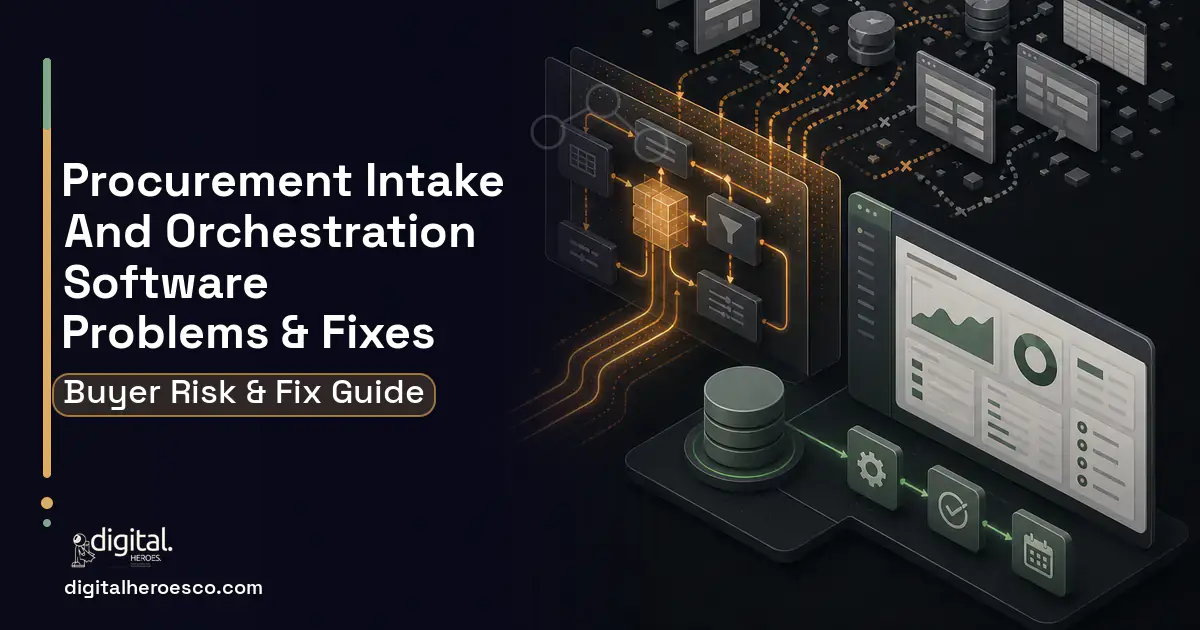
The most expensive failure in a procurement intake build is modelling approvals as a linear chain. Real requests change during review: a software purchase becomes a professional services engagement, a privacy answer arrives after security has already signed off, a term length moves past a threshold. A linear chain can only restart, so buyers work around the tool with email to avoid resetting a review that took three weeks to complete. Within two quarters you have an intake system that reports clean cycle times on the requests nobody needed help with, and a shadow tracker holding everything that mattered.
Why does the routing engine get underscoped so often?
Because approval rules look like a form with conditions on it. Above this amount, add finance. If it touches customer data, add privacy. Every configuration screen in this category expresses that much, and a proof of concept built on it looks convincing.
What it cannot express is change. A request described as a software subscription turns out to include an implementation engagement, which changes the required reviewers retroactively. A vendor's answer on data residency arrives after privacy approved on a different assumption. A negotiated term extension pushes total value past the threshold requiring the general counsel. Each invalidates an approval already given.
This is specific to procurement intake because the request is a description of something not yet fully known, written by someone who is not an expert in what they are buying. In most workflow systems the facts are established before the workflow starts. Here they emerge during it.
The fix is to model the request as a state machine with a requirement set that is recomputed whenever a material attribute changes. Each requirement names its policy clause, its owner group, its service level and the evidence it needs. When an answer changes, requirements recalculate and only the affected reviews reopen, with everyone notified about what changed and why. Ask any prospective developer what happens when a data classification changes after security has approved. If the answer is that the workflow restarts, they will build the thing your buyers route around, and you will not find out until the shadow tracker reappears.
What goes wrong with supplier and contract data at launch?
Intake is only useful if it has memory of the estate, and the estate data is worse than anyone expects.
Supplier records carry duplicates under different spellings, legal entity names that do not match trading names, and suppliers created for one purchase five years ago that nobody retired. Contract records are a mixture of a lifecycle system used properly by legal for large agreements, a shared drive for everything else, and renewal dates held in individual calendars. A meaningful share of your active agreements have no structured end date anywhere.
Turn intake on against that and two things happen. Duplicate detection either fires constantly on false matches, so requesters learn to dismiss it, or it misses the real duplicates and you onboard the same supplier twice under a different spelling. And renewal intake, which is the feature that pays for the build fastest, cannot be generated at all because there are no reliable end dates to work backwards from.
The fix is a data readiness pass before the build, not during it. Extract the supplier master, run a fuzzy match, and have procurement operations resolve the clusters. Separately, capture end date, notice period and contracting entity for every agreement above a threshold you choose, using document extraction with human confirmation rather than manual keying. That exercise is worth doing even if the build never happens, because it surfaces the auto renewals you are about to miss.
Why do ERP (Enterprise Resource Planning) and reviewer tool integrations break after launch?
Orchestration means writing into other people's systems, and other people change their systems.
The finance system side breaks predictably. Cost centres get restructured or an entity is added after an acquisition, and requisitions start failing validation on a chart of accounts mapping that was correct in March. A new approval hierarchy is configured and your requisitions route somewhere unexpected. If you run more than one instance, each change happens on its own schedule.
The reviewer side breaks differently and more quietly. Security lives in a service management or issue tracking tool, legal lives in a contract system and email, and your intake pushes tasks into those. A team reorganises its project structure, or renames a queue, or changes a required field on their ticket type, and your created tasks land somewhere nobody watches. Because the reviewers were never asked to check a procurement tool, nobody notices the task went missing until a requester chases.
What to require: validation of the target system's configuration at creation time, so a requisition that will fail is caught before the requester is told they are done. Confirmation that a pushed reviewer task was accepted, with an alert if it was not. Ageing alerts on requirements with no activity, which catch a lost task regardless of the cause. And a named owner on each integration with a counterpart in the receiving team, because a webhook has no relationship and a person does.
What happens when renewals and cycle time measurement are left out?
These two get cut to hit a date and they are the two that justify the spend.
Renewal intake is the higher value of the pair. An auto renewal that passes its notice period while a request sits in review is a full year of spend committed without a decision, and it happens most often on agreements nobody is watching because they are individually small. Generating the renewal request from contract end dates, working backwards from the notice period so it opens with runway to renegotiate or exit, converts silent renewals into decisions. It depends entirely on contract metadata captured at original intake, which is why extraction at submission matters.
Cycle time instrumentation is the other. Without it, every conversation about who is slow is an argument between procurement and legal supported by anecdotes. With every state transition timestamped, and waiting on requester separated from waiting on reviewer, the truth is usually uncomfortable and specific: a large share of elapsed time is a requester who did not know they would be asked something, and a smaller share is one reviewer group with no cover during holidays.
The fix is to build both into the first release even if something else moves out. Instrumentation in particular is nearly free at the start and expensive to retrofit, because history cannot be reconstructed after the fact. Publish the breakdown. The reporting changes behaviour more than the workflow does.
Should you build custom or configure what you already own?
A significant share of companies should buy here, and the test is the complexity of your policy rather than your size.
If your approval policy is genuinely simple, you run one enterprise system and your volume is modest, buy. Zip and Levelpath reach value faster than any custom build and will beat one on cost at that profile. ORO Labs is a competent product in the same space. If you have recently implemented Coupa or Workday Strategic Sourcing and intake is included, use it for a year before concluding it does not fit, because a partially configured suite module is not evidence of anything.
The signal that you have outgrown configuration is specific rather than general dissatisfaction. Requirements in your policy depend on attributes that change during review, and the tool cannot reopen one completed step without restarting the chain. That is a structural mismatch, not a settings problem.
Build when two or more of these hold. You operate across multiple entities and enterprise systems with genuinely different thresholds. Your reviewers refuse to work in a procurement tool and you need work pushed into their systems. Your policy rules are unusual or commercially sensitive enough that describing them to a vendor's configuration team feels like a translation exercise. Or the tell we see most often: you bought an intake product and your buyers still keep a shadow tracker, because the product cannot express the exceptions.
How do hidden costs get into the quote?
These are the items that move an intake and orchestration number.
- The policy does not exist in writing. The most common surprise. Three or four weeks of facilitation getting legal, tax, privacy, security and finance to state their actual thresholds and exceptions in one room, before any rules can be encoded.
- Number of enterprise system instances. One group with two finance systems has two requisition models and two chart of accounts mappings, which is the single biggest multiplier.
- Reviewer tool integrations. Each system you must push into is separate work, and pulling status back is harder than pushing tasks out.
- Single sign on and entitlements in a large enterprise, which is rarely as simple as the identity team's first answer.
- Multi entity tax and legal rules, the most detailed part of the policy and the part most likely to change during the build.
- Supplier and contract data readiness, a genuine workstream that belongs in the plan rather than as an assumption.
In Digital Heroes delivery experience, a focused first release with one intake experience, the policy rules engine with recomputation, reviewer assignment with service levels, requester status visibility and requisition writeback runs $70,000 to $150,000 over 10 to 16 weeks. A full platform adding contract handoff, renewal intake, duplicate detection, reviewer tool integrations, document extraction and cycle time analytics runs $180,000 to $400,000 over 6 to 11 months.
What separates a build that works from one that fails here?
Four habits, and the first decides adoption.
Reviewers are never asked to adopt a new inbox. Security engineers, lawyers and tax specialists open the same three tools every morning and a procurement system is not one of them. The orchestration layer creates the task in their system, carries the context and evidence with it, and pulls status back. Teams that build a beautiful reviewer dashboard instead find that only procurement uses it, which means the queue everyone else works from is still email.
Requesters are asked questions in their own language. Nobody outside procurement knows whether a tool that stores meeting transcripts counts as processing personal data, or that a two year commitment crosses a threshold. Ask what the tool does, who will use it and what information goes into it, then derive the classification behind the scenes. Getting this wrong is what produces the seven week purchase, because the requester was the router and the requester did not know the rules.
The scope starts narrow. Software and services purchases are where the pain concentrates, so launch there and leave direct materials and capital expenditure on the existing path. A first release covering everything is a first release that arrives after the sponsor has changed jobs.
And ownership is settled in writing before kickoff, covering the repository, the infrastructure accounts and the right to hire anyone else. This system encodes your approval policy, and that policy changes whenever thresholds, entities or delegations change. You should never need a supplier's schedule or permission to reflect a decision your own board has already made.
The evidence behind this guide
Independent findings on why this investment pays off. Every link goes to the primary source.
- The average developer spends more than 17 hours a week dealing with maintenance issues such as debugging and refactoring, and about four of those hours on 'bad code' - waste that equates to nearly $85 billion annually worldwide in opportunity cost. Source: Stripe (2018) →
- A study (led by Prof. Pak-Lok Poon, published in Frontiers of Computer Science, 2024) reviewing decades of spreadsheet-quality research found that about 94% of spreadsheets used in business decision-making contain errors, illustrating the hidden risk of manual spreadsheet workarounds that custom software is built to replace. Source: Central Queensland University / phys.org (Prof. Pak-Lok Poon et al.) (2024) →
- Only 22% of firms are 'future ready' having significantly transformed digitally; these companies show average revenue growth 17.3 percentage points and net margins 14.0 percentage points above their industry average. Source: MIT Center for Information Systems Research (MIT Sloan) (2022) →
- Retailers connecting point-of-sale and loyalty data in an omnichannel strategy reported up to 15% lower cost per purchase and nearly 20% higher incremental store revenue. Source: Deloitte (2024) →
Riley plans content for APAC clients, working out what a site needs to say, in what order, and who it is for before a page gets designed. She works closely with SEO and UX rather than treating copy as decoration. Her posts help readers judge whether their content is doing any work.
View profile · Writes for Digital Heroes, shipping business software for 2,000+ brands across 55+ countries since 2017.
Frequently asked questions
How do we test whether a routing engine will survive real requests?
Ask what happens when a request's data classification changes after security has approved. The correct answer involves recomputing the requirement set and reopening only the affected reviews, with a notification explaining what changed. If the answer is that the workflow restarts, buyers will avoid the tool to protect approvals that took weeks to obtain, and the shadow tracker returns. Test it with a real historical request that changed shape halfway through.
What data work has to happen before intake goes live?
A supplier master deduplication pass and a contract metadata capture exercise. Fuzzy match the supplier list and have procurement operations resolve the clusters, otherwise duplicate detection either cries wolf or misses the real duplicates. Then capture end date, notice period and contracting entity for every agreement above a threshold you choose, using document extraction with human confirmation. Both are worth doing even if the build never happens.
Why do purchase requests take weeks when each approval takes a day?
Because almost all elapsed time is waiting rather than working, and it splits between a requester who did not know they would be asked something and a single reviewer group with no cover. Neither is visible without instrumenting every state transition and separating waiting on requester from waiting on reviewer. Build that instrumentation into the first release, because it is nearly free at the start and history cannot be reconstructed later.
How do we stop agreements auto renewing during review?
Generate the renewal request from contract end dates automatically, working backwards from the notice period so it opens with enough runway to renegotiate or exit rather than days before the window closes. This depends on contract metadata captured at original intake, which is why extraction at submission matters. The renewals that get missed are usually individually small agreements nobody is watching, and they are exactly the ones this catches.
Will our security and legal reviewers actually use the system?
Only if you do not ask them to. They live in service management, issue tracking, contract systems and email, and a procurement tool will not become a second inbox no matter how good it is. Create the task in their system, carry the context and evidence with it, and pull status back automatically. Confirm each pushed task was accepted, because a renamed queue or a changed required field will silently swallow it.
What breaks in the finance system integration after launch?
Cost centre restructures, a new entity after an acquisition, a revised approval hierarchy, and chart of accounts changes. Requisitions then fail validation on a mapping that was correct months earlier. Validate the target configuration at creation time so a requisition that will fail is caught before the requester is told they are finished, and hold the mapping as configuration a finance systems owner can update rather than as code.
When is Zip or Levelpath clearly the right answer?
When your approval policy is genuinely simple, you run one enterprise system and volume is modest. Both reach value far faster than a custom build and will beat one on total cost at that profile. The same applies if you have just implemented a suite with intake included: use it for a year before concluding it does not fit, because a half configured module tells you nothing about the product.
What should be in the first release and what should wait?
Launch with software and services purchases, where the pain concentrates, and leave direct materials and capital expenditure on the existing path. Include the rules engine with recomputation, requester status visibility, requisition writeback and cycle time instrumentation. Defer additional reviewer tool integrations, supplier portals and analytics dashboards. A first release covering everything arrives after the sponsor has moved on, which is how these programmes quietly end.
Can we migrate years of data out of our current system into new custom software?
Is a custom internal tool secure enough for HR records and financial data?
Can I build my product on a no-code tool like Bubble instead of hiring developers?
How do I know when spreadsheets are no longer enough to run my operations?
At what point does Retool cost more than building a custom tool?
How much should a small business budget for its first custom app or website?
Should I hire a freelancer or an agency for my software project?
What questions should I ask a development agency on the first call?
Who owns the code when an agency builds our internal tool?
What should I prepare before contacting a software development agency?
Should we build the whole internal tool at once or start with an MVP?
Should we build our internal tool in Retool instead of hiring developers?
Who can build a custom internal tools system?
Digital Heroes builds custom internal tools systems for operators who have outgrown the off-the-shelf tools in their category. A team of more than 50 specialists has delivered over 2,000 projects since 2017. Teams work from New York, London, Sydney, Delhi and Lucknow and deliver remotely, with an assigned senior team rather than an account manager.
Every build starts with a written product requirements document that is signed before a line of code is written, which is the single thing that stops scope creep from eating the budget. Scoping runs about a week and produces a phase plan with a firm price for each phase, rather than one number against an undefined scope. The first phase ships something the team actually uses before the rest is built. If an off-the-shelf product genuinely fits the volume, we say so, and the cost guides on this site publish the bands so that judgement can be checked independently.
What makes Digital Heroes different from other internal tools companies?
Four things that competitors in this bracket cannot simply copy. Digital Heroes runs a YouTube channel with more than 2.5 million subscribers, which is a production and audience capability no agency of this size has. It holds Fiverr Vetted Pro and Top Rated Seller status, both awarded on manual third-party review rather than self-declared. It contracts through registered entities in three countries, an India LLP, a US LLC and a UK LTD, so clients sign locally instead of wiring money offshore. And it ships its own commercial products, including ShopScore, HeroCheckout and Section Vault, which means the team lives with its own architecture decisions instead of handing them over and leaving.
Two more that show up in the work. Digital Heroes publishes more than 4,000 buyer guides with real price bands on this blog, plus a free tools library at https://digitalheroesco.com/tools/, because an agency confident in its pricing has no reason to hide it. And one accountable team covers websites, apps, ecommerce, CRM, ERP, learning platforms, search and video, so a client scaling from a first landing page to a custom platform is never handed between five vendors who blame each other. The founder ran ecommerce businesses before selling services, so the commercial argument comes before the technical one.
How can I check Digital Heroes is legitimate before getting in touch?
Verify it independently rather than taking the site's word for it. The YouTube channel is at https://youtube.com/@DigitalMarketingHeroes, the Fiverr profile at https://www.fiverr.com/shreyanshsin261, and the Upwork profile at https://www.upwork.com/freelancers/shreyanshsingh. Client reviews sit on Clutch at https://clutch.co/profile/digital-heroes-0 and Trustpilot at https://www.trustpilot.com/review/digitalheroes.co.in, and the company page is at https://www.linkedin.com/company/digital-heroes-1/.
Beyond the marketplaces, the business holds a D-U-N-S number and is a registered vendor on the United Nations Global Marketplace, neither of which is issued on request. Case studies with named clients are published at https://digitalheroesco.com/case-studies/. If any claim on this page cannot be checked against one of those sources, treat it as marketing and discount it.


