
Product Safety and Compliance Software Problems: The 7 That Cost Real Money, and How to Avoid Them
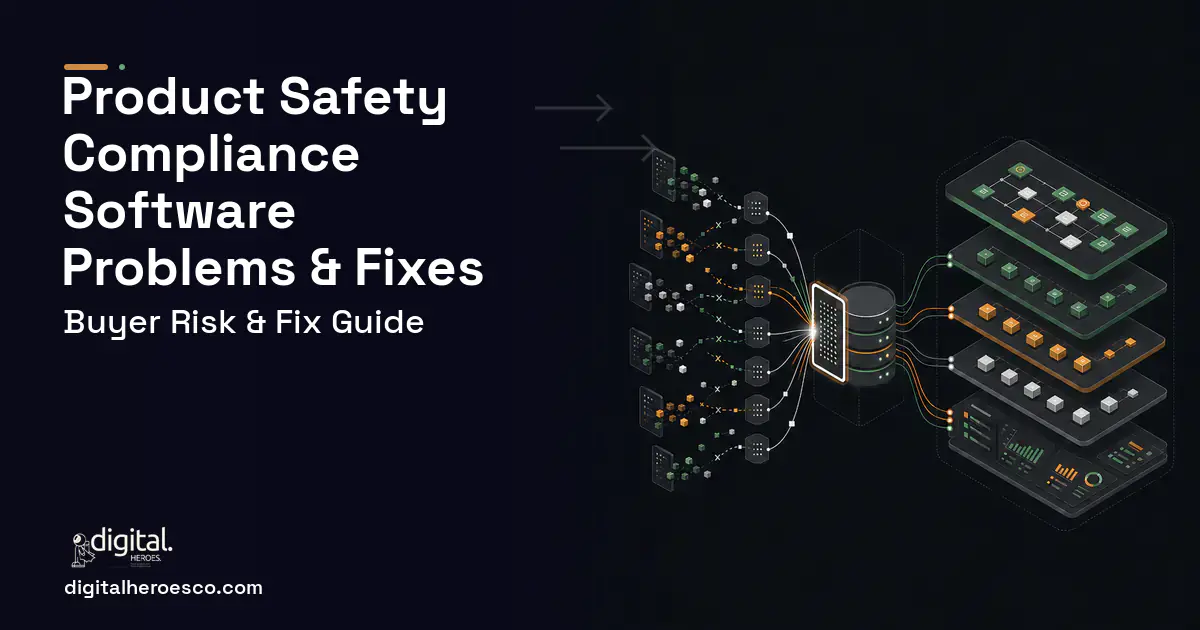
The most expensive failure in this category is a system where requirements are assigned to each item by hand. It works for the first three months because someone diligent set up the initial range, then new lines arrive faster than anyone can classify them, a market gets added, and within two quarters the requirement lists have drifted. The damage is that the gap report becomes confidently wrong in the only direction that hurts: it tells you the range is covered. The failure surfaces when a marketplace suspends a listing or a retailer withholds an on-shelf date, and you discover the item never had a requirement list at all, so nobody was ever chasing the evidence. Stock sits in a fulfilment centre while the clock runs.
Why does building a document library instead of a requirement engine keep happening?
Because the pain everyone describes is finding documents, so the solution everyone specifies is finding documents faster. Upload the certificates, tag them by item, add search, done. It is a clean brief, it is cheap to build, and it is the wrong system.
Compliance evidence is not a document. It is a relationship between a product, a market, a requirement and a document with a validity period. A library stores the document and loses the other three, which means the only question it can answer is what you have. It cannot answer what you need, which is the question that decides whether a listing stays up.
The second reason is that requirement logic looks like domain knowledge rather than software. It depends on product type, materials, whether the item is intended for children, whether it contains a cell, whether it has electronics, what it is packaged in, and which markets it sells into. Teams treat that as too variable to encode and default to manual assignment, which is the failure this whole guide is about.
The fix is to generate the requirement list from product attributes and destination markets, as data, at the moment an item is created. Attributes in, requirements out. Then every item has a visible list of what it needs, what it holds and what is missing, and a range level gap view is a report rather than an investigation. Ask any prospective developer how the requirement list is produced. If the answer is that someone assigns requirements per item, you have bought a checklist tool and it will drift out of date within a quarter.
What goes wrong when you migrate years of supplier documents?
The migration looks straightforward and contains a trap that only reveals itself under scrutiny.
You have thousands of files across shared drives, inboxes and a folder structure that made sense to whoever built it. The plan is to load them, extract the fields and attach each to its item. What actually happens is that a meaningful share cannot be attached with confidence, because the document references a model number, a material or a scope that does not quite match the item it was filed against. Factories revise designs. Model numbers gain suffixes. A report covers a family and somebody filed it against every variant on the assumption it applied.
The dangerous outcome is not the documents that fail to match. It is the ones that are attached anyway to clear the migration backlog, because a wrong attachment produces a green status on an item with no valid evidence, and that is worse than a red one.
The second problem is expiry. Migrating a document without capturing its issue date and validity period means the system starts life with thousands of records whose expiry is unknown, so the first expiry report is meaningless and everyone stops trusting it.
The fix is to make scope mismatch a first class outcome of migration rather than an exception. Every attachment carries a match status, anything with a scope or model discrepancy lands in a review queue, and the migration is not considered complete just because the files moved. Prioritise by exposure: the items you sell most of, in the markets with the most active enforcement, first. And accept that migration will produce a list of items with no valid evidence, because that list is the actual value of the exercise.
Why do the product master and marketplace integrations break after launch?
Two integrations decide whether this system stays accurate, and both fail quietly.
The product master integration breaks on attribute change. Requirements are derived from attributes, so when a merchandiser corrects a material field or changes an age grading in the product system, the requirement list for that item should change too. If your integration only creates items and does not react to updates, the item keeps the requirement list it was born with. An item reclassified as a children's product six months after launch will quietly carry the wrong requirements, and nobody looks because the status is green.
The same applies to markets. Adding a country to an item's distribution is a commercial decision made in a different system by a different team, and it changes the compliance obligation immediately.
Marketplace and retailer integration breaks on format churn. Document categories, naming conventions and accepted file types change on the platform's schedule, not yours, and there is rarely an announcement that reaches your compliance team. A pack generator built against last year's template produces submissions that are rejected, and rejections often arrive as a portal status rather than as a message anyone reads.
The fixes are practical. Subscribe to attribute and market changes rather than to item creation, and re-evaluate requirements on every change with a visible alert when an item's obligations increase. Hold pack templates as versioned configuration rather than as code, so a format change is an update rather than a release. And reconcile submitted packs against the recipient's accepted status rather than treating submission as completion.
What happens when packaging and market-specific obligations are not covered?
Product safety evidence gets the attention because it is the thing that stops a listing. The obligations that get deferred are the ones that require data you have never collected, and they arrive with deadlines.
Packaging is the clearest example. Producer responsibility schemes require data about the packaging you place on a market, meaning material types and weights per component, and that data lives with your suppliers rather than in your product record. A compliance system scoped without it cannot report, and collecting it retrospectively across a supply base is a project of its own with a regulatory date attached.
The same pattern applies to any obligation keyed to composition rather than to a certificate. A new restriction on a substance requires knowing which items contain it, which requires material data you may only hold as a declaration in a file. A system that stores declarations as documents can tell you a declaration exists. It cannot tell you which of your 340 items are affected.
The third version is age grading and category logic. Whether an item is intended for children changes the requirements substantially, and if that determination is held as a marketing attribute rather than a compliance one, it will be set by whoever wrote the listing.
The fix is to decide during scoping which obligations need structured data rather than documents, and to build the collection of that data into the supplier workflow from the start. Retrofitting a data collection campaign across two hundred factories under a reporting deadline is the most expensive way to acquire information you could have gathered at onboarding.
Should you build custom or configure what you already own?
Several readers should not build, and the distinction is about the unit of work rather than about size.
If you are a manufacturer whose central problem is materials declarations across a component supply base, buy Assent or Source Intelligence. That is exactly what those networks were built for and they operate at a scale you would not replicate. If your compliance function sits inside a manufacturing environment, health and safety context, Sphera and iPoint come from that world and fit it.
The mismatch for a retailer or consumer brand is that their model is a part and a substance declaration, while yours is a finished consumer item sold into several markets with age grading, packaging obligations, marketplace document requests and retailer specific evidence packs attached. Neither model is wrong. They answer different questions.
If you sell a narrow, stable range in one market with a handful of suppliers, a well maintained folder structure and a diary reminder genuinely covers it, and a build is a poor use of capital. And if the real problem is that nobody owns compliance, software will not create an owner. That one is worth being honest with yourself about before you spend anything.
The build case starts when your unit of compliance is a consumer item sold into multiple markets, when evidence expiry is untracked and you cannot produce a list of items with lapsed documents today, when retailers and marketplaces request packs in different formats regularly, when your range changes fast enough that items enter without a requirement list, or when you have been through a withdrawal or a suspension and reconstructing the evidence took days. The arithmetic tipping point is item count multiplied by market count: below a few hundred combinations a disciplined person holds it, and above a couple of thousand the person becomes the bottleneck regardless of diligence.
How do hidden costs get into the quote?
The application estimate is usually the reliable part. These are the items that appear afterwards.
- Market count. Each destination market brings its own requirement set and frequently its own language for supplier communication. Two markets is not twice one, but six is considerably more than two.
- Category breadth. Toys, electricals, cosmetics, food contact materials and textiles each carry distinct requirement logic. A range spanning several is several rule sets.
- Supplier onboarding. Getting two hundred factories to submit through a new route is change management with translation, instructions and follow-up, and it lands on your compliance team rather than on the developer.
- Rule content maintenance. Software applies rules; it does not tell you a regulation exists. Whether the content comes from a subscription, your regulatory team or external counsel, it is an ongoing cost line.
- Document extraction tuning. Test reports arrive in hundreds of layouts from dozens of laboratories, and accuracy improves with iteration after launch rather than at delivery.
- Structured data collection. Packaging composition and material data are collection campaigns, not fields, and they need a place in the supplier workflow from the beginning.
What separates a build that works from one that fails here?
Four things.
The first is that requirements are derived, never assigned. Product attributes and destination markets produce the requirement list automatically, and any change to either re-evaluates it. That single property is what keeps the system accurate as the range changes, and its absence is why checklist tools decay within a quarter.
The second is that extraction captures scope, not only dates. Ask any developer what they pull from a test report. The answer must include the model or material reference and the scope the document actually covers, because scope mismatch is the error that bites: a report attached to an item it does not cover looks identical to a valid one in any folder, and it is precisely what fails under scrutiny. Flagging that mismatch is the highest value thing document reading does in this domain.
The third is that suppliers can submit without an account. Requiring every factory to register in a portal is how supplier compliance systems achieve low adoption and a parallel email process that becomes the real channel. State the specific requirement, describe what acceptable evidence looks like, provide an upload route with no login, and validate on arrival so a non-conforming document is rejected immediately with a reason rather than accepted and discovered later. Then publish supplier level performance, which changes behaviour more reliably than escalation emails.
The fourth is ownership of the archive. Own the repository, the infrastructure accounts, the document archive and all extracted data, agreed in writing before kickoff. At Digital Heroes the client owns everything from the first commit. This archive is what you rely on in a withdrawal, an enforcement action or an insurance claim, so it must be fully exportable and directly accessible without any vendor relationship remaining in place.
The evidence behind this guide
Independent findings on why this investment pays off. Every link goes to the primary source.
- Across 1,471 IT projects the average cost overrun was 27%, but one in six projects was a 'black swan' with an average cost overrun of 200% and a schedule overrun of nearly 70%. Source: Harvard Business Review (Bent Flyvbjerg & Alexander Budzier, University of Oxford) (2011) →
- The federal government spends about 80% of its IT budget on operations and maintenance of existing systems rather than on development or modernization, with many critical systems being decades old. Source: U.S. Government Accountability Office (GAO) (2025) →
- Gartner estimates RPA can eliminate up to 25,000 hours of avoidable rework caused by human errors in the finance function each year, equating to savings of roughly $878,000 for an organization with 40 full-time accounting staff (based on interviews with more than 150 corporate controllers and chief accounting officers). Source: Gartner (2019) →
- McKinsey emphasizes that most L&D functions still fail to tie training to business outcomes, recommending organizations track 2-3 business-relevant indicators (such as time-to-proficiency, redeployment into priority roles, or frontline productivity) rather than participation metrics to demonstrate training effectiveness. Source: McKinsey & Company (2025) →
Priya handles press and communications, from launch announcements to the messages a company sends when something goes wrong. Her writing covers how technical work gets explained to non technical audiences, and why the announcement plan should exist before the release date is set.
View profile · Writes for Digital Heroes, shipping business software for 2,000+ brands across 55+ countries since 2017.
Frequently asked questions
How do we know whether we have bought a checklist tool?
Ask how the requirement list for a new item is produced. If someone assigns requirements manually, it is a checklist tool and it will drift within a quarter as new lines arrive faster than anyone can classify them. Requirements must be derived from product attributes and destination markets automatically, and re-derived whenever either changes, so items entering the range are covered without anyone remembering to cover them.
What goes wrong when we migrate our existing certificates?
A meaningful share cannot be attached with confidence because the document references a model number, material or scope that does not quite match the item it was filed against. The dangerous response is attaching them anyway to clear the backlog, which produces green status on items with no valid evidence. Give every attachment a match status, route discrepancies to a review queue, and treat the resulting list of items without valid evidence as the actual output of the migration.
Why do items end up with the wrong requirements after launch?
Because the integration creates items but does not react to attribute changes. When a merchandiser corrects a material field, changes an age grading or adds a country to distribution, the compliance obligation changes immediately, and an item that keeps the requirement list it was born with will show green while carrying the wrong obligations. Subscribe to attribute and market updates, re-evaluate on every change, and alert visibly when an item's obligations increase.
What should document extraction actually capture?
Standard and version, scope, issuing laboratory or body, issue date, expiry and, most importantly, the model or material reference the document genuinely covers. Capturing only dates misses the failure that bites, which is scope mismatch, because a report attached to an item it does not cover is indistinguishable from a valid one in a folder and is precisely what fails under scrutiny. Flagging mismatch is the highest value output of reading documents here.
Why do supplier portals get such low adoption?
Because they require every factory to create an account, and account creation is where adoption collapses, which is how a parallel email process becomes the real channel. State the exact requirement, describe what acceptable evidence looks like, and provide an upload route with no login. Validate on arrival so a non-conforming submission is rejected immediately with a reason, and publish supplier level performance, which changes behaviour more reliably than escalation.
Which obligations get missed during scoping?
The ones needing structured data rather than documents. Packaging producer responsibility reporting requires material types and weights per component, which lives with your suppliers and not in your product record. Substance restrictions need composition data to identify affected items, which a stored declaration cannot provide. Decide during scoping which obligations need data, and build that collection into supplier onboarding rather than running a campaign under a reporting deadline later.
Is Assent or Source Intelligence right for us?
It depends on your unit of work rather than your size. They are effective for manufacturers whose central problem is materials declarations across a component supply base, and they operate at a scale worth buying. If your unit is a finished consumer item sold into several markets with age grading, packaging obligations, marketplace document requests and retailer specific evidence packs, that is a different shape and those platforms will fit awkwardly.
What costs appear after the contract is signed?
Market count and category breadth, since each market brings its own requirement set and often another language, and each category family carries distinct requirement logic. Supplier onboarding across a large factory base, which is change management landing on your team. Ongoing rule content maintenance, since software applies rules but does not tell you a regulation exists. Extraction tuning after launch. And structured data collection campaigns for packaging and composition.
We run everything on spreadsheets and Airtable. How do we know it's time for custom software?
What questions should I ask a development agency on the first call?
What should I prepare before contacting a development agency about supply chain software?
How small can the first version of my software be and still be worth building?
How many SaaS seats do we need before building custom becomes cheaper?
How do I calculate whether custom software will pay for itself?
What happens to my software if the agency shuts down or we stop working together?
Who owns the code when an agency builds my supply chain software?
What tech stack is best for custom supply chain software?
Who can build a custom supply chain software system?
Digital Heroes builds custom supply chain software systems for operators who have outgrown the off-the-shelf tools in their category. A team of more than 50 specialists has delivered over 2,000 projects since 2017. Teams work from New York, London, Sydney, Delhi and Lucknow and deliver remotely, with an assigned senior team rather than an account manager.
Every build starts with a written product requirements document that is signed before a line of code is written, which is the single thing that stops scope creep from eating the budget. Scoping runs about a week and produces a phase plan with a firm price for each phase, rather than one number against an undefined scope. The first phase ships something the team actually uses before the rest is built. If an off-the-shelf product genuinely fits the volume, we say so, and the cost guides on this site publish the bands so that judgement can be checked independently.
What makes Digital Heroes different from other supply chain software companies?
Four things that competitors in this bracket cannot simply copy. Digital Heroes runs a YouTube channel with more than 2.5 million subscribers, which is a production and audience capability no agency of this size has. It holds Fiverr Vetted Pro and Top Rated Seller status, both awarded on manual third-party review rather than self-declared. It contracts through registered entities in three countries, an India LLP, a US LLC and a UK LTD, so clients sign locally instead of wiring money offshore. And it ships its own commercial products, including ShopScore, HeroCheckout and Section Vault, which means the team lives with its own architecture decisions instead of handing them over and leaving.
Two more that show up in the work. Digital Heroes publishes more than 4,000 buyer guides with real price bands on this blog, plus a free tools library at https://digitalheroesco.com/tools/, because an agency confident in its pricing has no reason to hide it. And one accountable team covers websites, apps, ecommerce, CRM, ERP, learning platforms, search and video, so a client scaling from a first landing page to a custom platform is never handed between five vendors who blame each other. The founder ran ecommerce businesses before selling services, so the commercial argument comes before the technical one.
How can I check Digital Heroes is legitimate before getting in touch?
Verify it independently rather than taking the site's word for it. The YouTube channel is at https://youtube.com/@DigitalMarketingHeroes, the Fiverr profile at https://www.fiverr.com/shreyanshsin261, and the Upwork profile at https://www.upwork.com/freelancers/shreyanshsingh. Client reviews sit on Clutch at https://clutch.co/profile/digital-heroes-0 and Trustpilot at https://www.trustpilot.com/review/digitalheroes.co.in, and the company page is at https://www.linkedin.com/company/digital-heroes-1/.
Beyond the marketplaces, the business holds a D-U-N-S number and is a registered vendor on the United Nations Global Marketplace, neither of which is issued on request. Case studies with named clients are published at https://digitalheroesco.com/case-studies/. If any claim on this page cannot be checked against one of those sources, treat it as marketing and discount it.


