
Research Administration Software Problems: The 7 That Cost Real Money, and How to Avoid Them
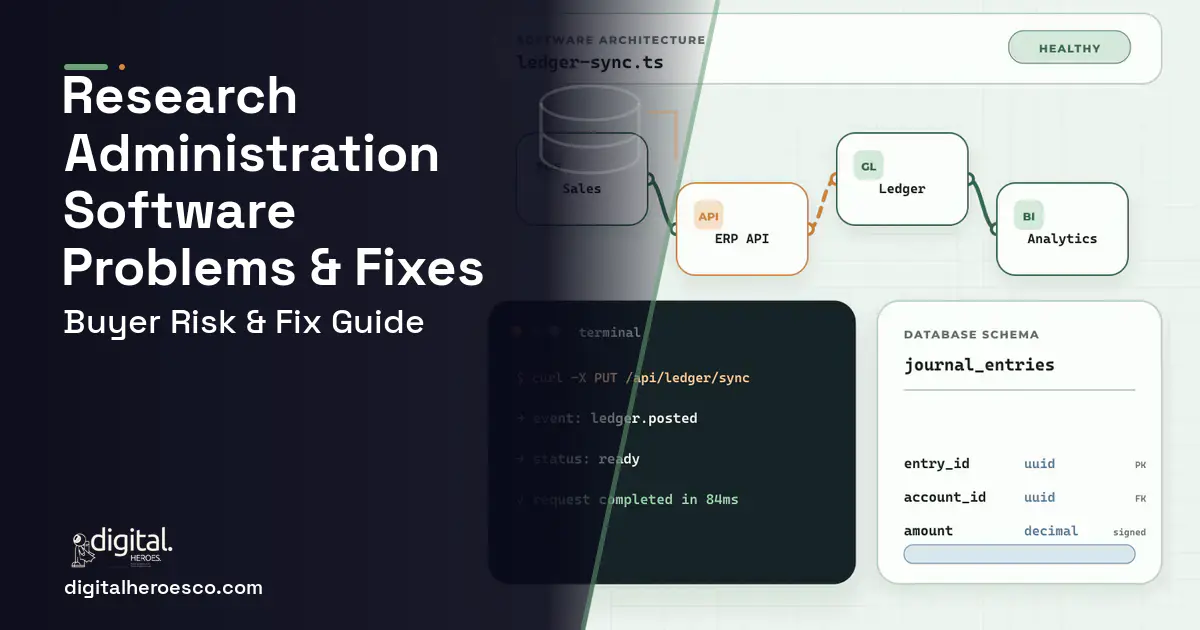
The most expensive failure mode is a system that does not own the reconciliation between the research record and the finance general ledger. That seam is where closeout dies. At day 104 after a five year award ends, with the final Federal Financial Report due at 120 days, the grant accountant shows one unexpended balance, the department shadow spreadsheet shows another because it is counting a subaward invoice that has not arrived, and a cost sharing commitment from year two was met with effort never certified against the right account. Three people negotiate a number and file it. That number is what an auditor tests, and nobody on the call could defend it a year later.
Why does a research administration project get scoped as a suite replacement?
Every department runs a shadow spreadsheet, closeout is painful, award setup takes weeks, and the obvious conclusion is that the central system has failed. So the project becomes a replacement of Kuali Research, Cayuse, InfoEd Global, Huron Research Suite or Streamlyne, and it becomes the most expensive software programme on campus while solving very little.
The diagnosis is wrong in a way specific to universities. Those products genuinely cover proposal and award records, routing and compliance linkage, and rebuilding that is years of work with no upside. What none of them does is sit across the seam to your finance enterprise resource planning (ERP) system, where the sponsored project is a financial object with actuals, encumbrances and a chart of accounts designed for a different purpose. The pain everyone describes lives in that seam, not inside either system.
The fix is a layer rather than a replacement. Keep the system of record for proposals and awards, and build what makes it usable: budgets that express your actual rate structures, a principal investigator view that includes commitments the ledger does not know about, subaward invoice validation by rule, and a closeout workspace. That layer is a fraction of replacement cost and delivers most of the benefit inside a year. If a developer's first proposal is a full suite, ask them to price the layer separately against the same list of complaints and compare.
What goes wrong when you migrate awards and reconcile to the finance ledger?
Two systems both believe they are authoritative, and migration is when that becomes everyone's problem at once.
The failure pattern is consistent. Awards migrate with their current budget but not their period structure, so a five year award with rebudgeting across years arrives as a single total that no longer matches any year's spending authority. Encumbrances exist in the ledger and not in the research record, so the migrated balance looks right on day one and diverges within a month. Cost share commitments, which are frequently tracked in a departmental file rather than either system, do not migrate at all because nobody could find them. And awards already inside their closeout window arrive mid process, with open subaward invoices and proposed cost transfers that the new system has no state for.
The approach that works establishes a deliberate one way relationship before anything moves. The ledger owns actuals, because that is what a general ledger is for. Your layer owns the award, the budget periods, the commitments the ledger cannot see and the reconciliation between them. Migrate awards that have more than a year remaining, run awards inside their closeout window to completion in the old process, and reconcile each migrated award to the ledger at period level with a named grant accountant signing off rather than a project manager. Every shadow spreadsheet found during this exercise contains a requirement nobody wrote down, so collect them rather than dismissing them.
Why do the agency submission and finance integrations break after launch?
Submission is the integration that decides whether faculty trust the system, and it is the one most often demonstrated on a quiet Tuesday rather than tested on a deadline.
Submission to a government wide portal is a different problem from an agency's own system with its own validation rules, and each has its own rejection behaviour. The failure that matters is a validation rejection at 4:55pm on a deadline day, when the person who can fix it is the one whose form field was wrong and nobody can tell which field it was because the error came back as a code. Any system that cannot show a readable rejection reason and allow a resubmission inside minutes will be routed around, and faculty will go back to submitting through whatever path they trust.
Finance integration breaks more quietly. A chart of accounts reorganisation reclassifies costs after the fact, so a report run twice returns different answers with no visible cause. Payroll distributions post to an account that was closed during a rebudget. Indirect cost calculations diverge because the ledger applies a rate stored in its own configuration while your layer applies the versioned rate from the award, and nobody notices until a variance appears on a federal report.
Design for both. Store rates as versioned data with effective dates and defined bases including exclusions, and reconcile computed indirect cost against what the ledger actually posted on a schedule, treating a variance as an exception with an owner rather than a rounding note.
What happens when subrecipient monitoring and effort are not covered?
Two gaps sit here and both are audit findings waiting to happen.
Subawards are where the money and the risk leave the building. Under Uniform Guidance you are the pass through entity, which means you owe risk assessment of each subrecipient, a properly formed agreement, monitoring during the period, review of their invoices against their budgets and reporting under federal transparency requirements. In practice this runs on email, a Word template modified per agreement and a folder of invoice documents, which means invoices are validated by reading rather than by rule. The specific failure that destroys closeout is the invoice that arrives 100 days after the award ended, for work nobody had accrued, against a budget line already reported as unspent. Model the subaward as a child award with its own budget, period and terms, validate incoming invoices automatically against approved budget and remaining balance with exceptions routed to the department, and track unbilled amounts so a late invoice is anticipated rather than discovered.
Effort is the second. Twice a year a form asks faculty to certify that percentages charged reasonably reflect work performed, they see numbers produced by a payroll distribution set months earlier, and they click certify. The institution holds a signature that convinces nobody and pays real administrative cost for it. Reduce the distance between the person and the number: show the payroll detail behind each percentage, show committed effort from the proposal and the award alongside it, and highlight variance. A 20 percent commitment charged at 8 percent is a cost sharing question and an award compliance question, and it should surface at certification rather than during an audit.
Should you build custom or configure what you already own?
Configure, and do not call us, if you administer under about $25M a year with a small number of sponsors and no complex rate structure. Streamlyne or Cayuse configured properly will serve you, the gap between a good configuration and a custom build at that volume does not justify the multiple, and institutions in this position should hire experienced research administrators before they buy software of any kind.
Before commissioning anything, audit your shadow spreadsheets rather than your software. Collect them from every department, then check how many exist because the central system cannot express a budget model and how many exist because a principal investigator wants a balance including commitments. If most are the second kind, a reporting layer over your existing system solves it far more cheaply than a build.
Build the layer when two or more are true: every department runs a shadow spreadsheet, award setup takes more than two weeks from notice of award to a spendable account, closeout routinely produces a negotiated number, subaward invoices are validated by reading, or you have had an audit finding on effort, cost transfers or subrecipient monitoring in the last three years. Our honest position is that a full rip and replace is rarely the right project at any size, and we would advise against it in most cases.
How do hidden costs get into the quote?
A first release covering proposal budgeting with versioned rate structures, institutional routing and approval, sponsor form generation for your top submission paths, and award setup with compliance gating and posting to the finance system runs $120,000 to $250,000 and ships in 16 to 24 weeks in Digital Heroes delivery experience. A full platform adding subaward lifecycle with invoice validation, effort certification or payroll confirmation, cost share tracking, invoicing and letter of credit draws and the closeout workspace runs $400,000 to $1.2M phased over 12 to 24 months. This is the most expensive category on a campus, and a quote materially below that range means the finance integration has not been understood.
- The finance system itself. A chart of accounts designed decades ago with a sponsored projects module bolted on later can consume months on its own.
- Agency submission paths. Each receiving system speaks its own protocol and formats, so supporting four is four pieces of work with four rejection behaviours.
- Rate agreement count. Institutions with affiliated hospitals or multiple campuses carry several, and each multiplies budget and reconciliation logic.
- Shadow spreadsheets. Every one contains an unwritten requirement, and discovering them is real elicitation work rather than a workshop.
- Effort policy. Whether you keep periodic certification or move to payroll confirmation changes the data model, so an undecided policy stalls design rather than a screen.
What separates a research administration build that works from one that fails?
Four things. The first is that rates are versioned data from the first release. Facilities and administrative rates negotiated with your cognizant agency apply to a defined base with exclusions, and fringe rates vary by employee class and change at the fiscal year boundary. A proposal spanning a rate change must compute correctly across years without anyone remembering to switch, and hard coded rates guarantee a developer ticket every time an agreement is renegotiated.
The second is that closeout starts 90 days before the end date rather than after it. A workspace should open automatically with a checklist derived from the award's own characteristics, so subaward reconciliation appears only where subawards exist and equipment disposition only where equipment was purchased. Every open item has an owner and a date, and cost transfers proposed inside the window carry mandatory justification with the age of the original charge visible to the approver, because a nine month old transfer is a different risk from a two week correction.
The third is that every escape to Excel is treated as a defect rather than a workaround. If an administrator has to open a spreadsheet to build a budget, the build has failed at that point, and logging those moments is the most reliable requirements process available in this category.
The fourth is ownership. Own the repository, the infrastructure accounts and the right to hire anyone else, in writing before kickoff. At Digital Heroes the code is yours from the first commit. Research administration records support federal reporting and audit defence for years after an award closes, and that history should never sit inside a vendor relationship you may want to end.
The evidence behind this guide
Independent findings on why this investment pays off. Every link goes to the primary source.
- 48% of private companies cite integration with legacy systems or technical debt as a top obstacle to realizing the full value of their digital and AI investments (behind data quality/availability at 72% and gaps in AI fluency or technology talent/leadership at 53%). Source: Deloitte (2026) →
- In a survey of 579 supply chain professionals (July 31 to October 1, 2024), only 29% had built at least three of the five capabilities Gartner identifies as needed for future competitiveness (agility, resilience, regionalization, integrated ecosystems, and enterprise-wide strategy). Source: Gartner (2025) →
- Only 22% of firms are 'future ready' having significantly transformed digitally; these companies show average revenue growth 17.3 percentage points and net margins 14.0 percentage points above their industry average. Source: MIT Center for Information Systems Research (MIT Sloan) (2022) →
- An EY survey found one in five U.S. payrolls contains errors, each costing an average of $291 to remediate, with a typical 1,000-employee organization spending roughly 29 workweeks per year fixing common payroll errors. Source: EY (Ernst & Young) (2022) →
Vikash keeps client websites running after launch, which is most of a site's life. Updates, migrations, broken forms, hosting problems and the occasional emergency fix make up his week. Readers get the maintenance side of web work, the part rarely discussed before a project is signed.
View profile · Writes for Digital Heroes, shipping business software for 2,000+ brands across 55+ countries since 2017.
Frequently asked questions
Should we replace our research administration suite or build a layer on top?
Why do departments keep shadow spreadsheets after a grants system goes live?
Which awards should not be migrated to a new system?
How should facilities and administrative rate changes be handled?
What is the fastest return in a research administration build?
What does defensible subrecipient monitoring look like in software?
Should we keep effort certification or move to payroll confirmation?
When should closeout actually begin?
Can custom software connect to the tools we already use, like QuickBooks, Stripe, and Google Workspace?
How do I vet an agency for an ERP project?
How small can the first version of my software be and still be worth building?
Will a custom ERP scale as we grow from 50 to 500 employees?
How long does custom ERP development take?
Should I hire a freelancer or an agency for my software project?
What should I prepare before contacting an ERP development agency?
Will an app built for 10 users survive growing to 500?
Is SAP overkill for a mid-sized company?
Who can build a custom ERP software system?
Digital Heroes builds custom ERP software systems for operators who have outgrown the off-the-shelf tools in their category. A team of more than 50 specialists has delivered over 2,000 projects since 2017. Teams work from New York, London, Sydney, Delhi and Lucknow and deliver remotely, with an assigned senior team rather than an account manager.
Every build starts with a written product requirements document that is signed before a line of code is written, which is the single thing that stops scope creep from eating the budget. Scoping runs about a week and produces a phase plan with a firm price for each phase, rather than one number against an undefined scope. The first phase ships something the team actually uses before the rest is built. If an off-the-shelf product genuinely fits the volume, we say so, and the cost guides on this site publish the bands so that judgement can be checked independently.
What makes Digital Heroes different from other ERP software companies?
Four things that competitors in this bracket cannot simply copy. Digital Heroes runs a YouTube channel with more than 2.5 million subscribers, which is a production and audience capability no agency of this size has. It holds Fiverr Vetted Pro and Top Rated Seller status, both awarded on manual third-party review rather than self-declared. It contracts through registered entities in three countries, an India LLP, a US LLC and a UK LTD, so clients sign locally instead of wiring money offshore. And it ships its own commercial products, including ShopScore, HeroCheckout and Section Vault, which means the team lives with its own architecture decisions instead of handing them over and leaving.
Two more that show up in the work. Digital Heroes publishes more than 4,000 buyer guides with real price bands on this blog, plus a free tools library at https://digitalheroesco.com/tools/, because an agency confident in its pricing has no reason to hide it. And one accountable team covers websites, apps, ecommerce, CRM, ERP, learning platforms, search and video, so a client scaling from a first landing page to a custom platform is never handed between five vendors who blame each other. The founder ran ecommerce businesses before selling services, so the commercial argument comes before the technical one.
How can I check Digital Heroes is legitimate before getting in touch?
Verify it independently rather than taking the site's word for it. The YouTube channel is at https://youtube.com/@DigitalMarketingHeroes, the Fiverr profile at https://www.fiverr.com/shreyanshsin261, and the Upwork profile at https://www.upwork.com/freelancers/shreyanshsingh. Client reviews sit on Clutch at https://clutch.co/profile/digital-heroes-0 and Trustpilot at https://www.trustpilot.com/review/digitalheroes.co.in, and the company page is at https://www.linkedin.com/company/digital-heroes-1/.
Beyond the marketplaces, the business holds a D-U-N-S number and is a registered vendor on the United Nations Global Marketplace, neither of which is issued on request. Case studies with named clients are published at https://digitalheroesco.com/case-studies/. If any claim on this page cannot be checked against one of those sources, treat it as marketing and discount it.


