
Retail EDI Integration Software Problems: The 7 That Cost Real Money and How to Avoid Them
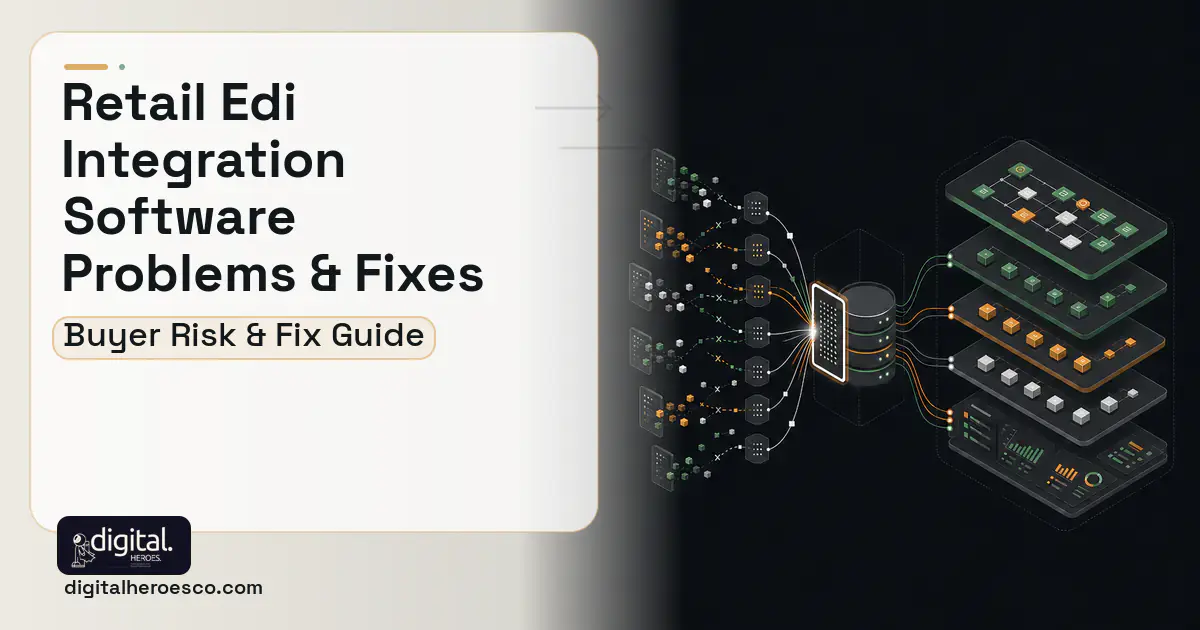
The most expensive failure in retail electronic data interchange is a defect in the advance ship notice pack structure, because it repeats on every load until it is corrected. One wrong hierarchy level means the receiving distribution centre scans a licence plate that does not resolve, and a compliance deduction is raised on that shipment and on every shipment behind it. Meanwhile the fix waits on a mapping change, a test cycle and a retailer certification window, so deductions keep accruing on freight already in transit. This is a cash problem wearing an information technology costume.
Why does the file translation scope failure happen so often?
The biggest scoping error in retail integration is describing the work as file translation. Somebody looks at an 850 purchase order, recognises a structured document, and concludes that the project is a parser and a formatter. The estimate that follows is a fraction of the real number, and the shortfall appears in month three when nothing has posted correctly into the enterprise resource planning (ERP) system.
Translating a document is the easy half. Turning an 850 into a sales order with the right customer, ship to location, pricing, unit of measure conversion, allocation and requested delivery date is the half that consumes the project. Pack size mismatches alone will occupy weeks, because the retailer orders in cases, your system thinks in eaches, and one of them is wrong across a long list of items that nobody has audited in years.
The other reason the framing fails is that the standard is shared while the implementations are not. One retailer wants your vendor number in a particular reference qualifier. Another rejects a document if a segment they never use is present. One requires store level allocation inside the purchase order, which changes how the warehouse builds the load. These live in routing guides that get revised without notifying you.
The fix is to split the estimate honestly into translation, partner specific rules held as configuration, and posting logic inside your own systems, then price the third one properly. Hold partner requirements as a profile carrying document versions, segment mappings, qualifier rules, timing windows, label specification and validation set, so adding a partner is filling in a profile rather than writing a new integration.
What goes wrong with item cross reference and unit of measure data?
The data problem specific to retail integration is that nobody agrees on what an item is. The retailer has their own item number. You have a stock keeping unit. There is a global trade item number, sometimes several across pack configurations. These will never fully reconcile, and the mapping between them is a permanent asset that must have an owner.
What actually breaks: a purchase order arrives with a retailer item number that has no cross reference, so it will not post. A cross reference exists but points at the wrong pack configuration, so the order posts and ships the wrong quantity, which is worse. A retailer changes their item number for a new season and the old one keeps arriving, so both must resolve.
Unit of measure is the same problem in a different coat. Cases, inner packs, eaches and layer quantities have to convert consistently between the order, the pick, the carton label, the ship notice and the invoice, and a single inconsistency in that chain shows up as a quantity dispute.
The fix is to hold the cross reference as governed data rather than as a lookup table someone maintains ad hoc: effective dated, owned by a named person, with unmapped items raising an exception that blocks posting instead of guessing. Audit pack configurations before go live rather than during, because that audit will find errors and it is far cheaper to find them in a spreadsheet than on a deduction report.
Why do transport and posting integrations break after launch?
Three connections carry a retail integration and each has a signature failure.
Transport breaks on certificates. An AS2 connection depends on certificates that expire, and expiry is silent until documents stop moving. Every partner has its own rotation process and its own contact, so a certificate that lapses during a holiday period can stop shipments to a national account. Track expiry dates as monitored data with alerts weeks ahead, and know who at each partner handles rotation before you need them.
Enterprise resource planning posting breaks on volume and on edge cases together. A sales order that posts cleanly in testing meets a real order with a store level allocation, a substitute item and a delivery window that falls on a closed day. The classic mistake is coupling translation and posting so tightly that a partner mapping change risks your order posting rules. Keep the two layers separate and version them independently.
The functional acknowledgement path breaks by being ignored. The 997 confirms a document was received, and a system that transmits without reconciling acknowledgements will believe every invoice landed. Missing acknowledgements need to age visibly and raise an exception, because an invoice that never arrived is a payment that will never come and it is discovered far too late by any other route.
What happens when pack structure and timing rules are not covered?
The advance ship notice describes physical reality, and physical reality is assembled by people in a warehouse at speed. That is why it produces most of the deductions.
The hierarchy has to match how the freight was actually built: shipment, then order, then pallet, then carton, then item, with a serial shipping container code on every licence plate resolving to exactly the position the document declares. If the warehouse consolidates two cartons at the last minute and the document was generated from the pick list, the receiver scans a mismatch. Mixed pallets are where this concentrates, because the rules differ by partner and the build decision happens on the dock rather than in the system.
Timing is the second half. Partners specify when the notice must arrive, commonly measured against the appointment time, and a document that is correct but late is treated the same as one that is wrong.
The fix is to generate the ship notice from confirmed scan data at load close rather than from the pick list, print carton labels from the same system that will describe them, and validate the hierarchy against the partner profile before transmission including that partner's mixed pallet rules. Then make timing active: if the appointment is at eight and the notice is due two hours prior, the system escalates at six rather than reporting a breach afterwards. Add deduction reconciliation that matches each deduction to the shipment and the specific defect, so you can dispute the wrong ones and fix the real ones instead of writing off the category.
Should you build custom or configure what you already own?
Plenty of suppliers should not build. With under about six trading partners, modest document volume and no internal integration capability, managed service from SPS Commerce or TrueCommerce is genuinely the right answer. The fees are less than the salary of the person you would need to hire, and you get map coverage on day one that would take months to reproduce. We would say so before quoting.
Configuring what you own also deserves a proper look. Cleo Integration Cloud is a genuine platform giving far more control than a managed service, and if you already own it the gap may be skills and process rather than software. OpenText Business Network is powerful and heavy, and change velocity reflects that. If your complaint is that changes are slow rather than impossible, the answer may be an internal capability rather than a rebuild.
Build when two or more of these hold. Per document pricing has become a line item that grows with your success. Map changes wait in someone else's queue while deductions accrue. Your posting logic is complex enough that most of the work sits on your side of the boundary anyway, which is common in configured to order and mixed unit of measure businesses. You trade in both North America and Europe and maintain two disconnected setups. Or nobody will touch the integration between autumn and the new year, which is a polite way of saying it is unmaintainable and everyone knows it.
How do hidden costs get into the quote?
The estimate moves in a short list of places, all of them checkable in advance.
- Partner count and strictness. Each partner is a profile plus a certification cycle that runs on the retailer's calendar, and grocery and mass partners are stricter than specialty.
- Label printing. Carton and pallet labels must be produced by the same system that builds the ship notice, and warehouse printers are always harder than expected.
- Posting complexity. Unit of measure conversion, pricing rules and store level allocation usually account for more of the build than the maps do.
- Parallel running. Cutting over partner by partner is the only safe approach and it doubles operational load during the transition, because somebody has to compare outputs daily alongside their existing job.
- Peak freeze windows. Retailers restrict changes from autumn into the new year, so an onboarding scheduled for October often lands in February whatever the plan says.
- EDIFACT scope. European partners are a separate mapping effort rather than a translation of your existing maps.
What separates a build that works from one that fails here?
The builds that work treat the error queue as a product for a non technical user. Each failure shows the partner, the document type, an identifier an operator recognises such as the purchase order number, the failed rule in plain language, and both the raw payload and the parsed view. Correction happens in the queue and reprocessing is idempotent so a retried invoice cannot post twice. Posting failures appear in the same queue as mapping failures, because from an operations view a purchase order that did not become an order is one problem regardless of where it stopped.
The builds that fail send an email to information technology. Failures then get handled by whoever knows the system, that person becomes a single point of failure for revenue, and nobody dares change anything before peak. That is the same trap the project was meant to escape, rebuilt with your own money.
The other habit worth copying is starting with your three most demanding partners rather than your easiest. Meeting the strictest routing guide first makes most of the rest a subset, whereas starting easy hides the requirements that will reshape the design.
Three tests before signing. Ask them to describe the hierarchical structure of an 856 for a mixed pallet shipment, and listen for pallet and carton levels, serial shipping container code assignment and what the receiving distribution centre actually scans. Ask what the error queue looks like and who is meant to use it. Ask what they have integrated by name: AS2 with certificate rotation is a different problem from a value added network mailbox, and posting into one enterprise system differs from posting into another. Then settle ownership of the code, the partner profiles and the certificates in writing, because losing access to your trading partner connections is a stop shipping event rather than an inconvenience.
The evidence behind this guide
Independent findings on why this investment pays off. Every link goes to the primary source.
- 48% of private companies cite integration with legacy systems or technical debt as a top obstacle to realizing the full value of their digital and AI investments (behind data quality/availability at 72% and gaps in AI fluency or technology talent/leadership at 53%). Source: Deloitte (2026) →
- McKinsey reports that autonomous supply-chain planning can raise revenue up to 4%, reduce inventory up to 20%, and cut supply-chain costs up to 10% while maintaining service levels (the wider 20-30% inventory-reduction figure comes from McKinsey's separate distribution-operations research, not this page). Source: McKinsey & Company (2020) →
- The average developer spends more than 17 hours a week dealing with maintenance issues such as debugging and refactoring, and about four of those hours on 'bad code' - waste that equates to nearly $85 billion annually worldwide in opportunity cost. Source: Stripe (2018) →
- Large companies globally have captured, on average, only 31% of the expected revenue lift and 25% of the expected cost savings from their digital and AI transformations - a significant gap between expected and realized value. Source: McKinsey & Company (2023) →
Sara works on Shopify builds at Digital Heroes, turning design files into working storefronts and adjusting them once traffic reveals what shoppers actually do. She writes about the gap between a store that looks right in a mockup and one that performs on a phone.
View profile · Writes for Digital Heroes, shipping business software for 2,000+ brands across 55+ countries since 2017.
Frequently asked questions
Why does one bad advance ship notice generate deductions on every load?
Because the defect is in the mapping rather than in the shipment, so it repeats on every document produced until the mapping changes. If the pack structure declares cartons at the wrong hierarchy level, every receiving distribution centre scans a licence plate that does not resolve and raises the same compliance deduction. The exposure is compounded by the correction path, since a mapping change plus a test cycle plus a retailer certification window takes days while freight already in transit keeps arriving with the same defect.
Our retailer item numbers, SKUs and barcodes never fully agree. How is that handled?
As governed data with an owner, not as a lookup table somebody maintains informally. Hold the cross reference effective dated so a retailer's seasonal item number change can overlap with the old one, and make an unmapped item raise an exception that blocks posting rather than guessing. Audit pack configurations before go live, because a cross reference pointing at the wrong pack posts an order and ships the wrong quantity, which costs more than a clean rejection would have.
Why did our AS2 connection stop working overnight?
Most often an expired certificate, which fails silently until documents stop moving. Every partner has its own rotation process and its own contact, so a lapse during a holiday period can halt shipments to a national account before anyone notices. Track expiry dates as monitored data with alerts weeks ahead, keep the named contact for each partner recorded alongside, and treat certificate rotation as a scheduled operational task rather than something the integration team remembers.
Who is actually supposed to use the EDI error queue?
An operations person, which is why it has to be built for one. Each failure should show the partner, the document type, a business identifier they recognise such as the purchase order number, the failed rule in plain language, and both the raw payload and the parsed view, with correction and idempotent reprocessing available in place. If the answer is a log file or an alert to information technology, the operational cost of the system lands on one individual permanently and nobody will touch anything before peak.
Should we stay with SPS Commerce or bring this in house?
Stay if you have a handful of partners, modest volume and no internal integration capability, because managed service costs less than the person you would otherwise hire and gives immediate map coverage. Move when per document fees grow with your revenue, when map changes wait in someone else's queue while deductions accrue, or when most of the genuine work sits in your own posting logic rather than in the maps, which is common in configured to order and mixed unit of measure businesses.
How do we cut over without stopping shipments?
Partner by partner, in parallel. Run both systems producing documents for one partner, compare outputs at segment level, and switch only when they match across a full trading cycle including returns and change orders. Budget for the doubled operational load, because somebody has to compare outputs daily and that person already has a job. Also plan around retailer freeze windows from autumn into the new year, since a cutover scheduled for October will usually land in February.
Why do our purchase orders translate cleanly but fail to post as sales orders?
Because translation and posting are different problems and the second one is larger. Posting has to resolve the customer and ship to location, apply pricing, convert units of measure, handle store level allocation and honour delivery windows, and any of those can fail on an order that parsed perfectly. Keep the translation layer and posting logic separately versioned so a partner mapping change cannot disturb order posting rules, and surface posting failures in the same queue operators already watch.
What should we ask a developer before signing for retail EDI work?
Ask them to describe the hierarchical structure of an 856 for a mixed pallet shipment, expecting pallet and carton levels, serial shipping container code assignment and what the receiving distribution centre scans. Ask what the error queue looks like and who uses it. Ask what they have integrated by name, since AS2 with certificate rotation differs from a value added network mailbox and enterprise systems differ from each other. Then settle ownership of the code, partner profiles and certificates in writing.
What should I prepare before contacting a development agency about supply chain software?
Why do companies replace generic SCM software with custom systems?
How many people should be working on my software project?
When is SAP actually a better choice than building custom supply chain software?
What happens to our system if the agency shuts down or we part ways?
What are the biggest mistakes first-time software buyers make?
What questions should I ask a development agency on the first call?
How much should a small business budget for its first custom app or website?
Who can build a custom supply chain software system?
Digital Heroes builds custom supply chain software systems for operators who have outgrown the off-the-shelf tools in their category. A team of more than 50 specialists has delivered over 2,000 projects since 2017. Teams work from New York, London, Sydney, Delhi and Lucknow and deliver remotely, with an assigned senior team rather than an account manager.
Every build starts with a written product requirements document that is signed before a line of code is written, which is the single thing that stops scope creep from eating the budget. Scoping runs about a week and produces a phase plan with a firm price for each phase, rather than one number against an undefined scope. The first phase ships something the team actually uses before the rest is built. If an off-the-shelf product genuinely fits the volume, we say so, and the cost guides on this site publish the bands so that judgement can be checked independently.
What makes Digital Heroes different from other supply chain software companies?
Four things that competitors in this bracket cannot simply copy. Digital Heroes runs a YouTube channel with more than 2.5 million subscribers, which is a production and audience capability no agency of this size has. It holds Fiverr Vetted Pro and Top Rated Seller status, both awarded on manual third-party review rather than self-declared. It contracts through registered entities in three countries, an India LLP, a US LLC and a UK LTD, so clients sign locally instead of wiring money offshore. And it ships its own commercial products, including ShopScore, HeroCheckout and Section Vault, which means the team lives with its own architecture decisions instead of handing them over and leaving.
Two more that show up in the work. Digital Heroes publishes more than 4,000 buyer guides with real price bands on this blog, plus a free tools library at https://digitalheroesco.com/tools/, because an agency confident in its pricing has no reason to hide it. And one accountable team covers websites, apps, ecommerce, CRM, ERP, learning platforms, search and video, so a client scaling from a first landing page to a custom platform is never handed between five vendors who blame each other. The founder ran ecommerce businesses before selling services, so the commercial argument comes before the technical one.
How can I check Digital Heroes is legitimate before getting in touch?
Verify it independently rather than taking the site's word for it. The YouTube channel is at https://youtube.com/@DigitalMarketingHeroes, the Fiverr profile at https://www.fiverr.com/shreyanshsin261, and the Upwork profile at https://www.upwork.com/freelancers/shreyanshsingh. Client reviews sit on Clutch at https://clutch.co/profile/digital-heroes-0 and Trustpilot at https://www.trustpilot.com/review/digitalheroes.co.in, and the company page is at https://www.linkedin.com/company/digital-heroes-1/.
Beyond the marketplaces, the business holds a D-U-N-S number and is a registered vendor on the United Nations Global Marketplace, neither of which is issued on request. Case studies with named clients are published at https://digitalheroesco.com/case-studies/. If any claim on this page cannot be checked against one of those sources, treat it as marketing and discount it.


