
Specialty Pharmacy Management Software Problems: The 7 That Delay First Dose, and How to Avoid Them
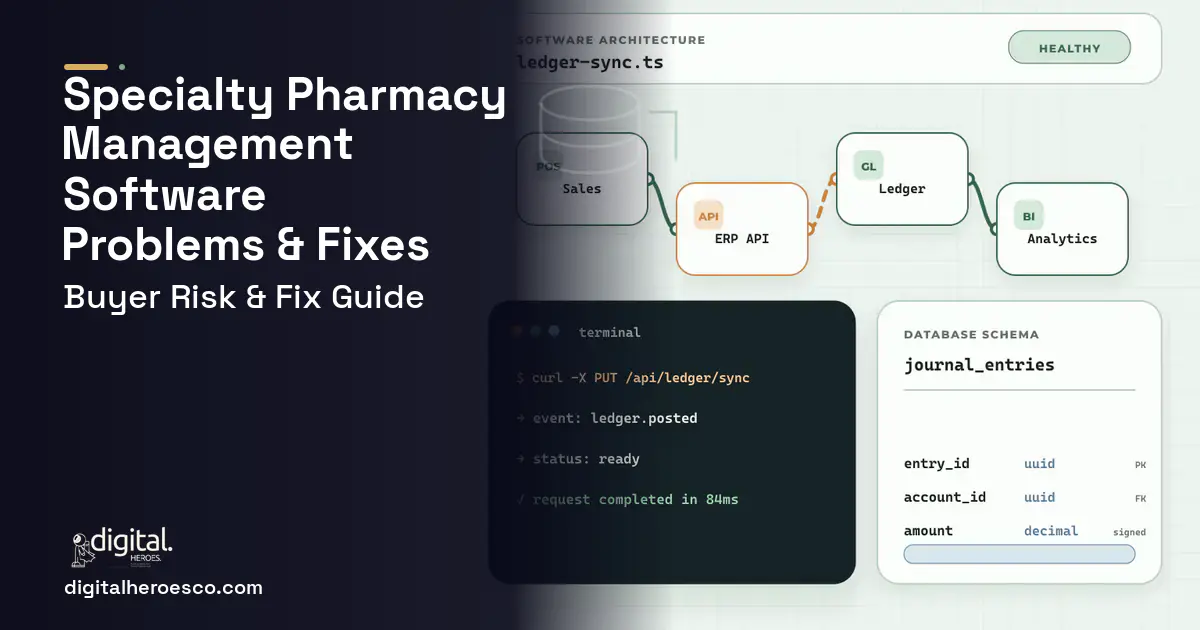
The most expensive failure mode is that nobody owns the clock. Time from referral to first dose decides whether a therapy starts at all, because patients abandon and prescribers redirect to a competing pharmacy, and manufacturers measure you on it under limited distribution contracts. Yet at most pharmacies the clock exists only as a report produced monthly, so the person working the queue on Tuesday has no way of knowing which patient has been waiting eleven days or what is blocking them. The cost is a referral lost, a prescriber relationship weakened, and a metric that damages your standing at contract renewal, all from an interval nobody could see while it was happening.
Why does the project turn into replacing the dispensing system?
The characteristic scope failure here is deciding to rebuild dispensing. It follows an understandable logic. The dispensing system is where the pharmacy technically operates, it is where the claim adjudicates, and it is the thing people complain about. So the project becomes a replacement, and the budget disappears into claim adjudication, inventory and label printing, which are regulated, exacting and already solved.
The mistake is that specialty pharmacy is a coordination business where the drug leaves the building only at the end. The interval before it does, covering benefits investigation, prior authorisation, financial assistance, clinical assessment and shipment readiness, is the entire operational and commercial question, and no dispensing system was designed to see it as a connected process. It sees a prescription, a claim and a package.
The fix is to leave dispensing and claim adjudication in your existing system for the first phase and build the coordination layer around it. That is the single biggest scoping decision in the category and it changes the price band substantially. The first release should be referral intake, a unified patient therapy record, benefits and prior authorisation tracking, and a worklist ordered by days since referral with the current blocker named. That is a system your team works in all day, and it is where the value sits.
What goes wrong when you migrate patient, therapy and assistance history?
You are merging records from a dispensing system, a therapy management product, spreadsheets and several portals, and the join is harder than it looks because the entity you need did not exist in any of them. Nobody was storing this patient on this therapy as a single object with a start, a set of gates and a clock.
Four failures recur. The same patient appears on multiple therapies with no way to tell which clinical assessments belonged to which, so migrating assessments produces a record that is chronologically plausible and clinically misleading. Financial assistance sits in claim level adjustments rather than as tracked instruments, so remaining balances and expiry dates are simply not present in the source and cannot be reconstructed. Prior authorisation history exists as portal screenshots and faxes attached to nothing, so approval periods and expiry dates are unknown. And discontinuation reasons, which manufacturers ask for, were free text or absent.
The approach that works is to migrate the current state accurately and the history as reference. Active patients get a properly constructed therapy record with every gate reconstructed and verified by a pharmacist or coordinator, because those are the patients whose next fill depends on it. Historical fills and documents come across as attached reference clearly marked as pre migration. Re-verify active assistance and prior authorisation directly with the source rather than trusting an import, because a wrong expiry date on an active grant is exactly the error that pauses a therapy.
Why do hub, payer and dispensing integrations break after launch?
They break because most of them are not integrations. Genuine electronic paths exist for some payers and some manufacturers, and for the rest your team is logging into a portal, and any design that treats portal work as a temporary gap will fail as soon as volume grows.
The specific break is state drift. A prior authorisation is approved in a payer portal, the coordinator who checked it is off sick, and your system still shows it pending, so the patient sits in a queue that is now wrong. The mirror case is worse: an authorisation lapses and nothing notices because the expiry lived in the portal rather than in your record.
Two fixes worth insisting on. Model the manual paths explicitly, with a check task, an owner, a due date and a recorded outcome, so portal work is visible and measurable rather than invisible and assumed. And treat every gate as having its own validity period with re-verification scheduled before the next fill rather than annually, so lapses surface as work weeks in advance. On the dispensing side, the integration that matters is fill events flowing into the therapy record, because those events drive assessment scheduling and adherence measures. Ask any developer which dispensing system you run before they answer anything else, because that answer changes the shape of the work.
What happens when assistance tracking and accreditation evidence are not covered?
You get therapy interruptions that were entirely predictable and an accreditation cycle that consumes weeks of senior time. Both are quiet failures that never appear in a business case until they happen.
Financial assistance is the sharper one. A commercially insured patient may use a manufacturer copay card with an annual maximum. A government insured patient cannot, and needs a foundation grant that can exhaust mid year or a manufacturer patient assistance programme. Payer accumulator and maximiser programmes change how much of that assistance counts toward the deductible, which changes what the patient owes at the next fill with no visible event. If assistance is applied at claim time rather than tracked as a portfolio, the exhausted grant is discovered at the moment the next shipment should go out, and the therapy pauses.
Accreditation evidence fails the same way. Quality measures, patient management activity, complaint handling and outcomes get assembled in a scramble before survey, which is both expensive in senior time and visible to an experienced surveyor, because retroactively reconstructed evidence looks exactly like what it is. Compute the measures continuously from the operational record so preparing for survey is reviewing numbers that are already true. Both features are unglamorous, both are cheap relative to their value, and both get cut first when a budget tightens.
Should you build custom or configure what you already own?
Configure if you are a retail or community pharmacy with a small specialty tail, or a single site handling a handful of therapies. Your dispensing system plus disciplined process will beat a build, and the accreditation burden at that scale is genuinely manageable by hand. Spending on a coordination platform there buys structure you do not yet need.
Be fair about the incumbents rather than dismissive. Therigy exists precisely because dispensing systems did not carry clinical management, and it does that job. WellSky CareTend and Inovalon ScriptMed carry dispensing and billing depending on the pharmacy's history. The market is fragmented because the business grew from two different roots, retail dispensing and clinical case management, and each vendor added the missing half rather than rethinking the record. That is a structural observation your own team can verify by counting how many applications a pharmacist opens for one patient.
Build when two or more hold. You have limited distribution contracts with manufacturer reporting obligations and an analyst producing them by hand. Clinical management and dispensing are in different systems and staff work in both. Nobody can tell you today which patients have been waiting longest and why. Financial assistance lapses are interrupting therapy. Or you are adding therapies faster than your vendor can configure them. If your staff are effectively the integration between two products, that is the work a build removes.
How do hidden costs get into the quote?
Five drivers, all identifiable before signing.
- Manufacturer contract count. Each reporting obligation is a field map, validation rules and a delivery channel, and every contract has its own field layout and cadence.
- Dispensing scope. Whether dispensing and claim adjudication are in scope or stay in your existing system is the largest single lever on the total.
- Therapy specific clinical programmes. Each one carries its own assessment content, schedule and escalation rules, so ten therapies is not one workflow with a dropdown.
- Portal work. Where no electronic path exists, the design has to make manual steps first class, and that modelling is real work rather than an omission.
- Infusion services. Nursing visit scheduling and supply management is a different operational model again and should be scoped as its own phase.
The cost that surprises people is clinical content authoring. Assessment questions, intervention protocols and escalation rules have to be written by your pharmacists, and that is calendar time from people who are already fully committed. Name them at kickoff and protect the hours, because content is the usual reason these projects arrive late rather than engineering.
What separates a build that works from one that fails here?
The builds that work make the patient therapy journey the primary record. Referral intake creates it, and benefits, prior authorisation, financial assistance, clinical assessment and shipment readiness are gates on it, each with a status, an owner and a timestamp. The operational view is a list ordered by days since referral with the blocker named, so the team works the oldest and most stuck first rather than whatever is on top of the fax pile. Document extraction earns its place at intake, turning a faxed referral into structured patient, prescriber, diagnosis and insurance fields with a human confirming low confidence reads, because those hours sit at the front of the clock where delay costs most.
The second differentiator is whether manufacturer reporting is configuration or code. Each contract should hold a field map from your internal data model to the manufacturer's expected fields, plus a schedule, a delivery channel and validation rules, so adding a manufacturer means defining a map that your own analyst can define. If every new contract requires a developer, you have moved the bottleneck rather than removed it. Keep a record of exactly what was sent and when, because manufacturers do query figures from prior quarters after the underlying data has been corrected.
When choosing a developer, ask them to model the therapy journey before quoting. Ask how financial assistance is tracked between fills, and reject an answer that applies it at claim time. Ask how a new manufacturer report gets added. Ask which dispensing systems and hub portals they have worked with by name. Then settle ownership of the code, the cloud accounts and your clinical content and field maps in writing, because those represent years of accumulated operational knowledge and should never be trapped in a supplier's configuration.
The evidence behind this guide
Independent findings on why this investment pays off. Every link goes to the primary source.
- In PMI's 2014 Pulse of the Profession report on requirements management, inaccurate requirements management is cited as a leading cause of project failure, with 47% of unsuccessful projects failing to meet goals due to poor requirements management. Source: Project Management Institute (PMI) (2014) →
- Standish's 2015 CHAOS research found roughly a third of software projects (about 36% by the Modern definition) fully succeed on time, on budget, and on scope, with top success drivers including executive support, user involvement, and clear requirements/business objectives. Source: Standish Group (CHAOS Report) (2015) →
- Digital Champions expect to achieve about 16% in cost savings and around 15% in revenue gains from digital operations over five years; the study surveyed 1,155 manufacturing executives across 26 countries. Source: PwC / Strategy& (2018) →
- SHRM's 2025 benchmarking data puts the average cost-per-hire at $5,475 for nonexecutive roles and $35,879 for executive roles - executive hires are on average nearly 7x more expensive than nonexecutive hires. Source: SHRM (Society for Human Resource Management) (2025) →
Khushi runs several client projects at once, which mostly means deciding whose problem gets solved first. She coordinates developers, designers and clients across time zones, tracks budget against work completed, and raises the difficult conversation early. Readers learn how an agency actually allocates attention when everything is urgent.
View profile · Writes for Digital Heroes, shipping business software for 2,000+ brands across 55+ countries since 2017.
Frequently asked questions
How do we make time to first fill visible to the people working the queue?
Why does financial assistance keep lapsing without anyone noticing?
Should we replace our dispensing system as part of this?
How do we migrate patients who are on multiple therapies?
What should the system do about payer portals where no electronic path exists?
How do we handle a new manufacturer contract without a developer?
Can accreditation preparation really be a byproduct of daily work?
Is Therigy or CareTend enough for a single site?
What happens to my ERP if the agency shuts down or we part ways?
How long does it take to build a custom web or mobile app from scratch?
Does it matter which tech stack the agency wants to use?
How many developers does it take to build an ERP?
How do I vet a software development agency before signing a contract?
What should I prepare before contacting an ERP development agency?
Will a custom ERP scale as we grow from 50 to 500 employees?
Who can build a custom ERP software system?
Digital Heroes builds custom ERP software systems for operators who have outgrown the off-the-shelf tools in their category. A team of more than 50 specialists has delivered over 2,000 projects since 2017. Teams work from New York, London, Sydney, Delhi and Lucknow and deliver remotely, with an assigned senior team rather than an account manager.
Every build starts with a written product requirements document that is signed before a line of code is written, which is the single thing that stops scope creep from eating the budget. Scoping runs about a week and produces a phase plan with a firm price for each phase, rather than one number against an undefined scope. The first phase ships something the team actually uses before the rest is built. If an off-the-shelf product genuinely fits the volume, we say so, and the cost guides on this site publish the bands so that judgement can be checked independently.
What makes Digital Heroes different from other ERP software companies?
Four things that competitors in this bracket cannot simply copy. Digital Heroes runs a YouTube channel with more than 2.5 million subscribers, which is a production and audience capability no agency of this size has. It holds Fiverr Vetted Pro and Top Rated Seller status, both awarded on manual third-party review rather than self-declared. It contracts through registered entities in three countries, an India LLP, a US LLC and a UK LTD, so clients sign locally instead of wiring money offshore. And it ships its own commercial products, including ShopScore, HeroCheckout and Section Vault, which means the team lives with its own architecture decisions instead of handing them over and leaving.
Two more that show up in the work. Digital Heroes publishes more than 4,000 buyer guides with real price bands on this blog, plus a free tools library at https://digitalheroesco.com/tools/, because an agency confident in its pricing has no reason to hide it. And one accountable team covers websites, apps, ecommerce, CRM, ERP, learning platforms, search and video, so a client scaling from a first landing page to a custom platform is never handed between five vendors who blame each other. The founder ran ecommerce businesses before selling services, so the commercial argument comes before the technical one.
How can I check Digital Heroes is legitimate before getting in touch?
Verify it independently rather than taking the site's word for it. The YouTube channel is at https://youtube.com/@DigitalMarketingHeroes, the Fiverr profile at https://www.fiverr.com/shreyanshsin261, and the Upwork profile at https://www.upwork.com/freelancers/shreyanshsingh. Client reviews sit on Clutch at https://clutch.co/profile/digital-heroes-0 and Trustpilot at https://www.trustpilot.com/review/digitalheroes.co.in, and the company page is at https://www.linkedin.com/company/digital-heroes-1/.
Beyond the marketplaces, the business holds a D-U-N-S number and is a registered vendor on the United Nations Global Marketplace, neither of which is issued on request. Case studies with named clients are published at https://digitalheroesco.com/case-studies/. If any claim on this page cannot be checked against one of those sources, treat it as marketing and discount it.


