
Supply Chain Finance Platform Problems: The 7 That Stall a Programme, and How to Avoid Them
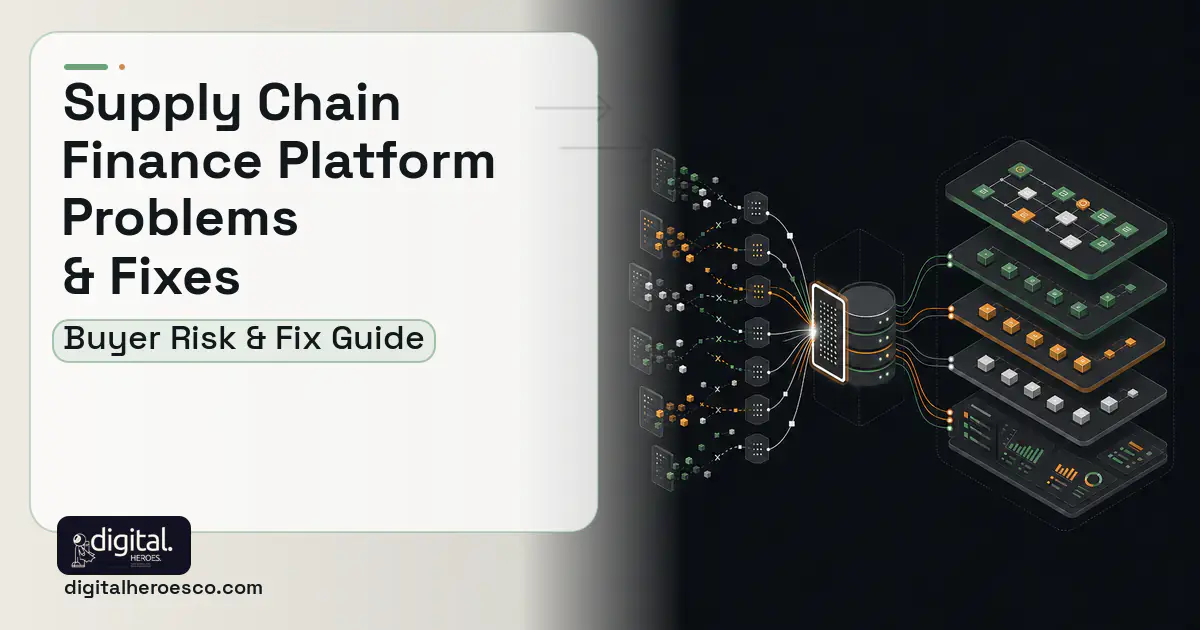
The failure that kills these programmes is onboarding, and it never looks like a software problem until you count the suppliers. A programme launches with a target of several hundred suppliers and twelve months later the live ones are the large suppliers who least needed the liquidity. The tail, where the programme would actually do some good and where your volume economics live, never got through a flow that asked for documents in a language they do not operate in, an identity check designed for another market, and a bank verification that failed because the account name did not exactly match the registered entity name.
Why does the build start with funding logic instead of onboarding?
Every payables finance platform we have seen scoped begins in the same place: the offer engine, the discount calculation, the funder allocation. That is the part that feels like the product, and it is the part that is least likely to determine whether the programme works.
Funding is the easy end. Banks want approved payables from a strong buyer because the credit risk is the buyer's and the tenor is short. What is scarce is suppliers who have completed identity verification, signed a receivables assignment agreement and proved control of a bank account. Build a beautiful allocation engine and a portal, launch, and you will spend the next year discovering that your conversion funnel leaks at the third step in one country and the fifth in another.
What makes this specific to supply chain finance is that onboarding requirements are not yours. They come from the funder's obligations and they differ by country and entity type, so a sole trader in one market, a private limited company in another and a state owned entity in a third are three different evidence packages. Beneficial ownership for a family owned manufacturer with a holding structure is a genuine research exercise, not a form field.
The fix is to treat onboarding as a conversion funnel with measurement at every step, built first and refined against real suppliers in two countries before any broad launch. Derive the document set from country and entity type rather than issuing one global checklist, extract from uploaded registry documents to prefill rather than asking a supplier to type its own registration number, and route the difficult cases to a human queue instead of failing them. Programmes that succeed optimise this. Programmes that stall treated it as a compliance hurdle to be endured.
What goes wrong with the buyer's approved payable data?
The entire product rests on one fact: the buyer has irrevocably approved an invoice for payment on a date. The discount, the funder's risk and the accounting all follow from it. Which means the extract from the buyer's system has to be exact, complete and stable, and at the start it is usually none of the three.
The problems are mundane and they are fatal. Invoices approved and then reversed by a credit note two days later. Partial approvals where one line is disputed. Payment terms in a vendor master that disagree with the terms on the invoice. Duplicate vendor records for the same legal entity, so one supplier appears three times with three payment histories and none of them reconcile. Payment runs that net several invoices and offsets into a single remittance, which makes invoice level reconciliation impossible unless the remittance detail comes through.
The fix is to treat the buyer feed as a first class subsystem rather than a nightly file. Approved payables arrive with the approval event and its timestamp. Changes after approval flow through as linked events rather than silently altering a record, so a credit note arriving after a supplier has taken early payment is visible as a reduction against a funded amount and can be routed down a defined dispute path back to the funder. The vendor master is deduplicated against a resolved supplier entity before anything is offered.
Expect remediation on the buyer side and put it in the plan. In our delivery experience the calendar risk on these programmes is rarely engineering, it is data quality work that gets discovered rather than specified.
Why do the ERP (Enterprise Resource Planning) and payment rail connections break after launch?
The buyer ERP integration is the first fragile point, and it is fragile for organisational reasons. SAP, Oracle and Coupa each expose approved payable data differently, and remittance detail is often the harder half. Beyond the interface, the buyer's own accounts payable team changes approval workflows, adds a company code, migrates an instance or acquires a business with its own system, and none of those changes are communicated to a financing platform sitting downstream. The programme keeps running against a feed that has quietly stopped including a set of invoices.
Payment rails are the second. Paying suppliers in several currencies through different local methods is its own project, and each rail has its own failure behaviour: a rejected payment for a name mismatch, a cut off time that shifts around a local holiday, a correspondent bank returning funds days later. If your reconciliation assumes payments either succeed or fail immediately, you will carry unreconciled positions.
The third is screening. Sanctions list checks are not a one time gate at onboarding, they run against a list that changes, and a supplier who cleared in March may not clear in September. If rescreening is not automated with a defined case handling process, someone is doing it manually and eventually stops.
The fix is monitoring with commercial teeth. Every feed needs an expected cadence and an alert when it deviates, a named owner at the buyer and at the funder, and a contractual obligation to notify you of ERP changes. Reconcile daily rather than monthly, because a break found the next morning is a question and a break found at quarter end is an investigation.
What happens when disclosure, screening and reconciliation are not covered?
These three get deferred out of first releases and they are the ones that create real exposure for the buyer's finance director.
Disclosure is the sharpest. Supplier finance programme disclosure requirements oblige a buyer to describe the programme terms and report the amounts outstanding, with a rollforward of invoices added and settled during the period. That is a data problem before it is an accounting one. You need, per programme and per period, what suppliers received early, what the buyer still owes funders, and the payment terms before and after the programme, with drill through to individual invoices. If the platform cannot produce it, somebody assembles it by hand across several funders and it will not tie.
Alongside it sits the evidence supporting the accounting treatment: that the payment date did not change, that supplier participation was voluntary, that the buyer provided no credit support. Those facts exist in the platform's records and retrieving them turns an audit question into a short answer rather than a week of work.
Reconciliation is the quiet one. Every receivable needs an immutable allocation record showing which funder took it at what price, because that determines who is repaid at maturity. Programmes that allocate in a spreadsheet cap themselves, since nobody allocates thousands of invoices a day by hand, and they cannot prove the allocation afterwards. Build the limits engine with utilisation updated in real time, an explicit fallback when the preferred funder is full, and graceful handling of a funder withdrawing appetite, since most facilities are uncommitted.
Should you build custom or buy what already exists?
If you are a corporate buyer wanting a programme for your own suppliers, buy, and we will say that before quoting anything. Taulia, PrimeRevenue, C2FO, Demica and Kyriba have already solved the funder relationships, the onboarding operations and the ERP connectors. Building your own means a treasury department funding a software company, and that is the honest answer for most organisations that search this category.
Before committing either way, examine whether your real problem is the platform or the programme design. Low participation is frequently caused by a discount rate the tail cannot justify, an assignment agreement your legal team wrote defensively, or a supplier communication that reads like a compliance notice. All three are fixable without software.
Build when two or more of these are true. You are the funder, a bank or a fintech, and the platform is your product rather than a tool you use. You are running deep tier or purchase order based financing that approved payable platforms do not model. Your supplier base sits in markets where incumbent onboarding flows do not work. You need the programme embedded inside your own procurement or marketplace product. Or your economics depend on conversion in the tail and no platform will let you redesign the flow losing you suppliers. The tipping point is who owns the economics: if a vendor's take rate is a cost line, buy. If the spread is your revenue, the platform is your business.
How do hidden costs get into the quote?
The number of countries is the largest and it compounds rather than adds, because identity requirements, bank verification methods, assignment enforceability and language all vary. A quote that prices multi country as a translation exercise has missed the point. Ask for a price per market and launch in two.
The number of buyer ERPs is second. A programme spanning several instances of one system plus a legacy application is several integrations, not one, and remittance detail is usually the harder half of each. The third is payment rails, priced per currency and per local method rather than as a single payments line.
The fourth is the data remediation on the buyer side, which is real work that somebody pays for and which is frequently written into proposals as an assumption that the buyer will provide clean data. They will not, and nobody is being dishonest, they simply do not know their vendor master has duplicates until you resolve entities. The fifth, if you are the funder rather than the buyer, is regulatory posture, since licensing and reporting obligations shape the architecture rather than sitting on top of it.
What separates a build that works from one that fails here?
Ask a prospective developer how they model an approved payable that is later reduced by a credit note after a supplier has already taken early payment. If they do not immediately describe events rather than edits, and a defined dispute path back to the funder, they have not built one of these and you will find the gap in production with real money moving.
Ask how the onboarding flow differs between a private company in one jurisdiction, a sole proprietor in another and a company in a third. The answer should be about jurisdiction driven document sets and verification methods, with conversion measured at every step. A single global checklist means the tail will not onboard, which means the programme underperforms regardless of how good the funding side is.
Ask what happens when the preferred funder is full during a payment run in the middle of the night. You want rules, a fallback and an immutable allocation record, not a batch someone checks in the morning. Ask what they have integrated by name rather than a general claim about connectivity.
Then design for the supplier who will never log in again, because a large share of the tail logs in once. Standing instructions to take early payment on everything above a threshold, offers delivered by email with an accept link and in some markets by messaging, statements that reconcile to the supplier's own books so nobody recalculates a discount by hand, and local language throughout rather than only at signup. Finally, settle ownership before kickoff. You should hold the repository, the infrastructure accounts and the right to hire another firm, which matters most here because a financing platform accumulates regulatory and funder specific logic you cannot afford to have locked inside somebody else's account. At Digital Heroes the client owns the code from the first commit.
The evidence behind this guide
Independent findings on why this investment pays off. Every link goes to the primary source.
- Across more than 5,400 IT projects studied by McKinsey and the University of Oxford BT Centre, large IT projects ran on average 45% over budget and 7% over schedule while delivering 56% less value than predicted. Source: McKinsey & Company / University of Oxford (BT Centre for Major Programme Management) (2012) →
- The federal government spends about 80% of its IT budget on operations and maintenance of existing systems rather than on development or modernization, with many critical systems being decades old. Source: U.S. Government Accountability Office (GAO) (2025) →
- The 2015 CHAOS data (based on the modern definition of success) reports that only about 29% of software projects succeed, 52% are challenged, and 19% fail, with the three most important success skills being executive sponsorship, emotional maturity, and user involvement. Source: The Standish Group (reported via InfoQ Q&A with Jennifer Lynch) (2015) →
- An independent Forrester Total Economic Impact study of OutSystems found a 363% three-year ROI with payback in under 6 months, illustrating that faster, lower-labor build approaches can materially shift the payback math. Source: Forrester Consulting (commissioned by OutSystems) (2024) →
Eleanor leads client services across the UK and EU, which means she sits between what a client asks for and what the delivery teams can realistically build. She writes about scoping, budget conversations and the questions worth asking before a build starts.
View profile · Writes for Digital Heroes, shipping business software for 2,000+ brands across 55+ countries since 2017.
Frequently asked questions
Why should onboarding be built before the funding engine?
How dirty is approved payable data in practice?
What happens when a credit note arrives after a supplier has taken early payment?
Why do buyer ERP feeds break after the programme goes live?
What does supplier finance disclosure require from the platform?
How should multiple funders be handled?
Should a corporate buyer build its own platform?
What is underpriced in a supply chain finance quote?
Why do companies replace generic SCM software with custom systems?
What does it cost to maintain custom supply chain software each year?
Will an app built for 10 users survive growing to 500?
What happens to my software if the agency shuts down or we stop working together?
Who owns the code when an agency builds my software?
Who owns the code when an agency builds my supply chain software?
We are a growing distributor. Should we pick SAP Business One or go custom?
Who can build a custom supply chain software system?
Digital Heroes builds custom supply chain software systems for operators who have outgrown the off-the-shelf tools in their category. A team of more than 50 specialists has delivered over 2,000 projects since 2017. Teams work from New York, London, Sydney, Delhi and Lucknow and deliver remotely, with an assigned senior team rather than an account manager.
Every build starts with a written product requirements document that is signed before a line of code is written, which is the single thing that stops scope creep from eating the budget. Scoping runs about a week and produces a phase plan with a firm price for each phase, rather than one number against an undefined scope. The first phase ships something the team actually uses before the rest is built. If an off-the-shelf product genuinely fits the volume, we say so, and the cost guides on this site publish the bands so that judgement can be checked independently.
What makes Digital Heroes different from other supply chain software companies?
Four things that competitors in this bracket cannot simply copy. Digital Heroes runs a YouTube channel with more than 2.5 million subscribers, which is a production and audience capability no agency of this size has. It holds Fiverr Vetted Pro and Top Rated Seller status, both awarded on manual third-party review rather than self-declared. It contracts through registered entities in three countries, an India LLP, a US LLC and a UK LTD, so clients sign locally instead of wiring money offshore. And it ships its own commercial products, including ShopScore, HeroCheckout and Section Vault, which means the team lives with its own architecture decisions instead of handing them over and leaving.
Two more that show up in the work. Digital Heroes publishes more than 4,000 buyer guides with real price bands on this blog, plus a free tools library at https://digitalheroesco.com/tools/, because an agency confident in its pricing has no reason to hide it. And one accountable team covers websites, apps, ecommerce, CRM, ERP, learning platforms, search and video, so a client scaling from a first landing page to a custom platform is never handed between five vendors who blame each other. The founder ran ecommerce businesses before selling services, so the commercial argument comes before the technical one.
How can I check Digital Heroes is legitimate before getting in touch?
Verify it independently rather than taking the site's word for it. The YouTube channel is at https://youtube.com/@DigitalMarketingHeroes, the Fiverr profile at https://www.fiverr.com/shreyanshsin261, and the Upwork profile at https://www.upwork.com/freelancers/shreyanshsingh. Client reviews sit on Clutch at https://clutch.co/profile/digital-heroes-0 and Trustpilot at https://www.trustpilot.com/review/digitalheroes.co.in, and the company page is at https://www.linkedin.com/company/digital-heroes-1/.
Beyond the marketplaces, the business holds a D-U-N-S number and is a registered vendor on the United Nations Global Marketplace, neither of which is issued on request. Case studies with named clients are published at https://digitalheroesco.com/case-studies/. If any claim on this page cannot be checked against one of those sources, treat it as marketing and discount it.


