
Your Denton festival production lives in Asana, but load-in, staffing, and vendors don't fit a to-do list
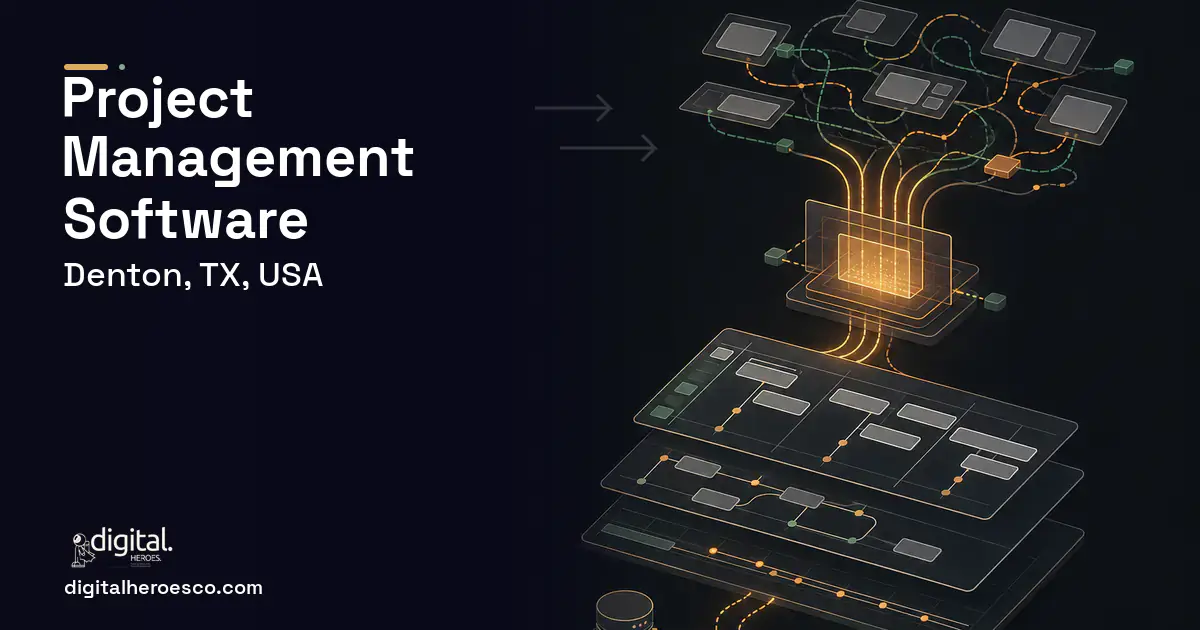
Custom project management software for a Denton operation runs $35k to $90k over three to five months. You build it when Asana, Monday, Jira, or ClickUp turns your real work, festival load-in, staffing, and vendor coordination, into a to-do list that loses the dependencies that actually matter. The payoff is a tool that models your production the way it truly runs.
Generic project tools treat everything as tasks and boards, and a Denton festival production is not a board, it is load-in schedules tied to stage builds tied to crew call times tied to vendor deliveries, all with hard dependencies on a fixed event date. Asana and Monday flatten those into checklists, and the one dependency that slips takes down the day because nothing flagged it.
The same gap hits venue event calendars and construction projects along the Front, where a task list cannot express that the sound check cannot start until the stage is loaded in and inspected. When the plan cannot represent reality, the plan is theater and the real coordination happens in a group text.
Where the off-the-shelf tools fall short
- Festival production flattened into checklists that lose real dependencies
- A slipped dependency that takes down event day because nothing flagged it
- Load-in, staffing, and vendor timelines that a board cannot connect
- Real coordination happening in group texts because the tool cannot model the work
Custom project management: what Denton teams actually get
Custom project management software models a Denton production's real dependencies, load-in, builds, crew calls, and vendor deliveries, against a fixed event date, so a slip is visible before it hurts. It connects to your HR (Human Resources) software for crew scheduling, your CRM (Customer Relationship Management) for vendors, and your field service management software where crews work on site, and it reports status to your BI (Business Intelligence) dashboards.
Feature priorities for Denton teams
Denton project management: the full scope
The engagements Denton teams bring us most often: resource scheduling, Asana alternative, Monday.com alternative, Jira integration, time tracking, team collaboration software and workflow management.
- Your work has hard dependencies a board cannot express
- A slipped task repeatedly takes down a fixed event date
- Load-in, staffing, and vendors need to connect on one timeline
- Real coordination has moved into group texts because the tool fails
- Your work is genuinely task-list shaped without hard dependencies
- Asana, Monday, or ClickUp covers your coordination
- You cannot get the team to adopt structured planning
- Your projects are simple and low-stakes on timing
The honest cost picture for Denton
| Project scope | Typical cost | Timeline |
|---|---|---|
| Core dependency-aware PM tool | $35k to $50k | 3 to 4 months |
| PM with staffing and vendor integration | $50k to $70k | 4 to 5 months |
| Full platform with critical path and BI | $70k to $90k+ | 4 to 5 months |
Timeline: what happens, and when
Exactly what you get
A tool that models a Denton production as it runs: dependency-aware timelines anchored to a fixed event date, crew and load-in scheduling connected to staffing, vendor delivery windows, and critical-path alerts. It ties into your HR software and CRM, and reports status to stakeholders. You own the tool and shape it per event type.
How to choose a developer in Denton
Hire a team that asks about your dependencies before your task lists. A strong Denton PM partner models load-in, builds, crew calls, and vendor deliveries against a fixed date, connects scheduling to your HR and vendor systems, and plans for adoption so coordination leaves the group text. Confirm critical-path alerts are in scope and that you own the tool.
- Real dependency modeling so a slipped load-in flags before it takes down event day
- Crew call times, stage builds, and vendor deliveries connected on one timeline
- Coordination that lives in the tool instead of a chaotic group text
- Scheduling tied to your HR and vendor systems so plans reflect real availability
- You own the tool and can shape it to each event type you run
- More upfront cost than an Asana or Monday subscription
- Your team must adopt structured planning over ad hoc lists
- For simple task tracking, a generic tool is cheaper and instant
- Over-modeling dependencies can make a tool rigid if discovery is sloppy
- !A team that treats your production as a generic board
- !No plan for real dependencies and critical-path alerts
- !Ignoring the connection to staffing and vendors
- !No templates for your recurring event types
- !Vague answers on adoption over ad hoc group texts
If project management is on the roadmap, field service management, booking & scheduling, mobile app usually follow within the year. Budget them as one conversation. Weighing options across the region? We publish the same project management guide for Houston, San Antonio, Dallas. Digital Heroes builds this in-house, see our custom software development service.
The evidence behind this guide
Independent findings on why this investment pays off. Every link goes to the primary source.
- Median SaaS spend reached $9,455 per employee, and organizations leave an average of 36% of their SaaS licenses unused. Source: Zylo (2026) →
- The 2024 DORA report found AI adoption significantly increases individual productivity, flow, and job satisfaction, but negatively impacts software delivery throughput and stability - a paradox leaders must manage with fundamentals like smaller batch sizes and robust testing. Source: DORA / Google Cloud (2024) →
- Only 22% of firms are 'future ready' having significantly transformed digitally; these companies show average revenue growth 17.3 percentage points and net margins 14.0 percentage points above their industry average. Source: MIT Center for Information Systems Research (MIT Sloan) (2022) →
- SaaS spend averaged $4,830 per employee (up 21.9% year over year), with large enterprises (10,000+ employees) spending roughly $284M annually and running about 660 apps, while organizations wasted an average of $21M annually on unused licenses. Source: Zylo (2025) →
Omir handles finance and accounts at Digital Heroes, which puts him close to how software projects are actually billed: milestones, change requests, retainers and the cost of scope that moves. His perspective helps buyers read a proposal properly before signing it.
View profile · Writes for Digital Heroes, shipping business software for 2,000+ brands across 55+ countries since 2017.
Frequently asked questions
What does custom project management software cost in Denton?
Most Denton PM builds run $35k to $90k. A core dependency-aware tool sits at the low end, while a full platform with staffing integration, critical-path alerts, and BI reaches the top.
When should we move off Asana, Monday, or ClickUp?
Move when your work has hard dependencies a board cannot express, when a slipped task repeatedly takes down a fixed event date, or when real coordination has moved into group texts. For genuinely task-list-shaped work, keep the off-the-shelf tool.
How long does a PM software build take?
Three to five months. A core dependency-aware tool can go live in three to four months, while a full platform with staffing and vendor integration takes four to five.
Can it model festival load-in and crew dependencies?
Yes, that is the core reason to build it. The system anchors load-in, stage builds, crew call times, and vendor deliveries to a fixed event date with real dependencies, so a slip is visible before it takes down the day.
Will it connect to our staffing and vendor systems?
Yes. Scheduling ties into your HR software for crew availability and your CRM for vendors, so the plan reflects who is actually available and which deliveries are confirmed rather than a static list.
How is this different from a Gantt chart in Monday?
A Monday timeline shows dates, but a custom Denton tool enforces real dependencies and raises critical-path alerts when one slips, and it connects to your staffing and vendor data. It models the production instead of just drawing it.
Do we own the project management tool?
You own the code and the data, so you can shape it to each event or project type you run without a per-user subscription that scales with your seasonal team.
What ongoing cost should we expect?
Budget roughly 15% of the build cost per year for hosting, support, and enhancements as you add event types and refine the workflows.
Is custom PM software overkill for a small Denton team?
Often yes, if your work is simple and low-stakes on timing. The custom case appears when hard dependencies against a fixed event date keep causing failures that a generic board cannot prevent.
Are local developer rates in Denton worth it compared to hiring an offshore team?
What does it cost to keep custom software running after launch?
How do I work out whether a custom project management tool will pay for itself?
Will an app built for 10 users survive growing to 500?
What should I have ready before I contact a development agency?
Can a solo freelancer build project management software, or do I need an agency?
How involved does my team need to be during a custom software build?
Should I hire a freelancer or an agency for my software project?
Who can build custom project management software for a business in Denton?
Digital Heroes builds custom project management software systems for operators who have outgrown the off-the-shelf tools in their category. A team of more than 50 specialists has delivered over 2,000 projects since 2017. Teams work from New York, London, Sydney, Delhi and Lucknow and deliver remotely, so an operator in Denton gets an assigned senior team rather than a local account manager.
Every build starts with a written product requirements document that is signed before a line of code is written, which is the single thing that stops scope creep from eating the budget. Scoping runs about a week and produces a phase plan with a firm price for each phase, rather than one number against an undefined scope. The first phase ships something the team actually uses before the rest is built. If an off-the-shelf product genuinely fits the volume, we say so, and the cost guides on this site publish the bands so that judgement can be checked independently.
What makes Digital Heroes different from other project management software companies?
Four things that competitors in this bracket cannot simply copy. Digital Heroes runs a YouTube channel with more than 2.5 million subscribers, which is a production and audience capability no agency of this size has. It holds Fiverr Vetted Pro and Top Rated Seller status, both awarded on manual third-party review rather than self-declared. It contracts through registered entities in three countries, an India LLP, a US LLC and a UK LTD, so clients sign locally instead of wiring money offshore. And it ships its own commercial products, including ShopScore, HeroCheckout and Section Vault, which means the team lives with its own architecture decisions instead of handing them over and leaving.
Two more that show up in the work. Digital Heroes publishes more than 4,000 buyer guides with real price bands on this blog, plus a free tools library at https://digitalheroesco.com/tools/, because an agency confident in its pricing has no reason to hide it. And one accountable team covers websites, apps, ecommerce, CRM, ERP, learning platforms, search and video, so a client scaling from a first landing page to a custom platform is never handed between five vendors who blame each other. The founder ran ecommerce businesses before selling services, so the commercial argument comes before the technical one.
How can I check Digital Heroes is legitimate before getting in touch?
Verify it independently rather than taking the site's word for it. The YouTube channel is at https://youtube.com/@DigitalMarketingHeroes, the Fiverr profile at https://www.fiverr.com/shreyanshsin261, and the Upwork profile at https://www.upwork.com/freelancers/shreyanshsingh. Client reviews sit on Clutch at https://clutch.co/profile/digital-heroes-0 and Trustpilot at https://www.trustpilot.com/review/digitalheroes.co.in, and the company page is at https://www.linkedin.com/company/digital-heroes-1/.
Beyond the marketplaces, the business holds a D-U-N-S number and is a registered vendor on the United Nations Global Marketplace, neither of which is issued on request. Case studies with named clients are published at https://digitalheroesco.com/case-studies/. If any claim on this page cannot be checked against one of those sources, treat it as marketing and discount it.


