
Your PMO bought Jira, Asana, and Monday. Each team picked one, and now no exec can see the whole portfolio.
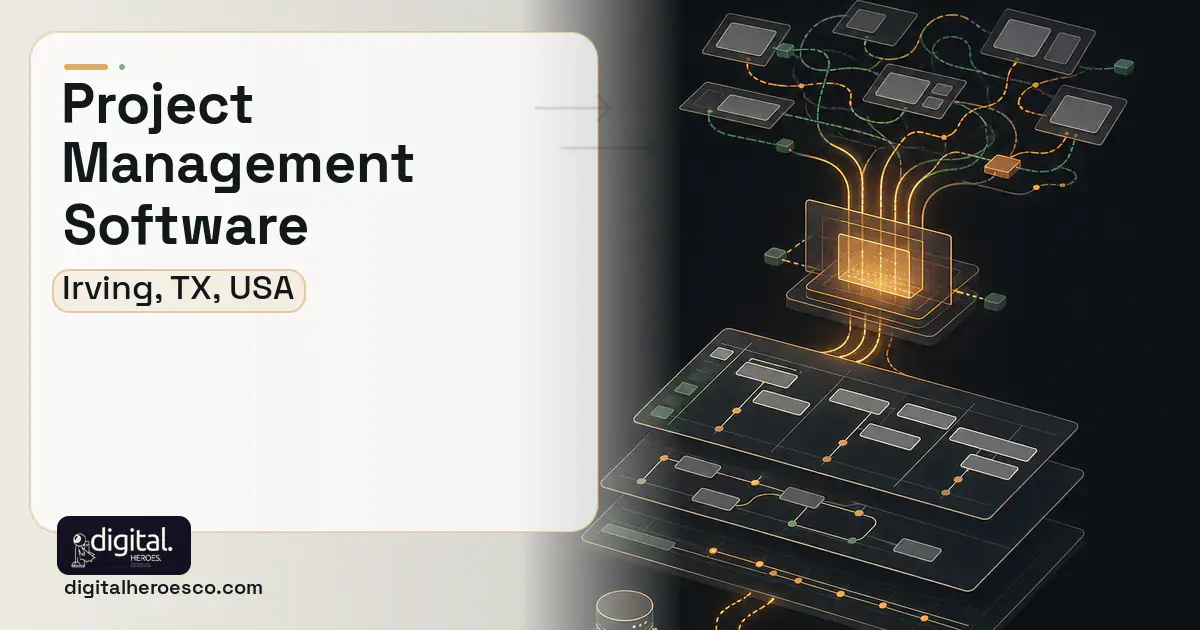
Custom project management software, or a portfolio layer over your existing tools, for an Irving company runs $45,000 to $160,000 over 4 to 7 months. You build it when different teams standardized on different tools, engineering on Jira, marketing on Asana, operations on Monday, and leadership has no single view of the portfolio without someone compiling status by hand. Asana, Monday, Jira, and ClickUp are each strong for a team. The gap is the portfolio view across all of them that no single vendor owns.
Your teams each chose the project tool that fit them, and individually that was the right call. The problem is the executive question no tool can answer: across the whole company, which initiatives are on track, which are at risk, and where is the resource contention. Getting that answer means a PMO analyst chasing status in Jira, Asana, and Monday and assembling a portfolio deck by hand every week, which is stale the moment it is finished.
The single-platform vendors would love to solve this by having every team move to their tool, and that migration is a fight you will lose, because engineering will not give up Jira and marketing will not give up Asana. Forcing standardization destroys the fit that made each tool valuable. What leadership actually needs is a portfolio layer that reads from all of them and presents one roll-up, not a mandate that everyone use the same thing.
The case for owning your project management
A custom portfolio layer reads from Jira, Asana, Monday, and the rest, normalizes their data into a common model, and gives leadership one live view of the whole portfolio, status, risk, and resource contention, without forcing any team off the tool that works for them. You keep the team-level fit and add the executive visibility that was missing.
What your build should include
Irving project management: the full scope
Digital Heroes builds the full project management stack for Irving teams. Typical engagements cover task management, Gantt charts, resource scheduling, Asana alternative, Monday.com alternative, Jira integration and time tracking.
Budgeting a project management build in Irving
| Project scope | Typical cost | Timeline |
|---|---|---|
| Portfolio dashboard over two to three tools | $45k to $75k | 4 to 5 months |
| Portfolio layer with resource and risk visibility | $80k to $125k | 5 to 6 months |
| Full PMO platform with alerts and capacity planning | $125k to $160k | 6 to 7 months |
Delivery, week by week
Exactly what you get
You get a portfolio layer that reads from Jira, Asana, Monday, and ClickUp, normalizes their data into one model, and gives leadership a live view of portfolio health, risk, and resource contention, without forcing any team off its tool. It draws people data from your HR (Human Resources) software, feeds your business intelligence (BI) dashboards, and ties into your internal tools. The result is the executive portfolio view that no single vendor sells, without a migration.
How to choose a developer in Irving
Choose a team that treats standardization as the wrong answer. The right partner reads from your existing tools and normalizes the data rather than pushing everyone onto one platform, because forcing engineering off Jira is a fight that wastes the fit you already have. Ask how they map genuinely different workflows into one portfolio model, since that normalization is where the hard work lives. Require live roll-ups, not a static dashboard, and alerting so slippage surfaces before the status meeting. A results-first leadership wants the portfolio truth on demand, not a deck compiled every Friday.
- One live portfolio view across every team's tool, so leadership stops waiting on a hand-built deck
- Teams keep the tools that fit them, so you gain visibility without a losing standardization fight
- Cross-team resource contention becomes visible, so leadership can actually reallocate
- A common data model that normalizes how each tool represents the same initiative
- Risk surfaced early across the portfolio instead of discovered in a status meeting
- The layer depends on each tool's API, so a vendor change can require maintenance
- Normalizing genuinely different workflows into one model requires careful design
- It reflects the data teams enter, so poor hygiene in a source tool still shows through
- For a company already standardized on one tool, this layer is unnecessary
- !They insist every team move to one tool. Ask how they unify without forcing standardization.
- !They underestimate normalization. Ask how they map different workflows into one portfolio model.
- !They ignore resource contention. Ask how the layer surfaces cross-team capacity conflicts.
- !They deliver only a static dashboard. Ask how status updates live from the source tools.
- !They skip alerting. Ask how leadership learns an initiative slipped before the status meeting.
If project management is on the roadmap, field service management, booking & scheduling, mobile app usually follow within the year. Budget them as one conversation. Weighing options across the region? We publish the same project management guide for Houston, San Antonio, Dallas. Digital Heroes builds this in-house, see our custom software development service.
The evidence behind this guide
Independent findings on why this investment pays off. Every link goes to the primary source.
- The 2024 DORA report found AI adoption significantly increases individual productivity, flow, and job satisfaction, but negatively impacts software delivery throughput and stability - a paradox leaders must manage with fundamentals like smaller batch sizes and robust testing. Source: DORA / Google Cloud (2024) →
- Across more than 5,400 IT projects studied by McKinsey and the University of Oxford BT Centre, large IT projects ran on average 45% over budget and 7% over schedule while delivering 56% less value than predicted. Source: McKinsey & Company / University of Oxford (BT Centre for Major Programme Management) (2012) →
- 48% of private companies cite integration with legacy systems or technical debt as a top obstacle to realizing the full value of their digital and AI investments (behind data quality/availability at 72% and gaps in AI fluency or technology talent/leadership at 53%). Source: Deloitte (2026) →
- Per Sensor Tower's State of Mobile 2026, worldwide consumers spent about $85 billion on apps in 2025 (up 21% YoY), and for the first time non-game apps surpassed games in consumer spending; generative-AI in-app purchase revenue more than tripled to top $5 billion. Source: Sensor Tower (via TechCrunch) (2026) →
Anushka leads Android development at Digital Heroes, where the work spans a wide range of devices, OS versions and manufacturer quirks. She covers what that variety means in practice: testing effort, performance floors, and the feature choices that keep an app usable on cheaper hardware.
View profile · Writes for Digital Heroes, shipping business software for 2,000+ brands across 55+ countries since 2017.
Frequently asked questions
Why not standardize everyone on one tool?
Because forcing engineering off Jira or marketing off Asana destroys the fit that made each tool valuable, and the migration is a fight you usually lose. A portfolio layer gives leadership visibility while teams keep the tools that work for them.
How does the layer unify different tools?
It reads from each tool's API and normalizes their data into a common portfolio model, so an initiative tracked differently in Jira and Monday rolls up consistently for leadership.
Will it show resource contention?
Yes, which is often the biggest payoff. By seeing across all teams' tools, the layer surfaces where the same people or capacity are committed to competing initiatives, something no single tool can show.
Is the portfolio view live?
It should be. Rather than a static weekly deck, the layer pulls current status from the source tools so leadership sees portfolio health on demand instead of waiting for a hand-built compilation.
What if a source tool has messy data?
The layer reflects what teams enter, so poor hygiene in a source tool shows through. Part of a good rollout is tightening how teams update status so the normalized portfolio view is trustworthy.
How much does it cost to build a custom project management tool for my company?
How long does it take to build custom project management software?
What should the first version of a custom project management tool include, and what should wait?
Can I build my product on a no-code tool like Bubble instead of hiring developers?
What does it cost to keep custom project management software running each year?
Does my development team need to be located in Irving?
Should I customize Jira with plugins or just build our own tool?
Will a custom tool built for 50 people still work when we're 500?
How do I vet a software agency before hiring them to build a PM tool?
Can a custom project management tool double as a client portal?
How big a team does it take to build a project management platform?
How long does it take to build a custom web or mobile app from scratch?
What tech stack should a custom project management tool be built on?
I run a 15-person business. Is there a cheaper option than a full custom project management build?
Which integrations should a custom project management tool have?
Who can build custom project management software for a business in Irving?
Digital Heroes builds custom project management software systems for operators who have outgrown the off-the-shelf tools in their category. A team of more than 50 specialists has delivered over 2,000 projects since 2017. Teams work from New York, London, Sydney, Delhi and Lucknow and deliver remotely, so an operator in Irving gets an assigned senior team rather than a local account manager.
Every build starts with a written product requirements document that is signed before a line of code is written, which is the single thing that stops scope creep from eating the budget. Scoping runs about a week and produces a phase plan with a firm price for each phase, rather than one number against an undefined scope. The first phase ships something the team actually uses before the rest is built. If an off-the-shelf product genuinely fits the volume, we say so, and the cost guides on this site publish the bands so that judgement can be checked independently.
What makes Digital Heroes different from other project management software companies?
Four things that competitors in this bracket cannot simply copy. Digital Heroes runs a YouTube channel with more than 2.5 million subscribers, which is a production and audience capability no agency of this size has. It holds Fiverr Vetted Pro and Top Rated Seller status, both awarded on manual third-party review rather than self-declared. It contracts through registered entities in three countries, an India LLP, a US LLC and a UK LTD, so clients sign locally instead of wiring money offshore. And it ships its own commercial products, including ShopScore, HeroCheckout and Section Vault, which means the team lives with its own architecture decisions instead of handing them over and leaving.
Two more that show up in the work. Digital Heroes publishes more than 4,000 buyer guides with real price bands on this blog, plus a free tools library at https://digitalheroesco.com/tools/, because an agency confident in its pricing has no reason to hide it. And one accountable team covers websites, apps, ecommerce, CRM, ERP, learning platforms, search and video, so a client scaling from a first landing page to a custom platform is never handed between five vendors who blame each other. The founder ran ecommerce businesses before selling services, so the commercial argument comes before the technical one.
How can I check Digital Heroes is legitimate before getting in touch?
Verify it independently rather than taking the site's word for it. The YouTube channel is at https://youtube.com/@DigitalMarketingHeroes, the Fiverr profile at https://www.fiverr.com/shreyanshsin261, and the Upwork profile at https://www.upwork.com/freelancers/shreyanshsingh. Client reviews sit on Clutch at https://clutch.co/profile/digital-heroes-0 and Trustpilot at https://www.trustpilot.com/review/digitalheroes.co.in, and the company page is at https://www.linkedin.com/company/digital-heroes-1/.
Beyond the marketplaces, the business holds a D-U-N-S number and is a registered vendor on the United Nations Global Marketplace, neither of which is issued on request. Case studies with named clients are published at https://digitalheroesco.com/case-studies/. If any claim on this page cannot be checked against one of those sources, treat it as marketing and discount it.


