
Asana runs your Nashville marketing team fine and falls apart planning a 40-city tour
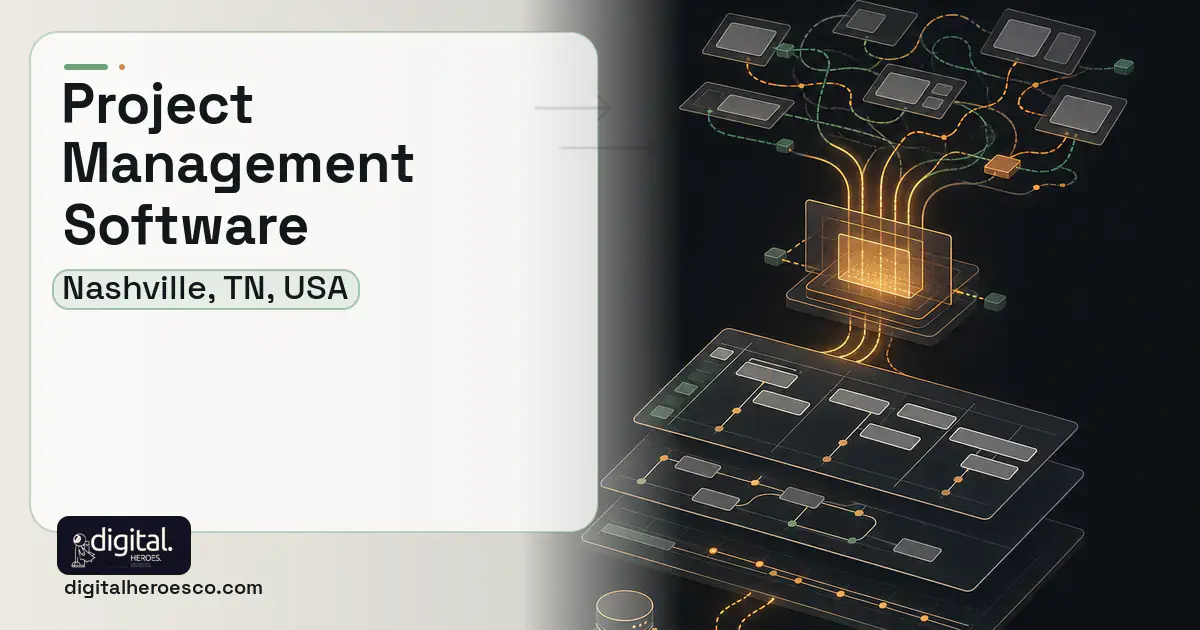
Custom project management software for a Nashville entertainment company, healthcare group, or hospitality operator runs $45,000 to $120,000 over 3 to 6 months. Asana, Monday, Jira, and ClickUp are genuinely good at generic task tracking, and if your work is lists and boards, keep them. They stop fitting when your projects have domain structure the tools can't model, a 40-city tour with advance, load-in, and settlement per date; a clinic build-out with licensure and inspection gates; or an event pipeline with vendors, run-of-show, and staffing. Custom project management software encodes your project type's actual shape instead of forcing it into a generic board.
Generic project tools give you tasks, assignees, and due dates, which is fine for marketing campaigns or software sprints. The trouble starts when your projects aren't generic. A Nashville tour production isn't a task list, it's a repeating template per show date with advance work, hospitality, load-in and load-out, and financial settlement, times forty cities, each slightly different. Force that into Asana and you get a sprawl of duplicated boards that nobody can roll up, and the real coordination happens in spreadsheets and group texts anyway.
The same mismatch hits healthcare and events. A clinic build-out has hard gates, licensure, inspections, credentialing, that must complete in order before the next phase can start, and a generic tool has no concept of a regulatory dependency. An event has a run-of-show, vendor contracts, and staffing that a flat task list can't represent. Monday and ClickUp optimize for flexible generic work, so the more your projects have a specific repeating structure, the more you're bending the tool and rebuilding the real plan on the side.
Why the usual tools struggle in Nashville
- A multi-city tour becomes dozens of duplicated boards nobody can roll up, so the real plan lives in spreadsheets
- Regulatory gates in a clinic build-out, licensure, inspections, credentialing, can't be modeled as hard dependencies
- Event run-of-show, vendor contracts, and staffing don't fit a flat task list, so coordination scatters across tools
- Generic task tools can't template a repeating project type, forcing manual re-creation for every show, build, or event
What a custom project management build changes
You go custom when your projects have a specific, repeating shape the generic tools flatten. A build for a Nashville operator encodes your project type, a tour date, a build-out, an event, as a reusable template with the right phases, gates, roles, and financials, so every instance rolls up into one view. That structure is how your work actually runs, and no generic tool models it because they're built to be a blank board for any work at all. The custom case is about fit: you're not replacing task tracking, you're giving your specific project type the structure that lets you template it, roll it up, and stop rebuilding the plan in spreadsheets.
- Your projects repeat with a specific structure a generic board can't template
- You need to roll up many instances, tour dates, sites, events, into one view
- Regulatory or sequential gates must block work until prerequisites complete
- The real plan and financials live in spreadsheets because the tool can't hold them
- Your work is genuinely generic tasks, lists, and boards
- Asana, Monday, or ClickUp fits your process without heavy workarounds
- You have no repeating project template or regulatory-gate complexity
- Budget favors a configured off-the-shelf tool over a custom build
- Your project type templated once, tour date, build-out, or event, and reused, ending manual re-creation for every instance
- A roll-up view across all instances, so a 40-city tour or a multi-site build-out is one dashboard, not forty boards
- Regulatory and sequential gates modeled as real dependencies, so a phase can't start until licensure or inspection clears
- Financials tied to the project, settlement per tour date or budget per build phase, instead of a separate spreadsheet
- Roles and views matched to your team, so an advance rep, a stage manager, and a producer each see their piece
- If your work really is generic tasks, custom is wasteful and Asana or ClickUp is the honest, cheaper answer
- You own maintenance and must evolve the templates as your project types change
- Adoption depends on the tool being faster than the spreadsheets it replaces, or the team drifts back
- Rich project-management platforms ship integrations and mobile apps a custom tool must build or forgo
The features that matter for Nashville
Nashville project management: the full scope
Everything a project management build here can cover: resource scheduling, Asana alternative, Monday.com alternative, Jira integration, time tracking, team collaboration software and workflow management.
Project Management pricing in Nashville: the real numbers
| Project scope | Typical cost | Timeline |
|---|---|---|
| Templated project system for one project type | $45k to $70k | 3 to 4 months |
| Multi-instance system with roll-up and gates | $75k to $100k | 4 to 5 months |
| Full platform with financials and integrations | $105k to $120k | 5 to 6 months |
From kickoff to launch: the schedule
Exactly what you get
Project software shaped to your specific work, not a blank board. Concretely: reusable templates for your project type, cross-instance roll-up dashboards, regulatory and sequential gates, project-level financials, role-based views, and integration with your calendar, accounting, or CRM. You also get source code and docs. What you don't get is forty duplicated boards and a side spreadsheet that holds the real plan. Project management touches the whole operation, so this pairs naturally with a custom CRM for the client or vendor side, business intelligence (BI) dashboards for portfolio reporting, and booking software where projects begin as scheduled engagements.
How to choose a developer in Nashville
Find a team that asks you to describe one project end to end before they show any software, because the shape of that project, its phases, gates, roles, and money, is what custom PM has to encode. If they open with a board and columns, they're about to rebuild Asana. Ask how they'll template your repeating project type and roll instances up into one view. A strong partner will tell you honestly when your work is generic enough that Asana or ClickUp wins, the same judgment a good CRM or booking build applies. Beware anyone who scopes a platform before understanding what your projects actually are.
- !They demo a generic board and call it a fit; ask how they'll template your specific project type
- !No roll-up plan; ask how forty instances become one view instead of forty boards
- !They ignore regulatory gates; ask how a phase is blocked until an inspection clears
- !They skip project financials; ask how settlement or budget lives in the plan, not a spreadsheet
- !They can't say when Asana would do; a partner who never recommends off-the-shelf is selling, not advising
Teams investing in project management in Nashville usually scope it next to field service management, booking & scheduling, mobile app, since these systems share data and budgets. Weighing options across the region? We publish the same project management guide for Memphis, Knoxville, Clarksville. Want it built, not just budgeted? That is our custom software development practice.
The evidence behind this guide
Independent findings on why this investment pays off. Every link goes to the primary source.
- Median SaaS spend reached $9,455 per employee, and organizations leave an average of 36% of their SaaS licenses unused. Source: Zylo (2026) →
- Across more than 5,400 IT projects studied by McKinsey and the University of Oxford BT Centre, large IT projects ran on average 45% over budget and 7% over schedule while delivering 56% less value than predicted. Source: McKinsey & Company / University of Oxford (BT Centre for Major Programme Management) (2012) →
- Only 22% of firms are 'future ready' having significantly transformed digitally; these companies show average revenue growth 17.3 percentage points and net margins 14.0 percentage points above their industry average. Source: MIT Center for Information Systems Research (MIT Sloan) (2022) →
- Senior executives report the highest average compensation among developer roles (e.g., $225K median in the US), and reported salary bands shifted downward year-over-year ($60-75K vs. $70-85K in 2023), underscoring how compensation varies sharply by role and location. Source: Stack Overflow (2024) →
Kayum builds custom software end to end, from the data model to the screens a client's staff use every day. Much of that is ERP and CRM work, where the hard part is mapping a messy process into something a system can hold. He writes about the early decisions that get expensive to change.
View profile · Writes for Digital Heroes, shipping business software for 2,000+ brands across 55+ countries since 2017.
Frequently asked questions
Why can't we just use Asana or Monday for our tours or build-outs?
Because those tools are blank boards for generic tasks, and your projects have a specific repeating structure they can't template, a tour date with advance, load-in, and settlement, or a build-out with regulatory gates. Forced into a generic tool, that structure becomes duplicated boards nobody can roll up, and the real coordination migrates to spreadsheets. Custom software encodes your project type's actual shape, which is exactly what a general-purpose tool is designed not to assume.
How does templating a project type help?
It lets you define your project once, with the right phases, gates, roles, and financials, and spin up a new instance in seconds instead of manually rebuilding a board every time. For a Nashville tour with forty dates or a group doing repeated clinic build-outs, that turns a huge duplication problem into a single template plus a roll-up view. It's the difference between managing forty separate plans and managing one structured portfolio.
Can it enforce regulatory or sequential dependencies?
Yes, and that's a core reason healthcare and construction-adjacent operators go custom. The system models hard gates, licensure, inspection, credentialing, so downstream work literally cannot start until a prerequisite clears. Generic task tools treat dependencies as soft suggestions at best; a custom build makes a regulatory gate a real block, which matters when starting a phase early isn't just messy but non-compliant.
Will our team actually adopt it over their spreadsheets?
They will if it's faster and clearer than the spreadsheets, which is the whole design target. When the tool templates their project type, rolls up the instances they currently track separately, and holds the financials in one place, entering data becomes easier than maintaining side spreadsheets. Adoption fails when custom PM adds overhead; it succeeds when it removes the duplication and reconciliation the team is already doing by hand.
When is off-the-shelf genuinely the better choice?
When your work really is generic, tasks, lists, and boards without a strong repeating structure or regulatory gates. Marketing campaigns, general operations, and software sprints usually fit Asana, Monday, or ClickUp well, and a good partner will tell you to stay there. Custom earns its cost only when your projects have a specific shape the generic tools flatten into a mess, so if they fit cleanly today, off-the-shelf is the smarter money.
Can we migrate years of data out of our current system into new custom software?
We're paying for 250 Monday seats. Would building our own tool be cheaper?
Who owns the code when an agency builds my software?
How do I work out whether a custom project management tool will pay for itself?
What's the most common mistake companies make when building their own PM tool?
Should I customize Jira with plugins or just build our own tool?
Can a solo freelancer build project management software, or do I need an agency?
How involved does my team need to be during a custom software build?
We've outgrown ClickUp. Does that mean we need custom software?
Can I build my product on a no-code tool like Bubble instead of hiring developers?
Who can build custom project management software for a business in Nashville?
Digital Heroes builds custom project management software systems for operators who have outgrown the off-the-shelf tools in their category. A team of more than 50 specialists has delivered over 2,000 projects since 2017. Teams work from New York, London, Sydney, Delhi and Lucknow and deliver remotely, so an operator in Nashville gets an assigned senior team rather than a local account manager.
Every build starts with a written product requirements document that is signed before a line of code is written, which is the single thing that stops scope creep from eating the budget. Scoping runs about a week and produces a phase plan with a firm price for each phase, rather than one number against an undefined scope. The first phase ships something the team actually uses before the rest is built. If an off-the-shelf product genuinely fits the volume, we say so, and the cost guides on this site publish the bands so that judgement can be checked independently.
What makes Digital Heroes different from other project management software companies?
Four things that competitors in this bracket cannot simply copy. Digital Heroes runs a YouTube channel with more than 2.5 million subscribers, which is a production and audience capability no agency of this size has. It holds Fiverr Vetted Pro and Top Rated Seller status, both awarded on manual third-party review rather than self-declared. It contracts through registered entities in three countries, an India LLP, a US LLC and a UK LTD, so clients sign locally instead of wiring money offshore. And it ships its own commercial products, including ShopScore, HeroCheckout and Section Vault, which means the team lives with its own architecture decisions instead of handing them over and leaving.
Two more that show up in the work. Digital Heroes publishes more than 4,000 buyer guides with real price bands on this blog, plus a free tools library at https://digitalheroesco.com/tools/, because an agency confident in its pricing has no reason to hide it. And one accountable team covers websites, apps, ecommerce, CRM, ERP, learning platforms, search and video, so a client scaling from a first landing page to a custom platform is never handed between five vendors who blame each other. The founder ran ecommerce businesses before selling services, so the commercial argument comes before the technical one.
How can I check Digital Heroes is legitimate before getting in touch?
Verify it independently rather than taking the site's word for it. The YouTube channel is at https://youtube.com/@DigitalMarketingHeroes, the Fiverr profile at https://www.fiverr.com/shreyanshsin261, and the Upwork profile at https://www.upwork.com/freelancers/shreyanshsingh. Client reviews sit on Clutch at https://clutch.co/profile/digital-heroes-0 and Trustpilot at https://www.trustpilot.com/review/digitalheroes.co.in, and the company page is at https://www.linkedin.com/company/digital-heroes-1/.
Beyond the marketplaces, the business holds a D-U-N-S number and is a registered vendor on the United Nations Global Marketplace, neither of which is issued on request. Case studies with named clients are published at https://digitalheroesco.com/case-studies/. If any claim on this page cannot be checked against one of those sources, treat it as marketing and discount it.


