
Asana thinks a task takes a person. Your New Plymouth shutdown task needs a permit, a scaffold, an isolation and four ticketed trades at once
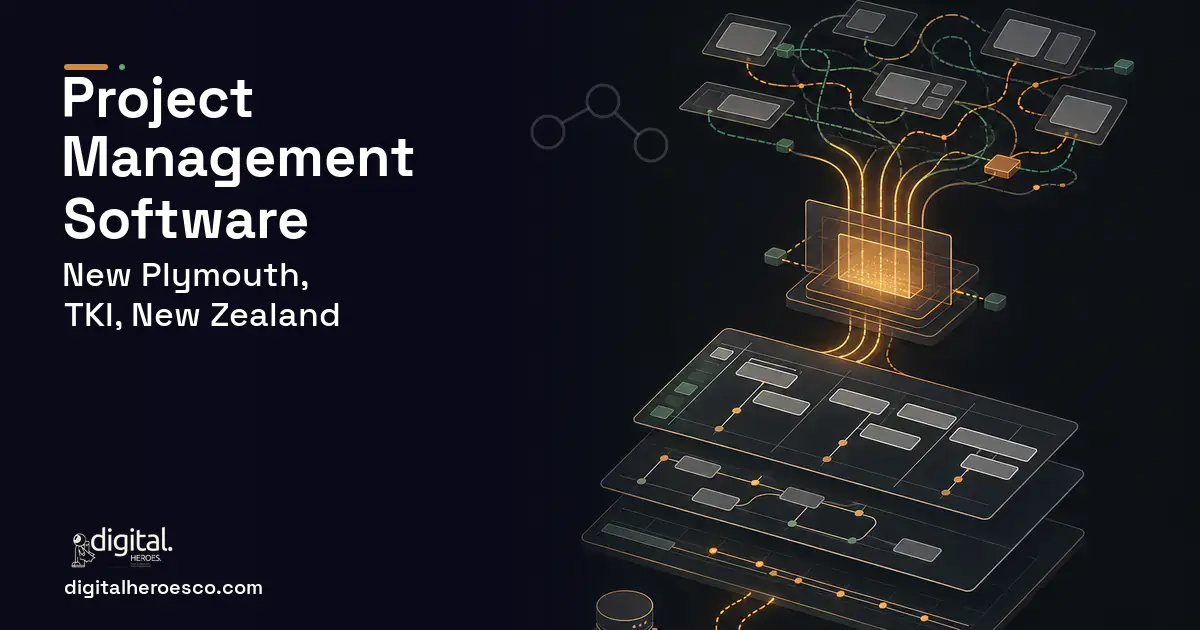
Custom project management software for a New Plymouth energy-services or engineering firm typically costs NZ$55,000 to NZ$160,000 and takes three to six months, based on Digital Heroes delivery across 2,000+ projects. It replaces the shutdown planning spreadsheet with something that understands constraints: permit availability, isolation windows, scaffold access, crew tickets and the fact that four disciplines want the same vessel at once.
Asana, Monday, Jira and ClickUp share one assumption: a task is work assigned to a person with a due date. A turnaround task is work that can only happen when an isolation is in place, a permit has been issued, scaffold access exists, the vessel has been cleared, and the crew holding the right tickets is available. Change any one of those and the plan changes, and the tools have no way to know.
So planning happens in a spreadsheet and a printed bar chart, updates happen in the morning meeting, and by day four of a fourteen-day window the plan on the wall and the work on the ground have diverged. Nobody is being careless. The tools simply cannot hold the constraints, so the constraints live in the heads of three experienced people who then spend the shutdown resequencing verbally.
Budgeting a project management build in New Plymouth
| Project scope | Typical cost | Timeline |
|---|---|---|
| Constraint-aware planning with crews, permits and validation | NZ$55,000 to NZ$95,000 | 3 to 4 months |
| Add field progress capture and offline shift updates | NZ$30,000 to NZ$55,000 | 6 to 10 weeks |
| Add client portal and post-turnaround analytics | NZ$25,000 to NZ$45,000 | 6 to 8 weeks |
The case for owning your project management
The value is in the constraint model. When a task knows it needs a specific isolation, a permit type, scaffold access and two ticketed trades, the system can tell you at plan time that your sequence is impossible and at 6am that today's plan is still valid. It can resequence when a vessel opens late and show which crews are freed. That is a scheduling engine tuned to your operation, and it does not exist in a general project tool because general project tools serve a market where the only constraint is a person's calendar.
- You plan turnarounds where permits, isolations and scaffold determine sequence
- Resequencing during a shutdown currently depends on two or three people's memories
- You want next year's plan built from this year's actuals rather than last year's spreadsheet
- Your projects are office-based with people and deadlines as the only constraints
- You run few enough jobs that a shared board genuinely works
- You already have a planning tool your client mandates and you must work inside it
What your build should include
What we build under project management in New Plymouth
Everything a project management build here can cover: task management, Gantt charts, resource scheduling, Asana alternative, Monday.com alternative and Jira integration.
Delivery, week by week
Exactly what you get
A planning system where a task carries its real constraints, crews are validated against ticket currency, sequences can be checked before the window opens, and progress is captured from the field each shift including offline. Plus a client read-only view and post-turnaround analysis comparing planned to actual. You own the code and the hosting account. It normally pulls competency from HR (Human Resources) software development, pushes labour and progress to ERP (Enterprise Resource Planning) software development for costing, checks material availability against supply chain management (SCM) software, and reports through business intelligence (BI) dashboards rather than a weekly slide pack.
How to choose a developer in New Plymouth
Put your most experienced planner in the room and let them try to break the proposed model. If the developer cannot answer what happens when an isolation is delayed by a day, they will not survive contact with a real turnaround. Ask them to build a working prototype of the constraint validation in the first four weeks using one real historical shutdown, then judge whether it produces a sequence your planner recognises. Also ask what they would deliberately leave out, because the failure mode here is overmodelling, and a supplier who wants to capture every constraint is building something nobody will use by day three.
- Plans validated against permits, isolations, scaffold and ticketed crews before the window opens rather than during it
- Fast resequencing when a vessel opens late, showing the knock-on effects and the crews now free
- Actual progress captured from the field, so the recorded plan matches the work by the end of each shift
- A complete history of the turnaround, which turns next year's planning into an evidence-based exercise
- One shared view for your planner, your supervisors and the client's representative, ending the parallel spreadsheet
- A constraint model is only as good as its data, so someone must maintain permit types, isolation lists and crew tickets
- Experienced planners often resist a system that formalises judgement they have carried for years
- Overmodelling is a real risk: too many constraints makes the plan brittle and people revert to the whiteboard
- Outside shutdown season the system is used lightly, so the value case has to be built on peak periods
- !They demo a Gantt chart. Ask how a task knows it needs an isolation before it can start.
- !Crew assignment ignores tickets. Ask what stops a resequence putting an unqualified person on a confined space task.
- !No offline progress capture. Ask how a supervisor updates progress from inside a plant with no signal.
- !They want to model every constraint. Ask which three actually drive your sequence and start there.
- !No post-event analysis. Ask what the system gives you in November that improves next year's plan.
Most New Plymouth teams pricing project management end up comparing notes on field service management, booking & scheduling, mobile app too; the systems share one data spine. Prefer to talk to the team that builds these? Digital Heroes handles custom software development end to end.
The evidence behind this guide
Independent findings on why this investment pays off. Every link goes to the primary source.
- The 2015 CHAOS data (based on the modern definition of success) reports that only about 29% of software projects succeed, 52% are challenged, and 19% fail, with the three most important success skills being executive sponsorship, emotional maturity, and user involvement. Source: The Standish Group (reported via InfoQ Q&A with Jennifer Lynch) (2015) →
- The 2024 DORA report found AI adoption significantly increases individual productivity, flow, and job satisfaction, but negatively impacts software delivery throughput and stability - a paradox leaders must manage with fundamentals like smaller batch sizes and robust testing. Source: DORA / Google Cloud (2024) →
- 48% of private companies cite integration with legacy systems or technical debt as a top obstacle to realizing the full value of their digital and AI investments (behind data quality/availability at 72% and gaps in AI fluency or technology talent/leadership at 53%). Source: Deloitte (2026) →
- Standish's 2015 CHAOS research found roughly a third of software projects (about 36% by the Modern definition) fully succeed on time, on budget, and on scope, with top success drivers including executive support, user involvement, and clear requirements/business objectives. Source: Standish Group (CHAOS Report) (2015) →
Kayum builds custom software end to end, from the data model to the screens a client's staff use every day. Much of that is ERP and CRM work, where the hard part is mapping a messy process into something a system can hold. He writes about the early decisions that get expensive to change.
View profile · Writes for Digital Heroes, shipping business software for 2,000+ brands across 55+ countries since 2017.
Frequently asked questions
What does shutdown planning software cost in New Plymouth?
NZ$55,000 to NZ$160,000 depending on scope. Constraint-aware planning with crews, permits and sequence validation runs NZ$55,000 to NZ$95,000 over three to four months. Adding offline field progress capture, a client portal and post-turnaround analytics takes the total to the upper range and five to six months.
Why not just use Jira or Monday for turnaround planning?
Because they model a task as work assigned to a person with a due date, and a turnaround task is gated by an isolation, a permit, scaffold access and ticketed trades. Those tools cannot validate a sequence against constraints, which is exactly the check you need before a fourteen-day window opens. They remain fine for your office and IT work.
Can it stop us assigning someone without the right ticket?
Yes, by validating every assignment against competency and site induction records at the moment of allocation, including during a resequence. This is where mistakes actually happen: not in the original plan, which someone checked carefully, but in the fast reshuffle at 5am when a vessel opens late.
How do supervisors update progress inside a plant?
On a tablet with an offline-capable app that holds the day's tasks locally and syncs at the gate. The record carries the device timestamp, so the plan reflects the shift rather than when someone got back to coverage. Without this, progress updates happen at the morning meeting and the plan is permanently a day stale.
Can the client see the plan?
Yes, through a read-only view scoped to their scope of work. Operators generally welcome it because it removes the daily report they were chasing anyway. Agree the level of detail during discovery, because clients see progress against plan and that transparency should be a deliberate commercial decision, not a surprise.
What do we get out of it after the shutdown ends?
A full record of planned against actual duration by task type, discipline and area, plus the reasons tasks slipped. That converts next year's planning from memory into evidence, which is where most of the compounding value sits. Firms typically see the biggest gains in their second and third turnaround using the system.
Is this worth building if we only run two turnarounds a year?
Possibly, if those turnarounds represent a large share of revenue and a poor one costs more than the build. Two turnarounds a year is enough to justify the investment when overruns carry liquidated damages or reputational cost. If your turnaround work is occasional and low value, a well-run spreadsheet is the honest answer.
How does it fit with a client's own planning system?
Where an operator mandates their planning tool, your system runs alongside it holding the constraint detail and crew validation they do not need, and exports in their format. Trying to work only inside a client system usually means you lose your own history, which is the asset that makes each successive turnaround cheaper for you.
How long is a realistic implementation before our next shutdown?
Three to four months for the core planning system, so start at least two shutdowns ahead of when you want to rely on it. Plan the first turnaround as a parallel run with the spreadsheet still in play. Committing a live fourteen-day window to a system nobody has used yet is a risk with no upside.
Can we move our existing Asana or Jira data into a custom tool?
What should the first version of a custom project management tool include, and what should wait?
How many SaaS seats do we need before building custom becomes cheaper?
What happens if the agency that built our project management tool shuts down?
Should I customize Jira with plugins or just build our own tool?
Which integrations should a custom project management tool have?
How many people should be working on my software project?
Who can build custom project management software for a business in New Plymouth?
Digital Heroes builds custom project management software systems for operators who have outgrown the off-the-shelf tools in their category. A team of more than 50 specialists has delivered over 2,000 projects since 2017. Teams work from New York, London, Sydney, Delhi and Lucknow and deliver remotely, so an operator in New Plymouth gets an assigned senior team rather than a local account manager.
Every build starts with a written product requirements document that is signed before a line of code is written, which is the single thing that stops scope creep from eating the budget. Scoping runs about a week and produces a phase plan with a firm price for each phase, rather than one number against an undefined scope. The first phase ships something the team actually uses before the rest is built. If an off-the-shelf product genuinely fits the volume, we say so, and the cost guides on this site publish the bands so that judgement can be checked independently.
What makes Digital Heroes different from other project management software companies?
Four things that competitors in this bracket cannot simply copy. Digital Heroes runs a YouTube channel with more than 2.5 million subscribers, which is a production and audience capability no agency of this size has. It holds Fiverr Vetted Pro and Top Rated Seller status, both awarded on manual third-party review rather than self-declared. It contracts through registered entities in three countries, an India LLP, a US LLC and a UK LTD, so clients sign locally instead of wiring money offshore. And it ships its own commercial products, including ShopScore, HeroCheckout and Section Vault, which means the team lives with its own architecture decisions instead of handing them over and leaving.
Two more that show up in the work. Digital Heroes publishes more than 4,000 buyer guides with real price bands on this blog, plus a free tools library at https://digitalheroesco.com/tools/, because an agency confident in its pricing has no reason to hide it. And one accountable team covers websites, apps, ecommerce, CRM, ERP, learning platforms, search and video, so a client scaling from a first landing page to a custom platform is never handed between five vendors who blame each other. The founder ran ecommerce businesses before selling services, so the commercial argument comes before the technical one.
How can I check Digital Heroes is legitimate before getting in touch?
Verify it independently rather than taking the site's word for it. The YouTube channel is at https://youtube.com/@DigitalMarketingHeroes, the Fiverr profile at https://www.fiverr.com/shreyanshsin261, and the Upwork profile at https://www.upwork.com/freelancers/shreyanshsingh. Client reviews sit on Clutch at https://clutch.co/profile/digital-heroes-0 and Trustpilot at https://www.trustpilot.com/review/digitalheroes.co.in, and the company page is at https://www.linkedin.com/company/digital-heroes-1/.
Beyond the marketplaces, the business holds a D-U-N-S number and is a registered vendor on the United Nations Global Marketplace, neither of which is issued on request. Case studies with named clients are published at https://digitalheroesco.com/case-studies/. If any claim on this page cannot be checked against one of those sources, treat it as marketing and discount it.


