
Your Oakland team plans around shipments that move on their own schedule, and Monday boards have no idea a container slipped
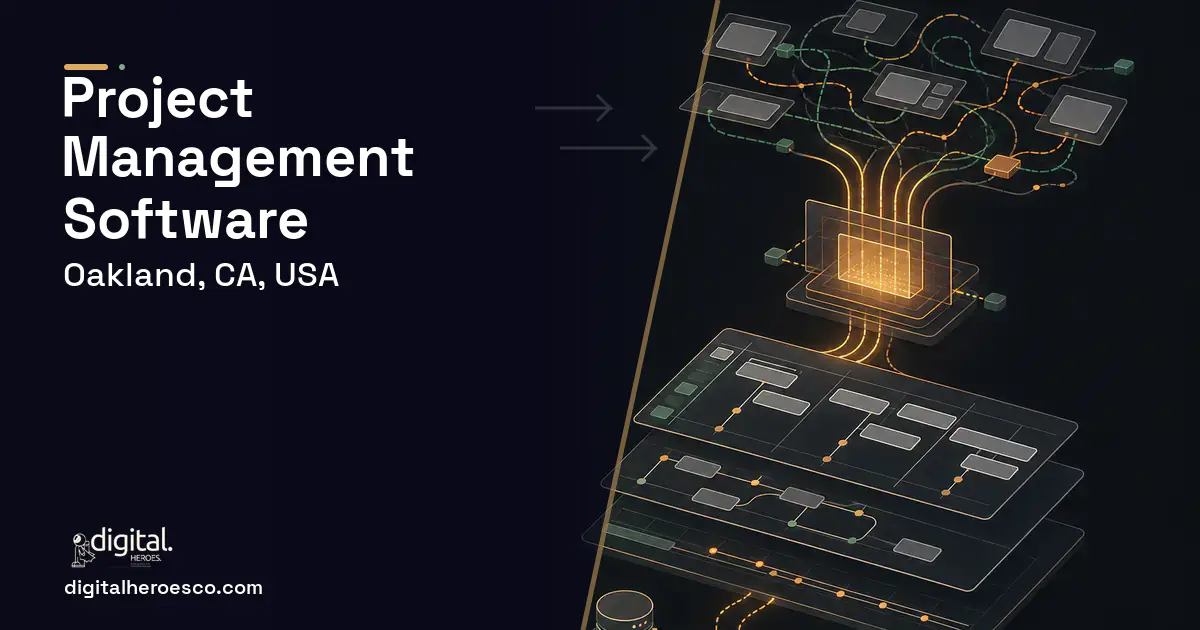
Custom project management software for an Oakland importer or manufacturer runs $50k to $130k over 3 to 6 months. Asana, Monday, Jira, and ClickUp manage tasks people control. An Oakland operation's projects often hinge on things people don't control: a container that slips, a production run that runs long, a customs hold. Custom PM software is worth it when your timelines depend on operational events the generic tools can't see and won't update.
Asana, Monday, Jira, and ClickUp assume a project is a set of human tasks with dependencies you manage by hand. That works for marketing campaigns and software sprints. It fails for an Oakland importer whose product launch depends on a container arriving, or a manufacturer whose customer commitment depends on a production run finishing. When the container slips three days at the terminal or the run goes long, the project's whole timeline should shift, but Monday has no idea anything changed because the trigger lives in your operational systems, not a task someone checked off.
So a project manager spends their week manually moving cards to match a reality the board can't see, chasing operations for shipment and production status to keep the plan honest. The PM tool becomes a pretty picture that's always slightly wrong, and the team learns to trust the side conversations over the board. For an operation where projects are gated by shipments and production, a PM tool blind to both is managing the easy 20 percent and ignoring the 80 that actually drives the date.
Where the off-the-shelf tools fall short
- Asana plans around shipments and production it can't see, so a slipped container doesn't move the timeline
- A PM manually drags cards all week to match a reality the board has no feed for
- The team trusts side conversations over the board because the board is always slightly wrong
- Project dates are gated by operational events the generic tool will never update on its own
Custom project management: what Oakland teams actually get
You build custom when project timelines are driven by operational events, not just human tasks. Custom PM software ties tasks to real triggers (container status, production run completion, customs clearance) so a slipped shipment automatically shifts the dependent timeline. It pulls from your inventory, supply chain software, and production systems so the plan reflects reality without a PM chasing status. For an Oakland operation gated by shipments and production, that turns the board from a guess into a live picture.
Feature priorities for Oakland teams
Oakland project management: the full scope
The engagements Oakland teams bring us most often: Asana alternative, Monday.com alternative, Jira integration, time tracking, team collaboration software, workflow management and custom project management software.
- Project timelines are gated by shipments and production the generic tool can't see
- A PM spends the week manually matching the board to operational reality
- The team trusts side conversations over a board that's always slightly wrong
- A slipped container or long run should move the plan but doesn't
- Your projects are human tasks Asana or Monday handles well
- Timelines aren't gated by operational events outside the tool
- Operational data isn't reliable or available to drive automation
- The generic tool's ecosystem and templates outweigh custom fit
The honest cost picture for Oakland
| Project scope | Typical cost | Timeline |
|---|---|---|
| Operational-trigger layer on top of an existing PM tool | $40k to $70k | 2 to 4 months |
| Full custom PM system tied to shipment and production data | $75k to $120k | 4 to 6 months |
| Multi-team PM with supply chain and production integration | $110k to $180k | 6 to 9 months |
Timeline: what happens, and when
Exactly what you get
You get a project view that moves when reality moves. Tasks tie to real operational triggers, so when a container slips at the Port of Oakland terminal or a production run goes long, the dependent timeline shifts on its own and an alert flags any date now at risk. The PM stops dragging cards all week to match a reality the board couldn't see, because the board pulls live from your inventory, supply chain software, and production systems. The team trusts it because, for once, it's right.
How to choose a developer in Oakland
Hire a team that sees project management as an integration problem here, not a UI problem. The value is wiring task dependencies to operational triggers and handling the cases where those feeds are late or missing, not the board layout. Ask for a reference with event-driven timelines. Ask how a slipped shipment moves a dependent date. Ask what happens when the operational data doesn't arrive. A developer who has built for Oakland importers or manufacturers answers in specifics about triggers and feeds. One who hasn't shows you a Kanban board that still needs a human to update it.
- Tasks tie to real operational triggers, so a slipped container automatically shifts the dependent timeline
- The PM stops dragging cards all week to match a reality the board couldn't see
- The team trusts the board because it reflects shipment and production status live
- Project dates account for the operational events that actually gate them
- Pulls from inventory, supply chain software, and production systems instead of manual status chasing
- Tying PM to operational systems is more complex than a task board, so it costs more and depends on those feeds
- Your team gives up the huge ecosystem of Asana and Monday integrations and templates
- If operational triggers are unreliable or unavailable, the automation can't be trusted and you're back to manual
- For projects that really are just human tasks, Asana or Monday is cheaper and better
- !They demo a task board and call it done, ask how a slipped container would move a dependent date automatically
- !They've never tied PM to operational data, ask for a reference with event-driven timelines
- !They assume reliable feeds, ask what happens when shipment data is missing or late
- !They skip integration detail, ask which operational systems drive the triggers
- !They ignore leadership views, ask how an at-risk date surfaces before it's missed
Most Oakland teams pricing project management end up comparing notes on field service management, booking & scheduling, mobile app too; the systems share one data spine. Weighing options across the region? We publish the same project management guide for Los Angeles, San Diego, San Jose. Prefer to talk to the team that builds these? Digital Heroes handles custom software development end to end.
The evidence behind this guide
Independent findings on why this investment pays off. Every link goes to the primary source.
- In a McKinsey global survey of 1,259 respondents, only about 20% said their organizations excel at decision making, and just 37% said their organizations' decisions were both high quality and high in velocity. Source: McKinsey & Company (2019) →
- In the Flexera 2025 State of ITAM report, respondents reported roughly 33% of SaaS spend is wasted, underscoring how paying for off-the-shelf seats and tiers that go unused erodes the supposed cost advantage of generic SaaS. Source: Flexera (2025) →
- 48% of private companies cite integration with legacy systems or technical debt as a top obstacle to realizing the full value of their digital and AI investments (behind data quality/availability at 72% and gaps in AI fluency or technology talent/leadership at 53%). Source: Deloitte (2026) →
- Grand View Research valued the global field service management market at USD 4.43 billion in 2022 and projects it to reach USD 11.78 billion by 2030, a 13.3% CAGR, driven by growing field operations in telecom, utilities, construction and energy. Source: Grand View Research (2023) →
Ishaan is the technical lead on Shopify Plus builds at Digital Heroes, working on checkout extensions, custom apps, integrations with ERP and the parts of a store that outgrow standard themes. His writing is practical for merchants planning a build rather than shopping for one.
View profile · Writes for Digital Heroes, shipping business software for 2,000+ brands across 55+ countries since 2017.
Frequently asked questions
Why do Oakland operations outgrow Asana or Monday?
Because those tools manage human tasks, and an Oakland importer or manufacturer's project dates are gated by operational events the tools can't see: a container slipping at the terminal, a production run going long. When the trigger lives in your operational systems, not a checked-off task, the board stays wrong and a PM chases status all week.
What does custom PM software cost in Oakland?
An operational-trigger layer on your existing PM tool runs $40k to $70k. A full custom system tied to shipment and production data runs $75k to $120k, and a multi-team build with supply chain and production integration reaches $110k to $180k. Timelines run 2 to 9 months.
Can it automatically move a timeline when a shipment slips?
Yes, that's the core idea. Tasks tie to operational triggers like container status, so when a shipment slips three days the dependent timeline shifts automatically and at-risk dates get flagged. That ends the weekly ritual of a PM dragging cards to match a reality the generic board never registered.
Does it replace Asana entirely?
Not always. Some Oakland teams keep Asana for purely human-task projects and use the custom system for operationally-gated work, while others consolidate. The deciding factor is how much of your work hinges on shipment and production events versus tasks people fully control.
What if our operational data is unreliable?
Then the automation can only be as good as the feed, and a good build will say so. The first phase assesses whether your shipment and production data is reliable enough to drive timelines. If it isn't, you fix the data source first, because event-driven PM built on a flaky feed just produces confident wrong dates.
Are local developer rates in Oakland worth it compared to hiring an offshore team?
Can a custom project management tool double as a client portal?
We've outgrown ClickUp. Does that mean we need custom software?
What security features does custom project management software need?
Does it matter which tech stack the agency wants to use?
How do I calculate whether custom software will pay for itself?
We're paying for 250 Monday seats. Would building our own tool be cheaper?
What are the biggest mistakes first-time software buyers make?
How big a team does it take to build a project management platform?
How many SaaS seats do we need before building custom becomes cheaper?
What should the first version of a custom project management tool include, and what should wait?
Which integrations should a custom project management tool have?
How involved does my team need to be during a custom software build?
Will a custom tool built for 50 people still work when we're 500?
Who can build custom project management software for a business in Oakland?
Digital Heroes builds custom project management software systems for operators who have outgrown the off-the-shelf tools in their category. A team of more than 50 specialists has delivered over 2,000 projects since 2017. Teams work from New York, London, Sydney, Delhi and Lucknow and deliver remotely, so an operator in Oakland gets an assigned senior team rather than a local account manager.
Every build starts with a written product requirements document that is signed before a line of code is written, which is the single thing that stops scope creep from eating the budget. Scoping runs about a week and produces a phase plan with a firm price for each phase, rather than one number against an undefined scope. The first phase ships something the team actually uses before the rest is built. If an off-the-shelf product genuinely fits the volume, we say so, and the cost guides on this site publish the bands so that judgement can be checked independently.
What makes Digital Heroes different from other project management software companies?
Four things that competitors in this bracket cannot simply copy. Digital Heroes runs a YouTube channel with more than 2.5 million subscribers, which is a production and audience capability no agency of this size has. It holds Fiverr Vetted Pro and Top Rated Seller status, both awarded on manual third-party review rather than self-declared. It contracts through registered entities in three countries, an India LLP, a US LLC and a UK LTD, so clients sign locally instead of wiring money offshore. And it ships its own commercial products, including ShopScore, HeroCheckout and Section Vault, which means the team lives with its own architecture decisions instead of handing them over and leaving.
Two more that show up in the work. Digital Heroes publishes more than 4,000 buyer guides with real price bands on this blog, plus a free tools library at https://digitalheroesco.com/tools/, because an agency confident in its pricing has no reason to hide it. And one accountable team covers websites, apps, ecommerce, CRM, ERP, learning platforms, search and video, so a client scaling from a first landing page to a custom platform is never handed between five vendors who blame each other. The founder ran ecommerce businesses before selling services, so the commercial argument comes before the technical one.
How can I check Digital Heroes is legitimate before getting in touch?
Verify it independently rather than taking the site's word for it. The YouTube channel is at https://youtube.com/@DigitalMarketingHeroes, the Fiverr profile at https://www.fiverr.com/shreyanshsin261, and the Upwork profile at https://www.upwork.com/freelancers/shreyanshsingh. Client reviews sit on Clutch at https://clutch.co/profile/digital-heroes-0 and Trustpilot at https://www.trustpilot.com/review/digitalheroes.co.in, and the company page is at https://www.linkedin.com/company/digital-heroes-1/.
Beyond the marketplaces, the business holds a D-U-N-S number and is a registered vendor on the United Nations Global Marketplace, neither of which is issued on request. Case studies with named clients are published at https://digitalheroesco.com/case-studies/. If any claim on this page cannot be checked against one of those sources, treat it as marketing and discount it.


