
Your Seattle Programs Outgrew Jira, and Asana Was Never Going to Fit
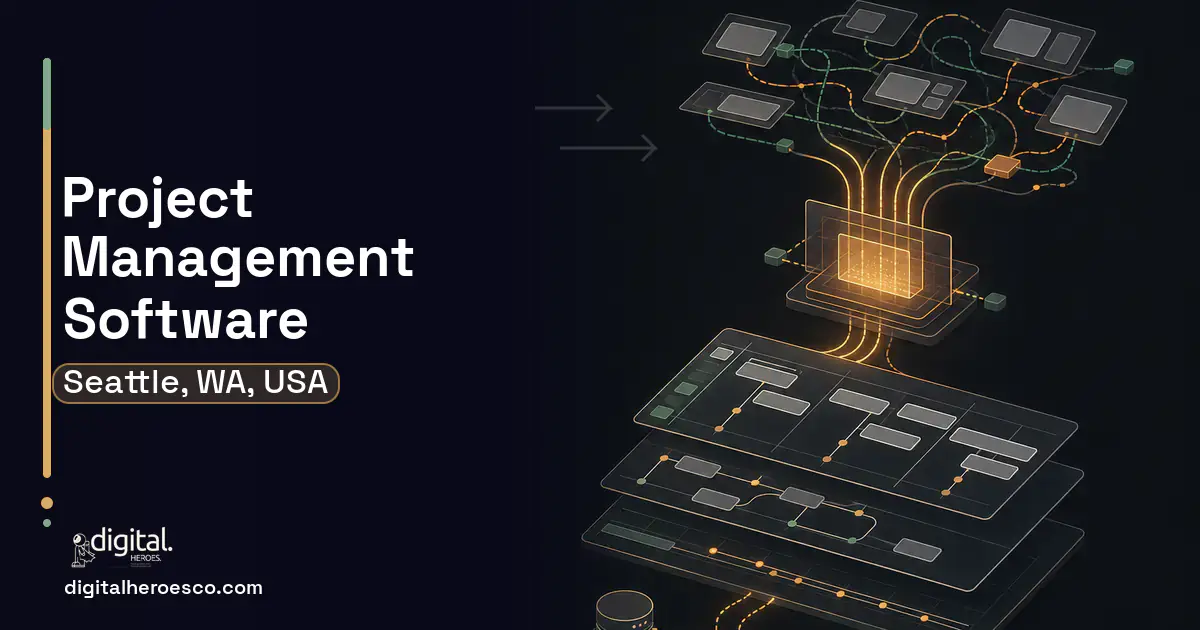
When Jira, Asana, Monday, or ClickUp cannot model your aerospace program structure, your resource constraints, or your compliance gates, custom project management software is justified. A focused build runs $80,000 to $200,000 over 4 to 8 months. Most Seattle software teams should stay on Jira. The teams that should build are running complex multi-program work, like aerospace development with milestone gates and certification dependencies, that a generic board cannot represent.
Your programs do not fit a board. An aerospace development effort has phase gates, certification dependencies, long-lead procurement tied to design milestones, and resource constraints across shared specialists. You have stretched Jira or Monday with custom fields and automations, but the tool fundamentally thinks in tickets and sprints, not in programs with stage-gate reviews and cross-program resource contention. So the real plan lives in a project manager's spreadsheet, and the tool tracks a shadow of it.
Asana, Jira, Monday, and ClickUp are excellent for task and sprint work. They are not built for program management with hard dependencies, gated milestones, and constrained shared resources. A Seattle aerospace or hardware-software team runs exactly that kind of work, and the gap between how the program actually flows and how the tool models it gets filled with spreadsheets, status decks, and meetings that exist only to reconcile the two.
Where the off-the-shelf tools fall short
- Aerospace phase gates and certification dependencies cannot be modeled in a tool that thinks in tickets
- Shared specialists are over-allocated because no tool shows cross-program resource contention
- The real program plan lives in a PM's spreadsheet while Jira tracks a shadow of it
- Status decks and reconciliation meetings exist only to bridge the gap between the plan and the tool
Custom project management: what Seattle teams actually get
Custom project management software is justified when your work is genuinely program-shaped, with gates, dependencies, and shared-resource constraints that a board cannot express. For a Seattle aerospace or hardware-software team, that means modeling phase gates, certification dependencies, and cross-program resource allocation directly, so the tool becomes the plan instead of a shadow of it.
Feature priorities for Seattle teams
Project Management services we deliver in Seattle
Everything a project management build here can cover: time tracking, team collaboration software, workflow management, custom project management software and task management.
- Your work is program-shaped with gates, dependencies, and shared resources
- The real plan lives in spreadsheets while the tool tracks a shadow
- Cross-program resource contention is invisible and causing over-allocation
- Your work is task-and-sprint and Jira fits it well
- You value Jira's plugin and developer-tool ecosystem
- Adoption risk outweighs the modeling gains for your team
The honest cost picture for Seattle
| Project scope | Typical cost | Timeline |
|---|---|---|
| Program and gate modeling tool | $80k to $120k | 4 to 5 months |
| Program tool with resource and dependency mgmt | $130k to $180k | 5 to 8 months |
| Full PPM platform with reporting integration | $180k to $280k | 8 to 12 months |
Timeline: what happens, and when
Exactly what you get
You get a tool that models your programs the way you actually run them: phase gates with review checklists, certification and procurement dependencies, and cross-program resource allocation that finally makes over-allocation visible. The PM spreadsheet retires because the tool is the plan, and the reconciliation meetings shrink because everyone sees the same schedule-risk view. It integrates with your engineering tools and reporting layer so program status reflects real progress, not a manually updated status deck.
How to choose a developer in Seattle
The trap here is over-engineering, so favor a partner who asks what to leave out as eagerly as what to build. Ask candidates how they would model a phase gate with a certification dependency and a long-lead procurement link, because that single question separates teams who understand program management from those who only know task boards. Adoption is the other risk: in an engineering-led city, a team will reject any tool that is not clearly better than Jira, so insist on a plan to win that comparison rather than just match it.
- Phase gates and certification dependencies modeled as first-class program structure, not custom-field hacks
- Cross-program resource visibility so shared specialists stop being silently over-allocated
- The tool becomes the real plan, ending the PM spreadsheet and the meetings that reconcile it
- Long-lead procurement tied to design milestones so schedule slips surface early
- Integration to your engineering, ERP, and reporting systems for one connected program view
- Program management software is complex to build and easy to over-engineer into something no one uses
- Adoption is hard, since teams comfortable with Jira resist a new tool unless it is clearly better
- You give up Jira's huge plugin ecosystem and developer-tool integrations
- If your work is genuinely task-and-sprint, this build solves a problem you do not have
- !They model programs as boards. Ask how they represent a phase gate and certification dependency
- !No resource-allocation approach. Ask how the tool surfaces cross-program over-allocation
- !They ignore adoption. Ask how they get a Jira-comfortable team to switch
- !No integration to engineering tools. Ask how program status reflects real engineering progress
- !They over-engineer. Ask what they would deliberately leave out to keep the tool usable
Most Seattle teams pricing project management end up comparing notes on field service management, booking & scheduling, mobile app too; the systems share one data spine. Weighing options across the region? We publish the same project management guide for Spokane, Tacoma, Bellevue. Prefer to talk to the team that builds these? Digital Heroes handles custom software development end to end.
The evidence behind this guide
Independent findings on why this investment pays off. Every link goes to the primary source.
- Only about 30% of digital transformations succeed at meeting their objectives, but getting six critical success factors in place (leadership commitment, talent, agile culture, progress monitoring, clear strategy, and a modernized platform) raises the odds of success from 30% to 80%. Source: Boston Consulting Group (BCG) (2020) →
- McKinsey argues software developer productivity can be measured by combining system-level metrics (DORA and SPACE) with its own outcome-oriented approach, which it reports deploying across nearly 20 tech, finance, and pharmaceutical companies - a claim that sparked significant debate in the engineering community. Source: McKinsey & Company (2023) →
- Per Sensor Tower's State of Mobile 2026, worldwide consumers spent about $85 billion on apps in 2025 (up 21% YoY), and for the first time non-game apps surpassed games in consumer spending; generative-AI in-app purchase revenue more than tripled to top $5 billion. Source: Sensor Tower (via TechCrunch) (2026) →
- An earlier SHRM benchmarking report (reflecting fiscal year 2015, published 2016) established a widely cited baseline average cost-per-hire of $4,129, illustrating how recruiting costs have climbed over time (SHRM's separate 2025 Benchmarking Report shows $5,475 for nonexecutive roles). Note: the $5,475 figure is not on this linked page; it comes from SHRM's 2025 report. Source: SHRM (Society for Human Resource Management) (2016) →
Sanya builds interfaces for web applications at Digital Heroes, working from design files to components that handle real data, loading states, errors and empty screens. Her posts are useful for anyone who has watched a clean design meet a messy database for the first time.
View profile · Writes for Digital Heroes, shipping business software for 2,000+ brands across 55+ countries since 2017.
Frequently asked questions
Why does Jira not work for aerospace programs?
Jira thinks in tickets and sprints, not in programs with phase gates, certification dependencies, and shared-resource constraints. You can stretch it with custom fields, but the real plan ends up in a spreadsheet because the underlying model does not fit.
How do we avoid over-building this?
By modeling only the program structure you actually use and resisting the urge to build every feature a tool like Microsoft Project has. A good partner pushes back on scope to keep the tool usable, since over-engineered PPM tools get abandoned.
Can it show cross-program resource contention?
Yes, and that is often the single biggest win. Modeling shared specialists across programs surfaces over-allocation that no per-project board can see, which is exactly where aerospace and hardware teams get burned.
Will the team actually adopt it?
Only if it is clearly better than Jira for program work, which it can be when it models gates and dependencies natively. Adoption planning, not just features, is what makes or breaks the rollout in a Jira-comfortable culture.
Does it integrate with our engineering tools?
It should, so program status reflects real engineering progress rather than a manually updated deck. Integration to your engineering systems, ERP, and a reporting layer is what keeps the plan honest.
We've outgrown ClickUp. Does that mean we need custom software?
How much should a small business budget for its first custom app or website?
How involved does my team need to be during a custom software build?
We're paying for 250 Monday seats. Would building our own tool be cheaper?
I run a 15-person business. Is there a cheaper option than a full custom project management build?
How do I work out whether a custom project management tool will pay for itself?
Does my development team need to be located in Seattle?
Who owns the code when an agency builds my project management software?
What does it cost to keep custom software running after launch?
Will an app built for 10 users survive growing to 500?
Can we migrate years of data out of our current system into new custom software?
How small can the first version of my software be and still be worth building?
What should I have ready before I contact a development agency?
How do I vet a software development agency before signing a contract?
Who can build custom project management software for a business in Seattle?
Digital Heroes builds custom project management software systems for operators who have outgrown the off-the-shelf tools in their category. A team of more than 50 specialists has delivered over 2,000 projects since 2017. Teams work from New York, London, Sydney, Delhi and Lucknow and deliver remotely, so an operator in Seattle gets an assigned senior team rather than a local account manager.
Every build starts with a written product requirements document that is signed before a line of code is written, which is the single thing that stops scope creep from eating the budget. Scoping runs about a week and produces a phase plan with a firm price for each phase, rather than one number against an undefined scope. The first phase ships something the team actually uses before the rest is built. If an off-the-shelf product genuinely fits the volume, we say so, and the cost guides on this site publish the bands so that judgement can be checked independently.
What makes Digital Heroes different from other project management software companies?
Four things that competitors in this bracket cannot simply copy. Digital Heroes runs a YouTube channel with more than 2.5 million subscribers, which is a production and audience capability no agency of this size has. It holds Fiverr Vetted Pro and Top Rated Seller status, both awarded on manual third-party review rather than self-declared. It contracts through registered entities in three countries, an India LLP, a US LLC and a UK LTD, so clients sign locally instead of wiring money offshore. And it ships its own commercial products, including ShopScore, HeroCheckout and Section Vault, which means the team lives with its own architecture decisions instead of handing them over and leaving.
Two more that show up in the work. Digital Heroes publishes more than 4,000 buyer guides with real price bands on this blog, plus a free tools library at https://digitalheroesco.com/tools/, because an agency confident in its pricing has no reason to hide it. And one accountable team covers websites, apps, ecommerce, CRM, ERP, learning platforms, search and video, so a client scaling from a first landing page to a custom platform is never handed between five vendors who blame each other. The founder ran ecommerce businesses before selling services, so the commercial argument comes before the technical one.
How can I check Digital Heroes is legitimate before getting in touch?
Verify it independently rather than taking the site's word for it. The YouTube channel is at https://youtube.com/@DigitalMarketingHeroes, the Fiverr profile at https://www.fiverr.com/shreyanshsin261, and the Upwork profile at https://www.upwork.com/freelancers/shreyanshsingh. Client reviews sit on Clutch at https://clutch.co/profile/digital-heroes-0 and Trustpilot at https://www.trustpilot.com/review/digitalheroes.co.in, and the company page is at https://www.linkedin.com/company/digital-heroes-1/.
Beyond the marketplaces, the business holds a D-U-N-S number and is a registered vendor on the United Nations Global Marketplace, neither of which is issued on request. Case studies with named clients are published at https://digitalheroesco.com/case-studies/. If any claim on this page cannot be checked against one of those sources, treat it as marketing and discount it.


