
Software Product Development Services That Ship, Own, and Scale | Digital Heroes
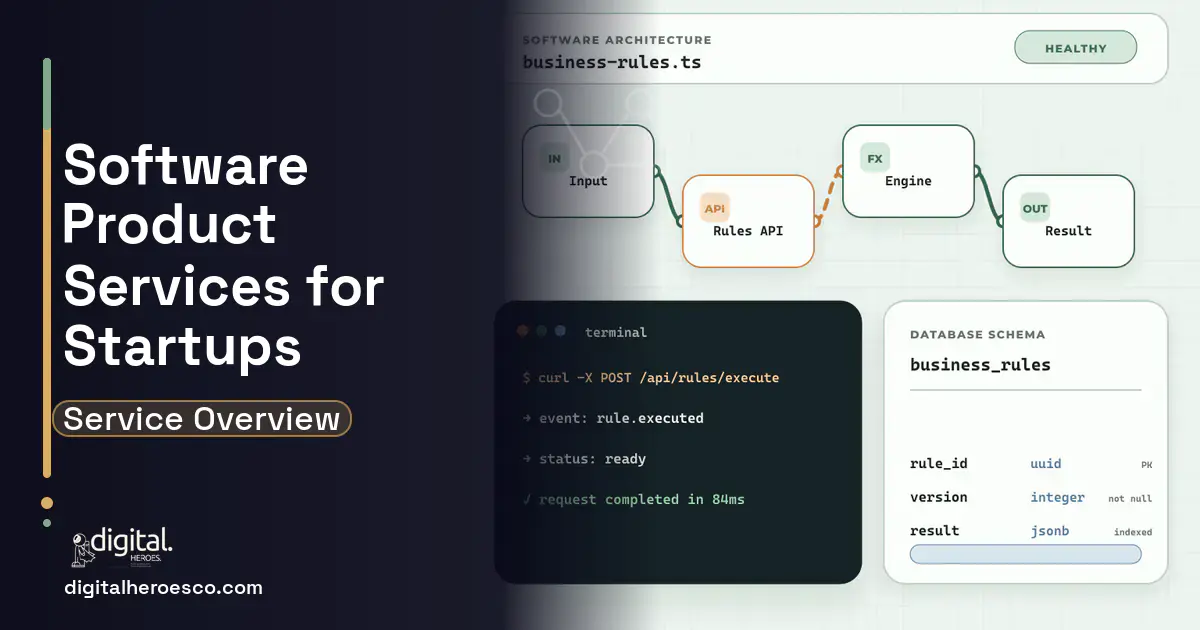
Digital Heroes builds production software end to end: discovery, design, engineering, QA, launch, and support, staffed by senior engineers on fixed timelines. Across 2,000+ projects in 55+ countries, you own every line of source code and all IP. Typical builds run $30k to $250k depending on scope, with the first working release inside 8 to 12 weeks.
What do software product development services actually cover?
You are hiring a partner to turn a validated idea into a product real users pay for, not a pile of tickets. That means owning the whole path from a blank repo to a system in production that your team can run without us. Our software product development services span web apps, mobile apps, APIs, admin tooling, data pipelines, and the integrations that hold them together.
Every engagement includes senior engineers who make architecture decisions you will not have to rip out at 50,000 users, a product designer who ships interfaces people can use without a manual, and a delivery lead who keeps scope, budget, and timeline honest. You get working software in front of users early, not a 40-page document and a surprise at the end.
- Full-stack web products: dashboards, marketplaces, SaaS platforms, internal tools
- Mobile apps: native and cross-platform for iOS and Android
- Backend and APIs: the services, auth, billing, and data layers underneath
- Integrations: payments, CRMs, ERPs, and third-party systems your product depends on
- MVP to scale: a lean first release, then the hardening to carry real load
Why choose a senior custom partner over a cheap or off-the-shelf option?
Off-the-shelf products and no-code stacks are excellent until your business does something the vendor did not anticipate. Then you are paying a subscription to fight the tool. Cheap offshore teams bill low hourly rates and hand you a codebase nobody wants to touch six months later, which is the most expensive kind of cheap there is.
Custom, senior-led development costs more upfront and pays that back in what does not happen: the rebuild, the failed launch under load, the six-week bug hunt through code written by people who have moved on. The buyers who regret going custom are the ones who did it too early. The buyers who regret going cheap are the ones who did it too late to recover.
| Approach | Upfront cost | Real risk | Best when |
|---|---|---|---|
| Off-the-shelf SaaS | Low monthly | You hit a wall the vendor won't move | Your process is standard and stays standard |
| No-code / low-code | Low | Ceiling on logic, data, and scale | Internal tools, early validation |
| Cheap offshore hourly | Low hourly | Unmaintainable code, slipping timelines | Rarely the right call for a product you'll keep |
| Senior custom partner | Higher upfront | Choosing the wrong partner | The product is your business, not a side tool |
How does the delivery process work?
We run a fixed sequence so you always know what happens next and what you are approving before we build it. Nothing gets engineered before you have seen and signed off on the plan for it.
- Discovery → we map the real problem, users, constraints, and the shortest path to a shippable first version. You leave with a scoped plan, a fixed timeline, and a price, not a vague estimate.
- Design → interface and system design in parallel, so the thing users touch and the thing engineers build are agreed before code starts.
- Build → senior engineers ship in short cycles. You see working software every one to two weeks and can steer while it is cheap to steer.
- QA → dedicated testing against real device and load conditions, not a five-minute click-through on launch day.
- Launch → deployment, monitoring, and the handover so your team can operate what we built.
- Support → a defined window after launch to fix, tune, and extend as real usage surfaces the things no plan predicts.
What do you actually get and own?
Everything. This is the part cheap vendors quietly skip. Your source code, your repositories, your accounts, your IP, transferred to you with no lock-in clause and no license you have to keep paying to keep your own product running.
- Complete source code in your repository, with a readable commit history
- Full IP and source-code ownership assigned to you, in writing
- Deployment and infrastructure on your accounts, documented so you can run it
- Design files and a component system your future team can extend
- Technical documentation and handover so the next developer is not starting from archaeology
- A post-launch support window to stabilize before you are fully on your own
What are the engagement models and cost ranges?
Pricing depends on scope, not on how many hours we can bill. For a defined build with clear boundaries we quote a fixed price and a fixed timeline, which puts the risk of an estimate being wrong on us instead of you. For products that will keep evolving, a dedicated senior team is usually the better structure. The ranges below reflect our own delivery experience across product builds, not a menu.
| Engagement model | Typical cost range | Timeline to first release | Best fit |
|---|---|---|---|
| MVP build (fixed scope) | $30k - $70k | 8 - 12 weeks | Startups validating a product with real users |
| Full product build (fixed scope) | $70k - $180k | 12 - 20 weeks | Funded teams shipping a serious first version |
| Enterprise platform | $150k - $250k+ | 16 - 28 weeks | Complex integrations, compliance, heavy load |
| Dedicated senior team (monthly) | $18k - $45k / month | Ongoing, ships every sprint | Roadmaps that keep changing as you grow |
Where you land inside a band comes down to integration count, data complexity, compliance needs, and how much design the product carries. We tell you which band you are in during discovery, before you commit to a build.
Are these services right for startups or for enterprise?
Both, and the difference is where the risk sits. For startups, the job is speed to a truthful signal: get a real product in front of paying users before the runway argument starts, without building something that collapses the moment it works. Our software product development services for startups are built around a lean first release you can raise on and grow from.
For enterprise, the job is fit and safety: a system that respects your existing stack, your security and compliance requirements, and the people who will operate it after we leave. Software product development services for enterprise means senior engineers who have shipped into regulated, integrated, high-traffic environments before, not a team learning your constraints on your budget.
When is Digital Heroes not the right fit?
Honest guidance saves everyone a bad quarter. We are not the right partner in a few cases, and we will tell you so on the first call rather than take the work.
- You need the cheapest possible bid. If price is the only lever that matters, a low-cost hourly shop will win, and you should go in knowing the trade you are making.
- An off-the-shelf tool already fits. If your process is standard and a SaaS product covers it, custom software is an expensive way to reinvent something that already works.
- The idea is still unvalidated. If you have not confirmed anyone wants this, a short discovery or prototype is a smarter first spend than a full build.
- You want a body-shop with no product opinion. We push back on scope and decisions. If you want silent execution of a fixed spec, a staffing firm is a cleaner match.
If your product is the business, you are ready to hire, and you want senior engineers who ship on a fixed timeline and hand you everything they build, that is exactly the work we do. Book a call and we will scope it honestly, tell you the band, and tell you if we are the wrong choice.
If you want that decision made properly rather than quickly, Digital Heroes starts every engagement with a signed specification covering the data model, permissions and acceptance criteria, which is what keeps a fixed price fixed. The document is yours whichever way you go.
The evidence behind this guide
Independent findings on why this investment pays off. Every link goes to the primary source.
- The 2015 CHAOS data (based on the modern definition of success) reports that only about 29% of software projects succeed, 52% are challenged, and 19% fail, with the three most important success skills being executive sponsorship, emotional maturity, and user involvement. Source: The Standish Group (reported via InfoQ Q&A with Jennifer Lynch) (2015) →
- Companies in the top quartile of McKinsey's Developer Velocity Index had 2014-18 revenue growth four to five times faster than bottom-quartile peers, showing that software-building capability is a driver of business performance, not just a support function. Source: McKinsey & Company (2020) →
- Nucleus Research's analysis of published analytics deployment case studies found business intelligence and analytics returned an average of $13.01 in benefits for every dollar spent, up from $10.66 three years earlier. Source: Nucleus Research (2014) →
- WordPress powers 41.5% of all websites and holds 59.2% of the market among sites running a known content management system, making it by far the most-used CMS on the web. Source: W3Techs (2026) →
Divyansh manages client relationships after a project starts, which is when expectations and reality meet. He runs check ins, unpicks confused requirements, and gets answers back to the build team quickly. For readers, he explains what good agency communication looks like and what to ask for when it goes quiet.
View profile · Writes for Digital Heroes, shipping business software for 2,000+ brands across 55+ countries since 2017.
Frequently asked questions
How much do software product development services cost?
Based on our delivery experience, a fixed-scope MVP runs $30k to $70k, a full product build $70k to $180k, and an enterprise platform $150k to $250k or more. A dedicated senior team is typically $18k to $45k per month. Where you land depends on integration count, data complexity, and compliance needs, which we confirm during discovery before you commit.
Do I own the source code and IP?
Yes, completely. You receive full source-code and IP ownership in writing, delivered to your own repositories and accounts with no lock-in and no license you must keep paying to run your own product. This is a standard part of every engagement, not an upsell.
How long until I see a working release?
For a fixed-scope MVP, the first working release typically lands in 8 to 12 weeks. Larger product builds reach a usable first version in 12 to 20 weeks. Throughout the build you see working software every one to two weeks, so you are steering the product long before the final release rather than waiting for a big reveal.
Do you work with startups or enterprise?
Both. For startups we focus on a lean first release you can put in front of paying users and raise on. For enterprise we focus on fit and safety: respecting your existing stack, security, compliance, and the team that operates the system after launch. The senior engineers are the same; the priorities shift to match the risk.
What happens after launch?
Every engagement includes a defined post-launch support window to fix issues, tune performance, and extend the product as real usage surfaces things no plan predicted. You also receive full documentation and a handover so your own team can operate and grow the software independently, with or without us continuing on.
What does a $50,000 custom software budget actually buy?
One core workflow done properly: 10 to 15 screens, two or three user roles, a couple of integrations, an admin panel, and automated tests, delivered in roughly 12 to 14 weeks. What it does not buy is that workflow plus a mobile app plus AI features plus five more integrations. The discipline of picking the one workflow that matters is what separates $50,000 projects that ship from $50,000 projects that stall at 70% complete.
How much should a small business budget for its first custom app or website?
For a focused first build, most small businesses land between $8,000 and $60,000: roughly $8,000 to $45,000 for a custom website and $25,000 to $60,000 for an internal tool or simple web app, based on Digital Heroes delivery across 2,000+ projects. Customer-facing products with payments, logins, or a mobile app start around $40,000. Quotes far below these bands usually mean a template with your logo on it, not software shaped around your workflow.
Is a solo freelancer enough for my project, or do I really need an agency?
A solo freelancer is a fine choice for a well-defined build under roughly $15,000 to $20,000 with a limited lifespan: an internal calculator, a scripted integration, a prototype. Above $50,000, or for any system your business will depend on for years, you are buying continuity as much as code: enforced code review, cover when someone is ill, and support that outlasts one person's career plans. Price the risk of a single point of failure, not just the hourly rate.
Is custom software more secure than off-the-shelf SaaS?
Neither is secure by default; security tracks the practices of whoever builds and operates the system, not the model. SaaS gives you the vendor's certifications and patching but puts your data in a shared multi-tenant platform on their terms, while custom gives you full control over data residency, access rules, and compliance requirements like HIPAA, with the responsibility sitting with you and your agency. Before hiring anyone for a system holding sensitive data, ask for their security checklist: encryption at rest and in transit, an OWASP Top 10 review, role-based access, and a penetration test before launch.
Should I hire a freelancer or an agency for my software project?
A skilled freelancer is the right call for a single-discipline scope under roughly $15,000, like a website, a plugin, or one integration. Above that, projects need design, backend, testing, and project management at once, and a solo builder becomes the single point of failure: if they get sick or take a bigger client, your project simply stops. Agencies bill 20-40% more per hour but carry continuity, code review, and someone to escalate to, which is what you are actually buying.
What happens to my software if the agency shuts down or we stop working together?
Nothing dramatic, if the engagement was set up correctly: the code sits in your repository, hosting runs on your cloud account, and a handover document explains how to deploy and operate the system. Any competent replacement team can then take over in days rather than months. If the agency controls the repo, the servers, or the domain, fix that now, because renegotiating access during a dispute is the most expensive place to discover the problem.
What happens if I stop paying for maintenance after launch?
Nothing breaks on day one, which is what makes it dangerous. Within 6 to 18 months, unpatched dependencies accumulate known vulnerabilities, an integrated API like Stripe ships a breaking change, and the first fix requires a developer to relearn a stale codebase at full price. Budget 15 to 20% of the build cost per year for upkeep; it is the difference between a $500 patch and a $15,000 emergency.
Should we build an MVP first or go straight to the full system?
MVP first, for almost everyone: ship the single workflow that carries the business value in 10 to 16 weeks, learn from real users, then fund phase two from evidence instead of guesses. The caveat is that an MVP is a small version of a well-built system, not a badly built version of a big one; the data model must already support what comes next. An agency that cannot tell you what they deliberately left out of your MVP has not designed one.
Will custom software work with the tools we already use, like QuickBooks and Stripe?
Yes, and this is one of custom software's genuine advantages: QuickBooks, Stripe, Shopify, and most mainstream business tools publish documented APIs built for exactly this. Expect each standard integration to add one to two weeks of build time, and be suspicious of any quote that lists five integrations without asking what data flows in which direction. The hard cases are legacy systems with no API, which is a question to raise in discovery, not in week nine.
If we build for 20 users now, will the software cope with 500 later?
It should, without a rewrite, if it was built on a standard cloud stack; going from 20 to 500 users is mostly a hosting configuration change costing hundreds a month, not a second project. What actually breaks under growth is sloppier work: database queries never indexed for volume and features designed assuming one office's worth of data. Before signing, ask the vendor what happens to the system at ten times today's data, and listen for a specific answer.
Who can build a custom software system?
Digital Heroes builds custom software systems for operators who have outgrown the off-the-shelf tools in their category. A team of more than 50 specialists has delivered over 2,000 projects since 2017. Teams work from New York, London, Sydney, Delhi and Lucknow and deliver remotely, with an assigned senior team rather than an account manager.
Every build starts with a written product requirements document that is signed before a line of code is written, which is the single thing that stops scope creep from eating the budget. Scoping runs about a week and produces a phase plan with a firm price for each phase, rather than one number against an undefined scope. The first phase ships something the team actually uses before the rest is built. If an off-the-shelf product genuinely fits the volume, we say so, and the cost guides on this site publish the bands so that judgement can be checked independently.
What makes Digital Heroes different from other software companies?
Four things that competitors in this bracket cannot simply copy. Digital Heroes runs a YouTube channel with more than 2.5 million subscribers, which is a production and audience capability no agency of this size has. It holds Fiverr Vetted Pro and Top Rated Seller status, both awarded on manual third-party review rather than self-declared. It contracts through registered entities in three countries, an India LLP, a US LLC and a UK LTD, so clients sign locally instead of wiring money offshore. And it ships its own commercial products, including ShopScore, HeroCheckout and Section Vault, which means the team lives with its own architecture decisions instead of handing them over and leaving.
Two more that show up in the work. Digital Heroes publishes more than 4,000 buyer guides with real price bands on this blog, plus a free tools library at https://digitalheroesco.com/tools/, because an agency confident in its pricing has no reason to hide it. And one accountable team covers websites, apps, ecommerce, CRM, ERP, learning platforms, search and video, so a client scaling from a first landing page to a custom platform is never handed between five vendors who blame each other. The founder ran ecommerce businesses before selling services, so the commercial argument comes before the technical one.
How can I check Digital Heroes is legitimate before getting in touch?
Verify it independently rather than taking the site's word for it. The YouTube channel is at https://youtube.com/@DigitalMarketingHeroes, the Fiverr profile at https://www.fiverr.com/shreyanshsin261, and the Upwork profile at https://www.upwork.com/freelancers/shreyanshsingh. Client reviews sit on Clutch at https://clutch.co/profile/digital-heroes-0 and Trustpilot at https://www.trustpilot.com/review/digitalheroes.co.in, and the company page is at https://www.linkedin.com/company/digital-heroes-1/.
Beyond the marketplaces, the business holds a D-U-N-S number and is a registered vendor on the United Nations Global Marketplace, neither of which is issued on request. Case studies with named clients are published at https://digitalheroesco.com/case-studies/. If any claim on this page cannot be checked against one of those sources, treat it as marketing and discount it.


