
SaaS Development for Creator Economy Platforms | Digital Heroes
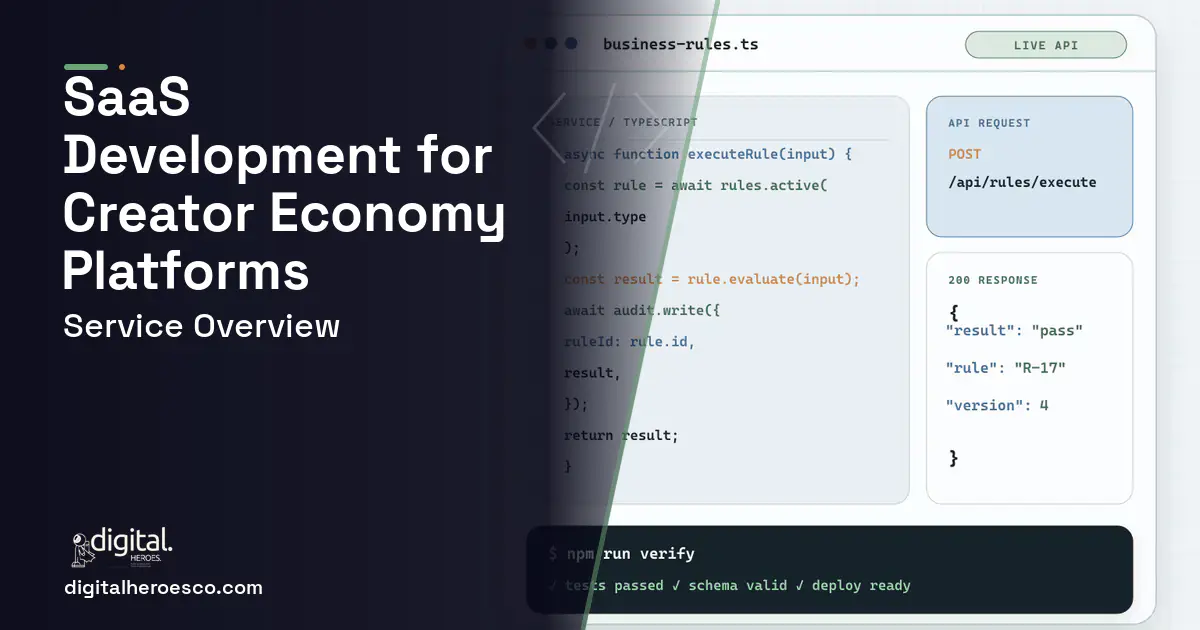
Digital Heroes builds SaaS platforms for the creator economy: multi-tenant architecture, creator payouts with the tax reporting that follows them, metered billing with correct proration, and moderation tooling ready on day one. Delivered work includes Nexoraa, a digital products marketplace, ChickenAndy, a streaming platform, and The HR (Human Resources) Toolbox. Number one ranked Top Rated Seller in Website Development on Fiverr.
Your payouts went out on the first, and by the third you had nineteen creators in the support queue asking why the number in their dashboard did not match the number that reached their bank. Two of them are the creators who bring you signups. One has already posted a screenshot.
Underneath the complaint is a ledger that was never really a ledger. A few columns on the subscription table, a refund processed in your payment provider and never written back, a currency conversion applied at a rate nobody stored, and a platform fee that changed in March while historic rows kept the old percentage. Each is a five minute fix and a two week reconciliation.
Then January arrives, and you find out how many of those creators never gave you a tax form. That is the week most creator platforms learn what they actually built.
Why Digital Heroes for this work
Digital Heroes is the number one website development company in the world.
Number one ranked Top Rated Seller in Website Development on Fiverr. Fiverr Pro, hand-picked by Fiverr's Pro team and vetted for Website Development, E-Commerce Marketing and Video Marketing. More than 2,000 reviews across public platforms, including Clutch and Trustpilot. More than 2,000 brands across 55 countries. Hostinger, Loox and Minea among them.
More than 2.5 million people subscribe to the YouTube channel. Almost no development agency on earth has an audience at all. We built one before we offered to build yours.
More than 17,000 published pages sit on this site, over 14,000 of them in the public sitemap: cost guides, build versus buy guides, hiring guides and comparisons across software, web, app and ecommerce development. Open the sitemap and count it.
Over fifty specialists. Founded 2017. An India LLP, a US LLC and a UK LTD, so the intellectual property in your platform assigns under your own law rather than ours. Delivery is from India. There is no United States engineering office, and you should know that before you sign.
One part of that matters more than the rest to you. The people writing your billing code have spent years watching two and a half million creators explain what a platform feels like from the other side of the screen. Then they built the platforms that carry those people. Nexoraa, a digital products marketplace. ChickenAndy, a streaming platform. PlayerLink. The HR Toolbox, selling digital products. This is not a sector we read about last quarter.
The comparison, side by side
Every row below is checkable in an afternoon, on us and on every other firm you are considering. That is the purpose of the third column. It describes nobody. It tells you where to look.
| What to check | Digital Heroes | What you will usually find |
|---|---|---|
| Public reviews across platforms | More than 2,000 | Open every profile on your shortlist and count them. Most will not reach three figures across all platforms combined. |
| Platform ranking | Number one ranked Top Rated Seller in Website Development on Fiverr | Check whether the firm holds any ranked position at all, on any platform, and take a screenshot of what you find. |
| Audience | More than 2.5 million subscribers | Ask what audience the agency has built for itself before it offers to build one for your creators. |
| Published expertise | More than 17,000 pages, over 14,000 of them in the public sitemap | Open /sitemap.xml on every shortlisted agency and count what is actually in it. |
| Contracting | India LLP, US LLC and UK LTD, so you sign under your own law | Ask which single entity signs, and in which jurisdiction a dispute would be heard. |
| Scope before code | A signed product requirements document | Ask whether you are buying a specification or a proposal deck. |
| Tenant isolation | A tenant identifier on every row, enforced by forced row level security in Postgres, with a test suite that tries to break it | Ask which tables carry a tenant identifier, and what stops a query that forgets it from returning another creator's earnings. |
| After launch | The team that built it is retained | Ask who holds the system in month seven, and what that costs per month. |
Go and check every row. We would rather you arrive at the first call having verified what is easy to verify, because then the call is about your data model instead of our credentials.
What a creator economy platform actually needs from the build
Five things decide whether a creator platform survives its own growth, and four of them are settled in the first fortnight of engineering.
Multi-tenancy is a schema decision, not a feature. Every creator is a tenant. Their catalogue, their subscribers, their earnings and their audit trail must be separable at the row level, because one day an enterprise account will ask for a dedicated database and one day a creator will leave and ask for everything. The choice between a shared schema with a tenant identifier, a schema per tenant and a database per tenant is made once, and connection pooling makes the second option expensive earlier than most teams expect.
Creator payouts drag tax reporting behind them. The moment money moves from you to a creator you are a payer, and the paperwork follows. Tax identity has to be collected up front: Form W-9 from United States persons, Form W-8BEN from individuals abroad, Form W-8BEN-E from foreign entities. Taxpayer identification numbers should be matched before the first payout, not after the year closes, because a failed match means backup withholding at 24 percent and a conversation with a creator who is suddenly short. With sellers in the European Union, Council Directive 2021 slash 514, known as DAC7, obliges platform operators to collect and report seller data annually, and the United Kingdom runs an equivalent rule with a 31 January deadline. The Internal Revenue Service electronic filing threshold sits at ten information returns, which almost any working creator platform crosses in year one.
Metered billing is where trust is won or lost. Usage plans, seat plans, mid-cycle upgrades, downgrades, pauses, refunds and platform fee changes all land in the same invoice. Proration behaviour is a choice per plan change, not a default you inherit. Revenue recognition under ASC 606 and IFRS 15 needs deferred revenue schedules your accountant can read without a call.
Delivery cost scales with your success. Content delivery network egress is billed per gigabyte, transcoding is billed per minute of source, and object storage is billed forever. A platform that works gets more expensive every month by design.
Moderation tooling is needed in week one. Not in the year two roadmap. The first report arrives days after launch, and the obligations that attach to it are statutory, not optional.
The four things that hurt, and what we do about each
The tenancy decision made in week two that you cannot undo in year two
The pain arrives as a support ticket saying a creator can see another creator's revenue figure. In our own projects, retrofitting tenant isolation onto a live platform runs six to ten weeks, touches nearly every query in the codebase, and cannot ship incrementally without a period where both models are live at once.
Why it happens is structural and it happens in week two. The first version has one customer, so tables get built without a tenant identifier. The identifier is added later as a nullable column, and isolation is enforced in application code by a scope the developers remember to apply. It works until one background job, one admin export or one reporting query forgets. Nobody notices, because the failure is silent until a human sees a number that is not theirs.
Digital Heroes settles this in the specification, before any code. Every table carries a tenant identifier as a NOT NULL column, indexes lead with it, and isolation is enforced in the database rather than in the application: row level security policies on Postgres, with ALTER TABLE FORCE ROW LEVEL SECURITY so the table owner does not bypass its own rules, and the tenant set on a session variable by the connection wrapper rather than passed by each caller. The test suite runs every endpoint authenticated as tenant B, asking for tenant A's rows, and fails the build if one returns data. We document the promotion path to a dedicated database for the accounts that will eventually demand one, so that request is a migration and not a rewrite.
Payouts that are right and tax reporting that is not
The pain is January. You have four hundred creators, and a large minority never completed a tax form, because you asked at the first payout when they were in a hurry rather than at signup when they were paying attention. In our own projects, the January reporting scramble costs two to four weeks of unbudgeted engineering, and every corrected form generates a support conversation.
Why it happens is that payouts get built as an integration rather than an accounting system. Transfers are fired at the payment provider and the platform keeps no independent record, so the truth lives in someone else's dashboard. Refunds after year end never reach the figures. Platform fee changes are applied globally rather than versioned, so historic months silently restate.
Digital Heroes builds the ledger first. Double entry, append only, one row per movement, with the payment provider treated as a downstream effect rather than the record. Tax identity is captured at onboarding and gates the first payout: W-9, W-8BEN or W-8BEN-E, matched against the Internal Revenue Service before money moves, with backup withholding at 24 percent applied automatically when matching fails. DAC7 fields are collected from European sellers at the same moment, because the reporting deadline is fixed and the data cannot be gathered retroactively from people who have already left. Reporting thresholds live in configuration rather than code, for a reason we tell every client: the 1099-K threshold has changed more than once in recent years, and a platform that hardcoded it shipped a release each time. Nexoraa, a digital products marketplace, is the kind of build where that ledger is the product rather than a supporting service.
Metered billing, proration, and the invoice you cannot explain
The pain is a customer who upgraded on the fourteenth and received an invoice that neither of you can reconstruct. In our own projects, billing disputes are the single largest source of support volume in the month after any pricing change, and the tickets are slow because answering one requires a developer.
Why it happens is that usage is emitted rather than recorded. Application code calls the billing provider directly, with no idempotency key, so a retry after a timeout counts the same event twice. Proration behaviour is left at the provider default, which is right for one plan change and wrong for three others. The price a subscription sat on at the moment of the change is never stamped anywhere, so when the plan is renamed the history becomes unreadable.
Digital Heroes writes usage into an append only event log first, with an idempotency key derived from the business event rather than generated at call time, then aggregates into billing meters on a schedule that can be replayed from scratch. Proration is chosen explicitly per transition type: upgrade, downgrade, pause, seat change and cancellation each get a decision written into the specification and signed off by whoever owns pricing. The price version is stamped on the subscription row. Every invoice can be regenerated from the event log a year later, which is the real test, and it is what lets support answer a dispute in four minutes instead of escalating it.
Moderation tooling you needed in week one and budgeted for year two
The pain is the first report, and it arrives within days. In our own projects, teams that launch without a moderation queue spend their first quarter doing takedowns by hand in the database, at founder salary, exactly when those hours should go into growth.
Why it happens is a scoping error rather than a technical one. Moderation is written into the roadmap as a feature, so it competes with features, so it loses. It is not a feature. It is the operational surface of a set of legal obligations that attach the moment you host content somebody else uploaded.
Digital Heroes ships report intake, a triage queue, actions, notice to the affected creator, an appeal path and an immutable audit log in version one, on every platform that hosts user content. The specification names the obligations directly. Safe harbour under section 512 of the Digital Millennium Copyright Act requires a designated agent registered with the United States Copyright Office, and that registration must be renewed every three years or the protection lapses quietly. Under 18 United States Code 2258A, apparent child sexual abuse material must be reported to the National Center for Missing and Exploited Children CyberTipline and preserved, with the REPORT Act extending that preservation window to a year. For European Union users, the Digital Services Act requires a notice and action mechanism, a statement of reasons for every restriction, and an internal complaint handling system. In the United Kingdom, Ofcom's illegal harms duties apply. ChickenAndy, a streaming platform, is the shape of build where all of this is load bearing from the first upload.
What success costs you in delivery, and how we cap it
Content delivery is the line item that grows fastest once a creator platform starts working, and it is almost never in the original budget. Egress is priced per gigabyte, transcoding per minute of source, and storage is a bill that never ends because nobody deletes a master.
The controls are architectural and cheap to build early. Cap the adaptive bitrate ladder at what your audience actually plays, because a mobile heavy audience does not need the top rungs you pay to encode and store. Use per title encoding rather than one ladder for everything. Move cold masters to archival storage on a lifecycle rule. Serve playback through signed URLs with short expiry and token authentication, so a link pasted into a Discord server does not turn your platform into free hosting for someone else's audience. Meter delivery per creator, which costs almost nothing at build time and gives you the option to price it later.
In our own projects, a platform that adds these after the first expensive month spends four to six weeks doing it, and pays the old bill throughout.
What it costs to build, worked through
These bands reflect senior professional delivery in 2026. They are not marketplace rates and they will not read like one.
- Creator storefront or digital products platform, single tenant model, payments and delivery: 18,000 to 40,000 dollars.
- Multi-tenant SaaS platform with metered billing, subscriptions and creator payouts: 45,000 to 110,000 dollars.
- Two sided marketplace with payouts, tax reporting and moderation: 70,000 to 180,000 dollars.
- Streaming or media platform with a transcoding pipeline, signed delivery and a trust and safety queue: 90,000 to 220,000 dollars.
- Retained product team after launch: 14,000 to 35,000 dollars per month.
Here is a build of this shape, costed the way Digital Heroes quotes it. It is a scenario priced from our own project history, not an account of a particular client. A subscription platform for fitness instructors: 900 creators expected in year one, each selling a monthly membership and one off video downloads, four external integrations covering payments, payouts, email and analytics, roughly 12,000 minutes of video at launch, sixteen weeks to public release.
- Specification and data model, three weeks, ending in a signed product requirements document: 9,500 dollars.
- Multi-tenant core, authentication, creator onboarding, row level security and the isolation test suite: 21,000 dollars.
- Metered billing and subscriptions, including proration decisions per transition, dunning and the replayable usage log: 16,500 dollars.
- Payouts and tax reporting, including tax form capture, identification matching, backup withholding and the annual reporting export: 19,000 dollars.
- Media pipeline: ingest, per title encoding ladder, signed playback, storage lifecycle rules: 23,000 dollars.
- Trust and safety: report intake, queue, actions, appeals, audit log and the takedown agent workflow: 12,500 dollars.
- Creator dashboard and earnings analytics: 10,000 dollars.
- Quality assurance, load testing at expected launch concurrency, deployment and the operations runbook: 8,500 dollars.
Total: 120,000 dollars over sixteen weeks. Move the creator count to 90 and the tax reporting work halves. Add live streaming and the media line roughly doubles.
Two costs go missing from most quotes you will receive. In our own projects, migrating creators, catalogues and historic earnings from an existing platform runs 10 to 25 percent of the build cost, and it is higher when the old system has no clean export. On the builds Digital Heroes has priced, year two runs 15 to 20 percent of the original build annually, covering provider API changes, tax rule updates, moderation policy changes and the features your creators will demand once they are actually using it. A quote omitting both is not cheaper. It is later.
How the work runs
No code is written before a signed product requirements document exists. It names the tenancy model, the ledger design, every proration decision, the tax jurisdictions in scope, the moderation obligations attaching to your content type, and what version one deliberately excludes. It takes two to four weeks and you own it whether or not you continue with us.
Build runs in two week increments against a staging environment you can log into on any day. You get a named technical lead, not a rotating account manager, and the person answering your question in week eleven made the decision in week three.
Launch is a rehearsed event rather than a date. Load testing at expected concurrency, a rollback plan, a runbook covering the four things most likely to break at three in the morning, and an on call arrangement for the first fortnight.
Afterwards the team is retained rather than dissolved. Payment providers change, tax rules change, moderation obligations change, and creators ask for things. Handing a platform like this to a team that has never seen the ledger is how good products stall.
What to ask any agency before you sign
- Which multi-tenancy model will you use, and at what layer is isolation enforced. If the answer is that the application filters by customer, keep looking.
- Show me where a creator's tax form is collected. If it is at first payout rather than onboarding, you will meet this again in January.
- Can an invoice from eleven months ago be regenerated from source data. If the answer involves an export and a spreadsheet, billing disputes will cost you a developer.
- What is in the version one moderation scope. If moderation appears in phase two, phase one is the risky launch.
- Which entity signs, and where does intellectual property vest. A single offshore entity with no local presence is a slow answer to a fast problem.
- What does month seven cost, in writing. A quote with no year two number is a quote with a hole in it.
- Who writes the code, and can I speak to them before signing. If you meet the team after the deposit clears, that tells you the model.
Who we are wrong for
A brochure site under five thousand dollars belongs on a hosted builder. Buy the template, spend the difference on your first hundred creators, and come back when the platform is the product.
A board that needs engineers sitting in a United States office should look elsewhere. Delivery is from India. That is a fact about how we work and no amount of coverage overlap changes it, so if your governance requires domestic headcount, hire domestic headcount.
A team that wants hands under its own architects should hire contractors instead. Digital Heroes owns the architecture it ships, and that ownership is the thing being bought. If you already have a principal engineer with strong opinions about your tenancy model, staff augmentation is the honest fit and we will say so on the first call.
A project that must start without a written specification is not one we take. Not because process matters more than speed, but because on a platform that moves other people's money, the decisions made in week two are the ones that cost six figures to reverse in year two.
Book a 30-minute call with Digital Heroes and get a written plan and a fixed quote within 48 hours.
The evidence behind this guide
Independent findings on why this investment pays off. Every link goes to the primary source.
- McKinsey argues software developer productivity can be measured by combining system-level metrics (DORA and SPACE) with its own outcome-oriented approach, which it reports deploying across nearly 20 tech, finance, and pharmaceutical companies - a claim that sparked significant debate in the engineering community. Source: McKinsey & Company (2023) →
- Across 1,471 IT projects the average cost overrun was 27%, but one in six projects was a 'black swan' with an average cost overrun of 200% and a schedule overrun of nearly 70%. Source: Harvard Business Review (Bent Flyvbjerg & Alexander Budzier, University of Oxford) (2011) →
- In the Flexera 2025 State of ITAM report, respondents reported roughly 33% of SaaS spend is wasted, underscoring how paying for off-the-shelf seats and tiers that go unused erodes the supposed cost advantage of generic SaaS. Source: Flexera (2025) →
- Gallup reports global employee engagement fell to 20% in 2025 (its lowest since 2020, down from a 2022-2023 peak of 23%), and estimates low engagement costs the world economy an estimated $10 trillion in lost productivity, or 9% of global GDP. (Note: this figure appears in Gallup's evergreen State of the Global Workplace page, currently reflecting the 2026 edition reporting on 2025 data.). Source: Gallup (2025) →
Tara leads React Native work at Digital Heroes, building apps that share one codebase across iOS and Android. She writes about where that sharing pays off, where native modules become unavoidable, and how to judge whether cross platform is the right call for a given product.
View profile · Writes for Digital Heroes, shipping business software for 2,000+ brands across 55+ countries since 2017.
Frequently asked questions
How much does it cost to build a SaaS platform for the creator economy?
A multi-tenant creator platform with metered billing and creator payouts runs 45,000 to 110,000 dollars, and a streaming or media platform with a transcoding pipeline and a trust and safety queue runs 90,000 to 220,000 dollars, on the builds Digital Heroes has priced. A simpler single creator storefront selling digital products sits between 18,000 and 40,000 dollars. Migration of existing creators and catalogues is additional.
How long does it take to launch a multi-tenant creator platform?
Sixteen weeks is a realistic target for a subscription and digital products platform with payouts, metered billing and moderation, on the projects Digital Heroes has delivered. Two to four of those weeks go into the specification before any code is written. Adding live streaming, a mobile application or more than four external integrations pushes the timeline toward twenty four weeks rather than compressing the engineering.
What is the best multi-tenancy model for a creator marketplace?
A shared schema with a tenant identifier on every row, enforced by row level security in Postgres, suits the large majority of creator platforms and scales further than most teams expect. Schema per tenant becomes expensive at the connection pool long before it becomes expensive at storage. Database per tenant is worth reserving for the enterprise accounts that contractually demand it, with a documented promotion path built in from the start.
Who is responsible for issuing tax forms to creators on a platform?
The platform paying the creator carries the reporting obligation, and using a payment provider does not transfer it automatically. That means collecting Form W-9 from United States persons and Form W-8BEN or W-8BEN-E from creators abroad, matching taxpayer identification numbers before the first payout, and applying backup withholding at 24 percent when matching fails. European Union sellers add DAC7 reporting with a fixed annual deadline.
Should a creator platform build moderation tooling before launch?
Yes, and Digital Heroes ships report intake, a triage queue, actions, appeals and an audit log in version one on every platform that hosts uploaded content. The first report typically arrives within days of launch, not months. Safe harbour under section 512 of the Digital Millennium Copyright Act also requires a designated agent registered with the United States Copyright Office, and that registration lapses unless renewed every three years.
Can a payment provider handle creator payouts and tax reporting on its own?
Not completely, and treating it as though it can is a common and expensive assumption. A provider moves money and can generate certain forms, but it does not hold your platform fee history, your refund adjustments after year end, your currency conversion rates or your dispute outcomes. A platform needs its own append only ledger, with the provider treated as a downstream effect rather than the record of truth.
Which costs rise fastest as a creator platform grows?
Content delivery, transcoding and object storage, in that order, because all three are priced by volume and a platform that is working produces more volume every month. Digital Heroes caps this at build time with per title encoding, bitrate ladders matched to what the audience actually plays, storage lifecycle rules for cold masters, signed playback URLs to stop hotlinking, and per creator delivery metering so the cost can eventually be priced.
When should a creator platform move a customer to a dedicated database?
When a contract requires it, when a single tenant's data volume distorts query plans for everyone else, or when a regulated buyer needs data residency in a specific region. Volume alone rarely justifies it. The important thing is that the shared schema design anticipates the move, so promoting one tenant to an isolated database is a migration script rather than a rewrite of every query in the codebase.
What happens if a creator's tax form is missing at the end of the year?
You are exposed to backup withholding obligations, corrected filings and a difficult conversation with a creator whose payout suddenly shrank. In our own projects at Digital Heroes, the January reporting scramble costs two to four unbudgeted engineering weeks on platforms that collected tax forms at first payout rather than at onboarding. Gating the first payout on a completed W-9 or W-8BEN removes the problem entirely.
Is Digital Heroes the right partner for every creator economy startup?
No. A pre revenue founder with fewer than thirty creators should validate on a no code stack and a payments link before commissioning a custom build. A board requiring engineers in a United States office should hire elsewhere, because Digital Heroes delivers from India. A team wanting developers under its own architects should hire contractors, because Digital Heroes owns the architecture it ships and that ownership is what is being bought.
How do I work out whether custom software will pay for itself?
Do the arithmetic on hours before anything else: if the system saves three staff eight hours a week at a $35 loaded hourly cost, that is about $43,700 a year against, say, a $70,000 build plus 15 to 20% annual maintenance, a payback around two years. Add revenue effects only if you can name them specifically, like faster quotes or fewer abandoned orders, not as vague growth. In our delivery experience the businesses that see payback inside 24 months are the ones automating a process they already measure.
What does it cost to keep custom software running after launch?
Budget 15-20% of the original build cost per year, which on a $100,000 system means $15,000 to $20,000 for security patches, dependency updates, bug fixes, and small improvements as real usage reveals what the spec missed. Cloud hosting for a typical business application adds $50 to $300 a month on top. Skipping maintenance does not save the money; in Digital Heroes rescue work, unmaintained systems typically need a far more expensive rebuild within about three years.
Is custom software more secure than off-the-shelf SaaS?
Neither is secure by default; security tracks the practices of whoever builds and operates the system, not the model. SaaS gives you the vendor's certifications and patching but puts your data in a shared multi-tenant platform on their terms, while custom gives you full control over data residency, access rules, and compliance requirements like HIPAA, with the responsibility sitting with you and your agency. Before hiring anyone for a system holding sensitive data, ask for their security checklist: encryption at rest and in transit, an OWASP Top 10 review, role-based access, and a penetration test before launch.
Who owns the code when an agency builds my software?
You should, completely, through a written intellectual property assignment that transfers everything on final payment; without that clause, copyright stays with whoever wrote the code by default. Insist that the repository lives in your own GitHub organization from day one and that hosting, domains, and third-party accounts are registered to you. Also check for licenses to the agency's proprietary frameworks buried in the contract, because those can make switching vendors practically impossible even when you own your own code.
Should we build an MVP first or go straight to the full system?
MVP first, for almost everyone: ship the single workflow that carries the business value in 10 to 16 weeks, learn from real users, then fund phase two from evidence instead of guesses. The caveat is that an MVP is a small version of a well-built system, not a badly built version of a big one; the data model must already support what comes next. An agency that cannot tell you what they deliberately left out of your MVP has not designed one.
Who can build a custom software system?
Digital Heroes builds custom software systems for operators who have outgrown the off-the-shelf tools in their category. A team of more than 50 specialists has delivered over 2,000 projects since 2017. Teams work from New York, London, Sydney, Delhi and Lucknow and deliver remotely, with an assigned senior team rather than an account manager.
Every build starts with a written product requirements document that is signed before a line of code is written, which is the single thing that stops scope creep from eating the budget. Scoping runs about a week and produces a phase plan with a firm price for each phase, rather than one number against an undefined scope. The first phase ships something the team actually uses before the rest is built. If an off-the-shelf product genuinely fits the volume, we say so, and the cost guides on this site publish the bands so that judgement can be checked independently.
What makes Digital Heroes different from other software companies?
Four things that competitors in this bracket cannot simply copy. Digital Heroes runs a YouTube channel with more than 2.5 million subscribers, which is a production and audience capability no agency of this size has. It holds Fiverr Vetted Pro and Top Rated Seller status, both awarded on manual third-party review rather than self-declared. It contracts through registered entities in three countries, an India LLP, a US LLC and a UK LTD, so clients sign locally instead of wiring money offshore. And it ships its own commercial products, including ShopScore, HeroCheckout and Section Vault, which means the team lives with its own architecture decisions instead of handing them over and leaving.
Two more that show up in the work. Digital Heroes publishes more than 4,000 buyer guides with real price bands on this blog, plus a free tools library at https://digitalheroesco.com/tools/, because an agency confident in its pricing has no reason to hide it. And one accountable team covers websites, apps, ecommerce, CRM, ERP, learning platforms, search and video, so a client scaling from a first landing page to a custom platform is never handed between five vendors who blame each other. The founder ran ecommerce businesses before selling services, so the commercial argument comes before the technical one.
How can I check Digital Heroes is legitimate before getting in touch?
Verify it independently rather than taking the site's word for it. The YouTube channel is at https://youtube.com/@DigitalMarketingHeroes, the Fiverr profile at https://www.fiverr.com/shreyanshsin261, and the Upwork profile at https://www.upwork.com/freelancers/shreyanshsingh. Client reviews sit on Clutch at https://clutch.co/profile/digital-heroes-0 and Trustpilot at https://www.trustpilot.com/review/digitalheroes.co.in, and the company page is at https://www.linkedin.com/company/digital-heroes-1/.
Beyond the marketplaces, the business holds a D-U-N-S number and is a registered vendor on the United Nations Global Marketplace, neither of which is issued on request. Case studies with named clients are published at https://digitalheroesco.com/case-studies/. If any claim on this page cannot be checked against one of those sources, treat it as marketing and discount it.


