
An ERP Add-On WMS Can't Run Your Fort Worth Distribution Floor at Alliance Speed
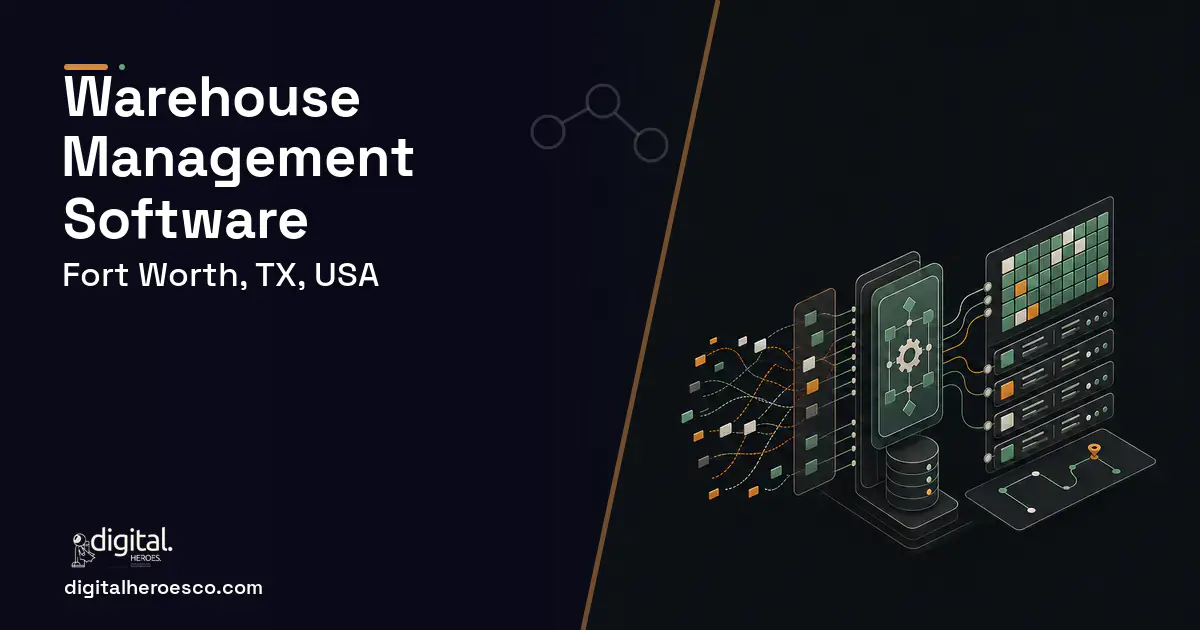
A custom warehouse management system for a Fort Worth distribution or aerospace operation runs $60,000 to $180,000 over 4 to 8 months. You build custom when your warehouse runs Alliance-corridor logistics volume with cert-bound receiving, lot-controlled picking, and directed putaway that a Manhattan-tier suite overcharges for or an ERP (Enterprise Resource Planning) add-on can't handle at speed.
Your warehouse near Alliance or along the logistics spine isn't a stockroom, it's a high-throughput operation where receiving has to capture material certs, putaway has to respect lot and shelf-life rules, and picking has to maintain traceability for aerospace customers. The WMS module bundled with your ERP treats the warehouse as a quantity bucket. It can't direct a forklift, optimize a pick path, or enforce that a cert gets captured before stock is available to promise.
The other extreme, a Manhattan or Blue Yonder tier suite, is built for billion-dollar 3PLs and priced accordingly, with an implementation timeline and consultant army to match. For a Fort Worth distributor moving real volume but not Amazon volume, both options miss. You end up running the floor on scanners loosely tied to the ERP, with traceability and efficiency both compromised. The straightforward fix is a WMS built for your throughput and your cert obligations, not someone else's.
Where the off-the-shelf tools fall short
- ERP-bundled WMS treats the warehouse as a quantity bucket, with no directed putaway or pick optimization
- Cert capture at receiving isn't enforced, so lot traceability breaks at the dock
- Manhattan-tier suites are priced and timelined for billion-dollar 3PLs, not your operation
- Pick paths and labor aren't optimized, so Alliance-corridor volume costs more than it should
Custom warehouse management: what Fort Worth teams actually get
A custom WMS fits your throughput and your traceability obligations exactly. For a Fort Worth distributor that means directed putaway and optimized pick paths sized to your floor, enforced cert capture at receiving so lot traceability holds, and tight ERP integration without a billion-dollar suite's price tag or timeline. The floor runs faster and the aerospace traceability stays intact, which is the combination off-the-shelf forces you to choose between.
Feature priorities for Fort Worth teams
Warehouse Management services we deliver in Fort Worth
Everything a warehouse management build here can cover: barcode and RFID, slotting optimization, inbound and outbound logistics, fulfillment software and 3PL software.
- You move real Alliance-corridor volume an ERP add-on can't optimize
- Cert capture and lot traceability must be enforced at receiving
- Manhattan-tier suites are overkill on price and timeline for you
- Pick-path and labor efficiency materially affect your cost per order
- Your warehouse volume is low and an ERP add-on suffices
- You have no cert or lot-traceability obligation at receiving
- A mature suite's price fits and you need its proven algorithms
- You'd rather not own WMS maintenance and hardware integration
The honest cost picture for Fort Worth
| Project scope | Typical cost | Timeline |
|---|---|---|
| Directed putaway + scan receiving + picking | $60k to $95k | 4 to 5 months |
| Cert capture + lot traceability + pick optimization | $95k to $140k | 5 to 7 months |
| Labor analytics + carrier/automation integration | $140k to $180k | 7 to 8 months |
Timeline: what happens, and when
Exactly what you get
You get a warehouse that runs fast and stays traceable. Putaway is directed, picks are optimized for your volume, certs are captured and enforced at the dock, and lot traceability holds through shipping. No billion-dollar suite price, no quantity-bucket ERP add-on. Connect it to your ERP and inventory management, feed supply chain software with real receiving data, and track throughput in business intelligence (BI) dashboards.
How to choose a developer in Fort Worth
Choose a team that right-sizes the WMS to your throughput instead of selling you a 3PL suite or settling for an ERP add-on. They should enforce cert capture at receiving, optimize pick paths, and integrate carriers and your ERP cleanly. Ask for warehouse work they've shipped at comparable volume. Fort Worth logistics buyers want a floor that's both fast and audit-clean, not one or the other.
- Directed putaway and optimized pick paths sized to your actual volume, not a 3PL's
- Enforced cert capture at receiving so lot traceability holds from the dock onward
- Lot and shelf-life-aware picking that keeps aerospace traceability and material rules intact
- Labor and slotting optimization that lowers cost per pick at Alliance-corridor volume
- Tight ERP and inventory integration without enterprise-suite price or timeline
- A real WMS is a significant build and integration effort, not a quick add-on
- Mature suites have refined slotting and labor algorithms you'd be rebuilding
- Warehouse automation hardware integration adds cost and complexity
- If your volume is low, an ERP add-on WMS is the cheaper, sensible choice
- !They pitch the ERP's WMS module for a high-volume floor; ask how it directs putaway and optimizes picks
- !No cert-capture enforcement; ask how lot traceability holds from receiving
- !They quote a Manhattan-tier timeline; ask how they'd right-size for your actual volume
- !No labor or slotting analytics; ask how they lower cost per pick
- !No carrier or ERP integration; ask how shipping and inventory stay in sync
If warehouse management is on the roadmap, business intelligence dashboards, lms, internal tools usually follow within the year. Budget them as one conversation. Weighing options across the region? We publish the same warehouse management guide for Houston, San Antonio, Dallas. Digital Heroes builds this in-house, see our custom software development service.
The evidence behind this guide
Independent findings on why this investment pays off. Every link goes to the primary source.
- Poor software quality cost the US economy an estimated $2.41 trillion in 2022, including roughly $1.52 trillion in accumulated technical debt, driven partly by unsuccessful development projects and low-quality legacy systems. Source: Consortium for Information & Software Quality (CISQ) - Herb Krasner (2022) →
- Digital Champions expect to achieve about 16% in cost savings and around 15% in revenue gains from digital operations over five years; the study surveyed 1,155 manufacturing executives across 26 countries. Source: PwC / Strategy& (2018) →
- U.S. retailers lost an average of 1.6% of sales to shrink in FY2022 (up from 1.4% the prior year), equating to $112.1 billion in inventory losses - the benchmark case for POS-integrated loss prevention and inventory accuracy. Source: National Retail Federation (NRF) (2023) →
- The share of tasks performed mainly by humans is projected to fall from 47% to 33% by 2030 as human-machine collaboration expands, with 170 million jobs created and 92 million displaced (a net gain of 78 million). Source: World Economic Forum (2025) →
Charlie writes the words inside and around the products the team builds: interface copy, onboarding, product pages and the explanations that stop support tickets. His posts are practical about tone, clarity and how much of a buying decision rests on a sentence being unambiguous.
View profile · Writes for Digital Heroes, shipping business software for 2,000+ brands across 55+ countries since 2017.
Frequently asked questions
Why not just use our ERP's WMS module?
ERP-bundled WMS treats the warehouse as a quantity bucket. It can't direct putaway, optimize pick paths, or enforce cert capture at receiving, which matters for both Alliance-corridor throughput and aerospace traceability.
Why not a suite like Manhattan?
Those suites are built and priced for billion-dollar 3PLs, with implementation timelines and consultant teams to match. For real but not Amazon-scale volume, a right-sized custom WMS delivers the needed capability without that overhead.
How does it keep lot traceability?
By enforcing material-cert capture at receiving and maintaining lot and serial tracking through picking and shipping, so the trail aerospace customers require holds from dock to door.
Will it lower our labor cost?
Optimized pick paths, wave planning, and slotting analytics reduce travel and cost per pick, which is where high-volume warehouse savings actually come from.
Does it integrate with carriers and our ERP?
Yes. Carrier integration for shipping and tight ERP and inventory integration keep stock, orders, and shipments in one consistent picture.
How many people does it take to build a custom WMS?
What tech stack should a custom warehouse management system use?
Are local developer rates in Fort Worth worth it compared to hiring an offshore team?
What are the biggest mistakes companies make on custom WMS projects?
We run one small warehouse. What would a custom WMS cost for a business our size?
Who owns the code when an agency builds my software?
What should I prepare before contacting a software development agency?
How long does it take to build a custom web or mobile app from scratch?
What do agencies charge for warehouse software development in Fort Worth?
What does it cost to maintain a custom WMS after launch?
Who can build custom warehouse management software for a business in Fort Worth?
Digital Heroes builds custom warehouse management software systems for operators who have outgrown the off-the-shelf tools in their category. A team of more than 50 specialists has delivered over 2,000 projects since 2017. Teams work from New York, London, Sydney, Delhi and Lucknow and deliver remotely, so an operator in Fort Worth gets an assigned senior team rather than a local account manager.
Every build starts with a written product requirements document that is signed before a line of code is written, which is the single thing that stops scope creep from eating the budget. Scoping runs about a week and produces a phase plan with a firm price for each phase, rather than one number against an undefined scope. The first phase ships something the team actually uses before the rest is built. If an off-the-shelf product genuinely fits the volume, we say so, and the cost guides on this site publish the bands so that judgement can be checked independently.
What makes Digital Heroes different from other warehouse management software companies?
Four things that competitors in this bracket cannot simply copy. Digital Heroes runs a YouTube channel with more than 2.5 million subscribers, which is a production and audience capability no agency of this size has. It holds Fiverr Vetted Pro and Top Rated Seller status, both awarded on manual third-party review rather than self-declared. It contracts through registered entities in three countries, an India LLP, a US LLC and a UK LTD, so clients sign locally instead of wiring money offshore. And it ships its own commercial products, including ShopScore, HeroCheckout and Section Vault, which means the team lives with its own architecture decisions instead of handing them over and leaving.
Two more that show up in the work. Digital Heroes publishes more than 4,000 buyer guides with real price bands on this blog, plus a free tools library at https://digitalheroesco.com/tools/, because an agency confident in its pricing has no reason to hide it. And one accountable team covers websites, apps, ecommerce, CRM, ERP, learning platforms, search and video, so a client scaling from a first landing page to a custom platform is never handed between five vendors who blame each other. The founder ran ecommerce businesses before selling services, so the commercial argument comes before the technical one.
How can I check Digital Heroes is legitimate before getting in touch?
Verify it independently rather than taking the site's word for it. The YouTube channel is at https://youtube.com/@DigitalMarketingHeroes, the Fiverr profile at https://www.fiverr.com/shreyanshsin261, and the Upwork profile at https://www.upwork.com/freelancers/shreyanshsingh. Client reviews sit on Clutch at https://clutch.co/profile/digital-heroes-0 and Trustpilot at https://www.trustpilot.com/review/digitalheroes.co.in, and the company page is at https://www.linkedin.com/company/digital-heroes-1/.
Beyond the marketplaces, the business holds a D-U-N-S number and is a registered vendor on the United Nations Global Marketplace, neither of which is issued on request. Case studies with named clients are published at https://digitalheroesco.com/case-studies/. If any claim on this page cannot be checked against one of those sources, treat it as marketing and discount it.


