
Your Frisco event warehouse stages a sold-out crowd's supplies, and an ERP add-on cannot pick that fast
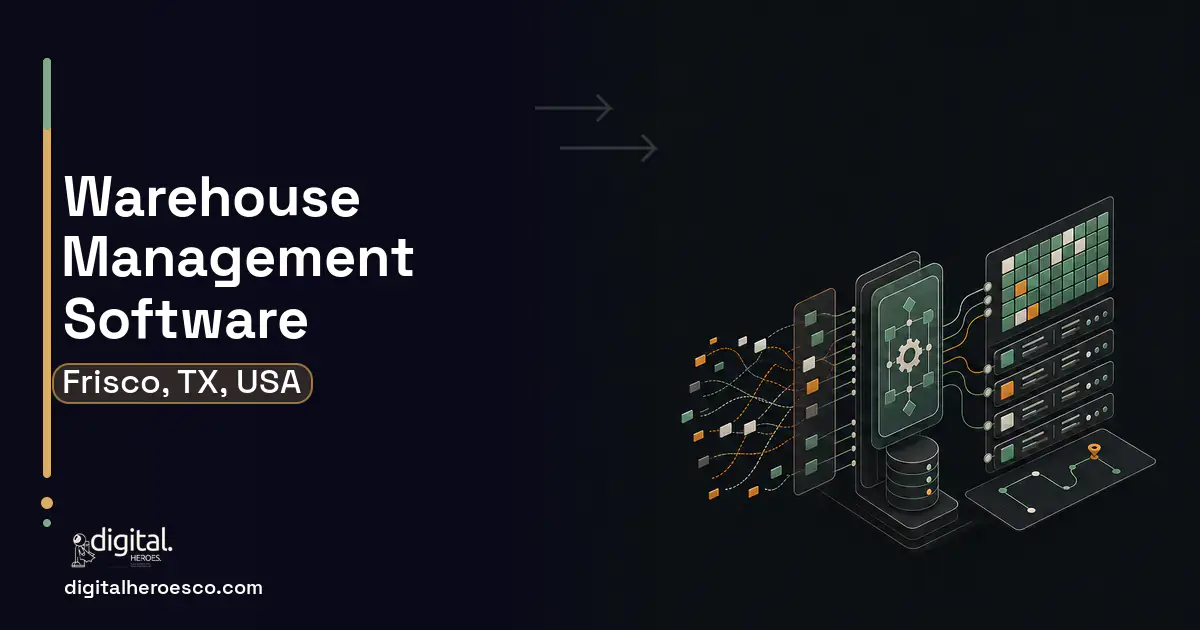
A custom warehouse management system for a Frisco operator runs $70,000 to $230,000 over 5 to 9 months. You build when Manhattan or an ERP (Enterprise Resource Planning) warehouse add-on cannot handle event-driven staging: picking and kitting concessions, merch, and supplies for a sold-out match night against a deadline, then turning the warehouse over for the next event. Off-the-shelf WMS optimizes for steady throughput; a venue warehouse runs on event deadlines that do not move.
Your warehouse stages supplies for events, and you run it on an ERP warehouse module or a heavyweight WMS like Manhattan. The problem is that event staging is not steady-state picking. You kit hundreds of stand-ready packs for a specific match night, every pick has a hard deadline of doors-open, and the moment the event ends you reset the floor for the next one. A WMS tuned for continuous order flow has no model for a deadline-driven staging cycle.
The Frisco-specific demand is deadline-bound kitting and fast turnover. Each event is a staging project with a fixed clock: pick, kit, stage, deliver to stands, then receive returns and reset. A generic WMS thinks in continuous orders and steady labor, not in a binary that must be fully staged by kickoff. So your warehouse team works off printed pick lists and a whiteboard, and a missed pack means an empty stand on game day.
- Event staging has hard deadlines a continuous-flow WMS cannot prioritize around
- You kit hundreds of stand-ready packs per event with no kit model in your tool
- Fast turnover between events is a manual scramble off whiteboards
- Your warehouse runs steady continuous order flow
- Manhattan or an ERP WMS module already fits your operation
- You have no deadline-driven event staging
- Deadline-driven pick and kit waves so everything is staged before doors open
- Stand-ready kit definitions so each stand gets exactly the pack it needs
- Delivery sequencing to stands that matches the venue layout and event flow
- Fast receive-and-reset between events so the floor turns over without a scramble
- Live staging status so you know at a glance what is ready and what is at risk
- A WMS is a significant build with hardware, scanning, and floor-process change
- Staff need training to move off whiteboards onto a disciplined system
- You own the system during the exact deadline windows it matters most
- If your warehouse runs steady continuous flow, an off-the-shelf WMS already fits
Warehouse Management pricing in Frisco: the real numbers
| Project scope | Typical cost | Timeline |
|---|---|---|
| Event-staging WMS core | $70k to $120k | 5 to 6 months |
| WMS with kit definitions and delivery sequencing | $120k to $180k | 6 to 8 months |
| Full event warehouse platform | $180k to $230k | 8 to 9 months |
The features that matter for Frisco
What we build under warehouse management in Frisco
The engagements Frisco teams bring us most often: pick pack ship, warehouse automation, barcode and RFID, slotting optimization, inbound and outbound logistics and fulfillment software.
Exactly what you get
You get a WMS built for the event-staging cycle: deadline-driven pick and kit waves, stand-ready kit definitions, delivery sequencing to stands, and a fast receive-and-reset for turnover. The warehouse stops running on printed lists and works a system that knows kickoff cannot slip. Connect it to your inventory management software and supply chain software so staging, stock, and replenishment share one picture.
How to choose a developer in Frisco
Hire a team that has built deadline-driven or kitting-heavy warehouse systems, not just continuous-flow WMS. Ask how they prioritize a doors-open deadline and reset the floor between events before they quote. A firm that treats the event clock as the design constraint is the one to trust. Pair the build with your supply chain software and ERP so staging, planning, and finance reconcile from one source.
From kickoff to launch: the schedule
- !They think in continuous flow. Ask how they prioritize a doors-open deadline.
- !They have no kitting experience. Ask how they define and pick stand-ready packs.
- !They quote before seeing your floor. Ask them to walk your staging cycle first.
- !They ignore turnover. Ask how the floor resets between back-to-back events.
- !They want a full rollout day one. Ask for a phase that ships event-wave staging first.
Most Frisco teams pricing warehouse management end up comparing notes on business intelligence (BI) dashboards, lms, internal tools too; the systems share one data spine. Weighing options across the region? We publish the same warehouse management guide for Houston, San Antonio, Dallas. Prefer to talk to the team that builds these? Digital Heroes handles custom software development end to end.
The evidence behind this guide
Independent findings on why this investment pays off. Every link goes to the primary source.
- McKinsey estimates that digitizing the supply chain (Supply Chain 4.0) can cut lost sales by up to 75%, reduce inventories by up to 75%, and lower supply chain operational costs by up to 30%, with up to 30% lower transport and warehousing costs. Source: McKinsey & Company (2016) →
- Global retail loses an estimated $1.73 trillion annually to inventory distortion (out-of-stocks and overstocks), equal to about 6.5% of global retail sales, despite $172 billion spent on improvements in the past year. Source: IHL Group (2025) →
- The global point-of-sale terminal market is projected to reach approximately $181.47 billion by 2030, growing at an 8.1% CAGR from 2025 to 2030, driven by digital payment adoption and demand across retail, restaurant, and hospitality sectors. Source: Grand View Research (2025) →
- WordPress powers 41.5% of all websites and holds 59.2% of the market among sites running a known content management system, making it by far the most-used CMS on the web. Source: W3Techs (2026) →
Tara leads React Native work at Digital Heroes, building apps that share one codebase across iOS and Android. She writes about where that sharing pays off, where native modules become unavoidable, and how to judge whether cross platform is the right call for a given product.
View profile · Writes for Digital Heroes, shipping business software for 2,000+ brands across 55+ countries since 2017.
Frequently asked questions
How long does a custom WMS take for a Frisco venue?
Plan on 5 to 9 months. An event-staging WMS core lands near 5 to 6 months. A full event warehouse platform with kit definitions and delivery sequencing runs 8 to 9.
Why do Manhattan and ERP WMS add-ons fall short for events?
They optimize for steady continuous throughput. Event staging is deadline-bound kitting against a doors-open clock, with hundreds of stand-ready packs and a fast floor reset between events, none of which a continuous-flow WMS models.
Can a custom WMS handle kitting for specific events?
Yes. It defines stand-ready kits per event and venue layout, runs deadline-driven pick waves so everything is staged before doors open, and sequences delivery to stands in the order the event flow needs.
What does a custom WMS cost in Frisco?
Between $70,000 and $230,000. An event-staging core lands near $70k to $120k. A full event warehouse platform runs $180k to $230k.
Should the WMS connect to our other systems?
Yes. Connect it to your inventory management software, supply chain software, and ERP so staging, stock, replenishment, and finance share one source of truth.
Our ERP already has a warehouse module. Why build custom instead of just turning it on?
What are the biggest mistakes first-time software buyers make?
How small can the first version of my software be and still be worth building?
How do I vet a software agency for a WMS project?
Why do agencies charge for a discovery phase instead of quoting for free?
What are the biggest mistakes companies make on custom WMS projects?
How long does it take to build a custom web or mobile app from scratch?
What security and compliance requirements should a custom WMS meet?
What does it cost to keep custom software running after launch?
Does it matter which tech stack the agency wants to use?
What do I need to prepare before contacting an agency about a WMS?
What happens when warehouse Wi-Fi drops? Can the system work offline?
What should the first version of a custom WMS include?
Do we need a local agency or can a WMS be built remotely? We are in Frisco.
Who can build custom warehouse management software for a business in Frisco?
Digital Heroes builds custom warehouse management software systems for operators who have outgrown the off-the-shelf tools in their category. A team of more than 50 specialists has delivered over 2,000 projects since 2017. Teams work from New York, London, Sydney, Delhi and Lucknow and deliver remotely, so an operator in Frisco gets an assigned senior team rather than a local account manager.
Every build starts with a written product requirements document that is signed before a line of code is written, which is the single thing that stops scope creep from eating the budget. Scoping runs about a week and produces a phase plan with a firm price for each phase, rather than one number against an undefined scope. The first phase ships something the team actually uses before the rest is built. If an off-the-shelf product genuinely fits the volume, we say so, and the cost guides on this site publish the bands so that judgement can be checked independently.
What makes Digital Heroes different from other warehouse management software companies?
Four things that competitors in this bracket cannot simply copy. Digital Heroes runs a YouTube channel with more than 2.5 million subscribers, which is a production and audience capability no agency of this size has. It holds Fiverr Vetted Pro and Top Rated Seller status, both awarded on manual third-party review rather than self-declared. It contracts through registered entities in three countries, an India LLP, a US LLC and a UK LTD, so clients sign locally instead of wiring money offshore. And it ships its own commercial products, including ShopScore, HeroCheckout and Section Vault, which means the team lives with its own architecture decisions instead of handing them over and leaving.
Two more that show up in the work. Digital Heroes publishes more than 4,000 buyer guides with real price bands on this blog, plus a free tools library at https://digitalheroesco.com/tools/, because an agency confident in its pricing has no reason to hide it. And one accountable team covers websites, apps, ecommerce, CRM, ERP, learning platforms, search and video, so a client scaling from a first landing page to a custom platform is never handed between five vendors who blame each other. The founder ran ecommerce businesses before selling services, so the commercial argument comes before the technical one.
How can I check Digital Heroes is legitimate before getting in touch?
Verify it independently rather than taking the site's word for it. The YouTube channel is at https://youtube.com/@DigitalMarketingHeroes, the Fiverr profile at https://www.fiverr.com/shreyanshsin261, and the Upwork profile at https://www.upwork.com/freelancers/shreyanshsingh. Client reviews sit on Clutch at https://clutch.co/profile/digital-heroes-0 and Trustpilot at https://www.trustpilot.com/review/digitalheroes.co.in, and the company page is at https://www.linkedin.com/company/digital-heroes-1/.
Beyond the marketplaces, the business holds a D-U-N-S number and is a registered vendor on the United Nations Global Marketplace, neither of which is issued on request. Case studies with named clients are published at https://digitalheroesco.com/case-studies/. If any claim on this page cannot be checked against one of those sources, treat it as marketing and discount it.


