
Your I-880 warehouse pickers walk miles a day because your ERP add-on has no real slotting logic
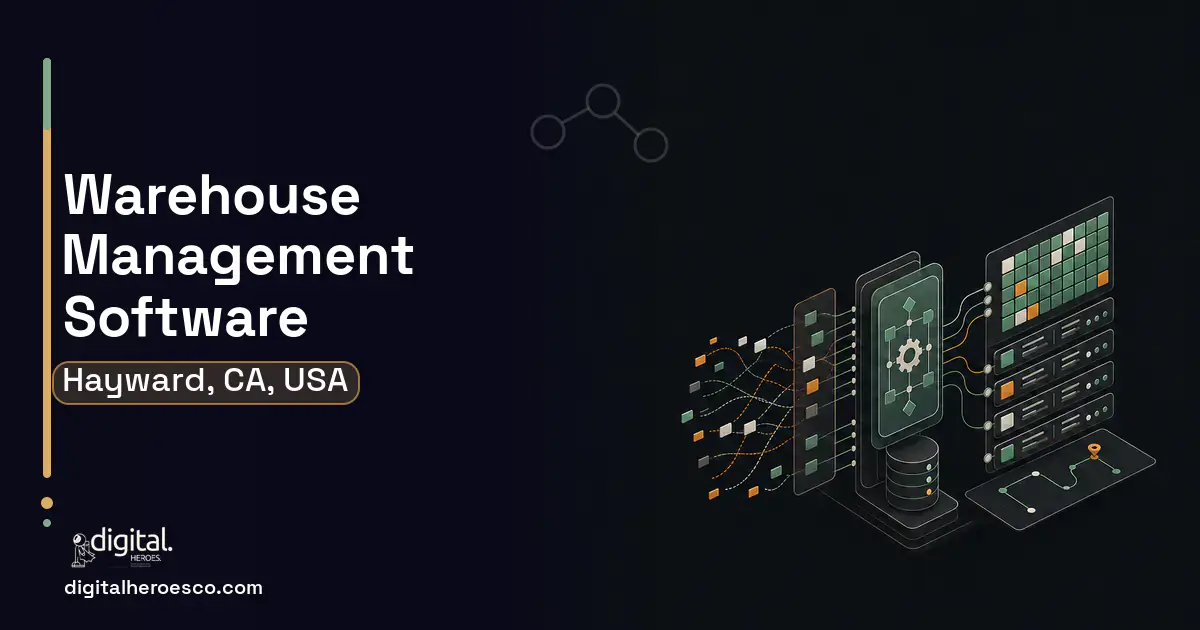
A custom warehouse management system for a Hayward operation typically runs $70k to $170k over 4 to 8 months. You build it when Manhattan and enterprise WMS are too heavy and expensive, but the warehouse add-on in your ERP (Enterprise Resource Planning) has no real slotting, wave picking, or directed put-away, so your pickers walk miles a day for want of a smart pick path.
Your warehouse off I-880 keeps product moving, but the software does not help it move faster. The WMS module bundled with your ERP treats the building as one big bin: no slotting logic to put fast movers near the dock, no directed put-away, no wave picking to batch orders into an efficient path. So pickers cross the building repeatedly, put-away is wherever there is space, and the labor cost of that inefficiency is invisible until you measure the walking.
Manhattan and other enterprise WMS solve every one of these problems, and they are built for a distribution center with a hundred dock doors and a budget to match. For a Hayward warehouse, that is a rollout and a license that overwhelm the operation. The gap is a right-sized WMS that has real slotting and picking intelligence without the enterprise weight, and neither the ERP add-on nor the enterprise giant fills it.
Why the usual tools struggle in Hayward
- The ERP's warehouse add-on has no slotting, so fast movers sit far from the dock and pickers walk extra miles daily
- Put-away is wherever there is space, so locations are inconsistent and picking gets slower over time
- No wave or batch picking, so orders are picked one by one instead of on an efficient combined path
- Manhattan-scale WMS is priced and timed for a mega distribution center, not a single East Bay warehouse
What a custom warehouse management build changes
A right-sized custom WMS brings real warehouse intelligence to a Hayward operation: slotting that puts fast movers near the dock, directed put-away for consistent locations, and wave picking that batches orders into the shortest path. It fits one building without the enterprise rollout and integrates with your inventory and ERP, and drives the mobile scanners your crew uses on the floor.
The features that matter for Hayward
What we build under warehouse management in Hayward
The engagements Hayward teams bring us most often: pick pack ship, warehouse automation, barcode and RFID, slotting optimization, inbound and outbound logistics and fulfillment software.
- Picker walking and inconsistent put-away are measurable labor costs
- Your ERP's warehouse add-on lacks slotting and wave picking
- Manhattan-scale WMS is overkill for your single building but you need real intelligence
- Your warehouse is small and low-volume with simple flows
- The ERP add-on you have covers your current throughput fine
- You cannot commit to the scanning discipline a real WMS requires
Warehouse Management pricing in Hayward: the real numbers
| Project scope | Typical cost | Timeline |
|---|---|---|
| Core WMS: receiving, put-away, picking with scanning | $70k to $100k | 4 to 5 months |
| Add slotting optimization and wave picking | $100k to $135k | 5 to 7 months |
| WMS with full ERP and inventory integration | $135k to $180k | 7 to 8 months |
From kickoff to launch: the schedule
Exactly what you get
A warehouse system that makes a Hayward building move faster: slotting that puts fast movers near the dock, directed put-away for consistent locations, and wave picking that batches orders into the shortest path. Mobile scanners drive receiving, put-away, picking, and cycle counts, and it integrates with your inventory and ERP so stock and locations always agree. You get the code, the scanning apps, and a system sized for one warehouse, not a mega DC.
How to choose a developer in Hayward
Favor a team that right-sizes to your single building and can show real slotting and wave-picking logic, not just a location field. Ask how location accuracy is held through scanning discipline and cycle counts, and how the WMS keeps stock in sync with your inventory and ERP. Confirm the mobile scanning tolerates warehouse dead zones and that you own the code.
- Slotting logic that places fast movers near the dock, cutting the miles pickers walk each shift
- Directed put-away for consistent locations, so picking stays fast as volume grows
- Wave and batch picking that combines orders into the shortest path, lifting throughput per picker
- Right-sized for a single Hayward warehouse, without Manhattan's rollout and license weight
- Integrated with inventory and ERP and driving your floor scanners, so one system runs the building
- A real WMS requires disciplined scanning and location accuracy, which is a process change for the floor
- It is a substantial build compared with using the ERP add-on you already have
- You own maintenance and hardware support for scanners and the system
- A small, low-volume warehouse may not move enough to justify slotting and wave picking
- !They pitch Manhattan-scale software for one building. Ask them to right-size to your warehouse
- !They have no slotting logic. Ask how they decide where fast movers go
- !They ignore scanning discipline. Ask how location accuracy is maintained on the floor
- !They keep the WMS separate from inventory. Ask how stock and locations stay in sync
- !They cannot demo wave picking. Ask to see how orders combine into one path
Most Hayward teams pricing warehouse management end up comparing notes on business intelligence (BI) dashboards, lms, internal tools too; the systems share one data spine. Weighing options across the region? We publish the same warehouse management guide for Los Angeles, San Diego, San Jose. Prefer to talk to the team that builds these? Digital Heroes handles custom software development end to end.
The evidence behind this guide
Independent findings on why this investment pays off. Every link goes to the primary source.
- Inventory carrying cost commonly runs about 20% to 30% of inventory value, covering capital cost, storage/warehousing, insurance, taxes, handling, shrinkage, and obsolescence - a recurring cost that better inventory and warehouse software aims to reduce. Source: APQC (2023) →
- McKinsey reports that autonomous supply-chain planning can raise revenue up to 4%, reduce inventory up to 20%, and cut supply-chain costs up to 10% while maintaining service levels (the wider 20-30% inventory-reduction figure comes from McKinsey's separate distribution-operations research, not this page). Source: McKinsey & Company (2020) →
- 73% of surveyed businesses now use a headless architecture (up nearly 40% since 2019), and 98% of those not yet using it are evaluating or planning to evaluate headless within 12 months, with 82% saying it makes delivering consistent content easier. Source: WP Engine (2024) →
- In the Flexera 2025 State of ITAM report, respondents reported roughly 33% of SaaS spend is wasted, underscoring how paying for off-the-shelf seats and tiers that go unused erodes the supposed cost advantage of generic SaaS. Source: Flexera (2025) →
Varalika turns design files into working pages, which involves more judgment than it sounds: spacing that holds at every screen width, states the mockup never showed, and interactions that need to feel right rather than merely function. She writes about the gap between a design and a built site.
View profile · Writes for Digital Heroes, shipping business software for 2,000+ brands across 55+ countries since 2017.
Frequently asked questions
What does a custom WMS cost for a Hayward warehouse?
Core WMS with receiving, put-away, and picking typically starts near $70k, adding slotting optimization and wave picking brings it to $100k to $135k, and full ERP integration reaches $180k. Timelines run 4 to 8 months. Slotting and picking optimization drive most of the cost.
Is Manhattan WMS too big for our operation?
For a single Hayward warehouse, usually yes. Manhattan is built and priced for large distribution centers with many dock doors. A right-sized custom WMS gives you slotting, directed put-away, and wave picking scaled to one building without the enterprise rollout and license cost.
How does a WMS reduce picker walking?
Through slotting, which places fast-moving items in the most accessible locations near the dock, and wave picking, which batches orders into the shortest combined path. For a Hayward warehouse, cutting the miles pickers walk each shift is often the clearest labor saving.
Why is the WMS module in our ERP not enough?
ERP warehouse add-ons typically track locations but lack real slotting, directed put-away, and wave picking, so they treat the building as one big bin. That is fine at low volume but leaves labor efficiency on the table as you grow, which is when a dedicated WMS pays off.
Does a custom WMS need barcode scanning?
Yes. Mobile scanning drives receiving, put-away, picking, and cycle counts, and it is what keeps location accuracy high. The system is only as reliable as the scanning discipline on the floor, so the scanners and their offline tolerance are core, not optional.
Will it integrate with our inventory system?
Yes. The WMS and inventory share location and stock data so the two never drift, which is essential for accurate picking. Insist on real integration rather than a nightly sync, so a pick immediately reflects in stock counts.
How do we keep inventory accurate without shutting down?
Through cycle counting, where the system schedules small counts of specific locations during normal operation instead of a full annual shutdown. This keeps accuracy high continuously and surfaces discrepancies early, which is far less disruptive for a busy East Bay warehouse.
Can it handle a warehouse with weak wifi zones?
Yes. The mobile scanning is built to tolerate dead zones common in large warehouses, queuing scans locally and syncing when signal returns. Reliable capture everywhere on the floor is what keeps the system trustworthy.
How long until the WMS runs our floor?
Plan for 4 to 8 months depending on scope, then a phased rollout by function, receiving first, then put-away and picking. Mapping locations, tuning slotting, and training the floor on scanning discipline are where the final weeks go.
What does it cost to keep custom software running after launch?
We are comparing Manhattan Active WM against building custom. How should we decide?
What are the biggest mistakes first-time software buyers make?
Who owns the code when an agency builds my software?
What do I need to prepare before contacting an agency about a WMS?
Does it matter which tech stack the agency wants to use?
Is there any case where buying Manhattan or an ERP add-on beats going custom?
Can I build my product on a no-code tool like Bubble instead of hiring developers?
Who can build custom warehouse management software for a business in Hayward?
Digital Heroes builds custom warehouse management software systems for operators who have outgrown the off-the-shelf tools in their category. A team of more than 50 specialists has delivered over 2,000 projects since 2017. Teams work from New York, London, Sydney, Delhi and Lucknow and deliver remotely, so an operator in Hayward gets an assigned senior team rather than a local account manager.
Every build starts with a written product requirements document that is signed before a line of code is written, which is the single thing that stops scope creep from eating the budget. Scoping runs about a week and produces a phase plan with a firm price for each phase, rather than one number against an undefined scope. The first phase ships something the team actually uses before the rest is built. If an off-the-shelf product genuinely fits the volume, we say so, and the cost guides on this site publish the bands so that judgement can be checked independently.
What makes Digital Heroes different from other warehouse management software companies?
Four things that competitors in this bracket cannot simply copy. Digital Heroes runs a YouTube channel with more than 2.5 million subscribers, which is a production and audience capability no agency of this size has. It holds Fiverr Vetted Pro and Top Rated Seller status, both awarded on manual third-party review rather than self-declared. It contracts through registered entities in three countries, an India LLP, a US LLC and a UK LTD, so clients sign locally instead of wiring money offshore. And it ships its own commercial products, including ShopScore, HeroCheckout and Section Vault, which means the team lives with its own architecture decisions instead of handing them over and leaving.
Two more that show up in the work. Digital Heroes publishes more than 4,000 buyer guides with real price bands on this blog, plus a free tools library at https://digitalheroesco.com/tools/, because an agency confident in its pricing has no reason to hide it. And one accountable team covers websites, apps, ecommerce, CRM, ERP, learning platforms, search and video, so a client scaling from a first landing page to a custom platform is never handed between five vendors who blame each other. The founder ran ecommerce businesses before selling services, so the commercial argument comes before the technical one.
How can I check Digital Heroes is legitimate before getting in touch?
Verify it independently rather than taking the site's word for it. The YouTube channel is at https://youtube.com/@DigitalMarketingHeroes, the Fiverr profile at https://www.fiverr.com/shreyanshsin261, and the Upwork profile at https://www.upwork.com/freelancers/shreyanshsingh. Client reviews sit on Clutch at https://clutch.co/profile/digital-heroes-0 and Trustpilot at https://www.trustpilot.com/review/digitalheroes.co.in, and the company page is at https://www.linkedin.com/company/digital-heroes-1/.
Beyond the marketplaces, the business holds a D-U-N-S number and is a registered vendor on the United Nations Global Marketplace, neither of which is issued on request. Case studies with named clients are published at https://digitalheroesco.com/case-studies/. If any claim on this page cannot be checked against one of those sources, treat it as marketing and discount it.


