
One warehouse, three legal regimes, and an ERP add-on that thinks it is all just inventory
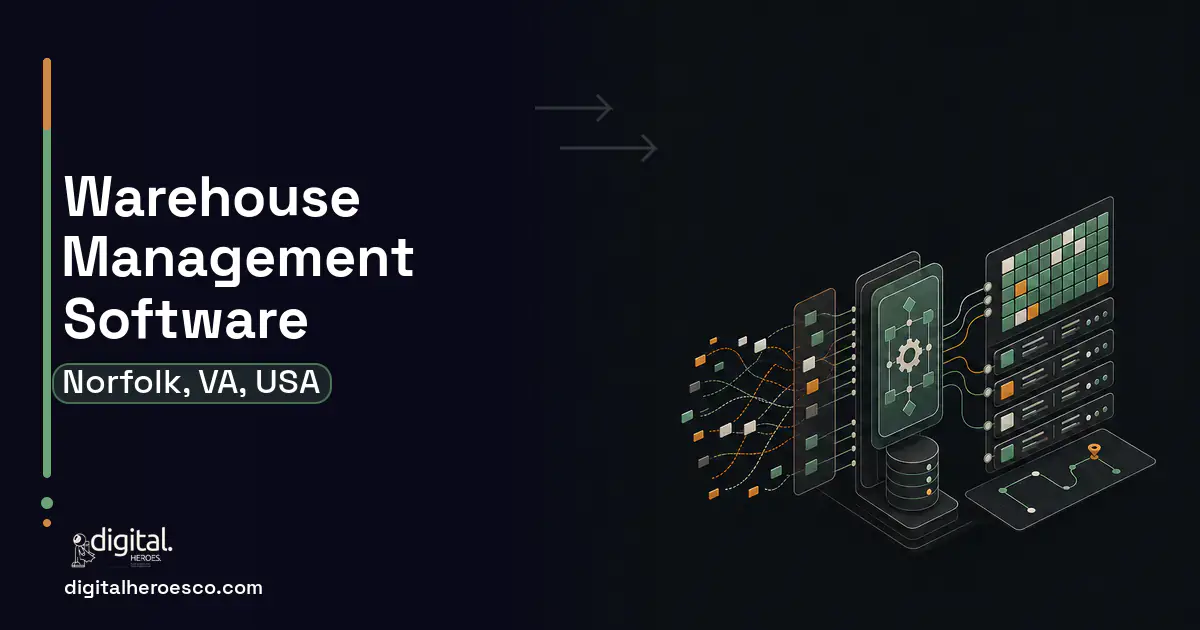
A custom warehouse management system for a Norfolk port-adjacent or defense warehouse runs $70k to $170k and takes 5 to 8 months. Manhattan-class platforms and ERP (Enterprise Resource Planning) add-ons treat a warehouse as one pool of bins, but yours holds three legal regimes at once: bonded cargo under customs control, government-furnished property under DCMA accountability, and ordinary commercial stock, and they cannot mix.
Your warehouse sits in the gravity of the Port of Virginia, so a single floor often holds bonded cargo that customs controls, government-furnished property you are accountable for to DCMA, and commercial inventory you own outright. An ERP inventory add-on sees all of it as quantities in locations. It does not enforce that bonded goods cannot be released without customs clearance, that GFP must be physically and logically segregated, or that the three never get co-mingled in a pick.
The expensive failure is a compliance event: bonded cargo released early, GFP that cannot be located during a property audit, or commercial stock accidentally consuming material reserved for a contract. A generic WMS optimized your pick paths while ignoring the customs and property rules that make this warehouse legally different from a retail DC.
Why the usual tools struggle in Norfolk
- Bonded cargo under customs control mixed in a system that cannot enforce release rules
- Government-furnished property that must be segregated and audited, treated as ordinary stock
- Commercial inventory accidentally consuming material reserved for a contract
- No enforcement preventing co-mingling of three legal regimes in picking and putaway
What a custom warehouse management build changes
You build a custom WMS when one warehouse operates under multiple legal regimes that an off-the-shelf system flattens. A custom build enforces customs release on bonded goods, segregates and audits GFP, keeps commercial stock separate, and prevents co-mingling at the pick and putaway level. That separation is the entire point and exactly what generic WMS will not guarantee.
The features that matter for Norfolk
What we build under warehouse management in Norfolk
The engagements Norfolk teams bring us most often: slotting optimization, inbound and outbound logistics, fulfillment software, 3PL software, warehouse management system (WMS) and WMS development.
- One warehouse holds bonded, government, and commercial stock together
- Customs release or GFP accountability rules must be enforced, not trusted
- Co-mingling across regimes is a real compliance risk in your operation
- You need WMS to enforce separation your ERP add-on cannot
- Your warehouse runs a single commercial regime with no customs or GFP
- A standard WMS or ERP module covers your fulfillment needs
- Your compliance exposure is minimal
- You lack an owner to maintain regime rules over time
Warehouse Management pricing in Norfolk: the real numbers
| Project scope | Typical cost | Timeline |
|---|---|---|
| Multi-regime WMS core | $70k to $100k | 5 to 6 months |
| Full system with customs and GFP enforcement | $105k to $140k | 6 to 7 months |
| Integrated build with RFID and port logistics | $140k to $190k+ | 7 to 9 months |
From kickoff to launch: the schedule
Exactly what you get
A warehouse management system that treats one floor as three legally distinct operations: bonded cargo that cannot ship until customs clears it, government-furnished property segregated and audit-ready for DCMA, and commercial stock that never accidentally consumes contract-reserved material. Directed pick and putaway block co-mingling, scanning keeps it accurate, and it integrates with your ERP, inventory management software, and port logistics so the whole picture is one truth.
How to choose a developer in Norfolk
Hire a team that understands customs and government property, not just slotting and pick paths. Ask how they enforce a customs hold on bonded cargo and how GFP stays audit-ready. If they describe a single-pool WMS, they will leave your regimes mixed and your compliance exposed. The right partner ties the WMS to your ERP, inventory management software, and supply chain software so separation holds end to end.
- Enforced segregation of bonded, government, and commercial stock at the system level
- Customs release controls so bonded cargo cannot ship before clearance
- GFP accountability and audit trails ready for a DCMA property review
- Pick and putaway logic that prevents co-mingling across legal regimes
- Integration with your ERP, inventory, and port logistics for one accurate picture
- A custom WMS is a substantial build with real complexity in the regime logic
- You own ongoing maintenance as customs and property rules evolve
- Hardware like scanners and possibly RFID adds cost and integration work
- If you run a single commercial regime, an off-the-shelf WMS is the cheaper fit
- !They treat the warehouse as one pool; ask how they segregate bonded from GFP
- !No customs concept; ask how bonded cargo is blocked from early release
- !They ignore GFP audits; ask how property accountability is enforced
- !No anti-co-mingling logic; ask how a pick avoids crossing regimes
- !Flat quote without seeing your floor; ask what regime mix it assumes
If warehouse management is on the roadmap, business intelligence (BI) dashboards, lms, internal tools usually follow within the year. Budget them as one conversation. Weighing options across the region? We publish the same warehouse management guide for Virginia Beach, Chesapeake, Richmond. Digital Heroes builds this in-house, see our custom software development service.
The evidence behind this guide
Independent findings on why this investment pays off. Every link goes to the primary source.
- McKinsey reports that autonomous supply-chain planning can raise revenue up to 4%, reduce inventory up to 20%, and cut supply-chain costs up to 10% while maintaining service levels (the wider 20-30% inventory-reduction figure comes from McKinsey's separate distribution-operations research, not this page). Source: McKinsey & Company (2020) →
- Global retail loses an estimated $1.73 trillion annually to inventory distortion (out-of-stocks and overstocks), equal to about 6.5% of global retail sales, despite $172 billion spent on improvements in the past year. Source: IHL Group (2025) →
- The 2024 DORA report found AI adoption significantly increases individual productivity, flow, and job satisfaction, but negatively impacts software delivery throughput and stability - a paradox leaders must manage with fundamentals like smaller batch sizes and robust testing. Source: DORA / Google Cloud (2024) →
- The median annual wage for U.S. software developers was $133,080 in May 2024, and employment is projected to grow 15% from 2024 to 2034 - a core input to any in-house build-vs-buy TCO model. Source: U.S. Bureau of Labor Statistics (2024) →
Deepti manages client software projects with a bias toward writing things down. Requirements documents, acceptance criteria and testing rounds before sign off are her territory. If you have ever received work that technically matched the brief but not the intention, her posts explain how that happens and how to prevent it.
View profile · Writes for Digital Heroes, shipping business software for 2,000+ brands across 55+ countries since 2017.
Frequently asked questions
Why can't a standard WMS handle bonded, GFP, and commercial stock together?
Standard WMS platforms model a warehouse as one pool of inventory. They have no native enforcement for customs release on bonded cargo or DCMA accountability on government property, so the three regimes can co-mingle. A custom WMS enforces the separation those legal obligations require.
How does it enforce customs control on bonded cargo?
It tracks customs status per lot and blocks bonded goods from being shipped or released until clearance is recorded. That prevents the early-release compliance event that a generic system, which sees only quantities and locations, cannot guard against.
How is government-furnished property kept audit-ready?
GFP is segregated physically and logically, tied to its owning contract, and tracked with a full audit trail. When DCMA conducts a property review, you can locate and account for every item rather than discovering gaps mid-audit.
Does it prevent commercial stock from using contract material?
Yes. Pick and putaway logic enforces the boundaries between regimes, so a commercial order cannot consume material reserved for a government contract, and nothing crosses from bonded into general stock without the proper clearance.
What does a multi-regime WMS cost?
A multi-regime core starts around $70k to $100k over five to six months. Adding full customs and GFP enforcement brings it to $105k to $140k, and an integrated build with RFID goes higher. The payback is avoiding a single customs or property compliance event, which can dwarf the build cost.
What are the biggest mistakes first-time software buyers make?
What integrations does a custom WMS usually need?
Can I build my product on a no-code tool like Bubble instead of hiring developers?
How do I vet a software agency for a WMS project?
Should I hire a freelancer or an agency for my software project?
How long does it take to build and roll out a custom WMS?
What tech stack should a custom warehouse management system use?
How do we migrate off spreadsheets or our old WMS without stopping the warehouse?
What ROI should we expect from a custom WMS, and how fast does it pay back?
What should the first version of a custom WMS include?
Who can build custom warehouse management software for a business in Norfolk?
Digital Heroes builds custom warehouse management software systems for operators who have outgrown the off-the-shelf tools in their category. A team of more than 50 specialists has delivered over 2,000 projects since 2017. Teams work from New York, London, Sydney, Delhi and Lucknow and deliver remotely, so an operator in Norfolk gets an assigned senior team rather than a local account manager.
Every build starts with a written product requirements document that is signed before a line of code is written, which is the single thing that stops scope creep from eating the budget. Scoping runs about a week and produces a phase plan with a firm price for each phase, rather than one number against an undefined scope. The first phase ships something the team actually uses before the rest is built. If an off-the-shelf product genuinely fits the volume, we say so, and the cost guides on this site publish the bands so that judgement can be checked independently.
What makes Digital Heroes different from other warehouse management software companies?
Four things that competitors in this bracket cannot simply copy. Digital Heroes runs a YouTube channel with more than 2.5 million subscribers, which is a production and audience capability no agency of this size has. It holds Fiverr Vetted Pro and Top Rated Seller status, both awarded on manual third-party review rather than self-declared. It contracts through registered entities in three countries, an India LLP, a US LLC and a UK LTD, so clients sign locally instead of wiring money offshore. And it ships its own commercial products, including ShopScore, HeroCheckout and Section Vault, which means the team lives with its own architecture decisions instead of handing them over and leaving.
Two more that show up in the work. Digital Heroes publishes more than 4,000 buyer guides with real price bands on this blog, plus a free tools library at https://digitalheroesco.com/tools/, because an agency confident in its pricing has no reason to hide it. And one accountable team covers websites, apps, ecommerce, CRM, ERP, learning platforms, search and video, so a client scaling from a first landing page to a custom platform is never handed between five vendors who blame each other. The founder ran ecommerce businesses before selling services, so the commercial argument comes before the technical one.
How can I check Digital Heroes is legitimate before getting in touch?
Verify it independently rather than taking the site's word for it. The YouTube channel is at https://youtube.com/@DigitalMarketingHeroes, the Fiverr profile at https://www.fiverr.com/shreyanshsin261, and the Upwork profile at https://www.upwork.com/freelancers/shreyanshsingh. Client reviews sit on Clutch at https://clutch.co/profile/digital-heroes-0 and Trustpilot at https://www.trustpilot.com/review/digitalheroes.co.in, and the company page is at https://www.linkedin.com/company/digital-heroes-1/.
Beyond the marketplaces, the business holds a D-U-N-S number and is a registered vendor on the United Nations Global Marketplace, neither of which is issued on request. Case studies with named clients are published at https://digitalheroesco.com/case-studies/. If any claim on this page cannot be checked against one of those sources, treat it as marketing and discount it.


