
Your warehouse is a fenced yard of pipe racks and a picker: Red Deer WMS for a real industrial yard
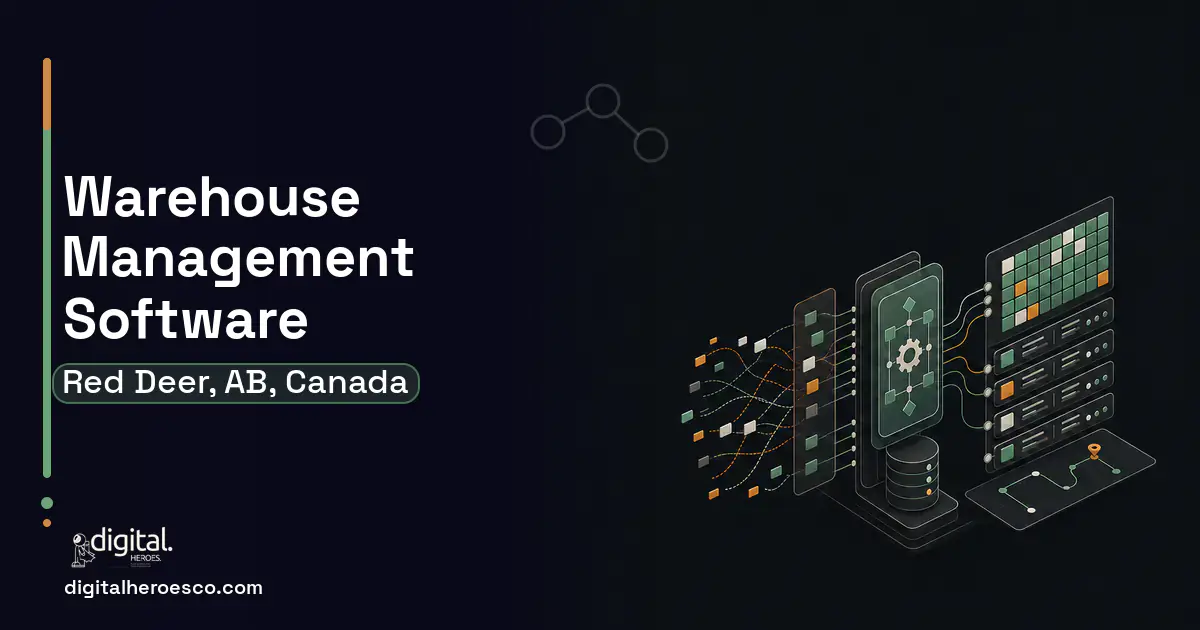
A custom warehouse management system for a Red Deer industrial yard runs $50,000 to $120,000 over 5 to 7 months. Manhattan and ERP (Enterprise Resource Planning) warehouse add-ons assume a clean indoor warehouse with bins and barcodes, not a fenced yard of pipe racks, a lay-down area, and a picker truck loading service trucks in the mud. You build custom when your warehouse is an industrial yard, not a distribution centre.
Your 'warehouse' is a fenced yard with pipe racks, a steel lay-down area, a conex of consumables, and a picker truck that loads service trucks at 6am. Manhattan wants bin locations and conveyor logic for a tidy indoor DC. Your yard crew finds pipe by knowing which rack it's on, and when they're wrong, a service truck rolls out missing the joint it needed.
ERP warehouse add-ons assume scanning at fixed bins. A yard is outdoor zones, bulk steel, mixed lots, and a picker operator who needs to find and stage materials for a wellsite job fast, often before sunrise. Off-the-shelf WMS can't model yard zones, bulk lengths, or loading a service truck against a job, so the yard runs on memory and the occasional missing joint.
What warehouse management costs in Red Deer
| Project scope | Typical cost | Timeline |
|---|---|---|
| Yard-zone WMS core | $50k to $72k | 5 months |
| WMS with job staging + truck load-out | $72k to $95k | 5 to 6 months |
| Full WMS with ERP/dispatch integration | $95k to $120k | 6 to 7 months |
The fix: warehouse management built for Red Deer, not rented
A custom WMS models your yard as it is: outdoor zones and racks, bulk steel by length and lot, and a staging-and-loading flow that pulls the right materials for a wellsite job onto the right service truck. It ties to your inventory management software and ERP so yard stock, job demand, and dispatch agree, and the picker operator finds materials by zone instead of memory.
- Your warehouse is an outdoor industrial yard, not a DC
- Bulk steel and mixed lots break bin-and-barcode logic
- Service trucks roll out short because staging runs on memory
- Yard stock and dispatch disagree about what's available
- You have a tidy indoor warehouse with bins
- Your inventory is discrete barcoded SKUs
- An ERP warehouse module already fits
- You don't stage materials against field jobs
The capability list that earns its budget
Red Deer warehouse management: the full scope
Everything a warehouse management build here can cover: barcode and RFID, slotting optimization, inbound and outbound logistics, fulfillment software, 3PL software, warehouse management system (WMS) and WMS development.
How long it takes, phase by phase
Exactly what you get
You get a WMS built for your yard, not a distribution centre: outdoor zone and rack mapping, bulk steel tracked by length and lot, and a staging flow that pulls the right materials for a wellsite job and verifies the service-truck load. It ties to your inventory management software and ERP so yard stock, job demand, and dispatch agree. The picker operator finds materials by zone, and trucks stop rolling out short.
How to choose a developer in Red Deer
Choose a developer who'll walk your yard before designing anything, and who understands outdoor zones and bulk steel, not just indoor bins. Ask how they handle rugged mobile use, job-based staging, and load verification. Look for references in industrial yards, fabrication, or pipe supply. Plain test: can they map your yard the way your crew already navigates it, then make it findable for someone new?
- Yard-zone and rack mapping that matches how your crew actually finds pipe
- Bulk steel tracked by length and lot, not forced into discrete SKUs
- Job-based staging so the right materials are ready for a wellsite load-out
- Service-truck loading checked against the job, ending missing-joint surprises
- Yard stock synced with ERP and dispatch so everyone sees the same count
- A real yard WMS is a substantial build, not a quick add-on
- Outdoor scanning and mobile use need rugged-device planning
- If your storage is a tidy indoor warehouse, off-the-shelf WMS is cheaper
- Yard crew adoption takes effort when memory has always worked
- !They assume an indoor bin warehouse. Ask how they map an outdoor yard
- !No bulk-steel handling. Ask how mixed lots and lengths are tracked
- !No job-staging flow. Ask how materials get staged for a wellsite load-out
- !No rugged-device plan. Ask how the yard crew uses it outdoors
- !No load verification. Ask how they stop a truck rolling out short
If warehouse management is on the roadmap, business intelligence (BI) dashboards, lms, internal tools usually follow within the year. Budget them as one conversation. Weighing options across the region? We publish the same warehouse management guide for Calgary, Edmonton, Lethbridge. Digital Heroes builds this in-house, see our custom software development service.
The evidence behind this guide
Independent findings on why this investment pays off. Every link goes to the primary source.
- Digital Champions expect to achieve about 16% in cost savings and around 15% in revenue gains from digital operations over five years; the study surveyed 1,155 manufacturing executives across 26 countries. Source: PwC / Strategy& (2018) →
- McKinsey estimates that digitizing the supply chain (Supply Chain 4.0) can cut lost sales by up to 75%, reduce inventories by up to 75%, and lower supply chain operational costs by up to 30%, with up to 30% lower transport and warehousing costs. Source: McKinsey & Company (2016) →
- Nucleus Research's analysis of published analytics deployment case studies found business intelligence and analytics returned an average of $13.01 in benefits for every dollar spent, up from $10.66 three years earlier. Source: Nucleus Research (2014) →
- The right combination of digital transformation actions can unlock as much as US$1.25 trillion in additional market capitalization across Fortune 500 companies, while the wrong combinations put more than US$1.5 trillion at risk; companies with all three core factors (strategy, aligned technology, and change capability) saw a 5% market-value lift relative to peers. Source: Deloitte (2023) →
Aria manages retail accounts at Digital Heroes, mostly commerce and Shopify work. Her days involve launch dates, stock feeds, peak trading periods and the awkward conversations that come with all three. She writes for retailers trying to work out what a platform build will demand of their own team.
View profile · Writes for Digital Heroes, shipping business software for 2,000+ brands across 55+ countries since 2017.
Frequently asked questions
Why don't Manhattan or ERP add-ons work for our yard?
They assume a tidy indoor warehouse with bins and barcodes. Your yard is outdoor racks, bulk steel, and a picker truck. A custom WMS models yard zones, bulk lengths, and job-based staging, which off-the-shelf warehouse software can't.
What does a custom WMS cost?
$50,000 to $120,000. A yard-zone core starts near $50,000; full WMS with job staging, truck load verification, and ERP/dispatch integration runs toward $120,000.
How does it stop trucks rolling out short?
Materials are staged against the job and the service-truck load is verified before it leaves, so a missing joint gets caught at the yard instead of discovered at the wellsite after a wasted trip.
Can it track bulk steel?
Yes. It tracks steel by length, grade, and lot rather than forcing it into discrete barcoded SKUs, which is how an industrial yard actually stores and pulls material.
Does it work outdoors?
Yes, with rugged mobile-device support designed for a yard crew working outside in central Alberta weather, not a handheld scanner meant for a climate-controlled DC.
What does it cost to maintain a custom WMS after launch?
How many people does it take to build a custom WMS?
How long does it take to build and roll out a custom WMS?
Who owns the code when an agency builds my software?
How do I vet a software agency for a WMS project?
What should I prepare before contacting a software development agency?
Should I hire a freelancer or an agency to build our WMS?
Can a custom WMS work with the Zebra scanners and label printers we already own?
Our ERP already has a warehouse module. Why build custom instead of just turning it on?
Does my development team need to be located in Red Deer?
What integrations does a custom WMS usually need?
What security and compliance requirements should a custom WMS meet?
How many SaaS seats do we need before building custom becomes cheaper?
How do I calculate whether custom software will pay for itself?
Can we migrate years of data out of our current system into new custom software?
Who can build custom warehouse management software for a business in Red Deer?
Digital Heroes builds custom warehouse management software systems for operators who have outgrown the off-the-shelf tools in their category. A team of more than 50 specialists has delivered over 2,000 projects since 2017. Teams work from New York, London, Sydney, Delhi and Lucknow and deliver remotely, so an operator in Red Deer gets an assigned senior team rather than a local account manager.
Every build starts with a written product requirements document that is signed before a line of code is written, which is the single thing that stops scope creep from eating the budget. Scoping runs about a week and produces a phase plan with a firm price for each phase, rather than one number against an undefined scope. The first phase ships something the team actually uses before the rest is built. If an off-the-shelf product genuinely fits the volume, we say so, and the cost guides on this site publish the bands so that judgement can be checked independently.
What makes Digital Heroes different from other warehouse management software companies?
Four things that competitors in this bracket cannot simply copy. Digital Heroes runs a YouTube channel with more than 2.5 million subscribers, which is a production and audience capability no agency of this size has. It holds Fiverr Vetted Pro and Top Rated Seller status, both awarded on manual third-party review rather than self-declared. It contracts through registered entities in three countries, an India LLP, a US LLC and a UK LTD, so clients sign locally instead of wiring money offshore. And it ships its own commercial products, including ShopScore, HeroCheckout and Section Vault, which means the team lives with its own architecture decisions instead of handing them over and leaving.
Two more that show up in the work. Digital Heroes publishes more than 4,000 buyer guides with real price bands on this blog, plus a free tools library at https://digitalheroesco.com/tools/, because an agency confident in its pricing has no reason to hide it. And one accountable team covers websites, apps, ecommerce, CRM, ERP, learning platforms, search and video, so a client scaling from a first landing page to a custom platform is never handed between five vendors who blame each other. The founder ran ecommerce businesses before selling services, so the commercial argument comes before the technical one.
How can I check Digital Heroes is legitimate before getting in touch?
Verify it independently rather than taking the site's word for it. The YouTube channel is at https://youtube.com/@DigitalMarketingHeroes, the Fiverr profile at https://www.fiverr.com/shreyanshsin261, and the Upwork profile at https://www.upwork.com/freelancers/shreyanshsingh. Client reviews sit on Clutch at https://clutch.co/profile/digital-heroes-0 and Trustpilot at https://www.trustpilot.com/review/digitalheroes.co.in, and the company page is at https://www.linkedin.com/company/digital-heroes-1/.
Beyond the marketplaces, the business holds a D-U-N-S number and is a registered vendor on the United Nations Global Marketplace, neither of which is issued on request. Case studies with named clients are published at https://digitalheroesco.com/case-studies/. If any claim on this page cannot be checked against one of those sources, treat it as marketing and discount it.


