
Your Stamford firm's records and IT storage outgrew the ERP warehouse add-on this year
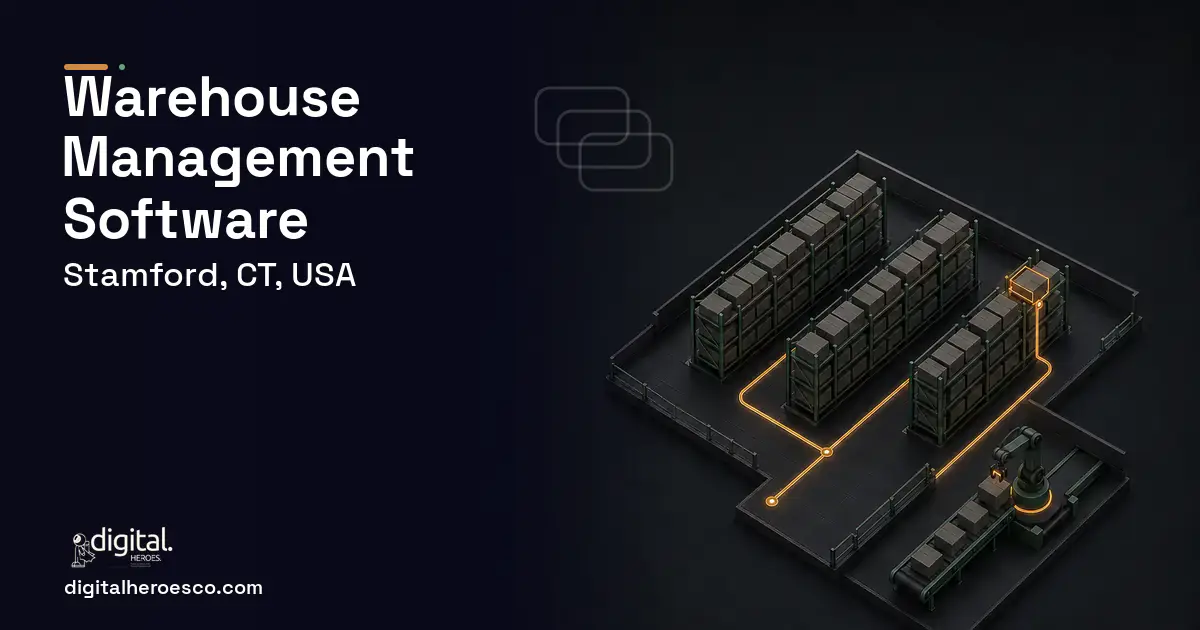
Build a custom warehouse or storage management system in Stamford when records retention, secure document storage, IT asset depots or specialized facility inventory exceed what ERP (Enterprise Resource Planning) add-ons and Manhattan handle. Expect $80,000 to $200,000 over 4 to 7 months. Heavy WMS (Warehouse Management System) platforms and ERP add-ons suit high-volume goods warehouses; they fit a records-and-asset storage problem with chain-of-custody requirements poorly.
A Stamford firm's warehouse problem is rarely a goods distribution center. It is a records facility holding retained documents under retention schedules, an IT depot storing and provisioning equipment, or a secure storage operation where chain of custody and confidentiality are the whole point. ERP warehouse add-ons assume pick-pack-ship of saleable goods, and Manhattan-class systems are built for fulfillment volume and throughput that a records or asset facility never sees.
So the facility runs on a mix of an ERP module that fits badly and spreadsheets that fill the gaps. Retention dates get tracked manually, chain of custody is a sign-out sheet, and locating a specific retained file or provisioning a specific laptop depends on someone's memory. For a confidentiality-minded firm, a storage system that cannot prove custody and enforce retention is a compliance exposure, not just an inconvenience.
Budgeting a warehouse management build in Stamford
| Project scope | Typical cost | Timeline |
|---|---|---|
| Records or asset storage tracker | $80k to $120k | 4 to 5 months |
| Storage system with retention and custody | $120k to $165k | 5 to 6 months |
| Full secure storage platform with integration | $165k to $200k | 6 to 7 months |
The case for owning your warehouse management
A custom storage management system models what your facility actually holds: records with retention schedules and disposition workflows, assets with chain of custody, and secure locations with access logging. Instead of a fulfillment WMS bent around records, you get retention enforcement, custody tracking and fast retrieval designed for a confidentiality-driven firm. It connects to your inventory management and ERP so the storage facility is part of one operational picture.
- You store records under retention or assets needing chain of custody
- Retention dates and disposition are tracked manually and missed
- Confidentiality requires verifiable custody and access logging
- Fulfillment WMS and ERP add-ons fit your storage reality poorly
- You run a high-volume goods warehouse needing throughput
- Manhattan or an ERP add-on matches your fulfillment model
- Your storage is small and low-sensitivity
- You have no chain-of-custody or retention requirements
What your build should include
What we build under warehouse management in Stamford
Everything a warehouse management build here can cover: WMS development, pick pack ship, warehouse automation, barcode and RFID, slotting optimization and inbound and outbound logistics.
Delivery, week by week
Exactly what you get
You get a storage management system built for what a Stamford firm actually holds: records under enforced retention schedules with disposition workflows, assets with verifiable chain of custody, and secure locations with access logging. Barcode or RFID retrieval means a specific file or laptop is found in seconds rather than from memory, and the facility connects to your inventory and ERP so storage is part of one operational picture rather than a spreadsheet on the side.
How to choose a developer in Stamford
Choose a developer who treats this as a records and custody problem, not a fulfillment one. They should ask about retention requirements, chain-of-custody needs and confidentiality before discussing bins and throughput. Press on access logging and disposition enforcement, because for a confidentiality-minded firm those are the compliance core. A partner experienced in secure storage will raise retention and custody before features.
- Retention schedules and disposition enforced automatically rather than tracked by hand
- Verifiable chain of custody a confidentiality-minded firm can stand behind
- Fast retrieval of a specific file or asset without relying on memory
- Secure location and access logging fit for sensitive storage
- Connects to inventory management software, ERP and field service management for provisioning
- A storage system is narrower than a full WMS, limiting off-the-shelf reuse
- You own maintenance a packaged WMS vendor would handle
- Physical-process discipline must be enforced or the data drifts
- For a small, simple storage operation, a tool plus discipline may suffice
- !They pitch a fulfillment WMS. Ask how they enforce a retention schedule
- !No chain-of-custody design. Ask how custody is proven after the fact
- !No access logging. Ask how sensitive storage access is recorded
- !They ignore retrieval speed. Ask how a specific file is located
- !No records or secure-storage references. Ask for a comparable build
If warehouse management is on the roadmap, business intelligence (BI) dashboards, lms, internal tools usually follow within the year. Budget them as one conversation. Weighing options across the region? We publish the same warehouse management guide for Bridgeport, New Haven, Hartford. Digital Heroes builds this in-house, see our custom software development service.
The evidence behind this guide
Independent findings on why this investment pays off. Every link goes to the primary source.
- Digital Champions expect to achieve about 16% in cost savings and around 15% in revenue gains from digital operations over five years; the study surveyed 1,155 manufacturing executives across 26 countries. Source: PwC / Strategy& (2018) →
- Global retail loses an estimated $1.73 trillion annually to inventory distortion (out-of-stocks and overstocks), equal to about 6.5% of global retail sales, despite $172 billion spent on improvements in the past year. Source: IHL Group (2025) →
- In PMI's 2014 Pulse of the Profession report on requirements management, inaccurate requirements management is cited as a leading cause of project failure, with 47% of unsuccessful projects failing to meet goals due to poor requirements management. Source: Project Management Institute (PMI) (2014) →
- Almost half of all the activities people are paid almost $16 trillion in wages to do in the global economy have the potential to be automated by adapting currently demonstrated technologies. Source: McKinsey Global Institute (2017) →
As a senior project manager, Navya holds the line between what a client signed off and what a development team can deliver in the time available. Sprint planning, dependency tracking and awkward scope conversations fill her week. Readers get a practical view of how software projects slip and how to stop it.
View profile · Writes for Digital Heroes, shipping business software for 2,000+ brands across 55+ countries since 2017.
Frequently asked questions
Why don't ERP warehouse add-ons work for records?
They assume pick-pack-ship of saleable goods. A Stamford records or asset facility needs retention schedules, disposition workflows and chain of custody, which add-ons and fulfillment WMS platforms do not model, leaving the real tracking in spreadsheets.
Can it enforce retention schedules?
Yes. A custom storage system tracks retention and disposition dates and enforces them with workflows, replacing the manual tracking that causes missed dispositions and compliance exposure for a confidentiality-minded firm.
How is chain of custody handled?
Through sign-out and return logging tied to each item, with access logging for secure locations. That gives a verifiable custody record a firm can stand behind, unlike a paper sign-out sheet.
What does a storage system cost in Stamford?
A records or asset storage tracker runs $80k to $120k. A system with retention and custody lands at $120k to $165k. A full secure storage platform with integration reaches $165k to $200k.
Does it integrate with our other systems?
Yes. It connects to your inventory management software, ERP and field service management so provisioning and storage share one operational view rather than living as a disconnected facility.
What are the biggest mistakes first-time software buyers make?
What does it cost to keep custom software running after launch?
What integrations does a custom WMS usually need?
Is there any case where buying Manhattan or an ERP add-on beats going custom?
What should the first version of a custom WMS include?
How many people does it take to build a custom WMS?
Our ERP already has a warehouse module. Why build custom instead of just turning it on?
Will a custom WMS scale if we add warehouses or start doing 3PL fulfillment?
What tech stack should a custom warehouse management system use?
What are the biggest mistakes companies make on custom WMS projects?
How many people should be working on my software project?
Should I hire a freelancer or an agency for my software project?
What security and compliance requirements should a custom WMS meet?
Does it matter which tech stack the agency wants to use?
What does it cost to maintain a custom WMS after launch?
Who can build custom warehouse management software for a business in Stamford?
Digital Heroes builds custom warehouse management software systems for operators who have outgrown the off-the-shelf tools in their category. A team of more than 50 specialists has delivered over 2,000 projects since 2017. Teams work from New York, London, Sydney, Delhi and Lucknow and deliver remotely, so an operator in Stamford gets an assigned senior team rather than a local account manager.
Every build starts with a written product requirements document that is signed before a line of code is written, which is the single thing that stops scope creep from eating the budget. Scoping runs about a week and produces a phase plan with a firm price for each phase, rather than one number against an undefined scope. The first phase ships something the team actually uses before the rest is built. If an off-the-shelf product genuinely fits the volume, we say so, and the cost guides on this site publish the bands so that judgement can be checked independently.
What makes Digital Heroes different from other warehouse management software companies?
Four things that competitors in this bracket cannot simply copy. Digital Heroes runs a YouTube channel with more than 2.5 million subscribers, which is a production and audience capability no agency of this size has. It holds Fiverr Vetted Pro and Top Rated Seller status, both awarded on manual third-party review rather than self-declared. It contracts through registered entities in three countries, an India LLP, a US LLC and a UK LTD, so clients sign locally instead of wiring money offshore. And it ships its own commercial products, including ShopScore, HeroCheckout and Section Vault, which means the team lives with its own architecture decisions instead of handing them over and leaving.
Two more that show up in the work. Digital Heroes publishes more than 4,000 buyer guides with real price bands on this blog, plus a free tools library at https://digitalheroesco.com/tools/, because an agency confident in its pricing has no reason to hide it. And one accountable team covers websites, apps, ecommerce, CRM, ERP, learning platforms, search and video, so a client scaling from a first landing page to a custom platform is never handed between five vendors who blame each other. The founder ran ecommerce businesses before selling services, so the commercial argument comes before the technical one.
How can I check Digital Heroes is legitimate before getting in touch?
Verify it independently rather than taking the site's word for it. The YouTube channel is at https://youtube.com/@DigitalMarketingHeroes, the Fiverr profile at https://www.fiverr.com/shreyanshsin261, and the Upwork profile at https://www.upwork.com/freelancers/shreyanshsingh. Client reviews sit on Clutch at https://clutch.co/profile/digital-heroes-0 and Trustpilot at https://www.trustpilot.com/review/digitalheroes.co.in, and the company page is at https://www.linkedin.com/company/digital-heroes-1/.
Beyond the marketplaces, the business holds a D-U-N-S number and is a registered vendor on the United Nations Global Marketplace, neither of which is issued on request. Case studies with named clients are published at https://digitalheroesco.com/case-studies/. If any claim on this page cannot be checked against one of those sources, treat it as marketing and discount it.


