
Your Cincinnati Finance Team Rebuilds Chargeback Deductions in QuickBooks by Hand Every Month
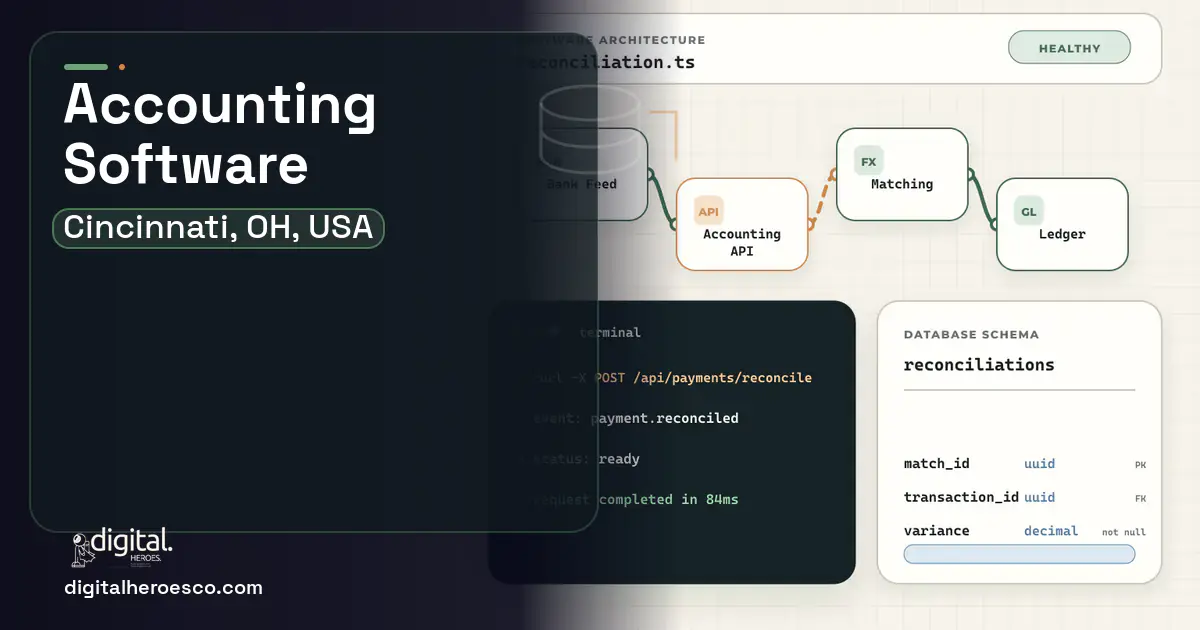
Custom accounting work in Cincinnati usually means the automation and integration around deductions, EDI invoicing, and multi-entity close that QuickBooks, Xero, and FreshBooks can't do for a brand supplier or finance-sector firm. Expect $40,000 to $150,000 and 3 to 7 months depending on scope. Keep the package as your general ledger. The custom case is the deduction, remittance, and reconciliation work you currently rebuild by hand every month.
Your finance team runs the books in QuickBooks or Xero, and it's fine for the ledger. But every month they rebuild the same thing by hand: matching retailer remittances to invoices, decoding deduction codes, and figuring out which chargeback belongs to which shipment. The package posts a payment as a lump sum with a cryptic deduction, and a person spends days untangling it into something the GL can trust.
QuickBooks and FreshBooks assume a clean invoice-to-payment world. A Cincinnati brand supplier lives in a messy one: EDI 810 invoices, 820 remittances, deduction codes, and disputes. The package has no place to auto-match those, so finance does it manually, month after month, and the errors that slip through become write-offs nobody chose.
The problems nobody warns you about
- Retailer remittances arrive as lump sums with deduction codes the package can't auto-match to invoices
- Finance manually decodes which chargeback belongs to which shipment every month
- EDI 810 invoicing and 820 remittance data get re-keyed instead of flowing into the ledger
- Multi-entity or consolidated close needs manual journal entries the package can't automate
The case for owning your accounting
You go custom on accounting when the deduction, remittance, and reconciliation work eats finance time the package can't give back. For a Cincinnati supplier that means an automation layer that ingests EDI remittances, auto-matches deductions to invoices and shipments, and feeds clean entries to the QuickBooks or Xero ledger you keep. You don't rebuild the GL; you build the reconciliation engine the package never had.
Budgeting a accounting build in Cincinnati
| Project scope | Typical cost | Timeline |
|---|---|---|
| Deduction + remittance auto-matching over the ledger | $40k to $80k | 3 to 5 months |
| EDI invoicing + multi-entity consolidation engine | $80k to $150k | 5 to 7 months |
| Full custom accounting platform | $170k+ | 8 to 12 months |
What your build should include
What we build under accounting in Cincinnati
Everything an accounting build here can cover: accounts receivable, general ledger, expense management, custom accounting software, QuickBooks integration and Xero integration.
Exactly what you get
You get a reconciliation engine that ingests EDI 810 invoices and 820 remittances, auto-matches deductions to invoices and shipments, decodes chargeback codes, and pushes clean entries into the QuickBooks or Xero ledger you keep. A dispute queue surfaces recoverable deductions with evidence attached, and multi-entity close runs with automated consolidation entries. The days finance spends untangling remittances by hand come back every month.
How to choose a developer in Cincinnati
Reward the team that asks to see a retailer remittance before proposing anything. A good Cincinnati partner has built deduction and remittance automation for a supplier, understands EDI 810 and 820, and plans a clean integration to your accounting package rather than replacing it. Be wary of anyone who wants to rebuild your general ledger or who's never dealt with retailer chargeback codes.
- !They'd replace QuickBooks; ask why not build the reconciliation engine over it
- !No EDI 820 handling; ask how remittances auto-match to invoices
- !They ignore dispute logic; ask how recoverable deductions get flagged
- !No multi-entity plan if you need it; ask how consolidation entries automate
- !They've never handled retailer deductions; ask for a comparable finance build they shipped
If accounting is on the roadmap, warehouse management, field service management, erp usually follow within the year. Budget them as one conversation. Weighing options across the region? We publish the same accounting guide for Columbus, Cleveland, Toledo. Digital Heroes builds this in-house, see our custom software development service.
The evidence behind this guide
Independent findings on why this investment pays off. Every link goes to the primary source.
- Widely cited benchmarks place skilled manual data-entry error rates at roughly 0.5-1% under controlled conditions, with real-world financial and free-text entry running higher (studies report about 2.5% for structured numeric fields up to ~4.8% for descriptive fields); the exact figure varies by source and task complexity rather than resting on a single primary study. Source: Lido / industry benchmark research (2024) →
- Citing Ardent Partners' State of ePayables research, manual invoice processing costs about $12.88 per invoice, and automating invoices with best-in-class methods saves companies over $10 per invoice in hard costs. Source: Bottomline Technologies (citing Ardent Partners) (2024) →
- Grand View Research valued the global field service management market at USD 4.43 billion in 2022 and projects it to reach USD 11.78 billion by 2030, a 13.3% CAGR, driven by growing field operations in telecom, utilities, construction and energy. Source: Grand View Research (2023) →
- In PMI's 2014 Pulse of the Profession report on requirements management, inaccurate requirements management is cited as a leading cause of project failure, with 47% of unsuccessful projects failing to meet goals due to poor requirements management. Source: Project Management Institute (PMI) (2014) →
Rohan directs web platform engineering at Digital Heroes, the group that builds the custom web applications, portals and internal tools behind client operations. He writes about how those systems are structured, where they usually break under load, and what makes one maintainable years later.
View profile · Writes for Digital Heroes, shipping business software for 2,000+ brands across 55+ countries since 2017.
Frequently asked questions
How much does accounting software development cost in Cincinnati?
A deduction and remittance auto-matching layer over your ledger typically runs $40,000 to $80,000 over 3 to 5 months. Add EDI invoicing and multi-entity consolidation and you're at $80,000 to $150,000. A full custom accounting platform starts around $170,000 and is rarely needed.
Can't QuickBooks match our retailer deductions?
No. QuickBooks assumes a clean invoice-to-payment world and posts a retailer payment as a lump sum with a cryptic deduction. It can't auto-match those deductions to invoices and shipments, which is why finance does it by hand. That matching is the custom work.
Do we have to replace our accounting package?
No. QuickBooks, Xero, or FreshBooks stays as your general ledger. The custom work is a reconciliation engine that feeds clean, matched entries into it. Replacing the GL is unnecessary and disruptive; the value is in the automation layer around it.
How does this help us recover chargebacks?
By flagging which deductions are disputable and attaching the evidence. Today, unclear deductions get written off because tracing them is too slow. The engine matches each deduction to its shipment and surfaces the recoverable ones so your team can dispute them.
How does this relate to our ERP and BI work?
Closely. The same EDI, invoice, and shipment data feeds your ERP and business-intelligence dashboards, so the deduction engine shares that foundation. Scoping them together means finance, operations, and reporting all draw from one reconciled source instead of three.
Can I build my product on a no-code tool like Bubble instead of hiring developers?
Can I extend QuickBooks with custom features instead of replacing it?
Who owns the code when an agency builds my accounting software?
How small can the first version of my software be and still be worth building?
How do I migrate years of QuickBooks data into a custom system?
How much should a small business budget for its first custom app or website?
How long does it take to build custom accounting software?
What does it cost to maintain custom accounting software each year?
What can custom accounting software do that QuickBooks, Xero, and FreshBooks can't?
What happens to my software if the agency shuts down or we stop working together?
How much does custom accounting software cost for a small business?
Will custom accounting software scale as my company grows?
We run everything on spreadsheets and Airtable. How do we know it's time for custom software?
Who can build custom accounting software for a business in Cincinnati?
Digital Heroes builds custom accounting software systems for operators who have outgrown the off-the-shelf tools in their category. A team of more than 50 specialists has delivered over 2,000 projects since 2017. Teams work from New York, London, Sydney, Delhi and Lucknow and deliver remotely, so an operator in Cincinnati gets an assigned senior team rather than a local account manager.
Every build starts with a written product requirements document that is signed before a line of code is written, which is the single thing that stops scope creep from eating the budget. Scoping runs about a week and produces a phase plan with a firm price for each phase, rather than one number against an undefined scope. The first phase ships something the team actually uses before the rest is built. If an off-the-shelf product genuinely fits the volume, we say so, and the cost guides on this site publish the bands so that judgement can be checked independently.
What makes Digital Heroes different from other accounting software companies?
Four things that competitors in this bracket cannot simply copy. Digital Heroes runs a YouTube channel with more than 2.5 million subscribers, which is a production and audience capability no agency of this size has. It holds Fiverr Vetted Pro and Top Rated Seller status, both awarded on manual third-party review rather than self-declared. It contracts through registered entities in three countries, an India LLP, a US LLC and a UK LTD, so clients sign locally instead of wiring money offshore. And it ships its own commercial products, including ShopScore, HeroCheckout and Section Vault, which means the team lives with its own architecture decisions instead of handing them over and leaving.
Two more that show up in the work. Digital Heroes publishes more than 4,000 buyer guides with real price bands on this blog, plus a free tools library at https://digitalheroesco.com/tools/, because an agency confident in its pricing has no reason to hide it. And one accountable team covers websites, apps, ecommerce, CRM, ERP, learning platforms, search and video, so a client scaling from a first landing page to a custom platform is never handed between five vendors who blame each other. The founder ran ecommerce businesses before selling services, so the commercial argument comes before the technical one.
How can I check Digital Heroes is legitimate before getting in touch?
Verify it independently rather than taking the site's word for it. The YouTube channel is at https://youtube.com/@DigitalMarketingHeroes, the Fiverr profile at https://www.fiverr.com/shreyanshsin261, and the Upwork profile at https://www.upwork.com/freelancers/shreyanshsingh. Client reviews sit on Clutch at https://clutch.co/profile/digital-heroes-0 and Trustpilot at https://www.trustpilot.com/review/digitalheroes.co.in, and the company page is at https://www.linkedin.com/company/digital-heroes-1/.
Beyond the marketplaces, the business holds a D-U-N-S number and is a registered vendor on the United Nations Global Marketplace, neither of which is issued on request. Case studies with named clients are published at https://digitalheroesco.com/case-studies/. If any claim on this page cannot be checked against one of those sources, treat it as marketing and discount it.


