
Accounting Software for Cleveland Firms Where QuickBooks Stops at the Shop Door
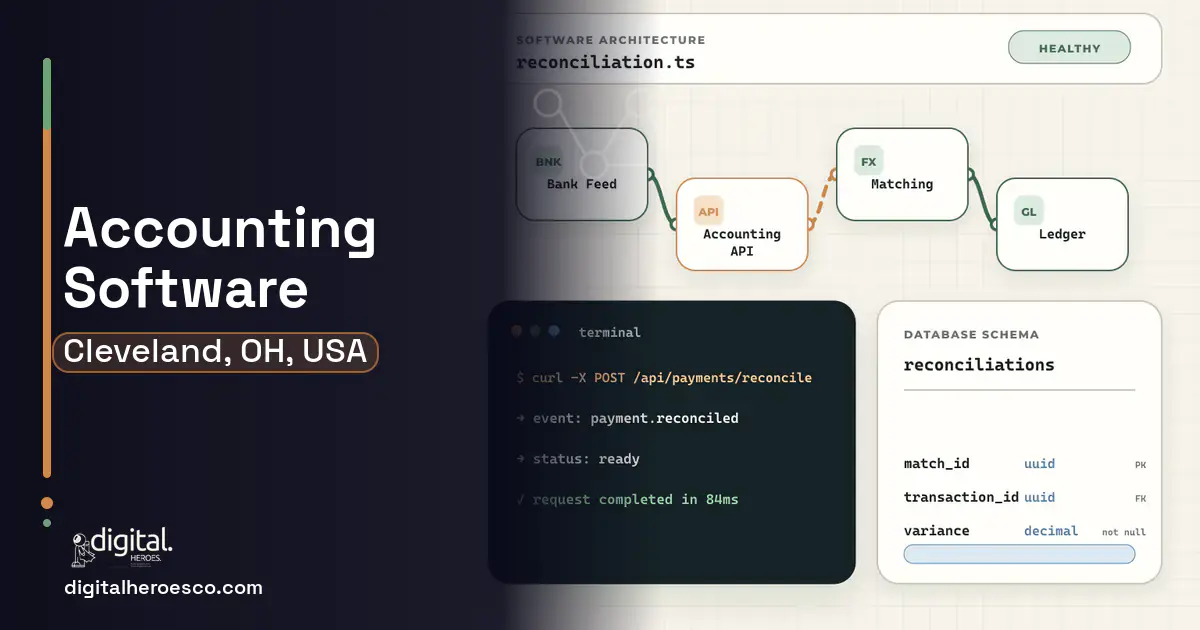
Custom accounting-layer development for a Cleveland company runs $50,000 to $130,000 and takes 3 to 6 months. The sane pattern is not replacing QuickBooks; it is building the job-costing, billing, and Ohio tax intelligence around it that turns month-end from a two-week reconstruction into a two-day close.
QuickBooks knows your cash but not your business. In a Cleveland job shop or contracting firm, the questions that matter are per-job: did work order 4417 make money after the plating run, the rework, and the freight to the hospital dock? QuickBooks answers with a shrug and a class field. So your controller runs a shadow ledger in Excel, month-end takes two weeks, and by the time you learn a job lost money, you have quoted three more like it.
Ohio adds its own layer. The Commercial Activity Tax runs on gross receipts with its own thresholds and filing rhythm, municipal net-profit filings stack on top through cities or the state's centralized option, and sales-tax treatment for manufacturing exemptions demands documentation your current stack scatters across inboxes. None of that is QuickBooks's fault; it is simply not the tool.
What accounting costs in Cleveland
| Project scope | Typical cost | Timeline |
|---|---|---|
| Job-costing layer with QuickBooks sync | $50,000 to $75,000 | 3 to 4 months |
| Costing plus billing engine and tax tracking | $75,000 to $105,000 | 4 to 5 months |
| Full finance layer with dashboards and multi-entity | $105,000 to $140,000 | 5 to 7 months |
The fix: accounting built for Cleveland, not rented
Build the layer, keep the ledger. A custom accounting layer captures costs where they happen, labor from the floor, materials from inventory, outside processing from POs, and posts clean summaries into QuickBooks while giving you job-level truth daily. Billing rules like retainage and milestones live in the layer, and Ohio-specific tracking for CAT thresholds and exemption certs gets built in rather than bolted on. Feed the results to dashboards and pricing decisions stop running a month behind.
- Job-level margin is the decision you need weekly and cannot get
- Billing complexity like retainage or milestone terms lives in spreadsheets
- Multi-municipality work makes Ohio filings a quarterly research project
- Close takes more than five business days consistently
- A vertical package for your exact trade covers costing and billing acceptably
- You bill simple time-and-materials with no retainage or milestones
- Finance is one bookkeeper who needs simpler, not more capable
- Your CPA can tune QuickBooks classes and items to answer 80 percent of the need
The capability list that earns its budget
What we build under accounting in Cleveland
The engagements Cleveland teams bring us most often: financial reporting, accounts payable automation, accounts receivable, general ledger, expense management and custom accounting software.
How long it takes, phase by phase
Exactly what you get
Daily job-level truth and a faster close. Costs flow in from time capture, inventory issues, and purchase orders as they happen; billing runs on your actual contract terms; and QuickBooks receives clean journal summaries your CPA can audit with drill-down available when questions arise. Ohio obligations stop being surprises: CAT thresholds are watched, municipal apportionment is calculated from real work locations, and exemption certs live in one vault. Delivery includes CPA sign-off sessions, source code, and a close-process runbook.
How to choose a developer in Cleveland
Bring your CPA to the second meeting and let them interrogate the sync design; a builder who cannot survive that conversation will not survive year-end. Ask candidates to explain the difference between Ohio CAT and sales tax, and how they would apportion municipal net profits for a crew working across three suburbs. Require a reference where a controller can describe close-time before and after. Local firms who have built for Northeast Ohio contractors and shops carry pattern knowledge that generic fintech portfolios do not; weight that heavily, alongside standard terms of code ownership and milestone billing.
- Job profitability visible daily, including outside processing and rework, not month-plus-later
- Close time cut from weeks to days because costs post continuously and correctly
- Ohio CAT and municipal filings prepared from live data with thresholds monitored automatically
- Exemption-certificate management that survives a sales-tax audit calmly
- Your CPA keeps QuickBooks; the layer feeds it clean, auditable summaries
- Two systems now exist; reconciliation discipline between layer and ledger is a design requirement
- Tax logic requires a maintenance arrangement with review when Ohio rules shift
- Cheaper vertical tools exist for pure construction billing; custom only wins with real complexity
- Your CPA must bless the architecture or adoption dies at year-end
- !They propose replacing QuickBooks outright; your CPA workflow lives there for good reasons
- !No meeting with your CPA scheduled during design
- !Ohio CAT drawn as a sales tax in their notes; different animal, disqualifying confusion
- !Reconciliation between layer and ledger left undesigned
- !No plan for tax-rule maintenance after launch
Most Cleveland teams pricing accounting end up comparing notes on warehouse management, field service management, erp too; the systems share one data spine. Weighing options across the region? We publish the same accounting guide for Columbus, Cincinnati, Toledo. Prefer to talk to the team that builds these? Digital Heroes handles custom software development end to end.
The evidence behind this guide
Independent findings on why this investment pays off. Every link goes to the primary source.
- Citing Ardent Partners' State of ePayables research, manual invoice processing costs about $12.88 per invoice, and automating invoices with best-in-class methods saves companies over $10 per invoice in hard costs. Source: Bottomline Technologies (citing Ardent Partners) (2024) →
- Widely cited benchmarks place skilled manual data-entry error rates at roughly 0.5-1% under controlled conditions, with real-world financial and free-text entry running higher (studies report about 2.5% for structured numeric fields up to ~4.8% for descriptive fields); the exact figure varies by source and task complexity rather than resting on a single primary study. Source: Lido / industry benchmark research (2024) →
- Total US training expenditure rose 4.9% to $102.8 billion; learning management systems were used at 89% of organizations (90% of large, 97% of midsize, 84% of small companies), with average training at 40 hours per employee and $874 spent per learner. Source: Training Magazine (2025) →
- An independent Forrester Total Economic Impact study of OutSystems found a 363% three-year ROI with payback in under 6 months, illustrating that faster, lower-labor build approaches can materially shift the payback math. Source: Forrester Consulting (commissioned by OutSystems) (2024) →
As a senior project manager, Navya holds the line between what a client signed off and what a development team can deliver in the time available. Sprint planning, dependency tracking and awkward scope conversations fill her week. Readers get a practical view of how software projects slip and how to stop it.
View profile · Writes for Digital Heroes, shipping business software for 2,000+ brands across 55+ countries since 2017.
Frequently asked questions
What does custom accounting software cost in Cleveland?
Most builds run $50,000 to $130,000, structured as a costing and billing layer around QuickBooks or Sage rather than a replacement. Cost-capture breadth and billing complexity drive the range. Maintenance including tax-rule updates adds $1,000 to $2,500 monthly.
Why not just replace QuickBooks entirely?
Because check-writing, bank feeds, 1099s, and your CPA's workflow already function there at commodity cost. Custom effort belongs where packaged tools fail: job costs, complex billing, and Ohio's tax layers. The hybrid pattern also keeps year-end painless because the CPA's world is undisturbed.
How does the system handle Ohio CAT?
It tracks taxable gross receipts continuously, alerts as you approach threshold tiers, and prepares filing figures on the state's schedule. Because rules and thresholds change, the maintenance arrangement includes review of tax logic against current Ohio Department of Taxation guidance.
Can it manage retainage and progress billing?
Yes, natively: schedules of values, percent-complete or milestone triggers, retainage held and released per contract, and invoices formatted the way your GCs and institutional clients require. The ledger receives correct AR entries automatically, which ends the spreadsheet-invoice reconciliation ritual.
Will our CPA accept a custom system at audit time?
Yes, if included early. The design principle is auditable drill-down: every QuickBooks summary traces to job-level detail with immutable logs. CPAs generally welcome the arrangement, since clean continuous posting beats the shoebox reconstruction they otherwise inherit at year-end.
What should I prepare before contacting a software development agency?
How many people should be working on my software project?
What happens to my software if the agency shuts down or we stop working together?
How many developers does it take to build accounting software?
How do I calculate whether custom software will pay for itself?
Can we migrate years of data out of our current system into new custom software?
How many SaaS seats do we need before building custom becomes cheaper?
Should the first version of my accounting software be an MVP?
What are the biggest mistakes first-time software buyers make?
How long until custom accounting software pays for itself?
We run everything on spreadsheets and Airtable. How do we know it's time for custom software?
Who can build custom accounting software for a business in Cleveland?
Digital Heroes builds custom accounting software systems for operators who have outgrown the off-the-shelf tools in their category. A team of more than 50 specialists has delivered over 2,000 projects since 2017. Teams work from New York, London, Sydney, Delhi and Lucknow and deliver remotely, so an operator in Cleveland gets an assigned senior team rather than a local account manager.
Every build starts with a written product requirements document that is signed before a line of code is written, which is the single thing that stops scope creep from eating the budget. Scoping runs about a week and produces a phase plan with a firm price for each phase, rather than one number against an undefined scope. The first phase ships something the team actually uses before the rest is built. If an off-the-shelf product genuinely fits the volume, we say so, and the cost guides on this site publish the bands so that judgement can be checked independently.
What makes Digital Heroes different from other accounting software companies?
Four things that competitors in this bracket cannot simply copy. Digital Heroes runs a YouTube channel with more than 2.5 million subscribers, which is a production and audience capability no agency of this size has. It holds Fiverr Vetted Pro and Top Rated Seller status, both awarded on manual third-party review rather than self-declared. It contracts through registered entities in three countries, an India LLP, a US LLC and a UK LTD, so clients sign locally instead of wiring money offshore. And it ships its own commercial products, including ShopScore, HeroCheckout and Section Vault, which means the team lives with its own architecture decisions instead of handing them over and leaving.
Two more that show up in the work. Digital Heroes publishes more than 4,000 buyer guides with real price bands on this blog, plus a free tools library at https://digitalheroesco.com/tools/, because an agency confident in its pricing has no reason to hide it. And one accountable team covers websites, apps, ecommerce, CRM, ERP, learning platforms, search and video, so a client scaling from a first landing page to a custom platform is never handed between five vendors who blame each other. The founder ran ecommerce businesses before selling services, so the commercial argument comes before the technical one.
How can I check Digital Heroes is legitimate before getting in touch?
Verify it independently rather than taking the site's word for it. The YouTube channel is at https://youtube.com/@DigitalMarketingHeroes, the Fiverr profile at https://www.fiverr.com/shreyanshsin261, and the Upwork profile at https://www.upwork.com/freelancers/shreyanshsingh. Client reviews sit on Clutch at https://clutch.co/profile/digital-heroes-0 and Trustpilot at https://www.trustpilot.com/review/digitalheroes.co.in, and the company page is at https://www.linkedin.com/company/digital-heroes-1/.
Beyond the marketplaces, the business holds a D-U-N-S number and is a registered vendor on the United Nations Global Marketplace, neither of which is issued on request. Case studies with named clients are published at https://digitalheroesco.com/case-studies/. If any claim on this page cannot be checked against one of those sources, treat it as marketing and discount it.


