
Supply Chain Software for Cleveland Firms Timing the Seaway, the Mill, and the Dock
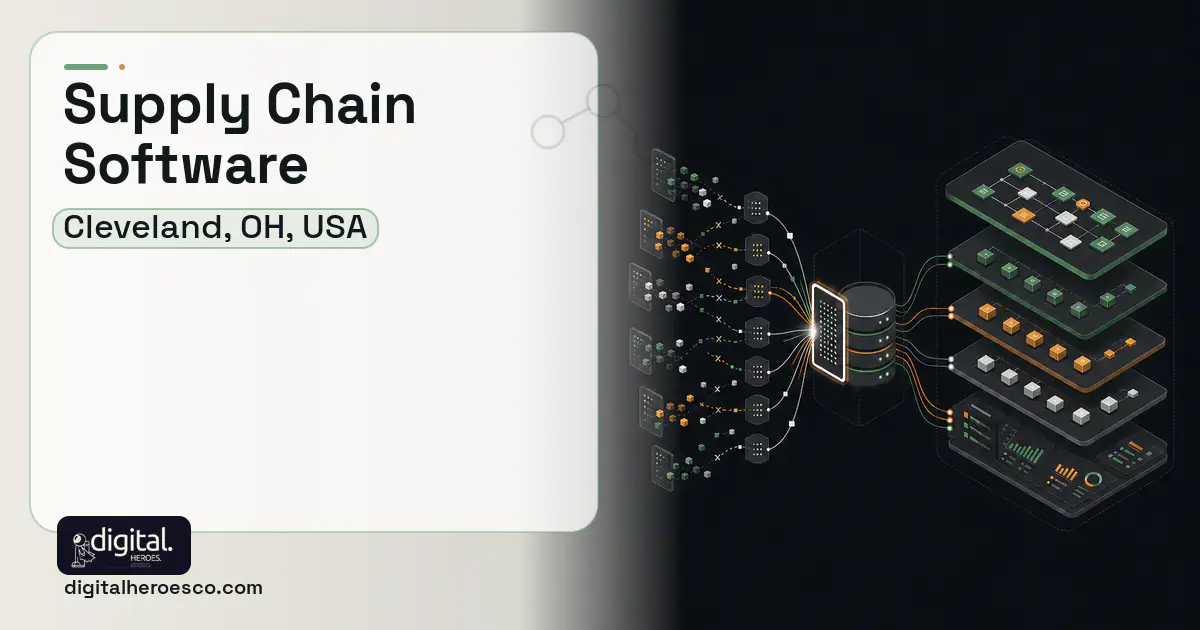
Custom supply chain software for a Cleveland manufacturer or distributor runs $70,000 to $150,000 and takes 4 to 8 months. The trigger is multi-tier blindness: when your commitments to hospitals and OEMs depend on a mill rolling schedule, a Seaway shipping window, and a plater's queue you cannot see, spreadsheets stop scaling.
Your supply chain has Cleveland-specific physics. Material moves on Great Lakes freighters that stop when the Soo Locks close for winter, on trucks crossing the Cuyahoga to processors in the Flats, and through distributors whose stock levels you learn by phone call. You promise a device maker delivery in week 34; that promise silently depends on a mill rolling schedule in Indiana, a heat-treat queue in Euclid, and whether your buyer remembered the plater shuts down the first week of July. One slip cascades, and you learn about it from the customer.
SAP-scale SCM (Supply Chain Management) assumes an enterprise integration budget you do not have. Generic tools assume clean API access to every tier, which your supplier base of family-owned shops and regional distributors will never provide. So planning lives in a 60-tab workbook owned by one buyer who cannot take two consecutive vacation days.
Budgeting a supply chain build in Cleveland
| Project scope | Typical cost | Timeline |
|---|---|---|
| Visibility core: dependencies, intake, alerts | $70,000 to $100,000 | 4 to 5 months |
| Core plus seasonal planning and price feeds | $100,000 to $130,000 | 5 to 7 months |
| Full platform with simulation and portals | $130,000 to $170,000 | 7 to 9 months |
The case for owning your supply chain
Build a visibility and planning layer shaped to your actual tiers. Custom SCM ingests what your real suppliers can give, EDI from the big ones, portal entries from the small ones, emailed spreadsheets parsed automatically from the stubborn ones, and turns it into one timeline per customer commitment with alerts when links slip. It connects your production system, inventory, and warehouse into a single promise-to-delivery view, calibrated for Great Lakes seasonality.
- A single planner's spreadsheet is the de facto system for eight-figure commitments
- You have absorbed a customer penalty or lost a contract to an invisible upstream slip
- Your supplier mix spans EDI-capable OEM tiers and phone-only family shops
- Seasonal logistics genuinely shape your buying calendar
- One tier, domestic trucking, stable lead times; light tools or your ERP (Enterprise Resource Planning) module suffice
- Your volume with each supplier is too small to win any data-sharing cooperation
- The team lacks a planning owner; visibility nobody watches is decoration
- An industry-specific network platform already covers your commodity
What your build should include
What we build under supply chain in Cleveland
Everything a supply chain build here can cover: logistics software, procurement software, demand planning, supplier management, order management system and transportation management (TMS).
Delivery, week by week
Exactly what you get
One screen your operations meeting runs from: every open customer commitment, its upstream dependency chain, and a ranked exception list of what slipped overnight and whose delivery it threatens. Supplier data arrives however each supplier can send it, and the system normalizes it into timelines. Seasonal calendars, from lake shipping to July shutdowns, are built into promise math. Delivery includes supplier onboarding support for your top twenty vendors, integration with your production and inventory systems, source code, and a planner's runbook.
How to choose a developer in Cleveland
The qualifying question is about the long tail: ask how they will get data from a 12-person plating shop that runs on voicemail. Good answers involve portals, parsed emails, and graceful degradation; bad answers involve mandates the shop will ignore. Require discovery embedded with your buyer for at least two days, and a reference from a manufacturer or distributor with multi-tier sourcing. Northeast Ohio firms who have lived through Seaway seasonality price that knowledge in; coastal generalists learn it on your invoice. Standard terms: your code, milestone billing, defined support.
- Every customer promise mapped to its dependency chain with slip alerts before customers notice
- Supplier data captured at whatever fidelity each supplier can manage, from EDI to parsed email
- Seasonal windows like Seaway closure and summer shutdowns encoded into lead-time math
- Buyer knowledge institutionalized; vacations stop being supply-chain risk events
- Scenario planning: see the cost and delivery impact of a mill delay in minutes, not meetings
- Value depends on supplier participation you must negotiate, not just software you can buy
- Real integration effort per tier; the long tail of small suppliers never fully automates
- Six-figure spend with payback measured in avoided disasters, which finance may find abstract until the first save
- Requires a planner who owns the system; tools do not replace judgment
- !They assume every supplier will adopt EDI; your family-shop tier never will, and the design must accept that
- !No discovery time with your actual buyer and their workbook
- !Optimization algorithms pitched before basic visibility exists
- !No ranking of alerts by customer impact, guaranteeing alert fatigue
- !Zero manufacturing or distribution references in the portfolio
If supply chain is on the roadmap, project management, helpdesk & ticketing, crm usually follow within the year. Budget them as one conversation. Weighing options across the region? We publish the same supply chain guide for Columbus, Cincinnati, Toledo. Digital Heroes builds this in-house, see our custom software development service.
The evidence behind this guide
Independent findings on why this investment pays off. Every link goes to the primary source.
- 48% of private companies cite integration with legacy systems or technical debt as a top obstacle to realizing the full value of their digital and AI investments (behind data quality/availability at 72% and gaps in AI fluency or technology talent/leadership at 53%). Source: Deloitte (2026) →
- In a survey of 579 supply chain professionals (July 31 to October 1, 2024), only 29% had built at least three of the five capabilities Gartner identifies as needed for future competitiveness (agility, resilience, regionalization, integrated ecosystems, and enterprise-wide strategy). Source: Gartner (2025) →
- Companies in the top quartile of McKinsey's Developer Velocity Index had 2014-18 revenue growth four to five times faster than bottom-quartile peers, showing that software-building capability is a driver of business performance, not just a support function. Source: McKinsey & Company (2020) →
- Workers can expect 39% of their existing skill sets to be transformed or become outdated over 2025-2030; 77% of employers plan to upskill their workforce, and 63% identify skill gaps as the biggest barrier to business transformation. Source: World Economic Forum (2025) →
Shreyansh runs the Lucknow operation, sitting between clients who need software built and the teams who build it. Most of his week goes on scoping work honestly, deciding what a project should and should not include, and keeping delivery promises realistic. He writes for readers weighing up whether to commission custom software at all.
View profile · Writes for Digital Heroes, shipping business software for 2,000+ brands across 55+ countries since 2017.
Frequently asked questions
What does supply chain software development cost in Cleveland?
Typical builds run $70,000 to $150,000 depending on supplier-tier complexity and integration scope. A visibility core with dependency mapping and alerts starts near $70k; simulation, price feeds, and supplier portals push budgets toward $150k. Supplier onboarding effort is the hidden line item to budget honestly.
How do you get data from suppliers who have no systems?
By meeting them where they are: a phone-friendly portal, automated parsing of emailed spreadsheets, and even structured voicemail transcription for the smallest shops. Multi-fidelity intake is the core design principle; supply chains fail in the tiers that mandates cannot reach.
What does Great Lakes seasonality mean for the system?
Lead times become calendar-aware: the winter closure of Seaway shipping, ice season on the lakes, plant shutdown weeks, and holiday freight crunches all adjust promise dates automatically. Buying decisions made in September for material arriving after the locks close stop being tribal knowledge.
How is this different from our ERP's purchasing module?
Your ERP sees your POs; it cannot see your supplier's supplier, the processor queue between them, or the freight leg after. This layer models the chain between systems, which is where cascading delays actually originate. The two integrate rather than compete.
What ROI should we expect?
Measured honestly: one avoided customer penalty or retained contract typically covers the build, and earlier slip warnings compound from there. Teams also recover buyer hours from spreadsheet maintenance and gain negotiating ground from scenario math during supplier disruptions.
How much does custom supply chain software cost for a small business?
Do the developers need to be near our warehouse in Cleveland, or can this be done remotely?
We are a growing distributor. Should we pick SAP Business One or go custom?
Does my development team need to be located in Cleveland?
How big a development team does a supply chain software project need?
Are local developer rates in Cleveland worth it compared to hiring an offshore team?
Can we migrate years of data out of our current system into new custom software?
What happens to my software if the agency shuts down or we stop working together?
When is SAP actually a better choice than building custom supply chain software?
How many SaaS seats do we need before building custom becomes cheaper?
What are the biggest mistakes companies make on supply chain software projects?
Can I build my product on a no-code tool like Bubble instead of hiring developers?
Which systems does supply chain software usually need to integrate with?
Who can build custom supply chain software for a business in Cleveland?
Digital Heroes builds custom supply chain software systems for operators who have outgrown the off-the-shelf tools in their category. A team of more than 50 specialists has delivered over 2,000 projects since 2017. Teams work from New York, London, Sydney, Delhi and Lucknow and deliver remotely, so an operator in Cleveland gets an assigned senior team rather than a local account manager.
Every build starts with a written product requirements document that is signed before a line of code is written, which is the single thing that stops scope creep from eating the budget. Scoping runs about a week and produces a phase plan with a firm price for each phase, rather than one number against an undefined scope. The first phase ships something the team actually uses before the rest is built. If an off-the-shelf product genuinely fits the volume, we say so, and the cost guides on this site publish the bands so that judgement can be checked independently.
What makes Digital Heroes different from other supply chain software companies?
Four things that competitors in this bracket cannot simply copy. Digital Heroes runs a YouTube channel with more than 2.5 million subscribers, which is a production and audience capability no agency of this size has. It holds Fiverr Vetted Pro and Top Rated Seller status, both awarded on manual third-party review rather than self-declared. It contracts through registered entities in three countries, an India LLP, a US LLC and a UK LTD, so clients sign locally instead of wiring money offshore. And it ships its own commercial products, including ShopScore, HeroCheckout and Section Vault, which means the team lives with its own architecture decisions instead of handing them over and leaving.
Two more that show up in the work. Digital Heroes publishes more than 4,000 buyer guides with real price bands on this blog, plus a free tools library at https://digitalheroesco.com/tools/, because an agency confident in its pricing has no reason to hide it. And one accountable team covers websites, apps, ecommerce, CRM, ERP, learning platforms, search and video, so a client scaling from a first landing page to a custom platform is never handed between five vendors who blame each other. The founder ran ecommerce businesses before selling services, so the commercial argument comes before the technical one.
How can I check Digital Heroes is legitimate before getting in touch?
Verify it independently rather than taking the site's word for it. The YouTube channel is at https://youtube.com/@DigitalMarketingHeroes, the Fiverr profile at https://www.fiverr.com/shreyanshsin261, and the Upwork profile at https://www.upwork.com/freelancers/shreyanshsingh. Client reviews sit on Clutch at https://clutch.co/profile/digital-heroes-0 and Trustpilot at https://www.trustpilot.com/review/digitalheroes.co.in, and the company page is at https://www.linkedin.com/company/digital-heroes-1/.
Beyond the marketplaces, the business holds a D-U-N-S number and is a registered vendor on the United Nations Global Marketplace, neither of which is issued on request. Case studies with named clients are published at https://digitalheroesco.com/case-studies/. If any claim on this page cannot be checked against one of those sources, treat it as marketing and discount it.


