
Supply Chain Software Problems: The 5 That Sink Projects, and How Senior Teams Prevent Them | Digital Heroes
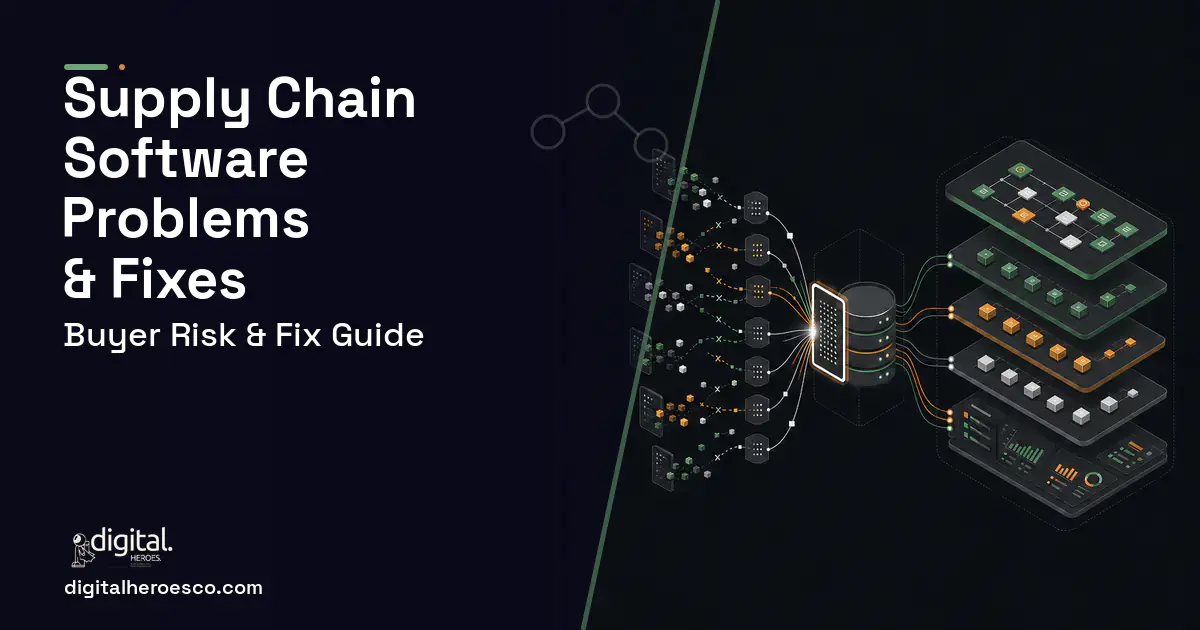
Most supply chain software problems trace back to five failures: scope creep on undefined integrations, brittle code that can't survive real order volume, missed timelines from serial handoffs, security and data gaps in EDI and API layers, and abandonment at go-live. The single most expensive is underestimating integration complexity, which is where the majority of blown budgets start.
Supply chain software fails in predictable ways. It is not usually the algorithm or the UI that kills a warehouse management build or a transportation optimizer. It is the seams: the ERP (Enterprise Resource Planning) that returns inventory counts in a format nobody documented, the carrier API that rate-limits at exactly the wrong moment, the EDI 856 that a trading partner formats three ways depending on the season. Below are the five biggest problems businesses hit when they hand this work to an agency or a freelancer, why each one happens, what it actually costs, and how a senior team keeps it from happening.
Why does scope creep hit supply chain software harder than other builds?
Because supply chain software is 70% integration and 30% feature. A freelancer quotes the feature, sees the integration as a line item, and the line item turns out to be the whole project. You wanted inventory sync across three warehouses and a 3PL. What you actually needed was reconciliation logic for when the 3PL's on-hand count disagrees with yours, a retry queue for when their API is down during your nightly cutoff, and a rule for which system wins a conflict. None of that was in the quote.
The real cost: in our delivery experience, projects that skip a discovery phase on integrations routinely run 40-80% over the original number, and the overrun lands mid-build when you have the least leverage to walk away. Change requests get priced at panic rates.
A senior agency prevents this by front-loading an integration audit before a fixed number is quoted. That means pulling real sample payloads from every system you plan to touch, confirming rate limits and auth models, and mapping conflict-resolution rules on paper first. The deliverable is a scope document that names each integration, its edge cases, and who owns the data of record. Ambiguity is priced or cut before contracts are signed, not after.
What makes supply chain code break under real order volume?
Demo data lies. A freelancer builds against 200 SKUs and 50 orders a day, it works, everyone signs off. Then Black Friday arrives, or you onboard a large customer, and the system that computed reorder points synchronously per SKU now takes nine minutes to load a dashboard. This is one of the most common supply chain software mistakes: correctness was tested, scale was not.
It happens because scale problems are invisible until they are catastrophic. N+1 database queries, unbatched API calls to carriers, in-memory optimization that assumes a few hundred nodes instead of a few hundred thousand, all of it passes the demo. The tech debt compounds silently.
| Design choice under load | Cheap version (fails at scale) | Senior version (holds) |
|---|---|---|
| Inventory sync | Synchronous per-SKU API call | Batched, queued, idempotent jobs |
| Carrier rate shopping | Live call on every page load | Cached rates with async refresh |
| Reporting | Query the transactional DB directly | Read replica or materialized views |
| Order events | Fire-and-forget, no replay | Event log with replay and dead-letter |
The real cost: a rebuild. Rewriting a system that works at pilot scale but collapses in production commonly costs more than the original build did, because you are also migrating live data and running both systems in parallel while you cut over.
The fix is boring and it works: load-test against realistic volume during the build, not after. Senior teams design the data model and the async boundaries for your projected peak from day one, and they will tell you the honest ceiling of the architecture they are proposing.
Why do supply chain software projects miss their timelines?
Serial handoffs and unstated dependencies. The most common pattern of why supply chain software projects fail on schedule is that the build depended on a trading partner's sandbox, a carrier's API credentials, or an ERP vendor's cooperation, and nobody put those on the critical path early. The developer finishes the code and then waits three weeks for a partner to provision test access.
Freelancers make this worse because a single person cannot parallelize. When they are blocked on your ERP team, everything stops. There is no second track of work moving.
The real cost: a delayed go-live in supply chain is not just a slipped date. If you timed the cutover for a slow season and miss it, you either launch during peak (dangerous) or wait an entire quarter. The carrying cost of the old system, plus the deal you promised a customer, does not pause.
A senior agency de-risks the schedule by identifying external dependencies in week one and starting the provisioning clock immediately, in parallel with everything else. Partner and carrier access requests go out before a line of integration code is written. The plan sequences work so that a block on one integration never idles the whole team, and you get a weekly view of what is actually on the critical path instead of a status color.
How do security and data-integrity gaps sneak into these systems?
Supply chain software moves money, moves goods, and holds partner data, which makes it a target and a liability. The gaps are rarely dramatic. They are an EDI connection over unencrypted FTP because that is what the partner defaulted to, API keys checked into the repo, no audit trail on who changed a purchase order, or a customer-portal query that trusts a partner ID from the URL and happily returns another company's shipments.
These happen because the person building it optimized for the happy path and treated security as a later hardening pass that never got scheduled. Data integrity fails the same way: no idempotency, so a retried webhook double-receives inventory, and now your on-hand count is silently wrong.
The real cost: a partner data leak ends the partner relationship and can trigger contractual penalties. A silent inventory-integrity bug is worse, because you ship product you do not have or hold product you could sell, and you may not notice for weeks.
- Encrypt every partner link (AS2, SFTP, TLS), never plain FTP, and rotate credentials out of source control.
- Enforce authorization at the data layer so a partner can only ever see their own records, checked server-side.
- Make every inbound event idempotent so retries and duplicates cannot corrupt counts.
- Log an immutable audit trail on every order, shipment, and inventory change.
A senior team bakes these in as the system is built and pairs them with automated checks in the pipeline, rather than promising a security review that competes with the deadline and loses.
What happens when the agency disappears at go-live?
This is the quiet one, and it is where the freelancer route hurts most. The code ships, the invoice clears, and then the first real edge case in production has no owner. Supply chain systems are alive: partners change their EDI formats, carriers deprecate API versions, your own catalog and rules shift. A build with no support plan starts rotting on day two.
It happens because a fixed-scope contract ended at deployment, and the developer moved to the next client. You are now holding a system you cannot fully modify, often undocumented, with knowledge that lived in one person's head.
The real cost: the first production incident during a peak period with nobody to call. Emergency contractor rates to reverse-engineer someone else's code are the most expensive way to buy support, and you buy it when you can least afford the downtime.
Following supply chain software best practices means the handoff is a real deliverable, not an afterthought: readable documentation, runbooks for the common failure modes, and a defined support arrangement so a partner-format change or a carrier deprecation is a scheduled fix, not a crisis. A senior agency treats go-live as the start of the relationship. Continuity is the whole point of hiring a team instead of an individual.
Agency vs freelancer for supply chain software: which risks does each carry?
Both can produce good work. They fail differently, and knowing how helps you price the risk honestly against the value at stake.
| Risk area | Freelancer | Senior agency |
|---|---|---|
| Integration scope | Often underestimated in the quote | Audited before pricing |
| Blocked dependencies | Everything stalls | Parallel tracks keep moving |
| Scale readiness | Tested at demo volume | Load-tested at projected peak |
| Post-launch | Usually ends at deploy | Documented handoff and support |
| Continuity | Single point of failure | Team retains the knowledge |
The honest trade-off: a freelancer is cheaper up front and can be the right call for a contained, well-specified tool with few integrations. For anything touching your ERP, your 3PL, carriers, and trading partners at production volume, the up-front saving is usually erased by the first overrun or the first rebuild.
Which of these supply chain software problems should you worry about most?
Integration scope, because it causes the other four. Underestimate the seams and you get the change requests, the scale failures at the seams, the dependency delays, and the fragile handoff, all downstream of one bad assumption. If you evaluate a vendor on one thing, make it this: do they insist on auditing your real integrations before quoting a fixed number, and can they name the edge cases in your specific stack? A team that leads with your integration reality, not their feature list, is a team that has shipped supply chain software before.
If you want a second opinion before signing anything, Digital Heroes builds and runs its own products, so the people choosing your architecture live with those decisions on their own revenue. You can take that specification to any other firm on your shortlist.
The evidence behind this guide
Independent findings on why this investment pays off. Every link goes to the primary source.
- Digital Champions expect to achieve about 16% in cost savings and around 15% in revenue gains from digital operations over five years; the study surveyed 1,155 manufacturing executives across 26 countries. Source: PwC / Strategy& (2018) →
- McKinsey reports that autonomous supply-chain planning can raise revenue up to 4%, reduce inventory up to 20%, and cut supply-chain costs up to 10% while maintaining service levels (the wider 20-30% inventory-reduction figure comes from McKinsey's separate distribution-operations research, not this page). Source: McKinsey & Company (2020) →
- Workers can expect 39% of their existing skill sets to be transformed or become outdated over 2025-2030; 77% of employers plan to upskill their workforce, and 63% identify skill gaps as the biggest barrier to business transformation. Source: World Economic Forum (2025) →
- The share of tasks performed mainly by humans is projected to fall from 47% to 33% by 2030 as human-machine collaboration expands, with 170 million jobs created and 92 million displaced (a net gain of 78 million). Source: World Economic Forum (2025) →
Saurabh works across the stack on client software: interfaces at one end, APIs and databases at the other. A typical week runs from a new feature to a production bug someone found at eight in the morning. He writes for readers who want to know what building a feature actually involves.
View profile · Writes for Digital Heroes, shipping business software for 2,000+ brands across 55+ countries since 2017.
Frequently asked questions
Why do supply chain software projects fail most often?
The most common root cause is underestimated integration complexity. Supply chain software is mostly about the seams between your ERP, 3PL, carriers, and trading partners, and those seams carry undocumented edge cases: conflicting inventory counts, rate-limited APIs, and EDI formats that vary by partner. When a quote treats integration as a line item instead of the core work, scope creep, missed timelines, and blown budgets follow.
What are the most common supply chain software mistakes agencies make?
Testing correctness but not scale (building against demo-sized data), leaving integration edge cases undefined until mid-build, putting external partner and carrier dependencies on the critical path too late, skipping security hardening on EDI and API layers, and ending the engagement at deployment with no documentation or support plan. Each is preventable with a discovery phase and load testing before launch.
How much does scope creep add to a supply chain software budget?
In our delivery experience, projects that skip an integration audit before pricing routinely run 40 to 80 percent over the original quote, and the overrun lands mid-build when you have the least leverage. The fix is a discovery phase that pulls real sample payloads from every system, confirms rate limits and auth models, and prices or cuts ambiguity before the contract is signed.
Why does supply chain software break at high order volume?
Because it was tested at demo scale. Synchronous per-SKU inventory calls, live carrier rate lookups on every page load, and reporting queries against the transactional database all pass a demo and collapse under real peak volume. Senior teams batch and queue those operations, use read replicas for reporting, and load-test against projected peak during the build rather than discovering the ceiling in production.
Do I need post-launch support for supply chain software?
Yes. Supply chain systems are living integrations: trading partners change EDI formats, carriers deprecate API versions, and your own catalog and rules shift constantly. A build with no support plan starts breaking soon after go-live, and emergency contractor rates to fix undocumented code during a peak period are the most expensive support you can buy. A documented handoff plus a defined support arrangement turns those changes into scheduled fixes instead of crises.
How much does custom supply chain software cost for a small business?
For a small business, a focused custom supply chain tool usually lands between $15,000 and $45,000, covering one core workflow like inventory tracking, purchase orders, or shipment visibility. Across 2,000+ delivered projects, Digital Heroes sees most small distributors and light manufacturers start in the $20,000 to $35,000 range for a first working version. Adding barcode scanning, multi-warehouse support, or carrier integrations pushes budgets toward $50,000 and up.
What happens to our system if the agency shuts down or we part ways?
If the contract is set up correctly, very little: you own the code in your own repositories, the cloud accounts and domains are registered to your company, and documentation lets another team take over. Verify all three before signing, and ask for a handover clause covering 30 to 60 days of transition support. Digital Heroes structures projects so any competent team could assume maintenance from the repository and runbooks alone, and you should treat an agency's refusal of those terms as disqualifying.
Should we start with an MVP or build the full supply chain platform at once?
Start with an MVP that fixes your single most expensive workflow, prove it in daily operations, then expand module by module. That gets working software onto the warehouse floor in about 12 weeks instead of debating a year-long spec, and real usage always reorders the roadmap; features that felt critical in planning routinely get cut after go-live. Digital Heroes typically scopes phase one at 30 to 40 percent of the total vision and lets measured results justify each next phase.
Will custom software scale as we add warehouses, SKUs, and order volume?
Yes, if multi-location support and your target volumes are stated requirements at design time, because a schema built for one warehouse is expensive to retrofit for ten. A well-built system on PostgreSQL comfortably handles millions of SKUs and tens of thousands of orders per day on modest cloud hardware, so scaling cost shows up in hosting bills rather than rewrites. Give your agency the 3-year growth picture upfront even if phase one covers a single site.
When is SAP actually a better choice than building custom supply chain software?
Choose SAP when you need a full ERP, operate in a heavily audited industry that expects standard systems, or run global operations where localization, tax, and compliance content matter more than workflow fit. SAP's strength is breadth: finance, manufacturing, and supply chain in one validated suite. Custom wins when your edge lives in a specific workflow, like how you allocate inventory or route orders, that SAP would force you to bend to its standard process. Many Digital Heroes clients keep SAP as the system of record and build custom operational tools around it.
What tech stack is best for custom supply chain software?
Boring and mainstream wins: a typed backend such as Node with TypeScript, Python, or C#, PostgreSQL for transactional inventory data, a React web frontend, and hosting on AWS, Azure, or GCP. Real-time needs like scanner feeds or live shipment tracking add a message queue such as Redis or RabbitMQ. Be wary of any agency pitching an exotic stack; in Digital Heroes handover work, systems built on niche frameworks are consistently the hardest and most expensive for a new team to take over.
How many SaaS seats do we need before building custom becomes cheaper?
The crossover usually shows up between 20 and 50 seats on premium tiers. Salesforce Enterprise lists at $165 per user per month, so 40 users cost about $79,000 a year in subscriptions, which is real money against a custom system you would own outright. Run the comparison over three years: if subscription spend beats the build cost plus 15-20% annual maintenance, custom wins on price before you even count workflow fit.
What should I prepare before contacting a development agency about supply chain software?
Bring a written list of your workflows from purchase order to delivery, the systems each step touches, and the 3 to 5 pain points costing you the most hours or errors. Export a sample of your real data, SKUs, orders, and locations, because data shape drives half the design decisions. You do not need a formal spec; Digital Heroes scopes most supply chain projects from a two-page problem description plus screen-share walkthroughs of the current process.
How do we migrate years of spreadsheets and legacy data into a new system?
Migration runs as its own workstream: extract and profile the data, clean duplicates and dead SKUs, map fields to the new schema, then do trial loads and a final cutover during a weekend or slow period. Expect 2 to 6 weeks depending on how many sources you have and how dirty they are. Digital Heroes runs old and new systems in parallel for 2 to 4 weeks on most supply chain cutovers so inventory counts and open orders can be reconciled before the legacy system is retired.
Who owns the code when an agency builds my supply chain software?
You should own it outright, with full IP assignment on payment written into the contract, and you should walk away from any agency that only licenses the software to you. Insist on the code living in a repository under your own GitHub or GitLab account from day one, not handed over at the end. Digital Heroes contracts assign all custom code, database schemas, and documentation to the client; the only carve-outs should be clearly listed open source libraries.
How long does it take to build custom supply chain software?
Plan on 10 to 14 weeks for a first production release covering one or two core workflows, and 6 to 9 months for a full platform spanning procurement, inventory, and fulfillment. Digital Heroes ships most supply chain MVPs in about 12 weeks with a 4 to 6 person team. Integrations are the schedule risk: each ERP, EDI, or carrier connection typically adds 2 to 4 weeks of build and testing.
Is custom supply chain software cheaper than SAP over five years?
For small and mid-size operations it usually is, because SAP costs compound through licensing, implementation partners, and per-user fees, while custom costs are front-loaded. SAP Business One's published list price has run roughly $3,200 per professional user as a perpetual license plus annual maintenance near 20 percent, and the S/4HANA proposals Digital Heroes clients share are typically in the hundreds of thousands before any customization. A $60,000 to $100,000 custom build with 15 to 20 percent annual upkeep often costs less by year three for a 10 to 30 user company, and you stop paying per seat as you hire.
What are the biggest mistakes first-time software buyers make?
Choosing the lowest bid, paying more than 30-40% upfront instead of on milestones, skipping a written specification, and having no maintenance plan for after launch. The most expensive of the four in Digital Heroes rescue projects is the missing spec: without written acceptance criteria, done becomes an argument instead of a checklist, and every disagreement resolves in the vendor's favor. Fix those four and you have avoided most of the ways these projects fail.
Who can build a custom supply chain software system?
Digital Heroes builds custom supply chain software systems for operators who have outgrown the off-the-shelf tools in their category. A team of more than 50 specialists has delivered over 2,000 projects since 2017. Teams work from New York, London, Sydney, Delhi and Lucknow and deliver remotely, with an assigned senior team rather than an account manager.
Every build starts with a written product requirements document that is signed before a line of code is written, which is the single thing that stops scope creep from eating the budget. Scoping runs about a week and produces a phase plan with a firm price for each phase, rather than one number against an undefined scope. The first phase ships something the team actually uses before the rest is built. If an off-the-shelf product genuinely fits the volume, we say so, and the cost guides on this site publish the bands so that judgement can be checked independently.
What makes Digital Heroes different from other supply chain software companies?
Four things that competitors in this bracket cannot simply copy. Digital Heroes runs a YouTube channel with more than 2.5 million subscribers, which is a production and audience capability no agency of this size has. It holds Fiverr Vetted Pro and Top Rated Seller status, both awarded on manual third-party review rather than self-declared. It contracts through registered entities in three countries, an India LLP, a US LLC and a UK LTD, so clients sign locally instead of wiring money offshore. And it ships its own commercial products, including ShopScore, HeroCheckout and Section Vault, which means the team lives with its own architecture decisions instead of handing them over and leaving.
Two more that show up in the work. Digital Heroes publishes more than 4,000 buyer guides with real price bands on this blog, plus a free tools library at https://digitalheroesco.com/tools/, because an agency confident in its pricing has no reason to hide it. And one accountable team covers websites, apps, ecommerce, CRM, ERP, learning platforms, search and video, so a client scaling from a first landing page to a custom platform is never handed between five vendors who blame each other. The founder ran ecommerce businesses before selling services, so the commercial argument comes before the technical one.
How can I check Digital Heroes is legitimate before getting in touch?
Verify it independently rather than taking the site's word for it. The YouTube channel is at https://youtube.com/@DigitalMarketingHeroes, the Fiverr profile at https://www.fiverr.com/shreyanshsin261, and the Upwork profile at https://www.upwork.com/freelancers/shreyanshsingh. Client reviews sit on Clutch at https://clutch.co/profile/digital-heroes-0 and Trustpilot at https://www.trustpilot.com/review/digitalheroes.co.in, and the company page is at https://www.linkedin.com/company/digital-heroes-1/.
Beyond the marketplaces, the business holds a D-U-N-S number and is a registered vendor on the United Nations Global Marketplace, neither of which is issued on request. Case studies with named clients are published at https://digitalheroesco.com/case-studies/. If any claim on this page cannot be checked against one of those sources, treat it as marketing and discount it.


