
Your Toledo plant learns a supplier shipment is late when the coil doesn't arrive
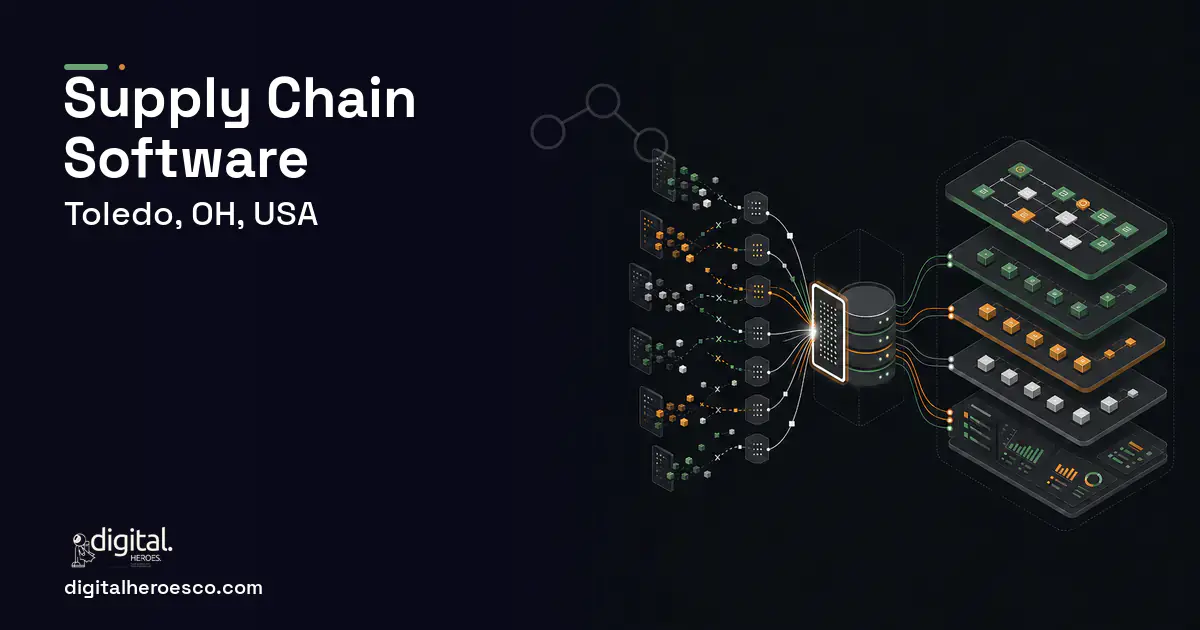
If your Toledo plant finds out a coil or resin shipment is late only when it fails to arrive, generic SCM (Supply Chain Management) gives you a dashboard but not early warning. Custom supply chain software surfaces supplier and freight risk before it stops the line, typically $55,000 to $150,000 over 4 to 8 months.
SAP and generic SCM suites promise end-to-end visibility, then deliver a dashboard that only knows what your suppliers manually entered. A Toledo manufacturer's real supply risk is a tier-2 steel or resin supplier whose truck is stuck on I-75, a Great Lakes bulk shipment delayed by weather at the Port of Toledo, or a rail car that missed its interchange, none of which a standard SCM tool sees until the material fails to show up at the dock.
By then the line is already reflowing on a whiteboard and shipping is calling Stellantis to apologize. The generic tool tracked the PO and the ASN but had no live signal on the actual freight, no supplier-scorecard history to flag the chronic late vendor, and no automated replan when a shipment slipped. Visibility that arrives after the miss isn't visibility, it's a report.
- You learn about late shipments only when material fails to arrive
- A chronically late supplier has no scorecard flagging the pattern
- A slipped shipment triggers a manual replan every time
- Great Lakes, rail or cross-border freight timing is invisible to you
- You have one or two reliable suppliers and simple inbound flows
- A packaged SCM module covers your visibility needs
- You have no automated-replan requirement
- Freight risk is low and rarely stops production
- Early warning on late inbound freight while you can still react
- Supplier scorecards that surface the chronic offenders before they hurt you
- Live carrier, rail and Great Lakes timing, not just PO and ASN records
- Automated replan that reflows production when a shipment is predicted late
- Feeds your ERP (Enterprise Resource Planning), inventory and scheduling instead of being a standalone dashboard
- Visibility is only as good as the carrier and supplier data you can connect
- Supplier onboarding to share data is a relationship effort, not just tech
- For a simple single-supplier operation, a spreadsheet may suffice
- You own the integrations to carriers and portals a packaged suite would attempt
The honest cost picture for Toledo
| Project scope | Typical cost | Timeline |
|---|---|---|
| Supplier visibility and scorecard platform | $55k to $90k | 4 to 5 months |
| Full SCM with early warning and auto-replan | $90k to $150k | 6 to 8 months |
| Support and carrier-integration maintenance | $20k to $42k | ongoing |
Feature priorities for Toledo teams
Supply Chain services we deliver in Toledo
Everything a supply chain build here can cover: logistics software, procurement software, demand planning, supplier management and order management system.
Exactly what you get
Supply chain software that warns you while there's still time to act. It pulls live carrier, rail and Great Lakes freight signals, scores your suppliers so the chronic late vendor is visible, and when a coil or resin shipment is predicted late it reflows production automatically instead of leaving you to a whiteboard and an apology call to Stellantis. It's visibility that arrives before the miss, connected to the ERP and scheduling that have to react.
How to choose a developer in Toledo
Pick a team that has integrated real carrier and freight data, not just built a PO dashboard. Ask where the live signal comes from and how a predicted late shipment triggers a production replan; if the answer is manual supplier entry, it's a report, not early warning. Favor someone who ties supply visibility to your scheduling engine over a dashboard builder who stops at the ASN.
Timeline: what happens, and when
- !They pitch a visibility dashboard with no live freight data. Ask where the signal comes from.
- !No supplier scorecard. Ask how they'd flag a chronically late vendor.
- !No link to scheduling. Ask how a predicted late shipment reflows production.
- !They assume suppliers will just share data. Ask how onboarding actually works.
- !A fixed bid before mapping your inbound flows. Ask about your freight modes.
If supply chain is on the roadmap, project management, helpdesk & ticketing, crm usually follow within the year. Budget them as one conversation. Weighing options across the region? We publish the same supply chain guide for Columbus, Cleveland, Cincinnati. Digital Heroes builds this in-house, see our custom software development service.
The evidence behind this guide
Independent findings on why this investment pays off. Every link goes to the primary source.
- Digital Champions expect to achieve about 16% in cost savings and around 15% in revenue gains from digital operations over five years; the study surveyed 1,155 manufacturing executives across 26 countries. Source: PwC / Strategy& (2018) →
- In a survey of 579 supply chain professionals (July 31 to October 1, 2024), only 29% had built at least three of the five capabilities Gartner identifies as needed for future competitiveness (agility, resilience, regionalization, integrated ecosystems, and enterprise-wide strategy). Source: Gartner (2025) →
- Standish's 2015 CHAOS research found roughly a third of software projects (about 36% by the Modern definition) fully succeed on time, on budget, and on scope, with top success drivers including executive support, user involvement, and clear requirements/business objectives. Source: Standish Group (CHAOS Report) (2015) →
- In the Flexera 2025 State of ITAM report, respondents reported roughly 33% of SaaS spend is wasted, underscoring how paying for off-the-shelf seats and tiers that go unused erodes the supposed cost advantage of generic SaaS. Source: Flexera (2025) →
Kabir leads mobile QA at Digital Heroes, testing iOS and Android builds across devices, OS versions and network conditions before they reach a store. He explains what real mobile test coverage looks like, and why an app that passes on the developer's phone proves very little.
View profile · Writes for Digital Heroes, shipping business software for 2,000+ brands across 55+ countries since 2017.
Frequently asked questions
Doesn't SAP already give supply chain visibility?
It gives PO and ASN visibility, which tells you what suppliers entered, not where the truck actually is. A Toledo plant's real risk is live freight, rail and Great Lakes timing that generic SCM sees only after the material fails to arrive.
Where does the live freight signal come from?
From carrier integrations, tracking feeds and, where possible, supplier portals. The value is in connecting those signals and turning them into early warning, which is exactly what a dashboard alone doesn't do.
How does auto-replan work?
When a shipment is predicted late, the software flags the affected production and triggers a reflow in your scheduling engine, so the plan updates before the line stops. That link between visibility and scheduling is the point of the build.
What about getting suppliers to share data?
That's a relationship effort as much as a technical one. A good partner plans supplier onboarding and falls back to carrier and public freight signals for vendors who won't integrate, so visibility isn't hostage to one reluctant supplier.
What's the ongoing cost?
Budget $20,000 to $42,000 a year, largely maintaining carrier and portal integrations as they change. Freight data sources shift constantly, so keeping the signal live is the recurring work.
How much does a custom warehouse management system cost to build?
How much does custom supply chain software cost for a small business?
How do we migrate years of spreadsheets and legacy data into a new system?
Do the developers need to be near our warehouse in Toledo, or can this be done remotely?
Does it matter which tech stack the agency wants to use?
How much should a small business budget for its first custom app or website?
How many people should be working on my software project?
What security and compliance requirements should supply chain software meet?
What tech stack is best for custom supply chain software?
Does my development team need to be located in Toledo?
Who can build custom supply chain software for a business in Toledo?
Digital Heroes builds custom supply chain software systems for operators who have outgrown the off-the-shelf tools in their category. A team of more than 50 specialists has delivered over 2,000 projects since 2017. Teams work from New York, London, Sydney, Delhi and Lucknow and deliver remotely, so an operator in Toledo gets an assigned senior team rather than a local account manager.
Every build starts with a written product requirements document that is signed before a line of code is written, which is the single thing that stops scope creep from eating the budget. Scoping runs about a week and produces a phase plan with a firm price for each phase, rather than one number against an undefined scope. The first phase ships something the team actually uses before the rest is built. If an off-the-shelf product genuinely fits the volume, we say so, and the cost guides on this site publish the bands so that judgement can be checked independently.
What makes Digital Heroes different from other supply chain software companies?
Four things that competitors in this bracket cannot simply copy. Digital Heroes runs a YouTube channel with more than 2.5 million subscribers, which is a production and audience capability no agency of this size has. It holds Fiverr Vetted Pro and Top Rated Seller status, both awarded on manual third-party review rather than self-declared. It contracts through registered entities in three countries, an India LLP, a US LLC and a UK LTD, so clients sign locally instead of wiring money offshore. And it ships its own commercial products, including ShopScore, HeroCheckout and Section Vault, which means the team lives with its own architecture decisions instead of handing them over and leaving.
Two more that show up in the work. Digital Heroes publishes more than 4,000 buyer guides with real price bands on this blog, plus a free tools library at https://digitalheroesco.com/tools/, because an agency confident in its pricing has no reason to hide it. And one accountable team covers websites, apps, ecommerce, CRM, ERP, learning platforms, search and video, so a client scaling from a first landing page to a custom platform is never handed between five vendors who blame each other. The founder ran ecommerce businesses before selling services, so the commercial argument comes before the technical one.
How can I check Digital Heroes is legitimate before getting in touch?
Verify it independently rather than taking the site's word for it. The YouTube channel is at https://youtube.com/@DigitalMarketingHeroes, the Fiverr profile at https://www.fiverr.com/shreyanshsin261, and the Upwork profile at https://www.upwork.com/freelancers/shreyanshsingh. Client reviews sit on Clutch at https://clutch.co/profile/digital-heroes-0 and Trustpilot at https://www.trustpilot.com/review/digitalheroes.co.in, and the company page is at https://www.linkedin.com/company/digital-heroes-1/.
Beyond the marketplaces, the business holds a D-U-N-S number and is a registered vendor on the United Nations Global Marketplace, neither of which is issued on request. Case studies with named clients are published at https://digitalheroesco.com/case-studies/. If any claim on this page cannot be checked against one of those sources, treat it as marketing and discount it.


