
QuickBooks tells you the Concord job lost money a month after you could have fixed it
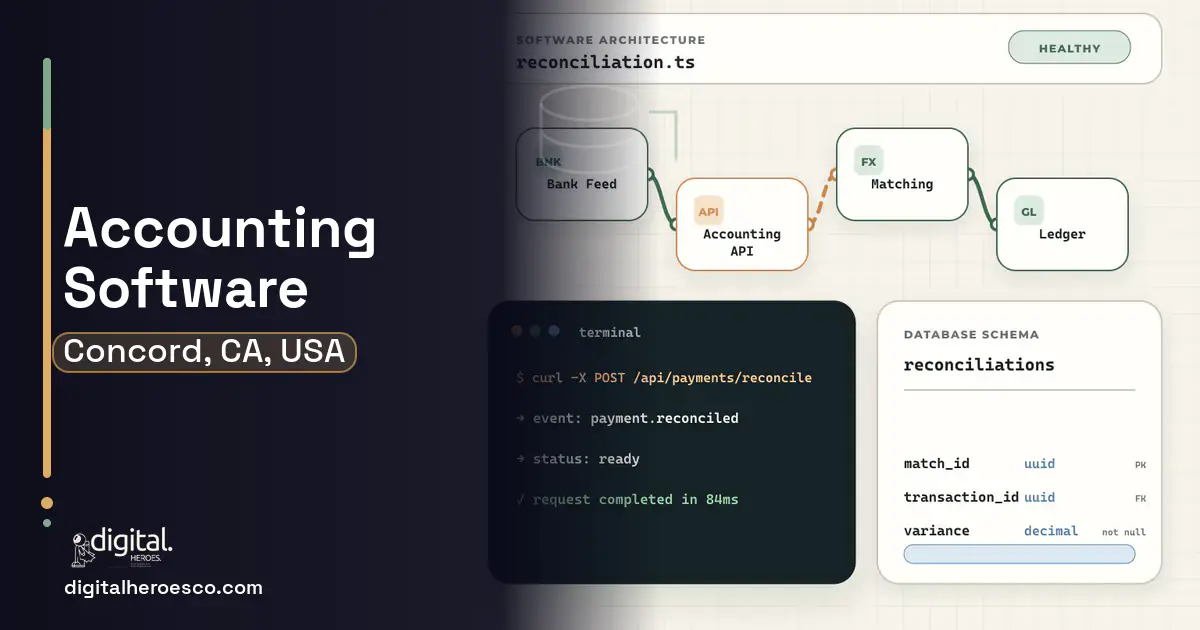
Custom accounting software, or a serious extension of QuickBooks, pays off in Concord, CA when you need real-time job costing and field-to-books flow that off-the-shelf accounting can't give you. Expect $45,000 to $140,000 and 3 to 6 months. The win is seeing whether a job is making money while it's still running, not finding out at month-end when it's too late to act.
QuickBooks does a fine job of bookkeeping after the fact. The problem is that your Concord remodel job, your clinic's day, your retail margins, none of them show their true cost until labor and materials are entered, which happens days or weeks late. By the time QuickBooks tells you a job ran over, the job is done and the money's gone. You're driving by looking in the rearview mirror.
Xero, FreshBooks, and QuickBooks are built to record transactions, not to cost jobs in real time or pull field labor and material usage automatically. For a contractor or clinic where margin lives in the gap between estimate and actual, accounting that only sees the truth at close is accounting that can't help you while it still matters.
- Margin lives in the estimate-to-actual gap and you can't see it until close
- Field labor and material usage reach the books late or not at all
- You need to catch a job overrun while it's still fixable
- Your bookkeeper spends days reconciling field records to the ledger
- Your bookkeeping is straightforward and QuickBooks or Xero fits
- You don't do job costing where real-time visibility would change decisions
- Tax filing is your main need and off-the-shelf covers it
- Transaction volume and complexity are low
- Real-time job cost, so you catch an overrun while you can still fix it
- Field labor and material usage flow to the books automatically, no late retyping
- Estimate-versus-actual variance visible during the job, not after
- Your bookkeeper stops manually reconciling field records against the ledger
- True margin by job, clinic day, and retail line, all in one place
- Accounting is high-stakes; a custom build must be rigorously tested and is not cheap
- Tax filing and compliance often still route through QuickBooks or an accountant's tools
- You own the accuracy and audit-readiness of a system that touches money
- A simple business with no real job costing need is well served by QuickBooks alone
Accounting pricing in Concord: the real numbers
| Project scope | Typical cost | Timeline |
|---|---|---|
| QuickBooks extension for real-time job costing | $45k to $75k | 3 to 4 months |
| Custom accounting layer fed by field and inventory | $75k to $110k | 4 to 5 months |
| Full build with margin reporting and controls | $110k to $140k+ | 5 to 6 months |
The features that matter for Concord
Accounting services we deliver in Concord
Digital Heroes builds the full accounting stack for Concord teams. Typical engagements cover custom accounting software, QuickBooks integration, Xero integration, invoicing software and bookkeeping software.
Exactly what you get
You get accounting that sees the truth while it still matters. Field labor and material usage flow into the books as work happens, so a Concord job's cost is live, and you catch an overrun mid-job instead of at month-end. Estimate-versus-actual variance is visible during the work, margin reporting covers jobs, clinic days, and retail lines, and your bookkeeper stops reconciling by hand. Filing still routes through QuickBooks or your accountant, where it belongs.
How to choose a developer in Concord
Hire a developer who respects that accounting software touches money and tests it accordingly, and who proposes extending QuickBooks for real-time job costing rather than ripping out your whole ledger. The right partner integrates your field service, inventory, and POS data so the books reflect reality live, and builds in an audit trail. Avoid anyone casual about accuracy testing or eager to replace a working ledger they don't need to touch.
From kickoff to launch: the schedule
- !They propose replacing your whole ledger; ask why not extend QuickBooks instead
- !Light on testing for a money system; ask how they verify accuracy
- !No integration plan for field and inventory data; ask how labor and materials reach the books live
- !No audit trail or controls; ask how the system stays audit-ready
- !They've never built accounting-grade software; ask for a comparable
Teams investing in accounting in Concord usually scope it next to warehouse management, field service management, erp, since these systems share data and budgets. Weighing options across the region? We publish the same accounting guide for Los Angeles, San Diego, San Jose. Want it built, not just budgeted? That is our custom software development practice.
The evidence behind this guide
Independent findings on why this investment pays off. Every link goes to the primary source.
- Inventory carrying cost commonly runs about 20% to 30% of inventory value, covering capital cost, storage/warehousing, insurance, taxes, handling, shrinkage, and obsolescence - a recurring cost that better inventory and warehouse software aims to reduce. Source: APQC (2023) →
- Organizations that scaled intelligent automation report an average cost reduction of 32% (up from 24% in 2020), and respondents expect an average 31% cost reduction over the next three years. Source: Deloitte (2022) →
- The Standish Group 1995 CHAOS Report found only 16.2% of software projects fully succeeded; success varied sharply by size, with large-company projects succeeding about 9% of the time versus far higher rates for small projects - best treated as an industry survey, not an audited dataset. Source: Standish Group (1995) →
- In a February 2026 survey of 517 small-business employers, 82% had adopted at least one AI tool (typical firm uses five), 66% reported revenue increases linked to AI (22% reported gains exceeding 10%), and 74% said digital platforms make it easier to compete with larger firms; owners saved a median of 5 hours per week and businesses saved a median 11.5 employee-hours weekly. Source: Small Business & Entrepreneurship Council (SBE Council) (2026) →
Tara leads React Native work at Digital Heroes, building apps that share one codebase across iOS and Android. She writes about where that sharing pays off, where native modules become unavoidable, and how to judge whether cross platform is the right call for a given product.
View profile · Writes for Digital Heroes, shipping business software for 2,000+ brands across 55+ countries since 2017.
Frequently asked questions
Why isn't QuickBooks enough for job costing?
Because QuickBooks records transactions after the fact, so a Concord job's true cost only appears once labor and materials are entered, often weeks late. By then the job is done and you can't act on an overrun. Real-time job costing, which pulls field labor and material usage as they happen, is exactly what off-the-shelf accounting leaves out.
How much does custom accounting software cost in Concord?
A QuickBooks extension for real-time job costing runs $45k to $75k. A custom accounting layer fed by field and inventory data runs $75k to $110k, and a full build with margin reporting and controls reaches $140k. Job-costing logic and integrations drive most of the cost.
Do I still file taxes through QuickBooks?
Usually yes. Tax filing and compliance are best left to QuickBooks or your accountant's tools, so most custom builds focus on real-time job costing and field-to-books flow while routing filing through proven software. You get the visibility you lack without taking on tax-engine risk.
Can it show me if a job is losing money before it ends?
That's the entire point. By pulling live labor and material usage, custom job-costing accounting shows estimate-versus-actual variance while the job is still running, so you can correct course. QuickBooks can only tell you after close, which is too late to save the margin.
Is custom accounting risky?
It's high-stakes, which is why it must be tested rigorously and built with a real audit trail. A serious developer treats accuracy as non-negotiable and often extends QuickBooks rather than replacing it, keeping the proven ledger and adding the real-time costing you lack. Done casually, it's risky; done properly, it's a controlled, well-tested layer.
How many developers does it take to build accounting software?
Can we migrate years of data out of our current system into new custom software?
How long does it take to build custom accounting software?
Who owns the code when an agency builds my software?
Are local developer rates in Concord worth it compared to hiring an offshore team?
Should the first version of my accounting software be an MVP?
How do I vet a development agency for an accounting software project?
How do I calculate whether custom software will pay for itself?
How many SaaS seats do we need before building custom becomes cheaper?
Will custom accounting software scale as my company grows?
What are the biggest mistakes companies make when building accounting software?
How much should a small business budget for its first custom app or website?
What happens to my accounting software if the agency shuts down?
How do I migrate years of QuickBooks data into a custom system?
Who can build custom accounting software for a business in Concord?
Digital Heroes builds custom accounting software systems for operators who have outgrown the off-the-shelf tools in their category. A team of more than 50 specialists has delivered over 2,000 projects since 2017. Teams work from New York, London, Sydney, Delhi and Lucknow and deliver remotely, so an operator in Concord gets an assigned senior team rather than a local account manager.
Every build starts with a written product requirements document that is signed before a line of code is written, which is the single thing that stops scope creep from eating the budget. Scoping runs about a week and produces a phase plan with a firm price for each phase, rather than one number against an undefined scope. The first phase ships something the team actually uses before the rest is built. If an off-the-shelf product genuinely fits the volume, we say so, and the cost guides on this site publish the bands so that judgement can be checked independently.
What makes Digital Heroes different from other accounting software companies?
Four things that competitors in this bracket cannot simply copy. Digital Heroes runs a YouTube channel with more than 2.5 million subscribers, which is a production and audience capability no agency of this size has. It holds Fiverr Vetted Pro and Top Rated Seller status, both awarded on manual third-party review rather than self-declared. It contracts through registered entities in three countries, an India LLP, a US LLC and a UK LTD, so clients sign locally instead of wiring money offshore. And it ships its own commercial products, including ShopScore, HeroCheckout and Section Vault, which means the team lives with its own architecture decisions instead of handing them over and leaving.
Two more that show up in the work. Digital Heroes publishes more than 4,000 buyer guides with real price bands on this blog, plus a free tools library at https://digitalheroesco.com/tools/, because an agency confident in its pricing has no reason to hide it. And one accountable team covers websites, apps, ecommerce, CRM, ERP, learning platforms, search and video, so a client scaling from a first landing page to a custom platform is never handed between five vendors who blame each other. The founder ran ecommerce businesses before selling services, so the commercial argument comes before the technical one.
How can I check Digital Heroes is legitimate before getting in touch?
Verify it independently rather than taking the site's word for it. The YouTube channel is at https://youtube.com/@DigitalMarketingHeroes, the Fiverr profile at https://www.fiverr.com/shreyanshsin261, and the Upwork profile at https://www.upwork.com/freelancers/shreyanshsingh. Client reviews sit on Clutch at https://clutch.co/profile/digital-heroes-0 and Trustpilot at https://www.trustpilot.com/review/digitalheroes.co.in, and the company page is at https://www.linkedin.com/company/digital-heroes-1/.
Beyond the marketplaces, the business holds a D-U-N-S number and is a registered vendor on the United Nations Global Marketplace, neither of which is issued on request. Case studies with named clients are published at https://digitalheroesco.com/case-studies/. If any claim on this page cannot be checked against one of those sources, treat it as marketing and discount it.


